SUBSCRIBE TO OUR FREE NEWSLETTER
Daily news & progressive opinion—funded by the people, not the corporations—delivered straight to your inbox.
5
#000000
#FFFFFF
To donate by check, phone, or other method, see our More Ways to Give page.
Daily news & progressive opinion—funded by the people, not the corporations—delivered straight to your inbox.
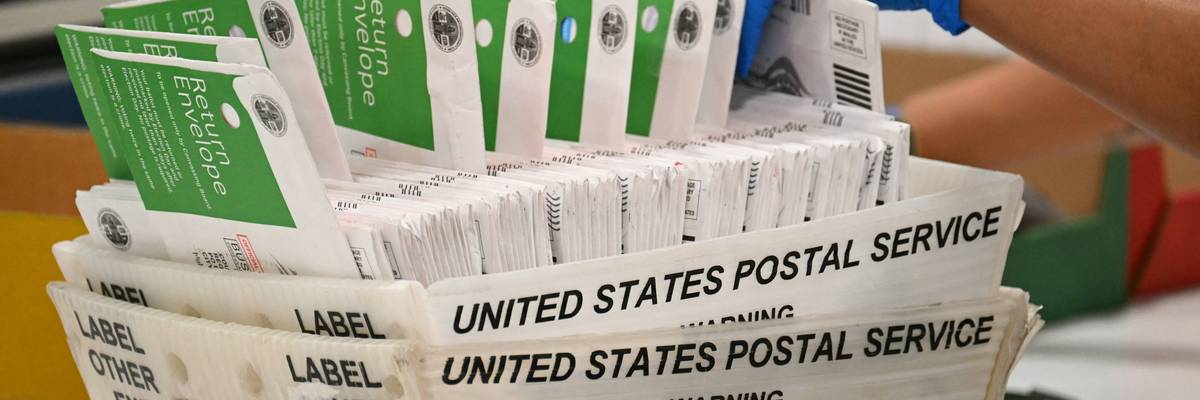
An election worker processes mail-in ballots at the Los Angeles County Ballot Processing Center during California's state primary election in the City of Industry on June 2, 2026.
"That this administration would direct USPS to adopt measures to impede voters from casting their ballots is shameful."
A leading civil rights organization on Wednesday accused the US Postal Service of unlawful complicity in President Donald Trump's assault on mail-in voting, which he launched in late March with an alarming executive order that is facing its own legal challenges.
With a new legal motion filed in a federal court in Washington, DC, the NAACP is challenging rules the Postal Service unveiled last week that would require states to notify USPS "of the individuals to whom they are mailing a mail-in or absentee ballot." The rules would also "identify new standards for the envelope design and review for outbound and return ballot envelopes."
The NAACP's filing—which reignites a pandemic-era legal fight—warns that under the proposed rule, "USPS would refuse to transmit mail-in ballots in states that did not use specific envelopes with specific codes, and would refuse to deliver ballots for voters not included on a state-specific Mail-In and Absentee Participation List."
That would violate a previous USPS agreement, reached in 2021, to prioritize "timely delivery of election mail" and run afoul of federal law, the motion argues, calling for a swift injunction to stop the Postal Service from implementing the rules.
“The proposed rule manifests USPS’ intent to disregard its commitment to timely deliver mail-in ballots to all voters,” said Sam Spital, associate director-counsel of the NAACP Legal Defense Fund (LDF). “This all is part of a coordinated effort by this Administration to create chaos and confusion in our elections, which creates particular dangers for Black voters who are already at the greatest risk of suffering discrimination in voting. The attempt to usurp the right of eligible voters to cast mail-in ballots is directly contrary to the legally enforceable agreement the parties reached in this case, and to USPS’ obligations under federal law. We are confident it will be rejected by the courts.”
Allison Zieve, director of Public Citizen Litigation Group—which joined LDF in filing the suit on behalf of the NAACP—said it is "shameful" that the Trump administration would "direct USPS to adopt measures to impede voters from casting their ballots."
"And that USPS would allow itself to be used for political purposes to advance the president’s irrational objection to mail-in voting is disgraceful, unlawful, and contrary to the commitments it made to settle our [2020] litigation," Zieve added.
The proposed USPS rules stem from an executive order that Trump issued on March 31, instructing the agency to obtain from states "a list of voters eligible to vote in a federal election in such state to whom the state intends to provide a mail-in or absentee ballot to be transmitted via the USPS." Trump directed his handpicked postmaster general, David Steiner, to advance "provisions specifying that the USPS shall not transmit mail-in or absentee ballots from any individual" who is not included on state mail-in ballot participation lists.
Last week, a Trump-appointed federal judge in Washington, DC declined to immediately block the president's executive order. But another federal judge in Boston "sharply questioned" Trump's order during a hearing for a similar yet separate legal challenge earlier this week.
Attorneys representing the plaintiffs in the latter case said in a statement after Tuesday's hearing that "the Trump administration is attempting to seize that power for itself with an unlawful and dangerous executive order."
"Together with our courageous clients, we’re seeking a preliminary injunction to stop further chaos in our elections, uphold the rule of law, and protect the millions of citizens who rely on mail-in voting, including people with disabilities, students, rural voters, and the elderly," the attorneys said. "We won't let the Trump administration continue to trample on the fundamental right to vote.”
Dear Common Dreams reader, It’s been nearly 30 years since I co-founded Common Dreams with my late wife, Lina Newhouser. We had the radical notion that journalism should serve the public good, not corporate profits. It was clear to us from the outset what it would take to build such a project. No paid advertisements. No corporate sponsors. No millionaire publisher telling us what to think or do. Many people said we wouldn't last a year, but we proved those doubters wrong. Together with a tremendous team of journalists and dedicated staff, we built an independent media outlet free from the constraints of profits and corporate control. Our mission has always been simple: To inform. To inspire. To ignite change for the common good. Building Common Dreams was not easy. Our survival was never guaranteed. When you take on the most powerful forces—Wall Street greed, fossil fuel industry destruction, Big Tech lobbyists, and uber-rich oligarchs who have spent billions upon billions rigging the economy and democracy in their favor—the only bulwark you have is supporters who believe in your work. But here’s the urgent message from me today. It's never been this bad out there. And it's never been this hard to keep us going. At the very moment Common Dreams is most needed, the threats we face are intensifying. We need your support now more than ever. We don't accept corporate advertising and never will. We don't have a paywall because we don't think people should be blocked from critical news based on their ability to pay. Everything we do is funded by the donations of readers like you. When everyone does the little they can afford, we are strong. But if that support retreats or dries up, so do we. Will you donate now to make sure Common Dreams not only survives but thrives? —Craig Brown, Co-founder |
A leading civil rights organization on Wednesday accused the US Postal Service of unlawful complicity in President Donald Trump's assault on mail-in voting, which he launched in late March with an alarming executive order that is facing its own legal challenges.
With a new legal motion filed in a federal court in Washington, DC, the NAACP is challenging rules the Postal Service unveiled last week that would require states to notify USPS "of the individuals to whom they are mailing a mail-in or absentee ballot." The rules would also "identify new standards for the envelope design and review for outbound and return ballot envelopes."
The NAACP's filing—which reignites a pandemic-era legal fight—warns that under the proposed rule, "USPS would refuse to transmit mail-in ballots in states that did not use specific envelopes with specific codes, and would refuse to deliver ballots for voters not included on a state-specific Mail-In and Absentee Participation List."
That would violate a previous USPS agreement, reached in 2021, to prioritize "timely delivery of election mail" and run afoul of federal law, the motion argues, calling for a swift injunction to stop the Postal Service from implementing the rules.
“The proposed rule manifests USPS’ intent to disregard its commitment to timely deliver mail-in ballots to all voters,” said Sam Spital, associate director-counsel of the NAACP Legal Defense Fund (LDF). “This all is part of a coordinated effort by this Administration to create chaos and confusion in our elections, which creates particular dangers for Black voters who are already at the greatest risk of suffering discrimination in voting. The attempt to usurp the right of eligible voters to cast mail-in ballots is directly contrary to the legally enforceable agreement the parties reached in this case, and to USPS’ obligations under federal law. We are confident it will be rejected by the courts.”
Allison Zieve, director of Public Citizen Litigation Group—which joined LDF in filing the suit on behalf of the NAACP—said it is "shameful" that the Trump administration would "direct USPS to adopt measures to impede voters from casting their ballots."
"And that USPS would allow itself to be used for political purposes to advance the president’s irrational objection to mail-in voting is disgraceful, unlawful, and contrary to the commitments it made to settle our [2020] litigation," Zieve added.
The proposed USPS rules stem from an executive order that Trump issued on March 31, instructing the agency to obtain from states "a list of voters eligible to vote in a federal election in such state to whom the state intends to provide a mail-in or absentee ballot to be transmitted via the USPS." Trump directed his handpicked postmaster general, David Steiner, to advance "provisions specifying that the USPS shall not transmit mail-in or absentee ballots from any individual" who is not included on state mail-in ballot participation lists.
Last week, a Trump-appointed federal judge in Washington, DC declined to immediately block the president's executive order. But another federal judge in Boston "sharply questioned" Trump's order during a hearing for a similar yet separate legal challenge earlier this week.
Attorneys representing the plaintiffs in the latter case said in a statement after Tuesday's hearing that "the Trump administration is attempting to seize that power for itself with an unlawful and dangerous executive order."
"Together with our courageous clients, we’re seeking a preliminary injunction to stop further chaos in our elections, uphold the rule of law, and protect the millions of citizens who rely on mail-in voting, including people with disabilities, students, rural voters, and the elderly," the attorneys said. "We won't let the Trump administration continue to trample on the fundamental right to vote.”
A leading civil rights organization on Wednesday accused the US Postal Service of unlawful complicity in President Donald Trump's assault on mail-in voting, which he launched in late March with an alarming executive order that is facing its own legal challenges.
With a new legal motion filed in a federal court in Washington, DC, the NAACP is challenging rules the Postal Service unveiled last week that would require states to notify USPS "of the individuals to whom they are mailing a mail-in or absentee ballot." The rules would also "identify new standards for the envelope design and review for outbound and return ballot envelopes."
The NAACP's filing—which reignites a pandemic-era legal fight—warns that under the proposed rule, "USPS would refuse to transmit mail-in ballots in states that did not use specific envelopes with specific codes, and would refuse to deliver ballots for voters not included on a state-specific Mail-In and Absentee Participation List."
That would violate a previous USPS agreement, reached in 2021, to prioritize "timely delivery of election mail" and run afoul of federal law, the motion argues, calling for a swift injunction to stop the Postal Service from implementing the rules.
“The proposed rule manifests USPS’ intent to disregard its commitment to timely deliver mail-in ballots to all voters,” said Sam Spital, associate director-counsel of the NAACP Legal Defense Fund (LDF). “This all is part of a coordinated effort by this Administration to create chaos and confusion in our elections, which creates particular dangers for Black voters who are already at the greatest risk of suffering discrimination in voting. The attempt to usurp the right of eligible voters to cast mail-in ballots is directly contrary to the legally enforceable agreement the parties reached in this case, and to USPS’ obligations under federal law. We are confident it will be rejected by the courts.”
Allison Zieve, director of Public Citizen Litigation Group—which joined LDF in filing the suit on behalf of the NAACP—said it is "shameful" that the Trump administration would "direct USPS to adopt measures to impede voters from casting their ballots."
"And that USPS would allow itself to be used for political purposes to advance the president’s irrational objection to mail-in voting is disgraceful, unlawful, and contrary to the commitments it made to settle our [2020] litigation," Zieve added.
The proposed USPS rules stem from an executive order that Trump issued on March 31, instructing the agency to obtain from states "a list of voters eligible to vote in a federal election in such state to whom the state intends to provide a mail-in or absentee ballot to be transmitted via the USPS." Trump directed his handpicked postmaster general, David Steiner, to advance "provisions specifying that the USPS shall not transmit mail-in or absentee ballots from any individual" who is not included on state mail-in ballot participation lists.
Last week, a Trump-appointed federal judge in Washington, DC declined to immediately block the president's executive order. But another federal judge in Boston "sharply questioned" Trump's order during a hearing for a similar yet separate legal challenge earlier this week.
Attorneys representing the plaintiffs in the latter case said in a statement after Tuesday's hearing that "the Trump administration is attempting to seize that power for itself with an unlawful and dangerous executive order."
"Together with our courageous clients, we’re seeking a preliminary injunction to stop further chaos in our elections, uphold the rule of law, and protect the millions of citizens who rely on mail-in voting, including people with disabilities, students, rural voters, and the elderly," the attorneys said. "We won't let the Trump administration continue to trample on the fundamental right to vote.”