5
#000000
#FFFFFF
To donate by check, phone, or other method, see our More Ways to Give page.
Daily news & progressive opinion—funded by the people, not the corporations—delivered straight to your inbox.
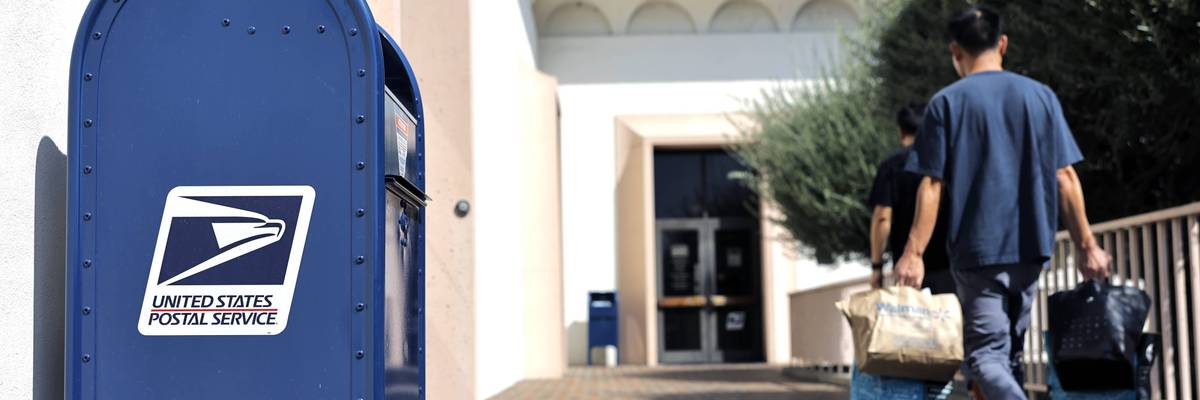
The United States Postal Service logo is displayed on a USPS mail collection box on September 18, 2026 in San Gabriel, California.
"In every state, a day’s delay in delivery means that if mail voters wait until the last day or two before the election to mail their ballot... they could be disenfranchised."
An analysis published Friday by Democracy Docket warned that "tens of thousands" of voters across the US face "risk of disenfranchisement" thanks to actions being taken by the United States Postal Service.
The analysis, written by veteran election reporter Jim Saksa, points to a new USPS policy known as Regional Transportation Optimization (RTO) that "will eliminate evening mail pickups from post offices more than 50 miles away from a regional processing facility, most of which are located in major urban areas."
For people who live in these areas, ballots sent on Election Day will be postmarked and delivered at least a day later than in previous election years, thus making it ineligible to be included in final election tallies.
"In every state, a day’s delay in delivery means that if mail voters wait until the last day or two before the election to mail their ballot," Saksa explained, "they could be disenfranchised."
Saksa reported that this policy is currently active in "about 42.5% of all ZIP codes" in the continental US, and is scheduled to eventually take effect in around 70% of all ZIP codes. No additional ZIP codes are expected to be added between now and election day.
Saksa also said that voters concerned about their ballots not being counted should deliver them in person to their local post office, where they can ask an employee to postmark it.
President Donald Trump has tried for the last several months to use USPS to meddle with states' mail-in voting systems.
In March, the president signed an executive order that instructed the United States Postal Service to not deliver ballots in any states that have not given the federal government access to their voter lists.
The US Supreme Court last month rejected Trump's efforts to interfere with mail-in voting, allowing states to continue sending ballots to voters as they've done in past elections.
Even with the Supreme Court loss, however, the president's repeated attacks on voting by mail has had a major impact on the 2026 midterm elections.
An NBC News poll released in September showed that just 23% of Democratic voters said they planned to vote by mail this year, a double-digit drop from 2024 when 34% of Democrats said they were voting by mail.
In an interview with Politico published Thursday, Quentin James, founder and president of The Collective Political Action Committee, said Black voters have been expressing concerns about sending in their ballots for fear that Trump will order USPS to not deliver them.
“I think there’s confusion,” James said. “We know that the president has spent six months talking about changing the rules regarding mail-in voting, and a lot of folks are concerned about their ballot being secure."
Indivisible co-founder Leah Greenberg also told Politico that her group is "absolutely hearing concern" about the mail voting process this year.
"But more importantly," Greenberg added, "what we’re hearing is people trying to figure out what they can do and how they can organize locally in order to protect elections."
Dear Common Dreams reader, It’s been nearly 30 years since I co-founded Common Dreams with my late wife, Lina Newhouser. We had the radical notion that journalism should serve the public good, not corporate profits. It was clear to us from the outset what it would take to build such a project. No paid advertisements. No corporate sponsors. No millionaire publisher telling us what to think or do. Many people said we wouldn't last a year, but we proved those doubters wrong. Together with a tremendous team of journalists and dedicated staff, we built an independent media outlet free from the constraints of profits and corporate control. Our mission has always been simple: To inform. To inspire. To ignite change for the common good. Building Common Dreams was not easy. Our survival was never guaranteed. When you take on the most powerful forces—Wall Street greed, fossil fuel industry destruction, Big Tech lobbyists, and uber-rich oligarchs who have spent billions upon billions rigging the economy and democracy in their favor—the only bulwark you have is supporters who believe in your work. But here’s the urgent message from me today. It's never been this bad out there. And it's never been this hard to keep us going. At the very moment Common Dreams is most needed, the threats we face are intensifying. We need your support now more than ever. We don't accept corporate advertising and never will. We don't have a paywall because we don't think people should be blocked from critical news based on their ability to pay. Everything we do is funded by the donations of readers like you. When everyone does the little they can afford, we are strong. But if that support retreats or dries up, so do we. Will you donate now to make sure Common Dreams not only survives but thrives? —Craig Brown, Co-founder |
An analysis published Friday by Democracy Docket warned that "tens of thousands" of voters across the US face "risk of disenfranchisement" thanks to actions being taken by the United States Postal Service.
The analysis, written by veteran election reporter Jim Saksa, points to a new USPS policy known as Regional Transportation Optimization (RTO) that "will eliminate evening mail pickups from post offices more than 50 miles away from a regional processing facility, most of which are located in major urban areas."
For people who live in these areas, ballots sent on Election Day will be postmarked and delivered at least a day later than in previous election years, thus making it ineligible to be included in final election tallies.
"In every state, a day’s delay in delivery means that if mail voters wait until the last day or two before the election to mail their ballot," Saksa explained, "they could be disenfranchised."
Saksa reported that this policy is currently active in "about 42.5% of all ZIP codes" in the continental US, and is scheduled to eventually take effect in around 70% of all ZIP codes. No additional ZIP codes are expected to be added between now and election day.
Saksa also said that voters concerned about their ballots not being counted should deliver them in person to their local post office, where they can ask an employee to postmark it.
President Donald Trump has tried for the last several months to use USPS to meddle with states' mail-in voting systems.
In March, the president signed an executive order that instructed the United States Postal Service to not deliver ballots in any states that have not given the federal government access to their voter lists.
The US Supreme Court last month rejected Trump's efforts to interfere with mail-in voting, allowing states to continue sending ballots to voters as they've done in past elections.
Even with the Supreme Court loss, however, the president's repeated attacks on voting by mail has had a major impact on the 2026 midterm elections.
An NBC News poll released in September showed that just 23% of Democratic voters said they planned to vote by mail this year, a double-digit drop from 2024 when 34% of Democrats said they were voting by mail.
In an interview with Politico published Thursday, Quentin James, founder and president of The Collective Political Action Committee, said Black voters have been expressing concerns about sending in their ballots for fear that Trump will order USPS to not deliver them.
“I think there’s confusion,” James said. “We know that the president has spent six months talking about changing the rules regarding mail-in voting, and a lot of folks are concerned about their ballot being secure."
Indivisible co-founder Leah Greenberg also told Politico that her group is "absolutely hearing concern" about the mail voting process this year.
"But more importantly," Greenberg added, "what we’re hearing is people trying to figure out what they can do and how they can organize locally in order to protect elections."
An analysis published Friday by Democracy Docket warned that "tens of thousands" of voters across the US face "risk of disenfranchisement" thanks to actions being taken by the United States Postal Service.
The analysis, written by veteran election reporter Jim Saksa, points to a new USPS policy known as Regional Transportation Optimization (RTO) that "will eliminate evening mail pickups from post offices more than 50 miles away from a regional processing facility, most of which are located in major urban areas."
For people who live in these areas, ballots sent on Election Day will be postmarked and delivered at least a day later than in previous election years, thus making it ineligible to be included in final election tallies.
"In every state, a day’s delay in delivery means that if mail voters wait until the last day or two before the election to mail their ballot," Saksa explained, "they could be disenfranchised."
Saksa reported that this policy is currently active in "about 42.5% of all ZIP codes" in the continental US, and is scheduled to eventually take effect in around 70% of all ZIP codes. No additional ZIP codes are expected to be added between now and election day.
Saksa also said that voters concerned about their ballots not being counted should deliver them in person to their local post office, where they can ask an employee to postmark it.
President Donald Trump has tried for the last several months to use USPS to meddle with states' mail-in voting systems.
In March, the president signed an executive order that instructed the United States Postal Service to not deliver ballots in any states that have not given the federal government access to their voter lists.
The US Supreme Court last month rejected Trump's efforts to interfere with mail-in voting, allowing states to continue sending ballots to voters as they've done in past elections.
Even with the Supreme Court loss, however, the president's repeated attacks on voting by mail has had a major impact on the 2026 midterm elections.
An NBC News poll released in September showed that just 23% of Democratic voters said they planned to vote by mail this year, a double-digit drop from 2024 when 34% of Democrats said they were voting by mail.
In an interview with Politico published Thursday, Quentin James, founder and president of The Collective Political Action Committee, said Black voters have been expressing concerns about sending in their ballots for fear that Trump will order USPS to not deliver them.
“I think there’s confusion,” James said. “We know that the president has spent six months talking about changing the rules regarding mail-in voting, and a lot of folks are concerned about their ballot being secure."
Indivisible co-founder Leah Greenberg also told Politico that her group is "absolutely hearing concern" about the mail voting process this year.
"But more importantly," Greenberg added, "what we’re hearing is people trying to figure out what they can do and how they can organize locally in order to protect elections."