SUBSCRIBE TO OUR FREE NEWSLETTER
Daily news & progressive opinion—funded by the people, not the corporations—delivered straight to your inbox.
5
#000000
#FFFFFF
To donate by check, phone, or other method, see our More Ways to Give page.
Daily news & progressive opinion—funded by the people, not the corporations—delivered straight to your inbox.
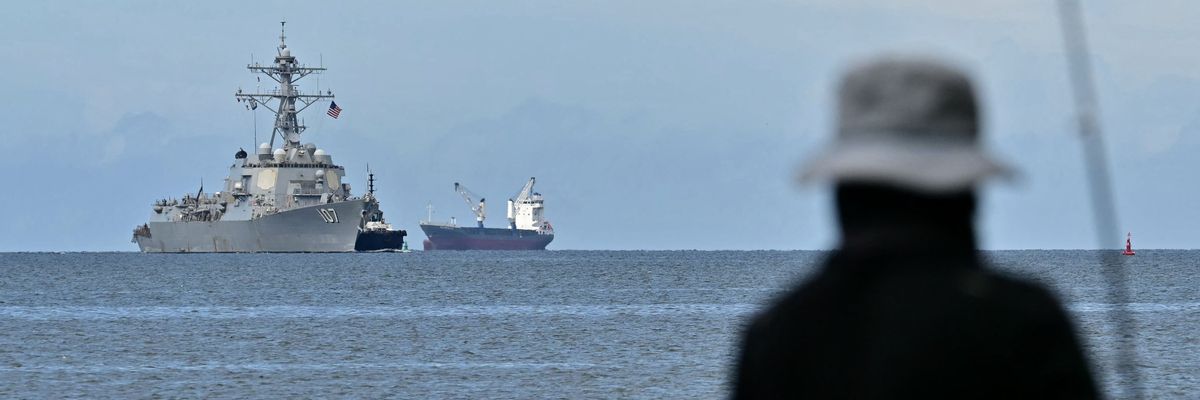
The USS Gravely warship is seen at a distance off the coast of Port of Spain, Trinidad and Tobago on October 26, 2025, as a fisherman looks on.
"We condemn in the strongest terms the military escalation against Venezuela," said progressive leaders from countries including the United Kingdom, Spain, and Greece.
With thousands of US troops patrolling the Caribbean, at least eight warships deployed in the region, and the BBC reporting that it tracked four US military planes that flew near Venezuela Thursday night, lawmakers and other leaders from across Europe on Friday issued a unified demand for the Trump administration to deescalate the tensions it has ratcheted up in recent weeks.
The administration's "show of force has already proved lethal," said the leaders, with more than 80 people—including fishermen and an out-of-work bus driver—having been killed in the US military's strikes on more than 20 boats, which the administration has insisted were trafficking drugs to the US. The White House has publicized no evidence of the claims.
President Donald Trump has not taken further military action against Venezuela since he was presented with "options" for potential strikes last week by officials including Defense Secretary Pete Hegseth, nor has he followed through with threats he's made against Mexico and Colombia.
But the European leaders—including British Members of Parliament Zarah Sultana and Jeremy Corbyn, former Greek Finance Minister Yanis Varoufakis, and Spanish Member of European Parliament Irene Montero Gil—noted that Trump "severed diplomatic channels with Caracas and approved covert [Central Intelligence Agency] operations in Venezuela" as the military buildup continues in the region.
The Trump administration has insisted it is engaged in a legal "armed conflict" with drug cartels in Venezuela, which it has accused of trafficking fentanyl to the US—though experts say drug boats originating in Venezuela are "are mainly moving cocaine from South America to Europe," and analysis by both the United Nations and US intelligence agencies have shown the South American country plays virtually no role in the production or transit of fentanyl.
The US Congress has not authorized any military action against drug cartels or Venezuela's government, and lawmakers from both sides of the aisle have attempted to pass war powers resolutions blocking the US from striking more boats or targets on land in Venezuela, only to have the resolutions voted down.
In his second term, Trump has sought to tie Venezuelan President Nicolás Maduro to drug cartels—despite a declassified US intelligence memo showing officials rejected the claim—and designated Cartel de los Soles a foreign terrorist organization last week, giving the White House what Hegseth called "new options" to go after the group.
But the escalation that Trump claims is the latest battle in the "War on Drugs" comes two years after he explicitly announced his desire to take control of Venezuela's oil, and following years of condemnation of Maduro's socialist government from Secretary of State Marco Rubio.
The European leaders said the administration's narrative about the threat Venezuela poses to the US and the escalation is simply the "latest attempt to threaten and undermine the sovereignty of Latin America and the Caribbean nations."
"Declassified documents have confirmed the CIA’s hand in overthrowing democratically elected governments in Latin America, such as Salvador Allende’s Chile in 1973, João Goulart’s Brazil in 1964, and Jacobo Árbenz’s Guatemala in 1954. The human cost of these regime change operations was catastrophic, and their political legacy endures," reads the letter, which was organized by Progressive International.
A military intervention by the US in Venezuela "would mark the first interstate war by the United States in South America," the leaders said, yet "the pretext for intervention is as tired as it is familiar."
"Under the banner of combating the 'narco-terrorists,' Trump celebrates lethal strikes against peaceful fishermen arbitrarily labeled as carrying drugs," the leaders said.
As in the past, they added, moving the War on Drugs to Venezuela would deliver "not security but a torrent of bloodshed, dispossession, and destabilization."
"Therefore, we condemn in the strongest terms the military escalation against Venezuela," they said. "Our demand is clear and our resolve is firm: No war on Venezuela."
As Peoples Dispatch reported Thursday, many European leaders have "subordinated" themselves to Trump and have avoided speaking out against the US escalation with Venezuela, but left-wing political parties have led the way in denouncing the US deployment of soldiers and warships to the region.
The Workers' Party of Belgium said recently that the world is "witnessing an unprecedented military escalation in 20 years, a multifaceted aggression that threatens not only Venezuela, but any project of sovereignty and social justice in Latin America."
Dear Common Dreams reader, It’s been nearly 30 years since I co-founded Common Dreams with my late wife, Lina Newhouser. We had the radical notion that journalism should serve the public good, not corporate profits. It was clear to us from the outset what it would take to build such a project. No paid advertisements. No corporate sponsors. No millionaire publisher telling us what to think or do. Many people said we wouldn't last a year, but we proved those doubters wrong. Together with a tremendous team of journalists and dedicated staff, we built an independent media outlet free from the constraints of profits and corporate control. Our mission has always been simple: To inform. To inspire. To ignite change for the common good. Building Common Dreams was not easy. Our survival was never guaranteed. When you take on the most powerful forces—Wall Street greed, fossil fuel industry destruction, Big Tech lobbyists, and uber-rich oligarchs who have spent billions upon billions rigging the economy and democracy in their favor—the only bulwark you have is supporters who believe in your work. But here’s the urgent message from me today. It's never been this bad out there. And it's never been this hard to keep us going. At the very moment Common Dreams is most needed, the threats we face are intensifying. We need your support now more than ever. We don't accept corporate advertising and never will. We don't have a paywall because we don't think people should be blocked from critical news based on their ability to pay. Everything we do is funded by the donations of readers like you. When everyone does the little they can afford, we are strong. But if that support retreats or dries up, so do we. Will you donate now to make sure Common Dreams not only survives but thrives? —Craig Brown, Co-founder |
With thousands of US troops patrolling the Caribbean, at least eight warships deployed in the region, and the BBC reporting that it tracked four US military planes that flew near Venezuela Thursday night, lawmakers and other leaders from across Europe on Friday issued a unified demand for the Trump administration to deescalate the tensions it has ratcheted up in recent weeks.
The administration's "show of force has already proved lethal," said the leaders, with more than 80 people—including fishermen and an out-of-work bus driver—having been killed in the US military's strikes on more than 20 boats, which the administration has insisted were trafficking drugs to the US. The White House has publicized no evidence of the claims.
President Donald Trump has not taken further military action against Venezuela since he was presented with "options" for potential strikes last week by officials including Defense Secretary Pete Hegseth, nor has he followed through with threats he's made against Mexico and Colombia.
But the European leaders—including British Members of Parliament Zarah Sultana and Jeremy Corbyn, former Greek Finance Minister Yanis Varoufakis, and Spanish Member of European Parliament Irene Montero Gil—noted that Trump "severed diplomatic channels with Caracas and approved covert [Central Intelligence Agency] operations in Venezuela" as the military buildup continues in the region.
The Trump administration has insisted it is engaged in a legal "armed conflict" with drug cartels in Venezuela, which it has accused of trafficking fentanyl to the US—though experts say drug boats originating in Venezuela are "are mainly moving cocaine from South America to Europe," and analysis by both the United Nations and US intelligence agencies have shown the South American country plays virtually no role in the production or transit of fentanyl.
The US Congress has not authorized any military action against drug cartels or Venezuela's government, and lawmakers from both sides of the aisle have attempted to pass war powers resolutions blocking the US from striking more boats or targets on land in Venezuela, only to have the resolutions voted down.
In his second term, Trump has sought to tie Venezuelan President Nicolás Maduro to drug cartels—despite a declassified US intelligence memo showing officials rejected the claim—and designated Cartel de los Soles a foreign terrorist organization last week, giving the White House what Hegseth called "new options" to go after the group.
But the escalation that Trump claims is the latest battle in the "War on Drugs" comes two years after he explicitly announced his desire to take control of Venezuela's oil, and following years of condemnation of Maduro's socialist government from Secretary of State Marco Rubio.
The European leaders said the administration's narrative about the threat Venezuela poses to the US and the escalation is simply the "latest attempt to threaten and undermine the sovereignty of Latin America and the Caribbean nations."
"Declassified documents have confirmed the CIA’s hand in overthrowing democratically elected governments in Latin America, such as Salvador Allende’s Chile in 1973, João Goulart’s Brazil in 1964, and Jacobo Árbenz’s Guatemala in 1954. The human cost of these regime change operations was catastrophic, and their political legacy endures," reads the letter, which was organized by Progressive International.
A military intervention by the US in Venezuela "would mark the first interstate war by the United States in South America," the leaders said, yet "the pretext for intervention is as tired as it is familiar."
"Under the banner of combating the 'narco-terrorists,' Trump celebrates lethal strikes against peaceful fishermen arbitrarily labeled as carrying drugs," the leaders said.
As in the past, they added, moving the War on Drugs to Venezuela would deliver "not security but a torrent of bloodshed, dispossession, and destabilization."
"Therefore, we condemn in the strongest terms the military escalation against Venezuela," they said. "Our demand is clear and our resolve is firm: No war on Venezuela."
As Peoples Dispatch reported Thursday, many European leaders have "subordinated" themselves to Trump and have avoided speaking out against the US escalation with Venezuela, but left-wing political parties have led the way in denouncing the US deployment of soldiers and warships to the region.
The Workers' Party of Belgium said recently that the world is "witnessing an unprecedented military escalation in 20 years, a multifaceted aggression that threatens not only Venezuela, but any project of sovereignty and social justice in Latin America."
With thousands of US troops patrolling the Caribbean, at least eight warships deployed in the region, and the BBC reporting that it tracked four US military planes that flew near Venezuela Thursday night, lawmakers and other leaders from across Europe on Friday issued a unified demand for the Trump administration to deescalate the tensions it has ratcheted up in recent weeks.
The administration's "show of force has already proved lethal," said the leaders, with more than 80 people—including fishermen and an out-of-work bus driver—having been killed in the US military's strikes on more than 20 boats, which the administration has insisted were trafficking drugs to the US. The White House has publicized no evidence of the claims.
President Donald Trump has not taken further military action against Venezuela since he was presented with "options" for potential strikes last week by officials including Defense Secretary Pete Hegseth, nor has he followed through with threats he's made against Mexico and Colombia.
But the European leaders—including British Members of Parliament Zarah Sultana and Jeremy Corbyn, former Greek Finance Minister Yanis Varoufakis, and Spanish Member of European Parliament Irene Montero Gil—noted that Trump "severed diplomatic channels with Caracas and approved covert [Central Intelligence Agency] operations in Venezuela" as the military buildup continues in the region.
The Trump administration has insisted it is engaged in a legal "armed conflict" with drug cartels in Venezuela, which it has accused of trafficking fentanyl to the US—though experts say drug boats originating in Venezuela are "are mainly moving cocaine from South America to Europe," and analysis by both the United Nations and US intelligence agencies have shown the South American country plays virtually no role in the production or transit of fentanyl.
The US Congress has not authorized any military action against drug cartels or Venezuela's government, and lawmakers from both sides of the aisle have attempted to pass war powers resolutions blocking the US from striking more boats or targets on land in Venezuela, only to have the resolutions voted down.
In his second term, Trump has sought to tie Venezuelan President Nicolás Maduro to drug cartels—despite a declassified US intelligence memo showing officials rejected the claim—and designated Cartel de los Soles a foreign terrorist organization last week, giving the White House what Hegseth called "new options" to go after the group.
But the escalation that Trump claims is the latest battle in the "War on Drugs" comes two years after he explicitly announced his desire to take control of Venezuela's oil, and following years of condemnation of Maduro's socialist government from Secretary of State Marco Rubio.
The European leaders said the administration's narrative about the threat Venezuela poses to the US and the escalation is simply the "latest attempt to threaten and undermine the sovereignty of Latin America and the Caribbean nations."
"Declassified documents have confirmed the CIA’s hand in overthrowing democratically elected governments in Latin America, such as Salvador Allende’s Chile in 1973, João Goulart’s Brazil in 1964, and Jacobo Árbenz’s Guatemala in 1954. The human cost of these regime change operations was catastrophic, and their political legacy endures," reads the letter, which was organized by Progressive International.
A military intervention by the US in Venezuela "would mark the first interstate war by the United States in South America," the leaders said, yet "the pretext for intervention is as tired as it is familiar."
"Under the banner of combating the 'narco-terrorists,' Trump celebrates lethal strikes against peaceful fishermen arbitrarily labeled as carrying drugs," the leaders said.
As in the past, they added, moving the War on Drugs to Venezuela would deliver "not security but a torrent of bloodshed, dispossession, and destabilization."
"Therefore, we condemn in the strongest terms the military escalation against Venezuela," they said. "Our demand is clear and our resolve is firm: No war on Venezuela."
As Peoples Dispatch reported Thursday, many European leaders have "subordinated" themselves to Trump and have avoided speaking out against the US escalation with Venezuela, but left-wing political parties have led the way in denouncing the US deployment of soldiers and warships to the region.
The Workers' Party of Belgium said recently that the world is "witnessing an unprecedented military escalation in 20 years, a multifaceted aggression that threatens not only Venezuela, but any project of sovereignty and social justice in Latin America."