SUBSCRIBE TO OUR FREE NEWSLETTER
Daily news & progressive opinion—funded by the people, not the corporations—delivered straight to your inbox.
5
#000000
#FFFFFF
To donate by check, phone, or other method, see our More Ways to Give page.
Daily news & progressive opinion—funded by the people, not the corporations—delivered straight to your inbox.
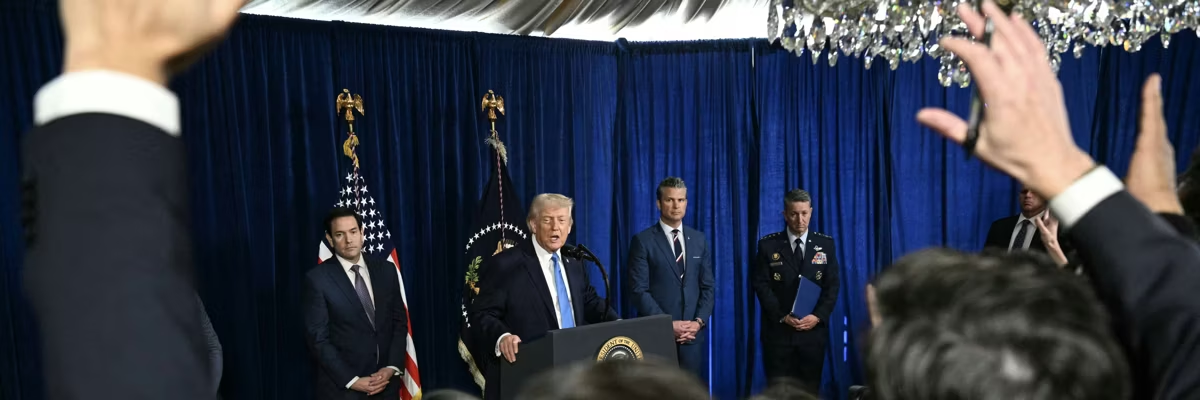
US President Donald Trump takes questions as he speaks to the press following US military actions in Venezuela, at his Mar-a-Lago residence in Palm Beach, Florida, on January 3, 2026.
“None of these acts of brazen aggression, violence, and violations of international law have, in any sustained or meaningful way, been referred to as acts of war, a coup, or invasion in US mainstream media reporting."
By the time the Trump administration began its operation this weekend to illegally kidnap Venezuelan President Nicolás Maduro before taking control of the country and its oil reserves, two of the United States’ most storied media outlets were well aware that the attack was about to happen.
According to a Saturday report from Semafor, “the New York Times and Washington Post learned of a secret US raid on Venezuela soon before it was scheduled to begin Friday night—but held off publishing what they knew to avoid endangering US troops, two people familiar with the communications between the administration and the news organizations said.”
Semafor wrote that the decision "to maintain official secrecy is in keeping with longstanding American journalistic traditions." But critics say it's part of a different tradition: One in which corporate media outlets act as dutiful stenographers for the US military establishment to help legitimize lawless, imperialist military adventures.
Prior to this weekend, the leading example of this deference was seen during the lead-up to then-President George W. Bush's war in Iraq, where legacy media outlets had been criticized for parroting the government's claims that Iraqi President Saddam Hussein possessed weapons of mass destruction, which turned out to be false.
In 2023, the 20-year anniversary of the invasion, which led to the deaths of an estimated half a million people, Adam Johnson wrote for the Real News Network that many of the journalists who pushed the lies that led to war—including the Atlantic's now-editor-in-chief Jeffrey Goldberg, the marquee MS NOW (formerly MSNBC) morning host Joe Scarborough, and New York magazine and Atlantic contributor Jonathan Chait—never suffered career consequences for helping to midwife a historic foreign policy crime, and have since seen their careers blossom.
Johnson wrote in the Intercept on Sunday that the Western media's reaction to yet another regime change war in Venezuela has been similarly uncritical of the Trump administration's justifications, even as it states, overtly this time, that its primary aim is to commandeer another country's natural resources:
The administration invaded Venezuela’s sovereign territory, bombing several buildings, killing... its citizens, kidnapping Venezuelan President Nicolás Maduro and his wife from their bed, and announcing they will, henceforth, "run" the country.
And yet none of these acts of brazen aggression, violence, and violations of international law have, in any sustained or meaningful way, been referred to as acts of war, a coup, or invasion in US mainstream media reporting.
He added that the media has spent months adopting a "pseudo-legal framing" of President Donald Trump's threats against Venezuela and his seizure of its oil tankers.
In particular, he noted that both the Times and CNN had referred to “international sanctions” against Venezuela, which are actually just US sanctions. The Times also cited a Navy lawyer who claimed that by stopping Venezuela from trading its oil by seizing its vessels, the US was enforcing the United Nations Convention on the Law of the Sea, a convention that the US itself has not signed.
"It needed to feel vaguely rules-based and international-y, so unilateral US dictates were passed off as ersatz international law," Johnson wrote.
As numerous legal scholars have pointed out, Article 2(4) of the United Nations Charter plainly states that "all members shall refrain in their international relations from the threat or use of force against the territorial integrity or political independence of any state, or in any other manner inconsistent with the purposes of the United Nations," making Trump's actions against Venezuela a blatant violation of the nation's sovereignty.
However, since Trump's invasion of Venezuela on Saturday, many media outlets have continued to adopt the dubious framing that US law, which has remained the Trump administration's sole justification for its kidnapping of Maduro—whom the Department of Justice indicted for alleged drug trafficking—somehow applies across borders and entitles the US to take over the country.
Assal Rad, a fellow at the Arab Center in Washington, DC and a frequent critic of US media coverage of foreign interventions, noted on social media that many outlets—including the Times, as well as Reuters, CNN, and the Associated Press—ran headlines framing the legality of Trump’s kidnapping of Maduro and subsequent assertion of authority to “run” the country as open questions.
"This framing is meant to cast doubt on the most basic principles of international law and sovereignty," Rad said.
Other outlets have simply denied that Trump's actions constituted acts of war at all. CBS News said the US had simply "ratcheted up" its "campaign" against Maduro. The Wall Street Journal used similar euphemistic language, describing it as a “pressure campaign” rather than a war. And others, including CNN, described the attack as a limited law enforcement "operation," rather than the opening salvo of what the White House itself has suggested may be a years-long project of ruling Venezuela for the purpose of converting it into a client state.
While the New York Times editorial board has since criticized Trump's action in Venezuela as "illegal and unwise," the Washington Post's editorial board—which was given a directive by its billionaire owner, Amazon founder Jeff Bezos earlier this year to use its pages to promote "free markets," issued unconditional support for Trump's attack and plans to govern Venezuela on Saturday, calling it a "triumph" and a "a major victory for American interests."
Other outlets have given explicit directives to use whitewashed language to refer to the US's unilateral snatching of Maduro.
Owen Jones, an independent British journalist and columnist, reported that the BBC had directed reporters not to refer to Maduro—who was whisked away in the dead of night by US soldiers along with his wife and shown bound and blindfolded by the US government—as having been “kidnapped” by the US, but rather “seized” or “captured.”
According to Johnson, CBS News editor-in-chief Bari Weiss, who has previously spiked stories damaging to the Trump administration at the behest of the network's new owners, directed the network's newly installed "Evening News" anchor to always refer to Maduro as a "dictator," echoing the government's line.
Johnson pointed out that the owner of CBS, Trump-aligned billionaire David Ellison, “recently partnered with Saudi Arabia, Qatar, and the United Arab Emirates” as part of his bid to take over CBS parent company Paramount, “so rest assured these dictatorships will not be getting the label.”
The New York Times has since updated the death toll from Trump's bombing of Caracas and other sites in Venezuela to at least 80 civilians and military personnel.
Sarah Lazare, an investigative reporter for Workday magazine, questioned why the Times and Post were concerned with the safety of US personnel, but "the danger posed to the Venezuelans killed in the bombing did not enter into the equation" when they decided to keep the story from public view until after the damage was done.
"This kind of fealty to perceived US interests is so ordinary because it's rewarded—it's the surest way to rise as a foreign policy reporter," Lazare added. "Makes me think of all the Iraq War cheerleaders who failed upward, now helm major news outlets, and narrate the events unfolding today. Being wrong about WMDs, being on the wrong side of history, did not hurt them professionally, and probably helped."
Dear Common Dreams reader, It’s been nearly 30 years since I co-founded Common Dreams with my late wife, Lina Newhouser. We had the radical notion that journalism should serve the public good, not corporate profits. It was clear to us from the outset what it would take to build such a project. No paid advertisements. No corporate sponsors. No millionaire publisher telling us what to think or do. Many people said we wouldn't last a year, but we proved those doubters wrong. Together with a tremendous team of journalists and dedicated staff, we built an independent media outlet free from the constraints of profits and corporate control. Our mission has always been simple: To inform. To inspire. To ignite change for the common good. Building Common Dreams was not easy. Our survival was never guaranteed. When you take on the most powerful forces—Wall Street greed, fossil fuel industry destruction, Big Tech lobbyists, and uber-rich oligarchs who have spent billions upon billions rigging the economy and democracy in their favor—the only bulwark you have is supporters who believe in your work. But here’s the urgent message from me today. It's never been this bad out there. And it's never been this hard to keep us going. At the very moment Common Dreams is most needed, the threats we face are intensifying. We need your support now more than ever. We don't accept corporate advertising and never will. We don't have a paywall because we don't think people should be blocked from critical news based on their ability to pay. Everything we do is funded by the donations of readers like you. When everyone does the little they can afford, we are strong. But if that support retreats or dries up, so do we. Will you donate now to make sure Common Dreams not only survives but thrives? —Craig Brown, Co-founder |
By the time the Trump administration began its operation this weekend to illegally kidnap Venezuelan President Nicolás Maduro before taking control of the country and its oil reserves, two of the United States’ most storied media outlets were well aware that the attack was about to happen.
According to a Saturday report from Semafor, “the New York Times and Washington Post learned of a secret US raid on Venezuela soon before it was scheduled to begin Friday night—but held off publishing what they knew to avoid endangering US troops, two people familiar with the communications between the administration and the news organizations said.”
Semafor wrote that the decision "to maintain official secrecy is in keeping with longstanding American journalistic traditions." But critics say it's part of a different tradition: One in which corporate media outlets act as dutiful stenographers for the US military establishment to help legitimize lawless, imperialist military adventures.
Prior to this weekend, the leading example of this deference was seen during the lead-up to then-President George W. Bush's war in Iraq, where legacy media outlets had been criticized for parroting the government's claims that Iraqi President Saddam Hussein possessed weapons of mass destruction, which turned out to be false.
In 2023, the 20-year anniversary of the invasion, which led to the deaths of an estimated half a million people, Adam Johnson wrote for the Real News Network that many of the journalists who pushed the lies that led to war—including the Atlantic's now-editor-in-chief Jeffrey Goldberg, the marquee MS NOW (formerly MSNBC) morning host Joe Scarborough, and New York magazine and Atlantic contributor Jonathan Chait—never suffered career consequences for helping to midwife a historic foreign policy crime, and have since seen their careers blossom.
Johnson wrote in the Intercept on Sunday that the Western media's reaction to yet another regime change war in Venezuela has been similarly uncritical of the Trump administration's justifications, even as it states, overtly this time, that its primary aim is to commandeer another country's natural resources:
The administration invaded Venezuela’s sovereign territory, bombing several buildings, killing... its citizens, kidnapping Venezuelan President Nicolás Maduro and his wife from their bed, and announcing they will, henceforth, "run" the country.
And yet none of these acts of brazen aggression, violence, and violations of international law have, in any sustained or meaningful way, been referred to as acts of war, a coup, or invasion in US mainstream media reporting.
He added that the media has spent months adopting a "pseudo-legal framing" of President Donald Trump's threats against Venezuela and his seizure of its oil tankers.
In particular, he noted that both the Times and CNN had referred to “international sanctions” against Venezuela, which are actually just US sanctions. The Times also cited a Navy lawyer who claimed that by stopping Venezuela from trading its oil by seizing its vessels, the US was enforcing the United Nations Convention on the Law of the Sea, a convention that the US itself has not signed.
"It needed to feel vaguely rules-based and international-y, so unilateral US dictates were passed off as ersatz international law," Johnson wrote.
As numerous legal scholars have pointed out, Article 2(4) of the United Nations Charter plainly states that "all members shall refrain in their international relations from the threat or use of force against the territorial integrity or political independence of any state, or in any other manner inconsistent with the purposes of the United Nations," making Trump's actions against Venezuela a blatant violation of the nation's sovereignty.
However, since Trump's invasion of Venezuela on Saturday, many media outlets have continued to adopt the dubious framing that US law, which has remained the Trump administration's sole justification for its kidnapping of Maduro—whom the Department of Justice indicted for alleged drug trafficking—somehow applies across borders and entitles the US to take over the country.
Assal Rad, a fellow at the Arab Center in Washington, DC and a frequent critic of US media coverage of foreign interventions, noted on social media that many outlets—including the Times, as well as Reuters, CNN, and the Associated Press—ran headlines framing the legality of Trump’s kidnapping of Maduro and subsequent assertion of authority to “run” the country as open questions.
"This framing is meant to cast doubt on the most basic principles of international law and sovereignty," Rad said.
Other outlets have simply denied that Trump's actions constituted acts of war at all. CBS News said the US had simply "ratcheted up" its "campaign" against Maduro. The Wall Street Journal used similar euphemistic language, describing it as a “pressure campaign” rather than a war. And others, including CNN, described the attack as a limited law enforcement "operation," rather than the opening salvo of what the White House itself has suggested may be a years-long project of ruling Venezuela for the purpose of converting it into a client state.
While the New York Times editorial board has since criticized Trump's action in Venezuela as "illegal and unwise," the Washington Post's editorial board—which was given a directive by its billionaire owner, Amazon founder Jeff Bezos earlier this year to use its pages to promote "free markets," issued unconditional support for Trump's attack and plans to govern Venezuela on Saturday, calling it a "triumph" and a "a major victory for American interests."
Other outlets have given explicit directives to use whitewashed language to refer to the US's unilateral snatching of Maduro.
Owen Jones, an independent British journalist and columnist, reported that the BBC had directed reporters not to refer to Maduro—who was whisked away in the dead of night by US soldiers along with his wife and shown bound and blindfolded by the US government—as having been “kidnapped” by the US, but rather “seized” or “captured.”
According to Johnson, CBS News editor-in-chief Bari Weiss, who has previously spiked stories damaging to the Trump administration at the behest of the network's new owners, directed the network's newly installed "Evening News" anchor to always refer to Maduro as a "dictator," echoing the government's line.
Johnson pointed out that the owner of CBS, Trump-aligned billionaire David Ellison, “recently partnered with Saudi Arabia, Qatar, and the United Arab Emirates” as part of his bid to take over CBS parent company Paramount, “so rest assured these dictatorships will not be getting the label.”
The New York Times has since updated the death toll from Trump's bombing of Caracas and other sites in Venezuela to at least 80 civilians and military personnel.
Sarah Lazare, an investigative reporter for Workday magazine, questioned why the Times and Post were concerned with the safety of US personnel, but "the danger posed to the Venezuelans killed in the bombing did not enter into the equation" when they decided to keep the story from public view until after the damage was done.
"This kind of fealty to perceived US interests is so ordinary because it's rewarded—it's the surest way to rise as a foreign policy reporter," Lazare added. "Makes me think of all the Iraq War cheerleaders who failed upward, now helm major news outlets, and narrate the events unfolding today. Being wrong about WMDs, being on the wrong side of history, did not hurt them professionally, and probably helped."
By the time the Trump administration began its operation this weekend to illegally kidnap Venezuelan President Nicolás Maduro before taking control of the country and its oil reserves, two of the United States’ most storied media outlets were well aware that the attack was about to happen.
According to a Saturday report from Semafor, “the New York Times and Washington Post learned of a secret US raid on Venezuela soon before it was scheduled to begin Friday night—but held off publishing what they knew to avoid endangering US troops, two people familiar with the communications between the administration and the news organizations said.”
Semafor wrote that the decision "to maintain official secrecy is in keeping with longstanding American journalistic traditions." But critics say it's part of a different tradition: One in which corporate media outlets act as dutiful stenographers for the US military establishment to help legitimize lawless, imperialist military adventures.
Prior to this weekend, the leading example of this deference was seen during the lead-up to then-President George W. Bush's war in Iraq, where legacy media outlets had been criticized for parroting the government's claims that Iraqi President Saddam Hussein possessed weapons of mass destruction, which turned out to be false.
In 2023, the 20-year anniversary of the invasion, which led to the deaths of an estimated half a million people, Adam Johnson wrote for the Real News Network that many of the journalists who pushed the lies that led to war—including the Atlantic's now-editor-in-chief Jeffrey Goldberg, the marquee MS NOW (formerly MSNBC) morning host Joe Scarborough, and New York magazine and Atlantic contributor Jonathan Chait—never suffered career consequences for helping to midwife a historic foreign policy crime, and have since seen their careers blossom.
Johnson wrote in the Intercept on Sunday that the Western media's reaction to yet another regime change war in Venezuela has been similarly uncritical of the Trump administration's justifications, even as it states, overtly this time, that its primary aim is to commandeer another country's natural resources:
The administration invaded Venezuela’s sovereign territory, bombing several buildings, killing... its citizens, kidnapping Venezuelan President Nicolás Maduro and his wife from their bed, and announcing they will, henceforth, "run" the country.
And yet none of these acts of brazen aggression, violence, and violations of international law have, in any sustained or meaningful way, been referred to as acts of war, a coup, or invasion in US mainstream media reporting.
He added that the media has spent months adopting a "pseudo-legal framing" of President Donald Trump's threats against Venezuela and his seizure of its oil tankers.
In particular, he noted that both the Times and CNN had referred to “international sanctions” against Venezuela, which are actually just US sanctions. The Times also cited a Navy lawyer who claimed that by stopping Venezuela from trading its oil by seizing its vessels, the US was enforcing the United Nations Convention on the Law of the Sea, a convention that the US itself has not signed.
"It needed to feel vaguely rules-based and international-y, so unilateral US dictates were passed off as ersatz international law," Johnson wrote.
As numerous legal scholars have pointed out, Article 2(4) of the United Nations Charter plainly states that "all members shall refrain in their international relations from the threat or use of force against the territorial integrity or political independence of any state, or in any other manner inconsistent with the purposes of the United Nations," making Trump's actions against Venezuela a blatant violation of the nation's sovereignty.
However, since Trump's invasion of Venezuela on Saturday, many media outlets have continued to adopt the dubious framing that US law, which has remained the Trump administration's sole justification for its kidnapping of Maduro—whom the Department of Justice indicted for alleged drug trafficking—somehow applies across borders and entitles the US to take over the country.
Assal Rad, a fellow at the Arab Center in Washington, DC and a frequent critic of US media coverage of foreign interventions, noted on social media that many outlets—including the Times, as well as Reuters, CNN, and the Associated Press—ran headlines framing the legality of Trump’s kidnapping of Maduro and subsequent assertion of authority to “run” the country as open questions.
"This framing is meant to cast doubt on the most basic principles of international law and sovereignty," Rad said.
Other outlets have simply denied that Trump's actions constituted acts of war at all. CBS News said the US had simply "ratcheted up" its "campaign" against Maduro. The Wall Street Journal used similar euphemistic language, describing it as a “pressure campaign” rather than a war. And others, including CNN, described the attack as a limited law enforcement "operation," rather than the opening salvo of what the White House itself has suggested may be a years-long project of ruling Venezuela for the purpose of converting it into a client state.
While the New York Times editorial board has since criticized Trump's action in Venezuela as "illegal and unwise," the Washington Post's editorial board—which was given a directive by its billionaire owner, Amazon founder Jeff Bezos earlier this year to use its pages to promote "free markets," issued unconditional support for Trump's attack and plans to govern Venezuela on Saturday, calling it a "triumph" and a "a major victory for American interests."
Other outlets have given explicit directives to use whitewashed language to refer to the US's unilateral snatching of Maduro.
Owen Jones, an independent British journalist and columnist, reported that the BBC had directed reporters not to refer to Maduro—who was whisked away in the dead of night by US soldiers along with his wife and shown bound and blindfolded by the US government—as having been “kidnapped” by the US, but rather “seized” or “captured.”
According to Johnson, CBS News editor-in-chief Bari Weiss, who has previously spiked stories damaging to the Trump administration at the behest of the network's new owners, directed the network's newly installed "Evening News" anchor to always refer to Maduro as a "dictator," echoing the government's line.
Johnson pointed out that the owner of CBS, Trump-aligned billionaire David Ellison, “recently partnered with Saudi Arabia, Qatar, and the United Arab Emirates” as part of his bid to take over CBS parent company Paramount, “so rest assured these dictatorships will not be getting the label.”
The New York Times has since updated the death toll from Trump's bombing of Caracas and other sites in Venezuela to at least 80 civilians and military personnel.
Sarah Lazare, an investigative reporter for Workday magazine, questioned why the Times and Post were concerned with the safety of US personnel, but "the danger posed to the Venezuelans killed in the bombing did not enter into the equation" when they decided to keep the story from public view until after the damage was done.
"This kind of fealty to perceived US interests is so ordinary because it's rewarded—it's the surest way to rise as a foreign policy reporter," Lazare added. "Makes me think of all the Iraq War cheerleaders who failed upward, now helm major news outlets, and narrate the events unfolding today. Being wrong about WMDs, being on the wrong side of history, did not hurt them professionally, and probably helped."