SUBSCRIBE TO OUR FREE NEWSLETTER
Daily news & progressive opinion—funded by the people, not the corporations—delivered straight to your inbox.
5
#000000
#FFFFFF
To donate by check, phone, or other method, see our More Ways to Give page.
Daily news & progressive opinion—funded by the people, not the corporations—delivered straight to your inbox.
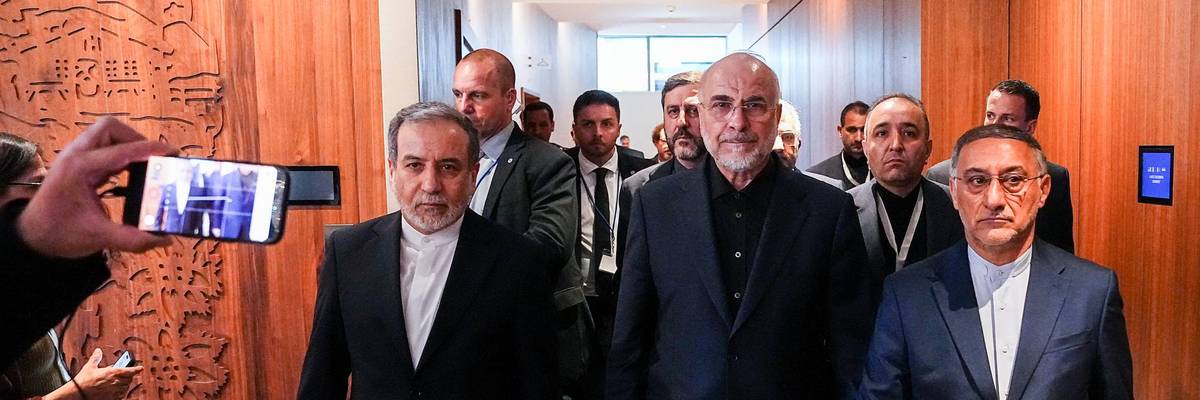
The Iranian delegation led by Mohammad Baqer Ghalibaf, speaker of the Iranian Parliament, arrives to meet with the Pakistani delegation led by Prime Minister Shehbaz Sharif on June 21, 2026 in Obbuergen, Switzerland.
Abbas Araghchi, Iran's top diplomat, specifically welcomed the announcement of a "deconfliction cell" aimed at "ensuring the termination of military operations in Lebanon."
Iran's top diplomat said late Sunday that peace negotiations in Switzerland have produced "major progress" despite US President Donald Trump's belligerent military threats and Israel's continued assault on Lebanon, both of which have risked derailing the high-stakes talks.
Abbas Araghchi, Iran's foreign minister, credited "tireless Pakistani and Qatari mediation" with securing commitments to establish a "deconfliction cell" to ensure "the termination of military operations in Lebanon," as required under the recently signed memorandum of understanding (MOU).
Araghchi added that negotiators agreed to an end to the US blockade on Iran, the release of some of Iran's frozen assets, and a "major reconstruction and development plan" for Iran, whose delegation reportedly left the Swiss negotiating venue on Sunday in response to Trump's threat to assassinate Iranian diplomats and "take over" the Middle East country. The threats violated the terms of the MOU, which requires parties to "refrain from the threat or use of force against each other."
In a joint statement late Sunday, the governments of Pakistan and Qatar said that negotiators agreed on "a roadmap towards reaching a final deal within 60 days, laying the foundation for the immediate commencement of further technical talks.
"In addition, a communication line between the parties has been formed... to avoid incidents and miscommunication with the aim of safe passage for commercial vessels through the Strait of Hormuz," the statement continued. "The mediating parties will continue to do their utmost to ensure that the negotiations continue to be conducted in a constructive atmosphere with the aim of reaching a final deal."
🔊PR No: 1️⃣5️⃣1️⃣/2️⃣0️⃣2️⃣6️⃣
Joint Statement by the State of Qatar and the Islamic Republic of Pakistan Regarding the Conclusion of Lake Lucerne Summit, First High-Level Committee Meeting with Participation of the United States of America and the Islamic Republic of Iran pic.twitter.com/2G3PAf7LVY
— Ministry of Foreign Affairs - Pakistan (@ForeignOfficePk) June 22, 2026
The optimistic comments from Iran's foreign minister and mediators came after the first round of formal talks in Switzerland got off to a shaky start, with Iran's delegation postponing its arrival due to a deadly barrage of Israeli airstrikes in southern Lebanon late last week.
Israel's leadership, which is not a party to the peace negotiations, has refused to end its occupation of Lebanon, a major obstacle in the way of a final deal to end the war on Iran that the US and Israel launched in late February. Iran has said the Trump administration must force the Israeli government to end its assault on Lebanon.
In a social media post on Sunday amid the negotiations in Switzerland, Israeli Defense Minister Israel Katz declared that "Israel has no intention of withdrawing from the Beaufort, which is an integral part of the security zone in Lebanon and essential for the defense of the Galilee settlements and IDF forces."
"As Prime Minister [Benjamin] Netanyahu and I have clarified—Israel will not withdraw from the security zone in Lebanon," Katz added.
Dear Common Dreams reader, It’s been nearly 30 years since I co-founded Common Dreams with my late wife, Lina Newhouser. We had the radical notion that journalism should serve the public good, not corporate profits. It was clear to us from the outset what it would take to build such a project. No paid advertisements. No corporate sponsors. No millionaire publisher telling us what to think or do. Many people said we wouldn't last a year, but we proved those doubters wrong. Together with a tremendous team of journalists and dedicated staff, we built an independent media outlet free from the constraints of profits and corporate control. Our mission has always been simple: To inform. To inspire. To ignite change for the common good. Building Common Dreams was not easy. Our survival was never guaranteed. When you take on the most powerful forces—Wall Street greed, fossil fuel industry destruction, Big Tech lobbyists, and uber-rich oligarchs who have spent billions upon billions rigging the economy and democracy in their favor—the only bulwark you have is supporters who believe in your work. But here’s the urgent message from me today. It's never been this bad out there. And it's never been this hard to keep us going. At the very moment Common Dreams is most needed, the threats we face are intensifying. We need your support now more than ever. We don't accept corporate advertising and never will. We don't have a paywall because we don't think people should be blocked from critical news based on their ability to pay. Everything we do is funded by the donations of readers like you. When everyone does the little they can afford, we are strong. But if that support retreats or dries up, so do we. Will you donate now to make sure Common Dreams not only survives but thrives? —Craig Brown, Co-founder |
Iran's top diplomat said late Sunday that peace negotiations in Switzerland have produced "major progress" despite US President Donald Trump's belligerent military threats and Israel's continued assault on Lebanon, both of which have risked derailing the high-stakes talks.
Abbas Araghchi, Iran's foreign minister, credited "tireless Pakistani and Qatari mediation" with securing commitments to establish a "deconfliction cell" to ensure "the termination of military operations in Lebanon," as required under the recently signed memorandum of understanding (MOU).
Araghchi added that negotiators agreed to an end to the US blockade on Iran, the release of some of Iran's frozen assets, and a "major reconstruction and development plan" for Iran, whose delegation reportedly left the Swiss negotiating venue on Sunday in response to Trump's threat to assassinate Iranian diplomats and "take over" the Middle East country. The threats violated the terms of the MOU, which requires parties to "refrain from the threat or use of force against each other."
In a joint statement late Sunday, the governments of Pakistan and Qatar said that negotiators agreed on "a roadmap towards reaching a final deal within 60 days, laying the foundation for the immediate commencement of further technical talks.
"In addition, a communication line between the parties has been formed... to avoid incidents and miscommunication with the aim of safe passage for commercial vessels through the Strait of Hormuz," the statement continued. "The mediating parties will continue to do their utmost to ensure that the negotiations continue to be conducted in a constructive atmosphere with the aim of reaching a final deal."
🔊PR No: 1️⃣5️⃣1️⃣/2️⃣0️⃣2️⃣6️⃣
Joint Statement by the State of Qatar and the Islamic Republic of Pakistan Regarding the Conclusion of Lake Lucerne Summit, First High-Level Committee Meeting with Participation of the United States of America and the Islamic Republic of Iran pic.twitter.com/2G3PAf7LVY
— Ministry of Foreign Affairs - Pakistan (@ForeignOfficePk) June 22, 2026
The optimistic comments from Iran's foreign minister and mediators came after the first round of formal talks in Switzerland got off to a shaky start, with Iran's delegation postponing its arrival due to a deadly barrage of Israeli airstrikes in southern Lebanon late last week.
Israel's leadership, which is not a party to the peace negotiations, has refused to end its occupation of Lebanon, a major obstacle in the way of a final deal to end the war on Iran that the US and Israel launched in late February. Iran has said the Trump administration must force the Israeli government to end its assault on Lebanon.
In a social media post on Sunday amid the negotiations in Switzerland, Israeli Defense Minister Israel Katz declared that "Israel has no intention of withdrawing from the Beaufort, which is an integral part of the security zone in Lebanon and essential for the defense of the Galilee settlements and IDF forces."
"As Prime Minister [Benjamin] Netanyahu and I have clarified—Israel will not withdraw from the security zone in Lebanon," Katz added.
Iran's top diplomat said late Sunday that peace negotiations in Switzerland have produced "major progress" despite US President Donald Trump's belligerent military threats and Israel's continued assault on Lebanon, both of which have risked derailing the high-stakes talks.
Abbas Araghchi, Iran's foreign minister, credited "tireless Pakistani and Qatari mediation" with securing commitments to establish a "deconfliction cell" to ensure "the termination of military operations in Lebanon," as required under the recently signed memorandum of understanding (MOU).
Araghchi added that negotiators agreed to an end to the US blockade on Iran, the release of some of Iran's frozen assets, and a "major reconstruction and development plan" for Iran, whose delegation reportedly left the Swiss negotiating venue on Sunday in response to Trump's threat to assassinate Iranian diplomats and "take over" the Middle East country. The threats violated the terms of the MOU, which requires parties to "refrain from the threat or use of force against each other."
In a joint statement late Sunday, the governments of Pakistan and Qatar said that negotiators agreed on "a roadmap towards reaching a final deal within 60 days, laying the foundation for the immediate commencement of further technical talks.
"In addition, a communication line between the parties has been formed... to avoid incidents and miscommunication with the aim of safe passage for commercial vessels through the Strait of Hormuz," the statement continued. "The mediating parties will continue to do their utmost to ensure that the negotiations continue to be conducted in a constructive atmosphere with the aim of reaching a final deal."
🔊PR No: 1️⃣5️⃣1️⃣/2️⃣0️⃣2️⃣6️⃣
Joint Statement by the State of Qatar and the Islamic Republic of Pakistan Regarding the Conclusion of Lake Lucerne Summit, First High-Level Committee Meeting with Participation of the United States of America and the Islamic Republic of Iran pic.twitter.com/2G3PAf7LVY
— Ministry of Foreign Affairs - Pakistan (@ForeignOfficePk) June 22, 2026
The optimistic comments from Iran's foreign minister and mediators came after the first round of formal talks in Switzerland got off to a shaky start, with Iran's delegation postponing its arrival due to a deadly barrage of Israeli airstrikes in southern Lebanon late last week.
Israel's leadership, which is not a party to the peace negotiations, has refused to end its occupation of Lebanon, a major obstacle in the way of a final deal to end the war on Iran that the US and Israel launched in late February. Iran has said the Trump administration must force the Israeli government to end its assault on Lebanon.
In a social media post on Sunday amid the negotiations in Switzerland, Israeli Defense Minister Israel Katz declared that "Israel has no intention of withdrawing from the Beaufort, which is an integral part of the security zone in Lebanon and essential for the defense of the Galilee settlements and IDF forces."
"As Prime Minister [Benjamin] Netanyahu and I have clarified—Israel will not withdraw from the security zone in Lebanon," Katz added.