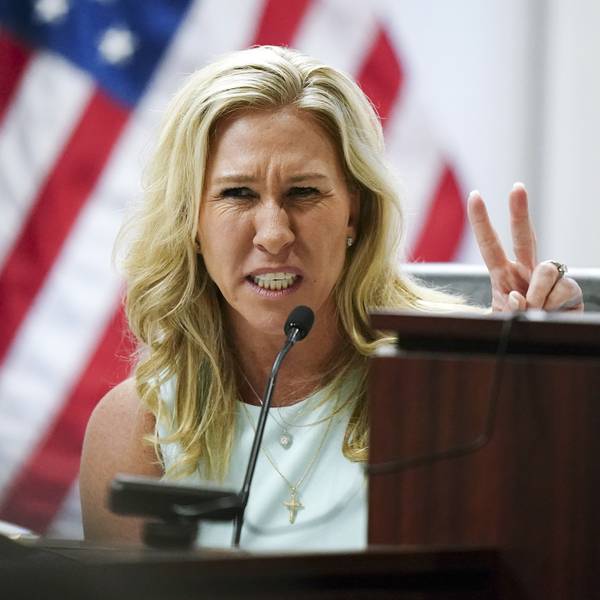

Pentagon Secretary Pete Hegseth and other officials testify during a Senate Armed Services Committee hearing on April 30, 2026.
Analyst Warns New Pentagon Plan for Iran Would Amount to 'Permanent State of War'
"Make no mistake," said Trita Parsi, "to periodically bomb a country is to fight a forever war."
The US Defense Department is reportedly considering a new strategy for Iran that would entail bombing the country "periodically" in an effort to keep ship traffic flowing through the Strait of Hormuz, a plan that one analyst said would amount to the kind of forever war that President Donald Trump once vowed to avoid.
"During previous administrations, Israel tried to sell war with Iran to the US and conceded that military strikes would not knock out Iran’s nuclear program, but would require 'periodic' return to kinetic action to keep the program in check," Trita Parsi, executive vice president of the Quincy Institute for Responsible Statecraft, wrote late Monday. "The US rejected the plan precisely because it didn’t want to be in a permanent state of war with Iran. Now, Trump’s secretary of war is pushing for it."
Parsi's comments came in response to new reporting by Axios indicating that Trump administration officials are weighing a plan under which US forces would "strike Iran periodically in order to keep moving dozens of oil tankers out of the Gulf relatively safely every day."
Pentagon Secretary Pete Hegseth supports the plan, unnamed US officials told the outlet.
Axios' reporting followed a Washington Post story detailing US military leaders' warning that "prolonging large-scale operations against Iran is unsustainable," increasing the likelihood of more limited strikes—though without a clearly defined timeline.
On Monday, Trump threatened to hit Iran "hard" in response to the country's retaliatory attacks on American military installations in Jordan and the United Arab Emirates. The Iranian attacks followed a US bombing campaign on Larak Island, marking the first military exchange in weeks as the costly and unpopular war—which Trump said would last just weeks—drags on with no end in sight.
Iran pledged to respond "dozens of times greater" to future US attacks, warning that "no target in the region is beyond Tehran’s reach."
"The invading US military has no choice but to leave the region," the general staff of Iran's armed forces said in a statement on Monday.
In his analysis, Parsi called the shifting US strategy "quite stunning," noting that "only a week ago, [Treasury Secretary] Scott Bessent said sanctions would make military action unnecessary."
"Six days later, the US bombed Iran again," Parsi observed. "And now, Axios reveals that all along, the Pentagon was preparing a plan for 'periodic' bombings of Iran to prevent it from suppressing traffic in the Strait of Hormuz. What does this tell us? First, the administration is apparently giving up on solving the issue militarily, economically, or diplomatically. Instead, permanent warfare is needed to manage the problem."
"Make no mistake," Parsi continued, "to periodically bomb a country is to fight a forever war."
An Urgent Message From Our Co-Founder
Dear Common Dreams reader, It’s been nearly 30 years since I co-founded Common Dreams with my late wife, Lina Newhouser. We had the radical notion that journalism should serve the public good, not corporate profits. It was clear to us from the outset what it would take to build such a project. No paid advertisements. No corporate sponsors. No millionaire publisher telling us what to think or do. Many people said we wouldn't last a year, but we proved those doubters wrong. Together with a tremendous team of journalists and dedicated staff, we built an independent media outlet free from the constraints of profits and corporate control. Our mission has always been simple: To inform. To inspire. To ignite change for the common good. Building Common Dreams was not easy. Our survival was never guaranteed. When you take on the most powerful forces—Wall Street greed, fossil fuel industry destruction, Big Tech lobbyists, and uber-rich oligarchs who have spent billions upon billions rigging the economy and democracy in their favor—the only bulwark you have is supporters who believe in your work. But here’s the urgent message from me today. It's never been this bad out there. And it's never been this hard to keep us going. At the very moment Common Dreams is most needed, the threats we face are intensifying. We need your support now more than ever. We don't accept corporate advertising and never will. We don't have a paywall because we don't think people should be blocked from critical news based on their ability to pay. Everything we do is funded by the donations of readers like you. When everyone does the little they can afford, we are strong. But if that support retreats or dries up, so do we. Will you donate now to make sure Common Dreams not only survives but thrives? —Craig Brown, Co-founder |
The US Defense Department is reportedly considering a new strategy for Iran that would entail bombing the country "periodically" in an effort to keep ship traffic flowing through the Strait of Hormuz, a plan that one analyst said would amount to the kind of forever war that President Donald Trump once vowed to avoid.
"During previous administrations, Israel tried to sell war with Iran to the US and conceded that military strikes would not knock out Iran’s nuclear program, but would require 'periodic' return to kinetic action to keep the program in check," Trita Parsi, executive vice president of the Quincy Institute for Responsible Statecraft, wrote late Monday. "The US rejected the plan precisely because it didn’t want to be in a permanent state of war with Iran. Now, Trump’s secretary of war is pushing for it."
Parsi's comments came in response to new reporting by Axios indicating that Trump administration officials are weighing a plan under which US forces would "strike Iran periodically in order to keep moving dozens of oil tankers out of the Gulf relatively safely every day."
Pentagon Secretary Pete Hegseth supports the plan, unnamed US officials told the outlet.
Axios' reporting followed a Washington Post story detailing US military leaders' warning that "prolonging large-scale operations against Iran is unsustainable," increasing the likelihood of more limited strikes—though without a clearly defined timeline.
On Monday, Trump threatened to hit Iran "hard" in response to the country's retaliatory attacks on American military installations in Jordan and the United Arab Emirates. The Iranian attacks followed a US bombing campaign on Larak Island, marking the first military exchange in weeks as the costly and unpopular war—which Trump said would last just weeks—drags on with no end in sight.
Iran pledged to respond "dozens of times greater" to future US attacks, warning that "no target in the region is beyond Tehran’s reach."
"The invading US military has no choice but to leave the region," the general staff of Iran's armed forces said in a statement on Monday.
In his analysis, Parsi called the shifting US strategy "quite stunning," noting that "only a week ago, [Treasury Secretary] Scott Bessent said sanctions would make military action unnecessary."
"Six days later, the US bombed Iran again," Parsi observed. "And now, Axios reveals that all along, the Pentagon was preparing a plan for 'periodic' bombings of Iran to prevent it from suppressing traffic in the Strait of Hormuz. What does this tell us? First, the administration is apparently giving up on solving the issue militarily, economically, or diplomatically. Instead, permanent warfare is needed to manage the problem."
"Make no mistake," Parsi continued, "to periodically bomb a country is to fight a forever war."
The US Defense Department is reportedly considering a new strategy for Iran that would entail bombing the country "periodically" in an effort to keep ship traffic flowing through the Strait of Hormuz, a plan that one analyst said would amount to the kind of forever war that President Donald Trump once vowed to avoid.
"During previous administrations, Israel tried to sell war with Iran to the US and conceded that military strikes would not knock out Iran’s nuclear program, but would require 'periodic' return to kinetic action to keep the program in check," Trita Parsi, executive vice president of the Quincy Institute for Responsible Statecraft, wrote late Monday. "The US rejected the plan precisely because it didn’t want to be in a permanent state of war with Iran. Now, Trump’s secretary of war is pushing for it."
Parsi's comments came in response to new reporting by Axios indicating that Trump administration officials are weighing a plan under which US forces would "strike Iran periodically in order to keep moving dozens of oil tankers out of the Gulf relatively safely every day."
Pentagon Secretary Pete Hegseth supports the plan, unnamed US officials told the outlet.
Axios' reporting followed a Washington Post story detailing US military leaders' warning that "prolonging large-scale operations against Iran is unsustainable," increasing the likelihood of more limited strikes—though without a clearly defined timeline.
On Monday, Trump threatened to hit Iran "hard" in response to the country's retaliatory attacks on American military installations in Jordan and the United Arab Emirates. The Iranian attacks followed a US bombing campaign on Larak Island, marking the first military exchange in weeks as the costly and unpopular war—which Trump said would last just weeks—drags on with no end in sight.
Iran pledged to respond "dozens of times greater" to future US attacks, warning that "no target in the region is beyond Tehran’s reach."
"The invading US military has no choice but to leave the region," the general staff of Iran's armed forces said in a statement on Monday.
In his analysis, Parsi called the shifting US strategy "quite stunning," noting that "only a week ago, [Treasury Secretary] Scott Bessent said sanctions would make military action unnecessary."
"Six days later, the US bombed Iran again," Parsi observed. "And now, Axios reveals that all along, the Pentagon was preparing a plan for 'periodic' bombings of Iran to prevent it from suppressing traffic in the Strait of Hormuz. What does this tell us? First, the administration is apparently giving up on solving the issue militarily, economically, or diplomatically. Instead, permanent warfare is needed to manage the problem."
"Make no mistake," Parsi continued, "to periodically bomb a country is to fight a forever war."