SUBSCRIBE TO OUR FREE NEWSLETTER
Daily news & progressive opinion—funded by the people, not the corporations—delivered straight to your inbox.
5
#000000
#FFFFFF
To donate by check, phone, or other method, see our More Ways to Give page.
Daily news & progressive opinion—funded by the people, not the corporations—delivered straight to your inbox.
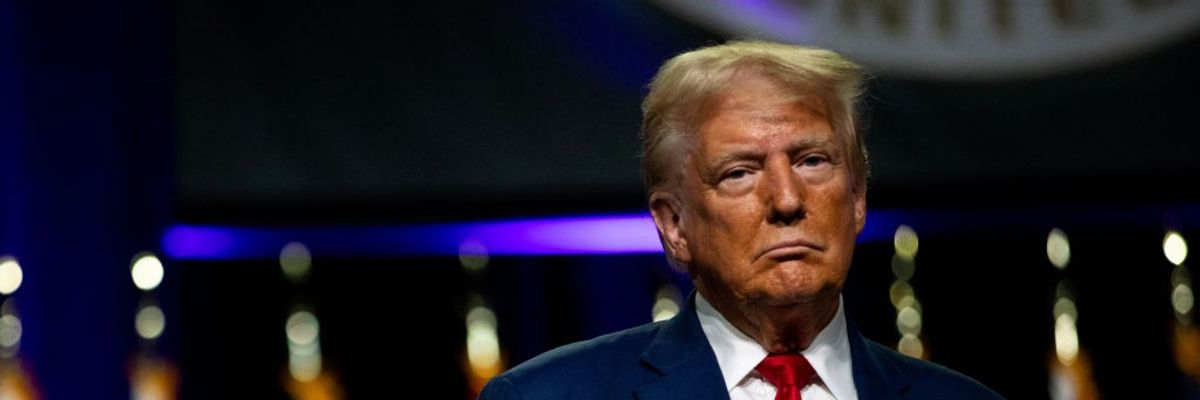
Donald Trump appears at an event in Detroit, Michigan on August 26, 2024.
"The Constitution provides no impoundment power to the president to unilaterally withhold funds appropriated by Congress," said Rep. Rosa DeLauro.
The top Democrat on the House Appropriations Committee warned Friday that President-elect Donald Trump is planning to "steal from the programs and services that affect middle-class, working, and vulnerable families" by refusing to spend money appropriated by Congress.
Rep. Rosa DeLauro (D-Conn.) said in a statement that Trump's strategy, known as "impoundment," is "uninformed and unconstitutional," adding that "the Supreme Court, the Department of Justice, and the Government Accountability Office are all in agreement—the Constitution provides no impoundment power to the president to unilaterally withhold funds appropriated by Congress."
"It is the sworn duty of the president of the United States to faithfully execute the law," DeLauro added, "and appropriations laws are no exception."
In a new fact sheet, Democrats on the House Appropriations Committee note that "the Constitution gives Congress the power of the purse, and nowhere does it give the president any unilateral power to either temporarily or permanently impound—steal, withhold, or prevent from being spent—funds appropriated by Congress."
"The Framers were right to give Congress the power of the purse," the fact sheet states. "If the president had the unilateral power to decline to spend resources as directed by Congress, then those who rely on Social Security, Medicare, Veterans Medical Care, and other federal spending programs would be subject to the whims of the executive branch. The American people would be unable to depend on promises made by Congress in appropriations laws."
Trump has explicitly vowed to use impoundment to "squeeze the bloated federal bureaucracy for massive savings," a plan endorsed by the billionaire pair tapped by the president-elect to run a new commission tasked with identifying spending and regulations to slash.
"With impoundment, we can simply choke off the money," Trump declared in a campaign ad.
"They have no authority. Does anybody get that?"
Following Elon Musk and Vivek Ramaswamy's visit to Capitol Hill on Thursday to discuss their plans for the "Department of Government Efficiency" (DOGE) with GOP lawmakers, The Washington Post reported that Republicans are "keen on expanding the president's power to impound spending—or refuse to spend money Congress authorizes."
"Musk and Ramaswamy said they were eager to test the constitutional limits of Trump's ability to unilaterally control spending decisions," the Post reported, citing two unnamed lawmakers. "Republicans largely left the more than two-hour meeting giddy."
Analysts argue Trump's plan to withhold federal spending would run afoul of the 1974 Congressional Budget and Impoundment Control Act (ICA). The law, as Propublica's Molly Redden explained, "forbids presidents from blocking spending over policy disagreements."
"A similar power grab led to his first impeachment," Redden wrote. "During his first term, Trump held up nearly $400 million in military aid to Ukraine while he pressured President Volodymyr Zelenskyy to open a corruption investigation into Joe Biden and his family. The U.S. Government Accountability Office later ruled his actions violated the Impoundment Control Act."
Democrats on the House Budget Committee recently pointed out that "although decided after the ICA passed, the Supreme Court unanimously held in Train v. City of New York that even without the ICA, the president does not have unilateral authority to impound funds."
That hasn't stopped Trump, Musk, and Ramaswamy from exploring ways to cut or block spending without congressional approval.
In a Wall Street Journal op-ed published last month, Musk and Ramaswamy wrote that "even without relying on" the view that the ICA is unconstitutional, "DOGE will help end federal overspending by taking aim at the $500 billion-plus in annual federal expenditures that are unauthorized by Congress or being used in ways that Congress never intended, from $535 million a year to the Corporation for Public Broadcasting and $1.5 billion for grants to international organizations to nearly $300 million to progressive groups like Planned Parenthood."
Housing assistance, childcare aid, student loan programs, and other spending would also be vulnerable under such an approach.
"They want [to cut] $2 trillion," DeLauro told reporters Thursday. "Think about the discretionary budget. It's $1.7 trillion. Where are they going for the money? Where are they going?"
"They have no authority," she added. "Does anybody get that?"
Dear Common Dreams reader, It’s been nearly 30 years since I co-founded Common Dreams with my late wife, Lina Newhouser. We had the radical notion that journalism should serve the public good, not corporate profits. It was clear to us from the outset what it would take to build such a project. No paid advertisements. No corporate sponsors. No millionaire publisher telling us what to think or do. Many people said we wouldn't last a year, but we proved those doubters wrong. Together with a tremendous team of journalists and dedicated staff, we built an independent media outlet free from the constraints of profits and corporate control. Our mission has always been simple: To inform. To inspire. To ignite change for the common good. Building Common Dreams was not easy. Our survival was never guaranteed. When you take on the most powerful forces—Wall Street greed, fossil fuel industry destruction, Big Tech lobbyists, and uber-rich oligarchs who have spent billions upon billions rigging the economy and democracy in their favor—the only bulwark you have is supporters who believe in your work. But here’s the urgent message from me today. It's never been this bad out there. And it's never been this hard to keep us going. At the very moment Common Dreams is most needed, the threats we face are intensifying. We need your support now more than ever. We don't accept corporate advertising and never will. We don't have a paywall because we don't think people should be blocked from critical news based on their ability to pay. Everything we do is funded by the donations of readers like you. When everyone does the little they can afford, we are strong. But if that support retreats or dries up, so do we. Will you donate now to make sure Common Dreams not only survives but thrives? —Craig Brown, Co-founder |
The top Democrat on the House Appropriations Committee warned Friday that President-elect Donald Trump is planning to "steal from the programs and services that affect middle-class, working, and vulnerable families" by refusing to spend money appropriated by Congress.
Rep. Rosa DeLauro (D-Conn.) said in a statement that Trump's strategy, known as "impoundment," is "uninformed and unconstitutional," adding that "the Supreme Court, the Department of Justice, and the Government Accountability Office are all in agreement—the Constitution provides no impoundment power to the president to unilaterally withhold funds appropriated by Congress."
"It is the sworn duty of the president of the United States to faithfully execute the law," DeLauro added, "and appropriations laws are no exception."
In a new fact sheet, Democrats on the House Appropriations Committee note that "the Constitution gives Congress the power of the purse, and nowhere does it give the president any unilateral power to either temporarily or permanently impound—steal, withhold, or prevent from being spent—funds appropriated by Congress."
"The Framers were right to give Congress the power of the purse," the fact sheet states. "If the president had the unilateral power to decline to spend resources as directed by Congress, then those who rely on Social Security, Medicare, Veterans Medical Care, and other federal spending programs would be subject to the whims of the executive branch. The American people would be unable to depend on promises made by Congress in appropriations laws."
Trump has explicitly vowed to use impoundment to "squeeze the bloated federal bureaucracy for massive savings," a plan endorsed by the billionaire pair tapped by the president-elect to run a new commission tasked with identifying spending and regulations to slash.
"With impoundment, we can simply choke off the money," Trump declared in a campaign ad.
"They have no authority. Does anybody get that?"
Following Elon Musk and Vivek Ramaswamy's visit to Capitol Hill on Thursday to discuss their plans for the "Department of Government Efficiency" (DOGE) with GOP lawmakers, The Washington Post reported that Republicans are "keen on expanding the president's power to impound spending—or refuse to spend money Congress authorizes."
"Musk and Ramaswamy said they were eager to test the constitutional limits of Trump's ability to unilaterally control spending decisions," the Post reported, citing two unnamed lawmakers. "Republicans largely left the more than two-hour meeting giddy."
Analysts argue Trump's plan to withhold federal spending would run afoul of the 1974 Congressional Budget and Impoundment Control Act (ICA). The law, as Propublica's Molly Redden explained, "forbids presidents from blocking spending over policy disagreements."
"A similar power grab led to his first impeachment," Redden wrote. "During his first term, Trump held up nearly $400 million in military aid to Ukraine while he pressured President Volodymyr Zelenskyy to open a corruption investigation into Joe Biden and his family. The U.S. Government Accountability Office later ruled his actions violated the Impoundment Control Act."
Democrats on the House Budget Committee recently pointed out that "although decided after the ICA passed, the Supreme Court unanimously held in Train v. City of New York that even without the ICA, the president does not have unilateral authority to impound funds."
That hasn't stopped Trump, Musk, and Ramaswamy from exploring ways to cut or block spending without congressional approval.
In a Wall Street Journal op-ed published last month, Musk and Ramaswamy wrote that "even without relying on" the view that the ICA is unconstitutional, "DOGE will help end federal overspending by taking aim at the $500 billion-plus in annual federal expenditures that are unauthorized by Congress or being used in ways that Congress never intended, from $535 million a year to the Corporation for Public Broadcasting and $1.5 billion for grants to international organizations to nearly $300 million to progressive groups like Planned Parenthood."
Housing assistance, childcare aid, student loan programs, and other spending would also be vulnerable under such an approach.
"They want [to cut] $2 trillion," DeLauro told reporters Thursday. "Think about the discretionary budget. It's $1.7 trillion. Where are they going for the money? Where are they going?"
"They have no authority," she added. "Does anybody get that?"
The top Democrat on the House Appropriations Committee warned Friday that President-elect Donald Trump is planning to "steal from the programs and services that affect middle-class, working, and vulnerable families" by refusing to spend money appropriated by Congress.
Rep. Rosa DeLauro (D-Conn.) said in a statement that Trump's strategy, known as "impoundment," is "uninformed and unconstitutional," adding that "the Supreme Court, the Department of Justice, and the Government Accountability Office are all in agreement—the Constitution provides no impoundment power to the president to unilaterally withhold funds appropriated by Congress."
"It is the sworn duty of the president of the United States to faithfully execute the law," DeLauro added, "and appropriations laws are no exception."
In a new fact sheet, Democrats on the House Appropriations Committee note that "the Constitution gives Congress the power of the purse, and nowhere does it give the president any unilateral power to either temporarily or permanently impound—steal, withhold, or prevent from being spent—funds appropriated by Congress."
"The Framers were right to give Congress the power of the purse," the fact sheet states. "If the president had the unilateral power to decline to spend resources as directed by Congress, then those who rely on Social Security, Medicare, Veterans Medical Care, and other federal spending programs would be subject to the whims of the executive branch. The American people would be unable to depend on promises made by Congress in appropriations laws."
Trump has explicitly vowed to use impoundment to "squeeze the bloated federal bureaucracy for massive savings," a plan endorsed by the billionaire pair tapped by the president-elect to run a new commission tasked with identifying spending and regulations to slash.
"With impoundment, we can simply choke off the money," Trump declared in a campaign ad.
"They have no authority. Does anybody get that?"
Following Elon Musk and Vivek Ramaswamy's visit to Capitol Hill on Thursday to discuss their plans for the "Department of Government Efficiency" (DOGE) with GOP lawmakers, The Washington Post reported that Republicans are "keen on expanding the president's power to impound spending—or refuse to spend money Congress authorizes."
"Musk and Ramaswamy said they were eager to test the constitutional limits of Trump's ability to unilaterally control spending decisions," the Post reported, citing two unnamed lawmakers. "Republicans largely left the more than two-hour meeting giddy."
Analysts argue Trump's plan to withhold federal spending would run afoul of the 1974 Congressional Budget and Impoundment Control Act (ICA). The law, as Propublica's Molly Redden explained, "forbids presidents from blocking spending over policy disagreements."
"A similar power grab led to his first impeachment," Redden wrote. "During his first term, Trump held up nearly $400 million in military aid to Ukraine while he pressured President Volodymyr Zelenskyy to open a corruption investigation into Joe Biden and his family. The U.S. Government Accountability Office later ruled his actions violated the Impoundment Control Act."
Democrats on the House Budget Committee recently pointed out that "although decided after the ICA passed, the Supreme Court unanimously held in Train v. City of New York that even without the ICA, the president does not have unilateral authority to impound funds."
That hasn't stopped Trump, Musk, and Ramaswamy from exploring ways to cut or block spending without congressional approval.
In a Wall Street Journal op-ed published last month, Musk and Ramaswamy wrote that "even without relying on" the view that the ICA is unconstitutional, "DOGE will help end federal overspending by taking aim at the $500 billion-plus in annual federal expenditures that are unauthorized by Congress or being used in ways that Congress never intended, from $535 million a year to the Corporation for Public Broadcasting and $1.5 billion for grants to international organizations to nearly $300 million to progressive groups like Planned Parenthood."
Housing assistance, childcare aid, student loan programs, and other spending would also be vulnerable under such an approach.
"They want [to cut] $2 trillion," DeLauro told reporters Thursday. "Think about the discretionary budget. It's $1.7 trillion. Where are they going for the money? Where are they going?"
"They have no authority," she added. "Does anybody get that?"