SUBSCRIBE TO OUR FREE NEWSLETTER
Daily news & progressive opinion—funded by the people, not the corporations—delivered straight to your inbox.
5
#000000
#FFFFFF
To donate by check, phone, or other method, see our More Ways to Give page.
Daily news & progressive opinion—funded by the people, not the corporations—delivered straight to your inbox.
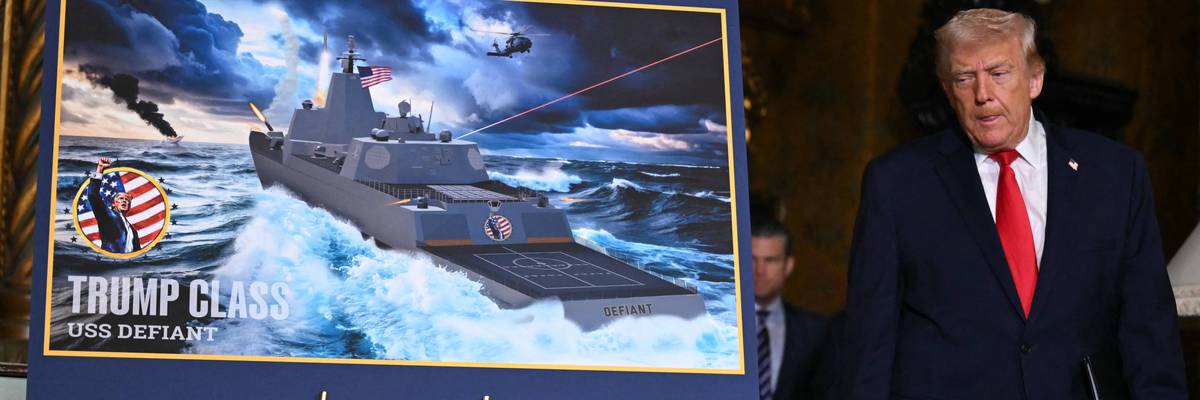
US President Donald Trump announces the US Navy's new Golden Fleet initiative at his Mar-a-Lago resort in Palm Beach, Florida, on December 22, 2025.
"At a time when families are struggling to afford groceries, gas, healthcare, and childcare, Congress cannot throw hundreds of billions of dollars at Trump’s ‘Golden Fleet,’" said one Democratic senator.
The Trump administration's controversial plan to build a new "Golden Fleet" of guided-missile battleships is drawing mounting criticism from budget watchdogs, defense analysts, and Democratic lawmakers, who warn the proposal would put taxpayers on the hook for what could be the costliest naval procurement in US history.
The nonpartisan Congressional Budget Office (CBO) on Wednesday said the cost to build 15 Trump-class nuclear-powered battleships is approximately $275 billion in current dollars through 2056—roughly 50% more than a previous estimate.
"Under the 2027 shipbuilding plan, compared with the 2025 plan, the Navy would purchase substantially more large surface combatants," the CBO said. "The average annual amount of funding needed to buy surface combatants would rise by slightly more than two-thirds, from about $11 billion to $19 billion."
"By 2035, the Navy's 2027 plan would more than double the tonnage of large surface combatants that shipbuilders would need to produce," the office added. "Overall, the tonnage of large surface combatants to be constructed would need to increase by 60%, while the tonnage of small surface combatants would decrease by about 40%. Accommodating such a sizable increase in the production of large surface combatants could be a challenge for the shipbuilding industry."
One journalist noted that the Trump-class battleships' cost would make them "the most expensive US warships ever produced."
President Donald Trump claimed in December that his proposed Golden Fleet would "help maintain American military supremacy, revive the American shipbuilding industry, and inspire fear in America’s enemies all over the world."
The president explicitly linked his desire to revive battleships—which were last built in the US in 1944 and were all decommissioned by the early 1990s—to his affinity for the 1950s television documentary series "Victory at Sea."
Critics say the program will inflate already historically high military budgets while diverting hundreds of billions of dollars that would be better spent on underfunded social programs.
"At a time when families are struggling to afford groceries, gas, healthcare, and childcare, Congress cannot throw hundreds of billions of dollars at Trump’s ‘Golden Fleet,’ including plastering his name across a new battleship," Senate Budget Committee Ranking Member Jeff Merkley (D-Ore.) said Wednesday in response to the CBO analysis.
"Congress cannot afford to commit to another massive military boondoggle that will only succeed in filling the coffers of the military-industrial complex."
"Just like Trump’s ‘Golden Dome,’ the ‘Golden Fleet’ is expected to cost much more than previously estimated," he continued, referring to the president's proposed missile defense system that Sen. Ed Markey (D-Mass.) derided as a "dangerous $1.2 trillion boondoggle."
“While we continue to see too many Pentagon programs burdened by cost overruns, delays, and unrealistic promises that fail to meet reality, Congress cannot afford to commit to another massive military boondoggle that will only succeed in filling the coffers of the military-industrial complex," Merkley added. "I will work with my colleagues on the Appropriations Committee to reject moving forward with this wasteful project, and instead invest in programs that help families thrive."
In addition to cost, military experts and others noted the obsolescence of battleships—which are now all scrapped or museum pieces—and the fact that they make great big targets.
Among the most outspoken critics of the Golden Fleet is Mark Cancian of the Center for Strategic and International Studies (CSIS), who has argued that the ships represent a throwback to outdated naval warfare doctrine.
Rather than concentrating enormous combat power in a handful of exceptionally expensive vessels, Cancian has said the Navy's own operational concepts increasingly emphasize "distributed maritime operations," the spreading of offensive capabilities across larger numbers of smaller, networked ships that are harder for adversaries to target.
Bernard Loo, a senior fellow at the Rajaratnam School of International Studies in Singapore, was even more blunt in a December CBNC interview, calling the proposed Trump-class ships "bomb magnets."
“The size and the prestige value of it all make it an even more tempting target," Loo added.
Dear Common Dreams reader, It’s been nearly 30 years since I co-founded Common Dreams with my late wife, Lina Newhouser. We had the radical notion that journalism should serve the public good, not corporate profits. It was clear to us from the outset what it would take to build such a project. No paid advertisements. No corporate sponsors. No millionaire publisher telling us what to think or do. Many people said we wouldn't last a year, but we proved those doubters wrong. Together with a tremendous team of journalists and dedicated staff, we built an independent media outlet free from the constraints of profits and corporate control. Our mission has always been simple: To inform. To inspire. To ignite change for the common good. Building Common Dreams was not easy. Our survival was never guaranteed. When you take on the most powerful forces—Wall Street greed, fossil fuel industry destruction, Big Tech lobbyists, and uber-rich oligarchs who have spent billions upon billions rigging the economy and democracy in their favor—the only bulwark you have is supporters who believe in your work. But here’s the urgent message from me today. It's never been this bad out there. And it's never been this hard to keep us going. At the very moment Common Dreams is most needed, the threats we face are intensifying. We need your support now more than ever. We don't accept corporate advertising and never will. We don't have a paywall because we don't think people should be blocked from critical news based on their ability to pay. Everything we do is funded by the donations of readers like you. When everyone does the little they can afford, we are strong. But if that support retreats or dries up, so do we. Will you donate now to make sure Common Dreams not only survives but thrives? —Craig Brown, Co-founder |
The Trump administration's controversial plan to build a new "Golden Fleet" of guided-missile battleships is drawing mounting criticism from budget watchdogs, defense analysts, and Democratic lawmakers, who warn the proposal would put taxpayers on the hook for what could be the costliest naval procurement in US history.
The nonpartisan Congressional Budget Office (CBO) on Wednesday said the cost to build 15 Trump-class nuclear-powered battleships is approximately $275 billion in current dollars through 2056—roughly 50% more than a previous estimate.
"Under the 2027 shipbuilding plan, compared with the 2025 plan, the Navy would purchase substantially more large surface combatants," the CBO said. "The average annual amount of funding needed to buy surface combatants would rise by slightly more than two-thirds, from about $11 billion to $19 billion."
"By 2035, the Navy's 2027 plan would more than double the tonnage of large surface combatants that shipbuilders would need to produce," the office added. "Overall, the tonnage of large surface combatants to be constructed would need to increase by 60%, while the tonnage of small surface combatants would decrease by about 40%. Accommodating such a sizable increase in the production of large surface combatants could be a challenge for the shipbuilding industry."
One journalist noted that the Trump-class battleships' cost would make them "the most expensive US warships ever produced."
President Donald Trump claimed in December that his proposed Golden Fleet would "help maintain American military supremacy, revive the American shipbuilding industry, and inspire fear in America’s enemies all over the world."
The president explicitly linked his desire to revive battleships—which were last built in the US in 1944 and were all decommissioned by the early 1990s—to his affinity for the 1950s television documentary series "Victory at Sea."
Critics say the program will inflate already historically high military budgets while diverting hundreds of billions of dollars that would be better spent on underfunded social programs.
"At a time when families are struggling to afford groceries, gas, healthcare, and childcare, Congress cannot throw hundreds of billions of dollars at Trump’s ‘Golden Fleet,’ including plastering his name across a new battleship," Senate Budget Committee Ranking Member Jeff Merkley (D-Ore.) said Wednesday in response to the CBO analysis.
"Congress cannot afford to commit to another massive military boondoggle that will only succeed in filling the coffers of the military-industrial complex."
"Just like Trump’s ‘Golden Dome,’ the ‘Golden Fleet’ is expected to cost much more than previously estimated," he continued, referring to the president's proposed missile defense system that Sen. Ed Markey (D-Mass.) derided as a "dangerous $1.2 trillion boondoggle."
“While we continue to see too many Pentagon programs burdened by cost overruns, delays, and unrealistic promises that fail to meet reality, Congress cannot afford to commit to another massive military boondoggle that will only succeed in filling the coffers of the military-industrial complex," Merkley added. "I will work with my colleagues on the Appropriations Committee to reject moving forward with this wasteful project, and instead invest in programs that help families thrive."
In addition to cost, military experts and others noted the obsolescence of battleships—which are now all scrapped or museum pieces—and the fact that they make great big targets.
Among the most outspoken critics of the Golden Fleet is Mark Cancian of the Center for Strategic and International Studies (CSIS), who has argued that the ships represent a throwback to outdated naval warfare doctrine.
Rather than concentrating enormous combat power in a handful of exceptionally expensive vessels, Cancian has said the Navy's own operational concepts increasingly emphasize "distributed maritime operations," the spreading of offensive capabilities across larger numbers of smaller, networked ships that are harder for adversaries to target.
Bernard Loo, a senior fellow at the Rajaratnam School of International Studies in Singapore, was even more blunt in a December CBNC interview, calling the proposed Trump-class ships "bomb magnets."
“The size and the prestige value of it all make it an even more tempting target," Loo added.
The Trump administration's controversial plan to build a new "Golden Fleet" of guided-missile battleships is drawing mounting criticism from budget watchdogs, defense analysts, and Democratic lawmakers, who warn the proposal would put taxpayers on the hook for what could be the costliest naval procurement in US history.
The nonpartisan Congressional Budget Office (CBO) on Wednesday said the cost to build 15 Trump-class nuclear-powered battleships is approximately $275 billion in current dollars through 2056—roughly 50% more than a previous estimate.
"Under the 2027 shipbuilding plan, compared with the 2025 plan, the Navy would purchase substantially more large surface combatants," the CBO said. "The average annual amount of funding needed to buy surface combatants would rise by slightly more than two-thirds, from about $11 billion to $19 billion."
"By 2035, the Navy's 2027 plan would more than double the tonnage of large surface combatants that shipbuilders would need to produce," the office added. "Overall, the tonnage of large surface combatants to be constructed would need to increase by 60%, while the tonnage of small surface combatants would decrease by about 40%. Accommodating such a sizable increase in the production of large surface combatants could be a challenge for the shipbuilding industry."
One journalist noted that the Trump-class battleships' cost would make them "the most expensive US warships ever produced."
President Donald Trump claimed in December that his proposed Golden Fleet would "help maintain American military supremacy, revive the American shipbuilding industry, and inspire fear in America’s enemies all over the world."
The president explicitly linked his desire to revive battleships—which were last built in the US in 1944 and were all decommissioned by the early 1990s—to his affinity for the 1950s television documentary series "Victory at Sea."
Critics say the program will inflate already historically high military budgets while diverting hundreds of billions of dollars that would be better spent on underfunded social programs.
"At a time when families are struggling to afford groceries, gas, healthcare, and childcare, Congress cannot throw hundreds of billions of dollars at Trump’s ‘Golden Fleet,’ including plastering his name across a new battleship," Senate Budget Committee Ranking Member Jeff Merkley (D-Ore.) said Wednesday in response to the CBO analysis.
"Congress cannot afford to commit to another massive military boondoggle that will only succeed in filling the coffers of the military-industrial complex."
"Just like Trump’s ‘Golden Dome,’ the ‘Golden Fleet’ is expected to cost much more than previously estimated," he continued, referring to the president's proposed missile defense system that Sen. Ed Markey (D-Mass.) derided as a "dangerous $1.2 trillion boondoggle."
“While we continue to see too many Pentagon programs burdened by cost overruns, delays, and unrealistic promises that fail to meet reality, Congress cannot afford to commit to another massive military boondoggle that will only succeed in filling the coffers of the military-industrial complex," Merkley added. "I will work with my colleagues on the Appropriations Committee to reject moving forward with this wasteful project, and instead invest in programs that help families thrive."
In addition to cost, military experts and others noted the obsolescence of battleships—which are now all scrapped or museum pieces—and the fact that they make great big targets.
Among the most outspoken critics of the Golden Fleet is Mark Cancian of the Center for Strategic and International Studies (CSIS), who has argued that the ships represent a throwback to outdated naval warfare doctrine.
Rather than concentrating enormous combat power in a handful of exceptionally expensive vessels, Cancian has said the Navy's own operational concepts increasingly emphasize "distributed maritime operations," the spreading of offensive capabilities across larger numbers of smaller, networked ships that are harder for adversaries to target.
Bernard Loo, a senior fellow at the Rajaratnam School of International Studies in Singapore, was even more blunt in a December CBNC interview, calling the proposed Trump-class ships "bomb magnets."
“The size and the prestige value of it all make it an even more tempting target," Loo added.