

5
#000000
#FFFFFF
To donate by check, phone, or other method, see our More Ways to Give page.
Daily news & progressive opinion—funded by the people, not the corporations—delivered straight to your inbox.
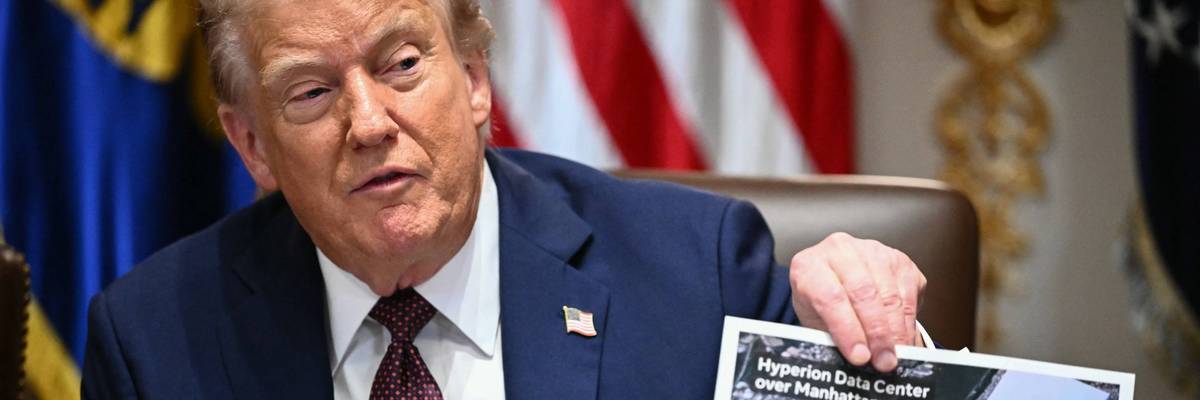
US President Donald Trump holds an image showing the size of Meta’s new data center in Washington, DC on August 26, 2025.
"Donald Trump is actively trying to help as many Democratic senators as possible get elected," said one polling expert.
President Donald Trump on Monday warned Americans that they risk becoming "backwards and poor" unless they allow Big Tech companies to build artificial intelligence data centers in their communities.
In a social media post, the president expressed indignation that any town or city wouldn't welcome data centers, which have drawn nationwide opposition for generating pollution and jacking up utility bills.
"The only reason that communities throughout the USA should not want Data Centers is if they want to end up being backwards and poor," Trump wrote. "If they want to be successful and rich, with far lower taxes and jobs all over the place, let Data Reign."
In reality, AI data centers create very few jobs once they are completed, as most of their functions are fully automated.
Trump then said that Americans "will only have yourselves to blame" if they "kill the Golden Goose" that is AI data centers.
"China could not be happier with this anti Data Center movement," Trump wrote. "Actually, they can't believe it is happening!"
Building AI data centers has become massively unpopular throughout the US.
A poll conducted by Embold Research and published by Heatmap Pro earlier this month shows that 75% of Americans now oppose building AI data centers in their area, including 61% registering strong opposition.
While Republicans polled in the survey were more supportive of data centers than Democrats and independent voters, it nonetheless found that opposition among Republicans outweighed support by 43 points.
Polling analyst G. Elliott Morris marveled at how politically tone deaf the president sounds when it comes to data centers, commenting that "Donald Trump is actively trying to help as many Democratic senators as possible get elected."
Longtime GOP operative Frank Luntz similarly noted data centers' unpopularity, citing a recent Gallup poll showing 63% of Republican voters oppose having one of the facilities built in their communities.
"We’re about to see whether President Trump can sway those voters to support them, as he’s done on many issues before," Luntz remarked.
Democratic US Senate hopeful Abdul El-Sayed wasted no time tying the president's position on data centers to his opponent, Republican Mike Rogers.
"Make no mistake—this is Mike Rogers' position on data centers," wrote El-Sayed. "He's got up to $2.6 million invested in companies cashing in on the data center boom, all while Michiganders watch their utility bills soar. You can't trust a word out of Mike's mouth because he's only out for himself, for Donald Trump, and for Big Tech—not Michigan."
Faiz Shakir, a longtime adviser to US Sen. Bernie Sanders (I-Vt.), observed that Trump is merely "sharing the perspective of Wall Street and Big Tech" and is showing "no interest... in grappling with the mass revolt across American communities, or to learn anything from them."
Screenwriter David Simon, creator of the acclaimed television series The Wire, accused Trump of brazenly lying about data centers' economic benefits.
"If data centers are a geographic benefit to communities, you can be sure they'd be siting and building them in affluent and politically connected environs," wrote Simon. "Curiously, they're dumped in poorer, less influential places. Go fucking figure."
Republican Kentucky state Rep. Savannah Maddox took issue with the president disparaging communities opposed to data centers, which include many of the rural communities that voted for him in three presidential elections.
"Rural doesn’t mean 'backwards and poor' and development doesn’t always equate to being 'successful and rich,'" wrote Maddox. "President Trump wouldn't be president without the rural voters who inhabit America’s heartland. It is not wrong of us to question the sudden and wide-scale effort to convert arable land into data centers. We are not stupid for wanting to protect our rural way of life."
This country and this world are at a monumental crossroads. US voters have an opportunity to beat back the forces of fascism and confront the billionaires who are rigging the economy, our media system, and our democracy, making it increasingly impossible for ordinary people to get by. We’re not just talking about the election. We’re talking about what must be done once these fascist elements are vanquished from power. We need a bolder set of solutions than what either major party has so far been willing to offer and a working-class movement ready to fight like hell for it. Trump didn't emerge from nowhere. The conditions that fueled MAGA authoritarianism were created by decades of radical neoliberal economic policies and a corrupt political system dominated by corporate interests. They slashed taxes on the super-rich, promising that the benefits would trickle down. They said giveaways to the corporate titans would make life more affordable for the rest of us. It was all bullshit. And when a bitter, betrayed populace searches for someone to blame, right-wing demagogues have little trouble finding scapegoats. People know when they're being lied to, but you won't hear any of this from the corporate media. Only independent journalism—powered and funded by people who believe in building a better world—can deliver truly trustworthy daily news. If you share our vision, please contribute whatever you can to sustain our work. |
President Donald Trump on Monday warned Americans that they risk becoming "backwards and poor" unless they allow Big Tech companies to build artificial intelligence data centers in their communities.
In a social media post, the president expressed indignation that any town or city wouldn't welcome data centers, which have drawn nationwide opposition for generating pollution and jacking up utility bills.
"The only reason that communities throughout the USA should not want Data Centers is if they want to end up being backwards and poor," Trump wrote. "If they want to be successful and rich, with far lower taxes and jobs all over the place, let Data Reign."
In reality, AI data centers create very few jobs once they are completed, as most of their functions are fully automated.
Trump then said that Americans "will only have yourselves to blame" if they "kill the Golden Goose" that is AI data centers.
"China could not be happier with this anti Data Center movement," Trump wrote. "Actually, they can't believe it is happening!"
Building AI data centers has become massively unpopular throughout the US.
A poll conducted by Embold Research and published by Heatmap Pro earlier this month shows that 75% of Americans now oppose building AI data centers in their area, including 61% registering strong opposition.
While Republicans polled in the survey were more supportive of data centers than Democrats and independent voters, it nonetheless found that opposition among Republicans outweighed support by 43 points.
Polling analyst G. Elliott Morris marveled at how politically tone deaf the president sounds when it comes to data centers, commenting that "Donald Trump is actively trying to help as many Democratic senators as possible get elected."
Longtime GOP operative Frank Luntz similarly noted data centers' unpopularity, citing a recent Gallup poll showing 63% of Republican voters oppose having one of the facilities built in their communities.
"We’re about to see whether President Trump can sway those voters to support them, as he’s done on many issues before," Luntz remarked.
Democratic US Senate hopeful Abdul El-Sayed wasted no time tying the president's position on data centers to his opponent, Republican Mike Rogers.
"Make no mistake—this is Mike Rogers' position on data centers," wrote El-Sayed. "He's got up to $2.6 million invested in companies cashing in on the data center boom, all while Michiganders watch their utility bills soar. You can't trust a word out of Mike's mouth because he's only out for himself, for Donald Trump, and for Big Tech—not Michigan."
Faiz Shakir, a longtime adviser to US Sen. Bernie Sanders (I-Vt.), observed that Trump is merely "sharing the perspective of Wall Street and Big Tech" and is showing "no interest... in grappling with the mass revolt across American communities, or to learn anything from them."
Screenwriter David Simon, creator of the acclaimed television series The Wire, accused Trump of brazenly lying about data centers' economic benefits.
"If data centers are a geographic benefit to communities, you can be sure they'd be siting and building them in affluent and politically connected environs," wrote Simon. "Curiously, they're dumped in poorer, less influential places. Go fucking figure."
Republican Kentucky state Rep. Savannah Maddox took issue with the president disparaging communities opposed to data centers, which include many of the rural communities that voted for him in three presidential elections.
"Rural doesn’t mean 'backwards and poor' and development doesn’t always equate to being 'successful and rich,'" wrote Maddox. "President Trump wouldn't be president without the rural voters who inhabit America’s heartland. It is not wrong of us to question the sudden and wide-scale effort to convert arable land into data centers. We are not stupid for wanting to protect our rural way of life."

