SUBSCRIBE TO OUR FREE NEWSLETTER
Daily news & progressive opinion—funded by the people, not the corporations—delivered straight to your inbox.
5
#000000
#FFFFFF
To donate by check, phone, or other method, see our More Ways to Give page.
Daily news & progressive opinion—funded by the people, not the corporations—delivered straight to your inbox.
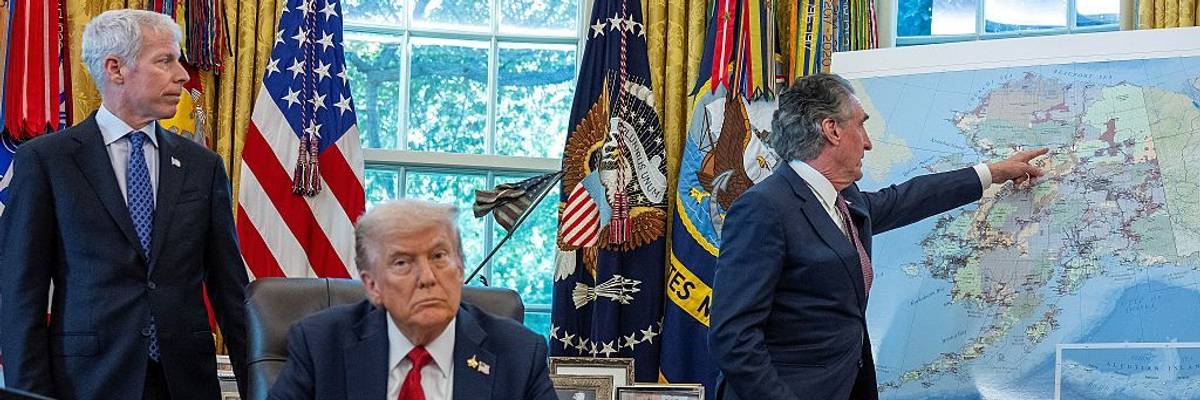
US President Donald Trump listens as Interior Secretary Doug Burgum points at a map of Alaska during an event in the Oval Office on October 6, 2025.
"We should be banning drilling in the Arctic Ocean, not making it easier for industry to exploit and pollute."
The Trump administration on Monday proposed weakening Obama-era safeguards for fossil fuel drilling in the Arctic Outer Continental Shelf, a move condemned by environmental groups as another industry handout that would make disastrous oil spills more likely.
The US Interior Department characterized the proposed changes, which will face a 90-day public comment period, as "targeted revisions" aimed at reducing "unnecessary regulatory burdens" that are limiting resource extraction off Alaska's coast. The new proposal, according to the agency, "would update requirements related to blowout preventer real-time monitoring, Arctic source control and containment equipment, relief rig capability, subsea isolation devices, mudline cellars, oil spill response plan-holder reviews, crane operations on artificial islands, and suspensions of operations and production."
The Trump administration unveiled the proposal as it pushed for a massive expansion of offshore drilling, even as the climate impacts of fossil fuel extraction continued to intensify across the US and worldwide. Joseph Gordon, campaign manager at Oceana, called the combination of expanded drilling and weakened safety standards "a recipe for catastrophe."
"This attempted rollback would make it even harder to prevent oil spills or tackle the horrors that inevitably follow in the remote and fragile Arctic," said Gordon. "Giving oil companies a pass on safety measures like blowout preventers would set a dangerous precedent that will put Alaska's waters, wildlife, and people at risk."
Cooper Freeman, Alaska director at the Center for Biological Diversity, said that "weakening rules for Arctic Ocean drilling is a truly terrible idea that threatens coastal communities and wildlife like bowhead whales and polar bears."
"Arctic oil drilling is one of the most dangerous extractive activities out there, and cleaning up a spill would be nearly impossible," Freeman added. "Stronger safeguards for Arctic offshore drilling came on the heels of the Deepwater Horizon blowout, where we learned that just one mishap can cause a catastrophe."
President Donald Trump, whose 2024 campaign was boosted by fossil fuel industry donations, began targeting Alaska drilling regulations on the first day of his second White House term, signing an executive order attacking "punitive restrictions implemented by the previous administration that specifically target resource development on both state and federal lands in Alaska."
In November, the Interior Department—led by Big Oil ally Doug Burgum—released a drilling plan targeting "every available offshore area in Alaska, including the High Arctic, which stretches 200 miles into the Arctic Ocean, with over 20 lease sales through 2031."
"We should be banning drilling in the Arctic Ocean, not making it easier for industry to exploit and pollute," Freeman said Monday.
Dear Common Dreams reader, It’s been nearly 30 years since I co-founded Common Dreams with my late wife, Lina Newhouser. We had the radical notion that journalism should serve the public good, not corporate profits. It was clear to us from the outset what it would take to build such a project. No paid advertisements. No corporate sponsors. No millionaire publisher telling us what to think or do. Many people said we wouldn't last a year, but we proved those doubters wrong. Together with a tremendous team of journalists and dedicated staff, we built an independent media outlet free from the constraints of profits and corporate control. Our mission has always been simple: To inform. To inspire. To ignite change for the common good. Building Common Dreams was not easy. Our survival was never guaranteed. When you take on the most powerful forces—Wall Street greed, fossil fuel industry destruction, Big Tech lobbyists, and uber-rich oligarchs who have spent billions upon billions rigging the economy and democracy in their favor—the only bulwark you have is supporters who believe in your work. But here’s the urgent message from me today. It's never been this bad out there. And it's never been this hard to keep us going. At the very moment Common Dreams is most needed, the threats we face are intensifying. We need your support now more than ever. We don't accept corporate advertising and never will. We don't have a paywall because we don't think people should be blocked from critical news based on their ability to pay. Everything we do is funded by the donations of readers like you. When everyone does the little they can afford, we are strong. But if that support retreats or dries up, so do we. Will you donate now to make sure Common Dreams not only survives but thrives? —Craig Brown, Co-founder |
The Trump administration on Monday proposed weakening Obama-era safeguards for fossil fuel drilling in the Arctic Outer Continental Shelf, a move condemned by environmental groups as another industry handout that would make disastrous oil spills more likely.
The US Interior Department characterized the proposed changes, which will face a 90-day public comment period, as "targeted revisions" aimed at reducing "unnecessary regulatory burdens" that are limiting resource extraction off Alaska's coast. The new proposal, according to the agency, "would update requirements related to blowout preventer real-time monitoring, Arctic source control and containment equipment, relief rig capability, subsea isolation devices, mudline cellars, oil spill response plan-holder reviews, crane operations on artificial islands, and suspensions of operations and production."
The Trump administration unveiled the proposal as it pushed for a massive expansion of offshore drilling, even as the climate impacts of fossil fuel extraction continued to intensify across the US and worldwide. Joseph Gordon, campaign manager at Oceana, called the combination of expanded drilling and weakened safety standards "a recipe for catastrophe."
"This attempted rollback would make it even harder to prevent oil spills or tackle the horrors that inevitably follow in the remote and fragile Arctic," said Gordon. "Giving oil companies a pass on safety measures like blowout preventers would set a dangerous precedent that will put Alaska's waters, wildlife, and people at risk."
Cooper Freeman, Alaska director at the Center for Biological Diversity, said that "weakening rules for Arctic Ocean drilling is a truly terrible idea that threatens coastal communities and wildlife like bowhead whales and polar bears."
"Arctic oil drilling is one of the most dangerous extractive activities out there, and cleaning up a spill would be nearly impossible," Freeman added. "Stronger safeguards for Arctic offshore drilling came on the heels of the Deepwater Horizon blowout, where we learned that just one mishap can cause a catastrophe."
President Donald Trump, whose 2024 campaign was boosted by fossil fuel industry donations, began targeting Alaska drilling regulations on the first day of his second White House term, signing an executive order attacking "punitive restrictions implemented by the previous administration that specifically target resource development on both state and federal lands in Alaska."
In November, the Interior Department—led by Big Oil ally Doug Burgum—released a drilling plan targeting "every available offshore area in Alaska, including the High Arctic, which stretches 200 miles into the Arctic Ocean, with over 20 lease sales through 2031."
"We should be banning drilling in the Arctic Ocean, not making it easier for industry to exploit and pollute," Freeman said Monday.
The Trump administration on Monday proposed weakening Obama-era safeguards for fossil fuel drilling in the Arctic Outer Continental Shelf, a move condemned by environmental groups as another industry handout that would make disastrous oil spills more likely.
The US Interior Department characterized the proposed changes, which will face a 90-day public comment period, as "targeted revisions" aimed at reducing "unnecessary regulatory burdens" that are limiting resource extraction off Alaska's coast. The new proposal, according to the agency, "would update requirements related to blowout preventer real-time monitoring, Arctic source control and containment equipment, relief rig capability, subsea isolation devices, mudline cellars, oil spill response plan-holder reviews, crane operations on artificial islands, and suspensions of operations and production."
The Trump administration unveiled the proposal as it pushed for a massive expansion of offshore drilling, even as the climate impacts of fossil fuel extraction continued to intensify across the US and worldwide. Joseph Gordon, campaign manager at Oceana, called the combination of expanded drilling and weakened safety standards "a recipe for catastrophe."
"This attempted rollback would make it even harder to prevent oil spills or tackle the horrors that inevitably follow in the remote and fragile Arctic," said Gordon. "Giving oil companies a pass on safety measures like blowout preventers would set a dangerous precedent that will put Alaska's waters, wildlife, and people at risk."
Cooper Freeman, Alaska director at the Center for Biological Diversity, said that "weakening rules for Arctic Ocean drilling is a truly terrible idea that threatens coastal communities and wildlife like bowhead whales and polar bears."
"Arctic oil drilling is one of the most dangerous extractive activities out there, and cleaning up a spill would be nearly impossible," Freeman added. "Stronger safeguards for Arctic offshore drilling came on the heels of the Deepwater Horizon blowout, where we learned that just one mishap can cause a catastrophe."
President Donald Trump, whose 2024 campaign was boosted by fossil fuel industry donations, began targeting Alaska drilling regulations on the first day of his second White House term, signing an executive order attacking "punitive restrictions implemented by the previous administration that specifically target resource development on both state and federal lands in Alaska."
In November, the Interior Department—led by Big Oil ally Doug Burgum—released a drilling plan targeting "every available offshore area in Alaska, including the High Arctic, which stretches 200 miles into the Arctic Ocean, with over 20 lease sales through 2031."
"We should be banning drilling in the Arctic Ocean, not making it easier for industry to exploit and pollute," Freeman said Monday.