

SUBSCRIBE TO OUR FREE NEWSLETTER
Daily news & progressive opinion—funded by the people, not the corporations—delivered straight to your inbox.
5
#000000
#FFFFFF
To donate by check, phone, or other method, see our More Ways to Give page.
Daily news & progressive opinion—funded by the people, not the corporations—delivered straight to your inbox.
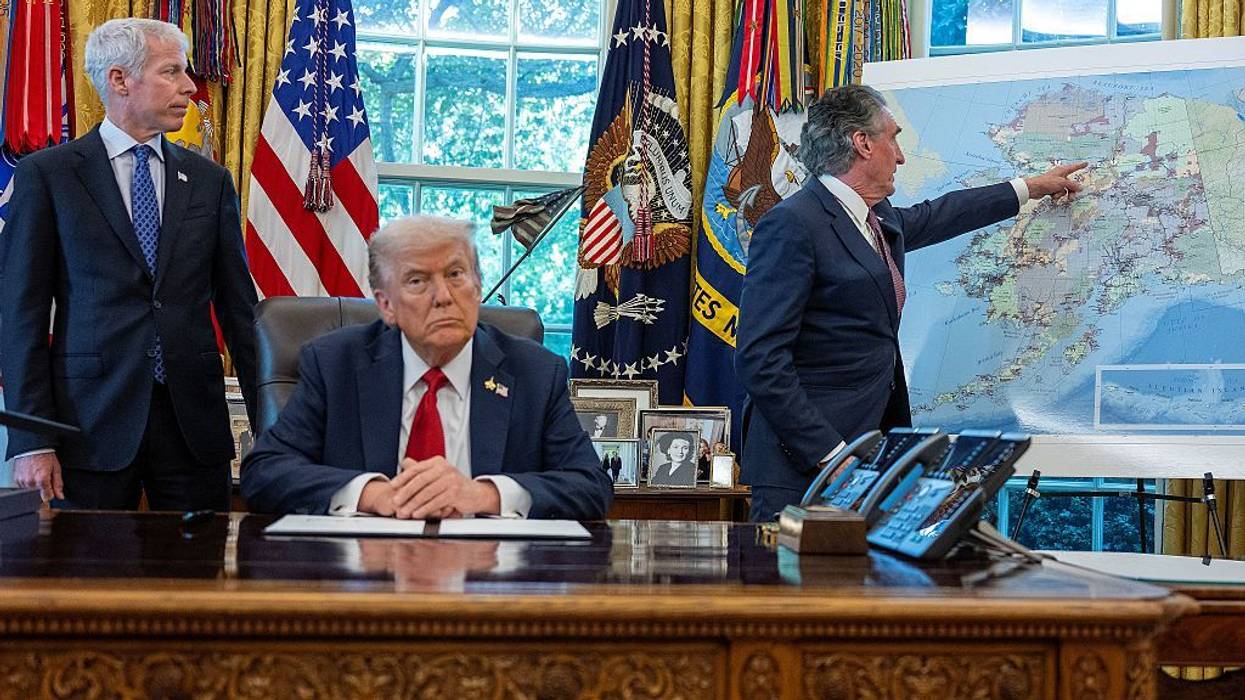
"We should be banning drilling in the Arctic Ocean, not making it easier for industry to exploit and pollute."
The Trump administration on Monday proposed weakening Obama-era safeguards for fossil fuel drilling in the Arctic Outer Continental Shelf, a move condemned by environmental groups as another industry handout that would make disastrous oil spills more likely.
The US Interior Department characterized the proposed changes, which will face a 90-day public comment period, as "targeted revisions" aimed at reducing "unnecessary regulatory burdens" that are limiting resource extraction off Alaska's coast. The new proposal, according to the agency, "would update requirements related to blowout preventer real-time monitoring, Arctic source control and containment equipment, relief rig capability, subsea isolation devices, mudline cellars, oil spill response plan-holder reviews, crane operations on artificial islands, and suspensions of operations and production."
The Trump administration unveiled the proposal as it pushed for a massive expansion of offshore drilling, even as the climate impacts of fossil fuel extraction continued to intensify across the US and worldwide. Joseph Gordon, campaign manager at Oceana, called the combination of expanded drilling and weakened safety standards "a recipe for catastrophe."
"This attempted rollback would make it even harder to prevent oil spills or tackle the horrors that inevitably follow in the remote and fragile Arctic," said Gordon. "Giving oil companies a pass on safety measures like blowout preventers would set a dangerous precedent that will put Alaska's waters, wildlife, and people at risk."
Cooper Freeman, Alaska director at the Center for Biological Diversity, said that "weakening rules for Arctic Ocean drilling is a truly terrible idea that threatens coastal communities and wildlife like bowhead whales and polar bears."
"Arctic oil drilling is one of the most dangerous extractive activities out there, and cleaning up a spill would be nearly impossible," Freeman added. "Stronger safeguards for Arctic offshore drilling came on the heels of the Deepwater Horizon blowout, where we learned that just one mishap can cause a catastrophe."
President Donald Trump, whose 2024 campaign was boosted by fossil fuel industry donations, began targeting Alaska drilling regulations on the first day of his second White House term, signing an executive order attacking "punitive restrictions implemented by the previous administration that specifically target resource development on both state and federal lands in Alaska."
In November, the Interior Department—led by Big Oil ally Doug Burgum—released a drilling plan targeting "every available offshore area in Alaska, including the High Arctic, which stretches 200 miles into the Arctic Ocean, with over 20 lease sales through 2031."
"We should be banning drilling in the Arctic Ocean, not making it easier for industry to exploit and pollute," Freeman said Monday.
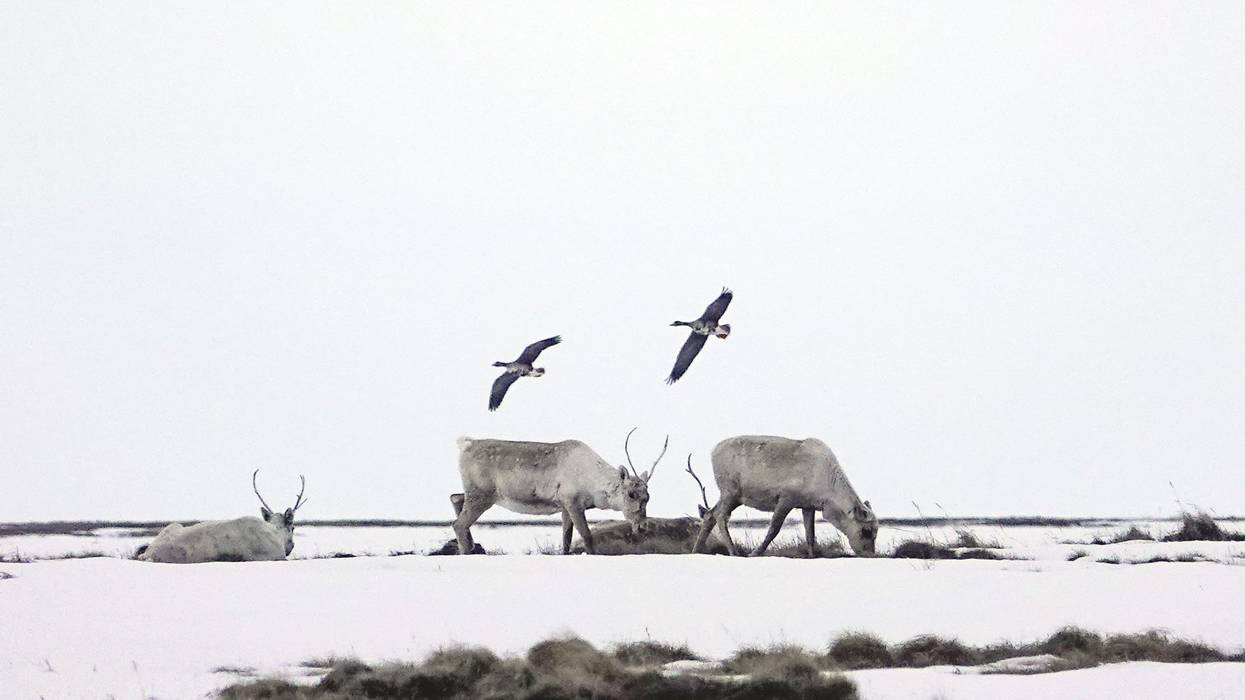
"This vote will authorize the fossil fuel industry's continued destruction of habitat and landscapes that are critical for wildlife to survive."
The Republican-controlled US Senate voted Thursday to scrap a Biden-era policy that protected millions of acres in the Alaskan Arctic from fossil fuel drilling, even as the government shutdown continued with no end in sight.
The final vote on the resolution, led by Sen. Dan Sullivan (R-Alaska), was 52-45, almost entirely along party lines. Sen. John Fetterman (D-Pa.) was the only Democrat to join Republicans in voting for the measure, which aims to use the Congressional Review Act to revoke a 2022 Biden administration decision protecting swaths of the Western Arctic.
The resolution still must pass the House, which is also controlled by Republicans.
Athan Manuel, director of the Sierra Club's Lands Protection Program, said the vote shows that President Donald Trump and his Republican allies are "exploiting" the prolonged shutdown to "hand over our public lands and wild places to corporate polluters."
"Donald Trump's government shutdown has dragged on for nearly five weeks, and what is the top priority for Congressional Republicans? Opening up the western Arctic to oil and gas drilling, not funding services or making sure our military is paid?" said Manuel. "It's shameful."
Robert Dewey, vice president of government relations at Defenders of Wildlife, warned that "this vote will authorize the fossil fuel industry's continued destruction of habitat and landscapes that are critical for wildlife to survive."
The Senate vote comes days after Trump's Interior Department, led by billionaire drilling enthusiast Doug Burgum, wrenched open all 1.56 million acres of the Coastal Plain of the Arctic National Wildlife Refuge to oil and gas leasing.
Trump campaigned on a pledge to accelerate climate-destroying fossil fuel drilling and openly promised oil and gas executives that he would move swiftly to gut regulations in exchange for their financial support in the election.
One estimate released in the wake of the election found that oil and gas interests spent nearly $450 million to boost Trump and Republican candidates and bolster their legislative priorities on Capitol Hill.
Andy Moderow, senior director of policy at the Alaska Wilderness League, said in a statement that Thursday's vote "is yet another reminder that the Trump administration and its allies in Congress are prioritizing profits for oil executives and billionaires over the basic needs of hardworking Americans."

With Trump’s return to the Oval Office, fossil fuel giants will get another chance to turn this pristine wilderness into the country’s largest gas station.
I’ve guided trips to Alaska’s North Slope and Brooks Range Mountains for 31 years, and I always start out with the same speech: “You are headed to some real wild country.” Alaska’s Arctic is home to some of our most iconic landscapes. This is probably the wildest place left in the United States and some of the most remote country in North America. What you see there—and what you won’t see–are things you’ll never forget.
I had guided rafting trips for a number of years across the western U.S., but I was unprepared for the sheer scale of this country. At all points of the compass, nothing but tundra for days and a river filled with exotically beautiful aufeis–layer upon frozen layer of ice. I’ve seen caribou, wolves, bears–a muskox nearly trampled my tent. I’ve had the good fortune to return to this landscape every year and it still is as wild and free from development as ever–for now. But with the return of Donald Trump to the White House, that could soon change.
To stem the tide of species loss and to give our environment a fighting chance, we need to protect more lands and waters by the end of the decade than we did in the last century.
The Arctic as we currently know it is thanks to Jimmy Carter, who passed away last week at the age of 100. Carter signed the Alaska National Interest Lands Conservation Act created 16 wildlife refuges, 13 national parks, two national monuments, two national forests, two conservation areas, and 26 wild and scenic rivers, and designated 57 million acres of wilderness. Ironically, Carter’s funeral will happen the same day the Biden administration holds its final lease sale in the Arctic Refuge—the smallest version they could legally offer. It’s a fitting move from an administration that, unlike Carter, had a complicated approach to the Arctic.
The Western Arctic was the setting for one of President Biden’s worst climate decisions—the March 2023 approval of the Willow project. Instead of preserving these landscapes from extraction, the president seemed to extend a new and dark era for the Arctic that began with Trump’s approval of oil drilling in the Arctic Refuge in 2017.
But a lot can change in a few months, and the Biden administration seemingly shifted strategies in the Western Arctic from extraction to preservation. Beginning last summer, the White House advanced a slate of new protections to safeguard millions of acres of public lands from oil and gas drilling. This summer was my 31st leading people into the Brooks Range mountains and the tundra beyond to the north in those little planes, and as we flew over wild Alaskan landscapes, we saw no signs of human development—in part due to Biden’s actions. But oil and gas companies will soon have a new ally to turn to.
With Trump’s return to the Oval Office, those same companies will get another chance to turn this pristine wilderness into the country’s largest gas station. On the campaign trail, Trump made it clear he would “drill, baby, drill” and give those Big Oil CEOs free rein to drill wherever and whenever they could. Opening up the Arctic Refuge to drilling was one of the first actions the Republican trifecta took in 2017, and extending that law is one of their top priorities this time around. For Arctic communities, wildlife, and ecosystems, it’s the biggest threat in a generation.
We’re currently witnessing an extinction crisis driven by habitat destruction, and the key driver of habitat destruction is development. At the same time, the effects of the climate crisis are being exacerbated by development that destabilizes ecosystems and natural carbon absorption. To stem the tide of species loss and to give our environment a fighting chance, we need to protect more lands and waters by the end of the decade than we did in the last century. The Arctic survived four years of Trump, but it’s up to us to ensure it survives another four.

Last week, Bank of America engaged in perhaps the single most irresponsible about-face of the climate era.
Bank of America has its roots in California. Founded in Los Angeles in 1923, it was acquired by a San Francisco bank, which took the name in 1930—and over time it has grown to become the world’s second-largest bank by deposits, second only to New York-based Chase.
I tell you this for two reasons. One, California is, as of this writing, being absolutely battered by an “atmospheric river” that has knocked out power to hundreds of thousands and caused mudslides on high ground along the Pacific Coast. As Andrew Dessler pointed out yesterday, the physics are pretty simple: “A warmer planet has more water vapor in the atmosphere. And, everything else being the same, an atmospheric river carrying more water vapor will cause more rainfall when it hits land and starts rising.”
And second, Bank of America is a proximate cause of this kind of chaos, because it refuses to stop lending for fossil fuel expansion. Indeed, last week it engaged in perhaps the single most irresponsible about-face of the climate era.
They’re far more afraid of some oil-soaked GOP state treasurer than they are of an atmospheric river bearing down on the world’s fifth largest economy.
Three years ago—in the wake of the Greta-inspired mass uprising of young people around the world—Bank of America apparently felt it had to make some gesture, so it chose a pretty easy route to demonstrate its newfound greenness. It said it would no longer lend for new coal mining or coal-fired power plants or for new oil exploration in the Arctic. These were seen to be beyond the pale because… well, they are. They represent some of the most egregious possible insults to this planet.
But last week they said, never mind. If you want some money for a new coal mine, our window is open again. If you’re an oil company that feels like searching for oil in the Arctic now that you’ve melted it, we can make a deal. As the Times reported last week
Bank of America’s change follows intensifying backlash from Republican lawmakers against corporations that consider environmental and social factors in their operations. Wall Street in particular has come under fire for what some Republicans have called “woke capitalism,” a campaign that has pulled banks into the wider culture wars.
That is to say, they’re far more afraid of some oil-soaked GOP state treasurer than they are of an atmospheric river bearing down on the world’s fifth largest economy. It’s proof, of course, that their words about climate change were just pious nonsense. They’d insisted that they understood how crucial it was to change: “Climate change is no longer a far off risk but rather a global concern with impacts that are already beginning to unfold, including increased frequency and severity of extreme weather conditions, melting glaciers, loss of sea ice, accelerated sea-level rise, and longer, more intense heatwaves and droughts.” But that was, we now understand, to be understood entirely as greenwashing, an effort to reduce the heat they were temporarily feeling.
The actual heat they could care less about. It’s not like something has happened since 2021—except the hottest year in the last 125,000, which takes us back even before the advent of money, if BofA executives can even imagine such a time.
But the only weather change they’ve noticed is political. Out with Greta et al., in with GOP politicians saying scary things. And BofA is not alone. The Bureau of Investigative Journalism reported last week that global giant HSBC, despite a solemn promise that it would stop financing new oil and gas fields, has found ways to keep
selling shares in the refining business of Saudi Aramco, one of the most aggressive expanders of oil and gas. An investor in HSBC told the Bureau of Investigative Journalism that the bank’s policy has been cleverly worded to allow it to fund some of the world’s biggest polluters while boasting about its green credentials.
An analysis of Refinitiv data by TBIJ has found that in the year since HSBC’s new policy was announced, the bank has helped raise more than $47 billion (£37 billion) for companies that are expanding the production of oil and gas, despite dire warnings from scientists that this will push the world beyond its survivable limits.
This is all just sick. The International Energy Agency said in 2021 that if we had a chance of meeting the Paris temperature targets, finance for fossil fuel expansion had to end now. But the banks, and big asset managers like BlackRock, just can’t help themselves. For short-term gain, and to protect themselves from attack by right-wing politicians, they are willing to break the back of the planet’s climate system. The unbelievable economic fallout of those decisions—the fact that the world be immensely poorer, with its prospects hugely degraded, by the resulting rise in temperature—will be the problem of some other CEO down the road; it’s hard not to see our financial system as a suicide machine.
Fighting back is hard. At places like Third Act, we’ve done loads of sit-ins and pickets, and it helps—that’s the kind of action that forced these pledges in the first place. But we need some big players on our side. We’re trying, for instance, to convince Costco to pressure its banker Citi; we need the big tech companies, too, to worry not just about about the climate impact of their phones but also about the climate impact of their money (which is far far larger).
We have some champions, of course, but they’re not as hard-hitting as their Red State counterparts. Brad Lander, comptroller of New York City, gets credit for being willing to take the banks on—last week he announced that he’d try to get them to disclose their ratio of dirty energy to clean energy lending, which would certainly be good to know.
“Despite all their talk, the big banks have made little progress in the energy finance transition over the past couple of years,” said Comptroller Lander. “As long-term investors exposed to climate risk, we can’t just take their word for it. Reporting transparently on their ratios of clean energy to fossil fuel finance is key to seeing whether or not they are living up to their net-zero commitments. Right now, they aren’t—and that must change. Our planet, our economy, and our investment portfolios are all at stake.”
All of that is true. But if the planet is at stake, then perhaps a somewhat harder shove might be required. Lander’s plan seems like a way to win slowly, which on most political issues makes sense. But unless he also has a plan to refreeze a melted Arctic, this kind of pressure seems a tad too gentlemanly.
As you can tell, this about face by BofA stings. It takes so much work to move these guys an inch, and then given half a chance they slide right back to where they were before.
Small banks seem able to make money doing decent things—here’s a nice story about a merger of local California banks where they pledged, among other things, to “refrain from any new financing of fossil fuel extraction activities, especially expansion projects that would develop and lock in dependence on new fossil fuel infrastructure, either through corporate or project-based finance, subject to compliance with banking rules and regulations.”
But the big boys? Damn them to hell, which is clearly where they’re content to send all of us.
The Obama administration announced late Friday that it was canceling new lease sales for drilling in the Arctic's Beaufort and Chukchi Seas. Environmentalists hail this decision as a step toward keeping unburnable oil "in the ground."
Interior Secretary Sally Jewell declared that two offshore lease sales scheduled for 2016 and 2017 would be canceled, citing "current market conditions" and "low industry interest" and Shell's recent decision to scrap its Arctic drilling plans.
However, campaigners said the move was likely the result of the fierce opposition campaign and the growing awareness that if the White House intends to reduce our greenhouse gas emissions, the country must cease new oil exploration and, instead, invest in more renewable energy alternatives.
"Scientists have long been clear that fully 100% of Arctic oil is unburnable if we're serious about averting the worst impacts of climate change. That's why the climate movement stepped up and forced even the most irresponsible company on Earth to admit that it wouldn't make sense to drill in the Arctic," said 350.org executive director May Boeve. "Now, the Obama administration is heeding the call as well--and slowly shifting action to match its rhetoric on climate change."
Boeve said that the Keystone XL pipeline company, TransCanada, and the rest of Big Oil should "take this as a very bad sign for their future."
The Interior Department also noted that the Bureau of Safety and Environmental Enforcement (BSEE) also denied requests from Shell and Statoil for extensions on their drilling leases, meaning the current lease for drilling in the Beaufort Sea will expire in 2017 and 2020 for the Chukchi Sea.
Miyoko Sakashita with the Center for Biological Diversity hailed the move as a "huge win for Arctic wildlife and our climate."
"Americans have spoken repeatedly about the perils of Arctic drilling," Sakashita said. "It's gratifying to see these leases finally canceled, and now it's time to declare the Arctic off-limits to drilling forever."
Echoing the sentiments of other groups that want to see the administration follow through with strong decisions against the Keystone XL pipeline and fossil fuel leasing on public lands, Sakashita added: "It can't stop here though: It's time to take the next step and pledge to keep this oil in the ground and transition quickly to energy sources that are safer, smarter and better for all of us."
Though President Obama made headlines Sunday night by signing an executive order that officially renames Alaska's Mt. McKinley to Denali--the name used by Indigenous people and most Alaskan residents--his visit to the country's most northern state remains clouded for many by a contradictory stance in which he calls for strong climate action on one hand while simultaneously championing offshore Arctic drilling with the other.
In restoring Mt. McKinely's name as Denali--which at 20,320 feet is North America's tallest mountain--Obama was instating, as the Associated Press notes, a moniker Alaskans have informally used for centuries. The name means "the high one" in Athabascan.
With Obama and Secretary of State John Kerry now in Alaska for a three-day visit, the optics are challenging for the two men. They have used powerful speeches to indicate the administration's understanding of the threat posed by human-caused global warming but continue to fall short, in the eyes of experts and environmental campaigners, when it comes to taking concrete steps.
As Bill McKibben, co-founder of 350.org, expressed in an analysis on Sunday parsing the divisions between climate politics and climate physics, "the alarm [the president] is sounding is muffled by the fact that earlier this year he gave Shell Oil a permit to go drill in the Arctic, potentially opening up a giant new pool of oil."
And writing at the Washington Post on Monday, Chris Mooney points out that though Obama certainly has the power to rename a mountain, there is no executive order by itself that can stop the "loss of ice" experienced by Denali and the clear and present impacts climate change is having across Alaska's wild spaces in recent years.
Taking to social media following the news about Denali, several users on Twitter--with varying degrees of charity--pointed out that even as the restitution of the mountain's name is welcomed by the Athabascan tribes and others, the gesture should not overshadow the inherent threat of offshore drilling in Alaska's pristine coastal waters:
In recent statements, Obama has defended the drilling as economically necessary even as experts warn that a large-scale spill in the region is not only "inevitable," given the harsh conditions, but represents humanity's worst instincts when it comes to going after increasingly hard-to-reach fossil fuel deposits as a time when scientists are saying the majority of the world's untapped reserves must stay in the ground.
"There is a very obvious contradiction between meaningful action to address climate change and continued exploration for remote and difficult hydrocarbon resources," said Michael LeVine, Arctic campaigner for Oceana, ahead of Obama's arrival. "Moving forward with exploiting Arctic oil and gas is inconsistent with the Administration's stated goal and meaningful action on climate change."
And as Hannah McKinnon, a writer and campaigner for Oil Change International, wrote just as Obama and Kerry touched down in Alaska on Sunday:
The Obama Administration is planning its energy policy on the basis that its own climate policy will fail (as well as any that comes in the coming years). It is reckless, disingenuous, and downright offensive to those living the impacts of climate change everyday around the world.
Scientists are clear that we must leave at least 80% of the fossil fuels we already have access to in the ground. Exploration and expansion of resources like the Arctic that wouldn't come online for at least a decade is nothing short of climate denial.
President Obama and Secretary Kerry seem to get the urgent need to tackle climate change, at least on a rhetorical level. We have heard compelling speeches, seen noble policy efforts, and heard about the impact having children has had on the urgency felt to leave a strong climate legacy.
But until President Obama and Secretary Kerry actually work towards an end to exploration, expansion and production of oil, coal and gas that we clearly cannot afford to burn - their legacy threatens to ultimately be one of denial of what this crisis truly requires. Alaskans will undoubtedly be sharing compelling stories this week, and it is time for the President to listen, do what is right, and put an end to high risk Arctic oil exploration.
The crux of the contradiction and Obama's dilemma, according to 350.org's McKibben, is that planetary warming driven by human activity does not conform to most other policy issues lawmakers face. "Climate change is not like most of the issues politicians deal with," he wrote, "the ones where compromise makes complete sense."
When they say a picture is worth a thousand words, writers rebel (or they write 1,500 words). I mean, pictures are great, but they can't convey complicated concepts—except when they can.
Which would be the summer of 2015, on two separate occasions. Early in the summer, on the West Coast of the United States, "kayaktivists" in Seattle Harbor surrounded Shell Oil's giant Polar Pioneer drilling rig, trying to keep it from getting out of the harbor. They didn't succeed in that, of course--the Coast Guard cleared them out of the way--but they did succeed in reminding everyone of the scale of the destruction Shell has planned. Seeing those small, many kayaks against that one brute drilling platform brought home the existential nature of the struggle: it's all of us, the little guys, against the immense, concentrated wealth and power of the biggest companies on earth.

And then again last weekend in Germany, at the amazing #EndeGelande protests, when more than a thousand activists managed to elude authorities and congregate inside Europe's largest coal mine, in front of what are the world's single largest terrestrial machines. (One, the Bagger 288 is so big it even has its own song). They sat there for most of the day, and the great machines could do no work--and that means, since they move 240,000 tons of coal a day, that a lot of coal was not mined.
But activists can't stay there forever, and in the end, the picture will do the company and the German government more damage. The Star Wars-like image of people standing in front of the Jurassic digger makes the same point of the inhuman, absurd scale.
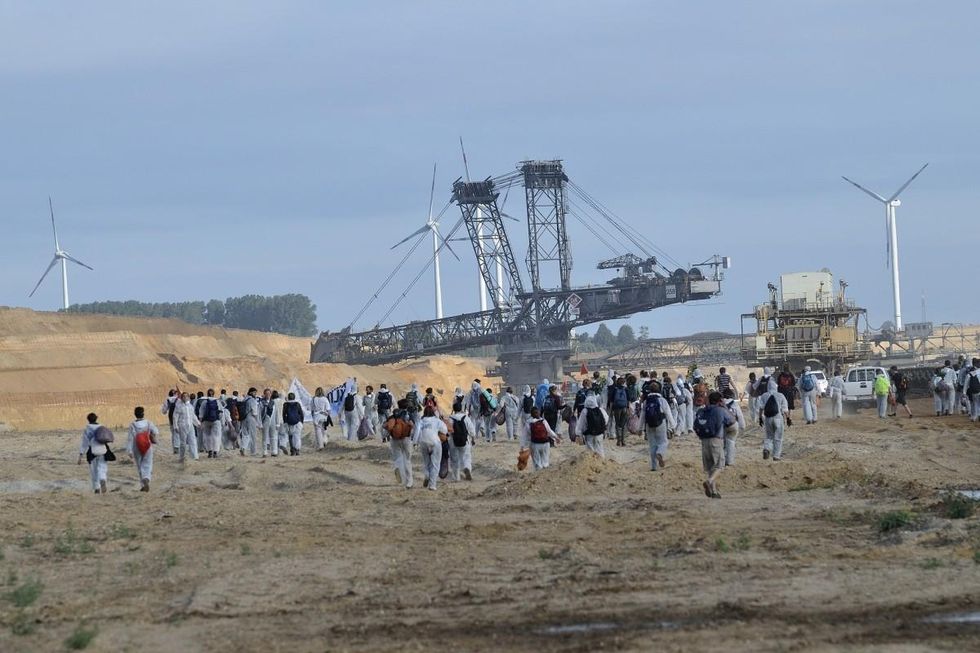
Pictures don't always turn the future, of course. The German images reminded me of the most famous picture of the Tiananmen saga...

... but sadly, the forces behind those tanks are still in control. His courage faced them down momentarily, but their implacable might won the day.
In the energy world, though, I'm willing to bet that these images poison the fossil fuel industry. It's not just because of their sheer, inhuman, oversized ugliness but because they manage to look somehow so antique. Or rather, so modern in a postmodern world. We're moving quickly to a planet where the small and distributed makes more sense than the centralized and gigantic--that's why you're likely getting your news from the net, not a TV channel. Even without understanding the science of climate change--the horror that the carbon from that digger and that drill rig is driving--, you have a visceral sense that they're in the wrong moment, the wrong mood.
The fight against Arctic oil and German coal will be long and hard. But we already know, once we've won, what the pictures in the textbooks will be.
Placing the "fate of the Arctic" in the care of Big Oil, the Obama administration granted Shell the final permit to drill deep into the waters off the Alaskan coast on Monday.
The permit, issued by the Bureau of Safety and Environmental Enforcement (BSEE), comes days after President Obama announced an upcoming Alaska visit, highlighting what he called "one of the greatest challenges we face this century: climate change."
Shell applied for the permit after the MSV Fennica icebreaker was held up due to damage. The vessel carries the "capping stack," which the BSEE requires to be easily deployed ahead of drilling in potential oil-bearing zones "in the unlikely event of a loss of well control."
"The capping stack, staged on the vessel M/V Fennica, is now in the region and capable of being deployed within 24 hours," the BSEE statement said.
In a statement, Greenpeace USA executive director Annie Leonard said the approval "means the Obama administration is leaving the fate of the Arctic up to Shell this summer. But that doesn't mean the future of the Arctic has to be in Shell's hands."
Referring to the groundswell of activism that has erupted in opposition to the Arctic drilling plan, Leonard added, "The President has seen how big the movement to save the Arctic and to keep fossil fuels in the ground has become, and it's only going to get bigger if he doesn't put a stop to this catastrophic plan."
"Alaskans are on the front lines of one of the greatest challenges we face this century: climate change," President Barack Obama said in a video posted on the White House website Thursday, announcing an upcoming trip to the state to highlight the global warming crisis. "Climate change once seemed like a problem for future generations. But for most Americans, it's already a reality."
The words are nice. However, some environmentalists have seized on the hypocrisy of Obama's rhetoric, given that he recently gave the final go-ahead for Royal Dutch Shell to drill for Arctic offshore oil in the Chukchi Sea near Alaska.
Climate activists and scientists alike have warned that Shell's spotty safety record, combined with carbon that would be unlocked through drilling and extraction, poses a severe danger to the ocean ecosystem, climate, and frontline communities.
Indeed, the prospect of drilling in the Arctic while promoting the need to protect it is "like shooting rhinos to save them," Ben Schreiber, climate and energy program director at Friends of the Earth, told the Huffington Post's Kate Sheppard.
Just yesterday, Oil Change International and Greenpeace released a report stating plainly that Arctic oil must stay in the ground to stave off "climate disaster." According to the assessment, Arctic drilling is "inconsistent" with efforts to keep global warming to less than 2 degrees Celsius. This finding echoed similar findings by other researchers.
"The bottom line is that there is no room for Arctic oil in a climate-safe world," OCI's Hannah McKinnon wrote. "By allowing Shell to drill in the U.S. offshore Arctic Ocean, the Obama Administration is ignoring the world's best scientists, as well as millions of concerned citizens in North America and beyond."
Bloomberg reported Friday that "Obama's trip has prompted concern among Alaska politicians that he may announce new executive actions on climate change while in the state."
"The president of the United States doesn't go to anybody's state and stay three days and not do something," Sen. Lisa Murkowski (R-Alaska.) reportedly said at a breakfast with Bloomberg editors and reporters in Washington earlier this month.
"So this is the talk about town. 'Oh my gosh, what's he gonna do? Is he going to lock up ANWR?''" she said, using an acronym for the Arctic National Wildlife Refuge. "'Is he going to put the Bering Sea canyons in as a marine protected sanctuary?' We don't have any idea."
But for now, the announcement merely underscores what climate activist and anti-capitalist Naomi Klein said of Obama on Democracy Now! last month: "He's doing a very good job of showing us what a climate leader sounds like," she told DN! host Amy Goodman. But I'm afraid we've got a long way to go before we see what a climate leader acts like."
When you think of the Arctic, you may picture vast glaciers, frigid waters, miles of ice, and probably the quintessential polar bear. For centuries, the Arctic has been the final frontier, the end of the earth.
But a new reality is setting in in the region - a reality of a changing climate and the scramble of Big Oil to move in where sea ice is disappearing. But this irony is just the beginning. Royal Dutch Shell is leading the charge in the Alaskan Offshore Arctic, investing billions in a high-risk bet that the world will fail to tackle climate change.
In a new report we published Thursday with Greenpeace USA, we lay bare the case for why the future of Arctic oil is inherently tied to action on climate change. The bottom line is that there is no room for Arctic oil in a climate-safe world.
Here are the key reasons why:
The fossil fuel industry wants us to believe that oil, gas, and coal will continue to dominate our energy supply for decades to come. This fatalism is far from reality, yet it is the basis for flawed policy worldwide and justifies ongoing exploration. It is time to align energy policy with climate science and start planning for the energy transition everyone knows we must make to meet our collective climate goals.
By allowing Shell to drill in the U.S. offshore Arctic Ocean, the Obama Administration is ignoring the world's best scientists and millions of concerned citizens in North America and beyond. The message is clear: the melting Arctic is a dire warning, not an invitation.
Don't miss the new report: Untouchable: The Climate Case Against Arctic Drilling.