SUBSCRIBE TO OUR FREE NEWSLETTER
Daily news & progressive opinion—funded by the people, not the corporations—delivered straight to your inbox.
5
#000000
#FFFFFF
To donate by check, phone, or other method, see our More Ways to Give page.
Daily news & progressive opinion—funded by the people, not the corporations—delivered straight to your inbox.
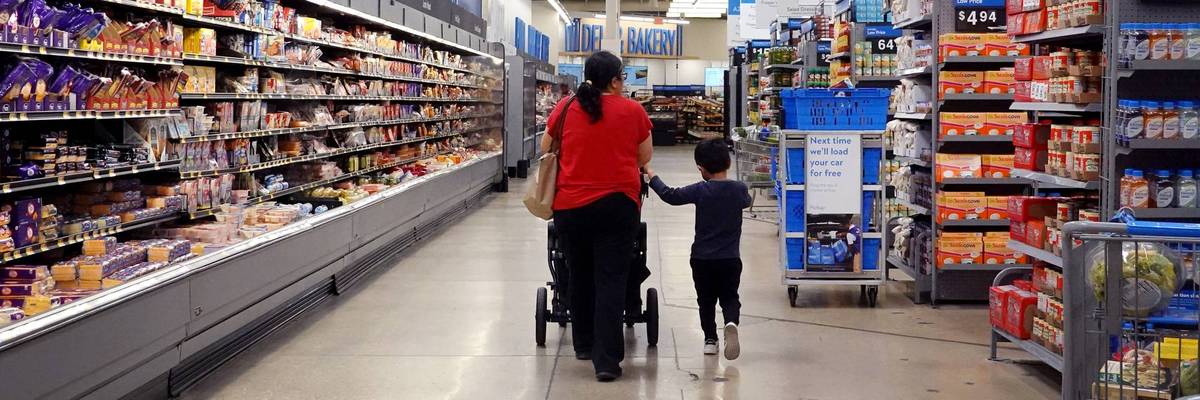
Customers shop at a Walmart store on May 18, 2023 in Chicago, Illinois.
Large companies have rolled back efforts to protect the public as the federal government has "largely abandoned chemical safety as a priority," the report notes.
This year's Retailer Report Card, released on Wednesday by the research and advocacy group Toxic-Free Future, notes that consumers today are especially reliant on the corporate accountability efforts of large companies when it comes to staying safe from toxic materials in products they buy, as the Trump administration has "largely abandoned chemical safety as a priority."
Unfortunately for millions of families who shop and eat at major stores and restaurants like Walmart, Trader Joe's, and McDonald's, the report finds that nearly half of the companies included in the analysis are backsliding in efforts to remove toxic chemicals and plastics from their products and packaging.
Twenty-two of the 45 retailers saw their scores decline by at least two percentage points, as TFF rated them on whether they have a corporate safer chemicals policy, their transparency regarding ingredients, their bans on toxic chemicals and plastics, and whether they offer products that are Safer Choice Certified by the Environmental Protection Agency (EPA).
Walmart and Whole Foods saw the greatest declines in their grades, with both plummeting by at least 20 percentage points and earning "C" grades.
Whole Foods, which is owned by Amazon, has a list of banned or restricted substances—and widely publicizes its restricted components and ingredients on its shopping bags—but did not report progress on its goal of reducing its chemical footprint by 30% by 2025, in time for the Retailer Report Card's release. It also has not supported governmental policies to eliminate or reduce chemicals or plastics of high concern.
Walmart previously led the way in calculating and reporting its chemical footprint, said TFF, "but this year, while it released data about the percentage reduction of its chemical footprint for formulated products, it offered reduced transparency about the gross amount of toxic chemicals in these products."
“After a decade of growing retailer action, this backsliding should be a wake-up call,” said Cheri Peele, a co-author of the report and director of government and market policy at TFF. "Protecting people’s health must remain a priority.”
While significant backsliding was evident at companies like Whole Foods, Walmart, and retailers that dropped by 10 or more percentage points, including Amazon, Dick's Sporting Goods, and Walgreens, Peele emphasized that "companies know how to make products safer, and this year’s leaders show that progress is possible."
Apple, IKEA, Target, and Sephora, which all received "A" or "A-" grades, were credited with adopting comprehensive safer chemicals policies that apply to their products, manufacturing, private-label, and brand-name items.
IKEA also had the distinction of being one of the most improved retailers, jumping 11 percentage points. The furniture and home goods store "has made significant progress over many years in restricting chemicals and plastics of high concern including formaldehyde, PVC [polyvinyl chloride], PFAS [per- and polyfluoroalkyl substances], BPA [bisphenol A], and expanded polystyrene in a number of products."
In 2025, the company also introduced a total ban on PFAS—which are also called "forever chemicals" and have been linked to multiple cancers, reproductive harms, and other health problems—in all of its large materials. The policy came a year before President Donald Trump's EPA proposed rolling back limits on PFAS in drinking water.
Dollar Tree was the most improved store, increasing its score by 16 points after strengthening its reporting requirements, expanding its restricted substance list, and requiring private-label suppliers to use safer alternatives to restricted chemicals.
“Families shouldn’t have to choose between what they can afford and their health,” said José Bravo, national coordinator of the Campaign for Healthier Solutions. “It’s encouraging to see Dollar Tree restrict more harmful chemicals and require more transparency and accountability from suppliers at a time when other retailers are backsliding. Dollar stores tend to operate in communities that are overburdened by pollution and other stressors on health. Even small improvements to dollar store chemical policies make a real difference.”
The report's "Hall of Shame," including 16 retailers that earned failing grades, was rife with companies that have failed to "take any steps toward reducing toxic chemicals." Ahold Delhaize—which owns major grocery chains including Hannaford, Food Lion, and Stop & Shop—Publix, Alberstons, and Trader Joe's were among the stores in the Hall of Shame.
While 22 retailers (44%) reported progress by phasing out PFAS in food packaging and textiles, bisphenols in receipt paper, and/or PVC in packaging, this was "a considerable reduction from 34 retailers (68%) reporting similar progress in 2024."
The report also found "insufficient" progress in ingredient transparency, with 21 companies (42%) failing to ask their suppliers for the chemical content of their products.
"This is an improvement from 2024, when 54% did not ask suppliers for chemical content," reads the report, while adding: "Retailers can’t manage chemicals they do not know are in their products."
The report notes that governmental policies have been shown to improve retailers' safety protocols.
"Before Washington state’s ban on toxic bisphenols in receipts took effect in January 2026, several retailers including Best Buy, Costco, CVS Health, REI, Target, TJX, Walgreens, Whole Foods Market, and others had already begun eliminating toxic bisphenols from receipts nationwide, demonstrating that safer alternatives were possible," reads the report. "Washington state’s ban was followed by California passing a similar law in September 2026, showing how retailer action and strong state policies can build on each other to drive safer practices across the marketplace."
Sarah Doll, national director of the environmental health alliance Safer States, said that "strong state policies that put health first, together with retailer action, help drive safer products across the marketplace."
“Families deserve the same protections wherever they shop," said Doll. "Retailers should build on this progress, not move backward.”
This country and this world are at a monumental crossroads. US voters have an opportunity to beat back the forces of fascism and confront the billionaires who are rigging the economy, our media system, and our democracy, making it increasingly impossible for ordinary people to get by. We’re not just talking about the election. We’re talking about what must be done once these fascist elements are vanquished from power. We need a bolder set of solutions than what either major party has so far been willing to offer and a working-class movement ready to fight like hell for it. Trump didn't emerge from nowhere. The conditions that fueled MAGA authoritarianism were created by decades of radical neoliberal economic policies and a corrupt political system dominated by corporate interests. They slashed taxes on the super-rich, promising that the benefits would trickle down. They said giveaways to the corporate titans would make life more affordable for the rest of us. It was all bullshit. And when a bitter, betrayed populace searches for someone to blame, right-wing demagogues have little trouble finding scapegoats. People know when they're being lied to, but you won't hear any of this from the corporate media. Only independent journalism—powered and funded by people who believe in building a better world—can deliver truly trustworthy daily news. If you share our vision, please contribute whatever you can to sustain our work. |
This year's Retailer Report Card, released on Wednesday by the research and advocacy group Toxic-Free Future, notes that consumers today are especially reliant on the corporate accountability efforts of large companies when it comes to staying safe from toxic materials in products they buy, as the Trump administration has "largely abandoned chemical safety as a priority."
Unfortunately for millions of families who shop and eat at major stores and restaurants like Walmart, Trader Joe's, and McDonald's, the report finds that nearly half of the companies included in the analysis are backsliding in efforts to remove toxic chemicals and plastics from their products and packaging.
Twenty-two of the 45 retailers saw their scores decline by at least two percentage points, as TFF rated them on whether they have a corporate safer chemicals policy, their transparency regarding ingredients, their bans on toxic chemicals and plastics, and whether they offer products that are Safer Choice Certified by the Environmental Protection Agency (EPA).
Walmart and Whole Foods saw the greatest declines in their grades, with both plummeting by at least 20 percentage points and earning "C" grades.
Whole Foods, which is owned by Amazon, has a list of banned or restricted substances—and widely publicizes its restricted components and ingredients on its shopping bags—but did not report progress on its goal of reducing its chemical footprint by 30% by 2025, in time for the Retailer Report Card's release. It also has not supported governmental policies to eliminate or reduce chemicals or plastics of high concern.
Walmart previously led the way in calculating and reporting its chemical footprint, said TFF, "but this year, while it released data about the percentage reduction of its chemical footprint for formulated products, it offered reduced transparency about the gross amount of toxic chemicals in these products."
“After a decade of growing retailer action, this backsliding should be a wake-up call,” said Cheri Peele, a co-author of the report and director of government and market policy at TFF. "Protecting people’s health must remain a priority.”
While significant backsliding was evident at companies like Whole Foods, Walmart, and retailers that dropped by 10 or more percentage points, including Amazon, Dick's Sporting Goods, and Walgreens, Peele emphasized that "companies know how to make products safer, and this year’s leaders show that progress is possible."
Apple, IKEA, Target, and Sephora, which all received "A" or "A-" grades, were credited with adopting comprehensive safer chemicals policies that apply to their products, manufacturing, private-label, and brand-name items.
IKEA also had the distinction of being one of the most improved retailers, jumping 11 percentage points. The furniture and home goods store "has made significant progress over many years in restricting chemicals and plastics of high concern including formaldehyde, PVC [polyvinyl chloride], PFAS [per- and polyfluoroalkyl substances], BPA [bisphenol A], and expanded polystyrene in a number of products."
In 2025, the company also introduced a total ban on PFAS—which are also called "forever chemicals" and have been linked to multiple cancers, reproductive harms, and other health problems—in all of its large materials. The policy came a year before President Donald Trump's EPA proposed rolling back limits on PFAS in drinking water.
Dollar Tree was the most improved store, increasing its score by 16 points after strengthening its reporting requirements, expanding its restricted substance list, and requiring private-label suppliers to use safer alternatives to restricted chemicals.
“Families shouldn’t have to choose between what they can afford and their health,” said José Bravo, national coordinator of the Campaign for Healthier Solutions. “It’s encouraging to see Dollar Tree restrict more harmful chemicals and require more transparency and accountability from suppliers at a time when other retailers are backsliding. Dollar stores tend to operate in communities that are overburdened by pollution and other stressors on health. Even small improvements to dollar store chemical policies make a real difference.”
The report's "Hall of Shame," including 16 retailers that earned failing grades, was rife with companies that have failed to "take any steps toward reducing toxic chemicals." Ahold Delhaize—which owns major grocery chains including Hannaford, Food Lion, and Stop & Shop—Publix, Alberstons, and Trader Joe's were among the stores in the Hall of Shame.
While 22 retailers (44%) reported progress by phasing out PFAS in food packaging and textiles, bisphenols in receipt paper, and/or PVC in packaging, this was "a considerable reduction from 34 retailers (68%) reporting similar progress in 2024."
The report also found "insufficient" progress in ingredient transparency, with 21 companies (42%) failing to ask their suppliers for the chemical content of their products.
"This is an improvement from 2024, when 54% did not ask suppliers for chemical content," reads the report, while adding: "Retailers can’t manage chemicals they do not know are in their products."
The report notes that governmental policies have been shown to improve retailers' safety protocols.
"Before Washington state’s ban on toxic bisphenols in receipts took effect in January 2026, several retailers including Best Buy, Costco, CVS Health, REI, Target, TJX, Walgreens, Whole Foods Market, and others had already begun eliminating toxic bisphenols from receipts nationwide, demonstrating that safer alternatives were possible," reads the report. "Washington state’s ban was followed by California passing a similar law in September 2026, showing how retailer action and strong state policies can build on each other to drive safer practices across the marketplace."
Sarah Doll, national director of the environmental health alliance Safer States, said that "strong state policies that put health first, together with retailer action, help drive safer products across the marketplace."
“Families deserve the same protections wherever they shop," said Doll. "Retailers should build on this progress, not move backward.”