

SUBSCRIBE TO OUR FREE NEWSLETTER
Daily news & progressive opinion—funded by the people, not the corporations—delivered straight to your inbox.
5
#000000
#FFFFFF
To donate by check, phone, or other method, see our More Ways to Give page.
Daily news & progressive opinion—funded by the people, not the corporations—delivered straight to your inbox.
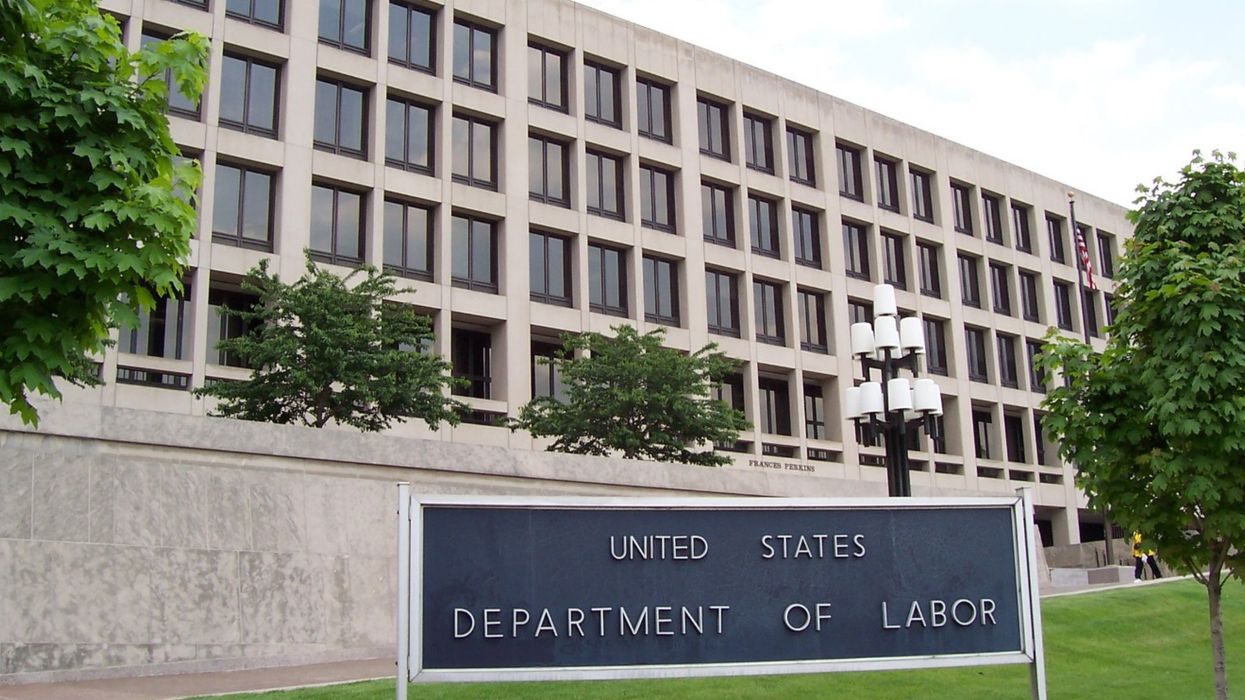
"It's unconscionable that roofing companies hire 15-year-olds," said one labor expert—but in state after state and even at the federal level, lawmakers are rolling back restrictions on teen workers.
Workers' rights advocates on Wednesday decried a meager fine for an Alabama contractor that illegally employed a 15-year-old boy who died on the job, a move that came amid a push by Republicans at the federal and state level to roll back child labor protections.
The U.S. Department of Labor fined Pelham, Alabama-based Apex Roofing & Restoration $117,175 in civil penalties for violation of child labor laws resulting in the July 1, 2019 death of a 15-year-old Guatemalan worker during his first day on the job in Cullman, 50 miles north of Birmingham.
The teen—who could not be identified because he was a minor—fell through insulation and plunged 35-50 feet to his death on a concrete floor inside the building on which he was working,
according to a Cullman Tribune report at the time.
The Labor Department's Wage and Hour Division found that the company's employment of the teen violated a provision of the Fair Labor Standards Act that prohibits workers under the age of 18 from doing dangerous jobs including roofing or construction.
"Apex Roofing risked the life of a child by employing him to work on a roof in violation of federal child labor laws, leaving relatives and friends to grieve an unnecessary and preventable tragedy," Wage and Hour Administrator Jessica Looman said in a statement.
The Labor Department action came shortly after the Alabama Policy Institute, a right-wing think tank, published its annual agenda. The document advocates rolling back limits on 14- and 15-year-olds in the workplace.
An Apex Roofing spokesperson told Common Dreams:
We at Apex Roofing & Restoration are truly heartbroken by the senseless death of a minor at a job site in 2019. The tragic incident occurred when a subcontractor's worker brought his sibling to a worksite without Apex's knowledge or permission.
Apex has a long-standing policy prohibiting any form of child labor. In addition, since that accident, Apex has implemented a number of measures to further strengthen job site security and safety. Our hearts are with this family and any family who suffers a loss.
Common Dreams reported last year that congressional Democrats implored the Labor Department to act following a Reuters investigation that found dozens of chidren as young as 12 years old—most of them Central American migrants—working in Alabama and Georgia factories supplying the Korean auto giant Hyundai.
Across the country, Republican state lawmakers have been advancing legislation to remove restrictions on child labor, despite several high-profile workplace deaths of minors.
At the federal level, Sen. James Risch (R-Idaho) and Rep. Jared Golden (D-Maine) last year introduced a bill that would allow 16- and 17-year-olds to work in the logging industry.
Major corporations including McDonald's, Costco, Starbucks, Amazon-owned Whole Foods, and PepsiCo have said they're taking steps to tackle child labor in their supply chains, The New York Times reported Wednesday.
Whole Foods said in a statement that it has "been actively evolving our focus on the risk of migrant child labor domestically."
According to Labor Department data, the number of minors employed in violation of child labor laws soared by 283% from 2015 to 2022. Over that same period, the number of minors employed in violation of hazardous occupation orders rose 94%.
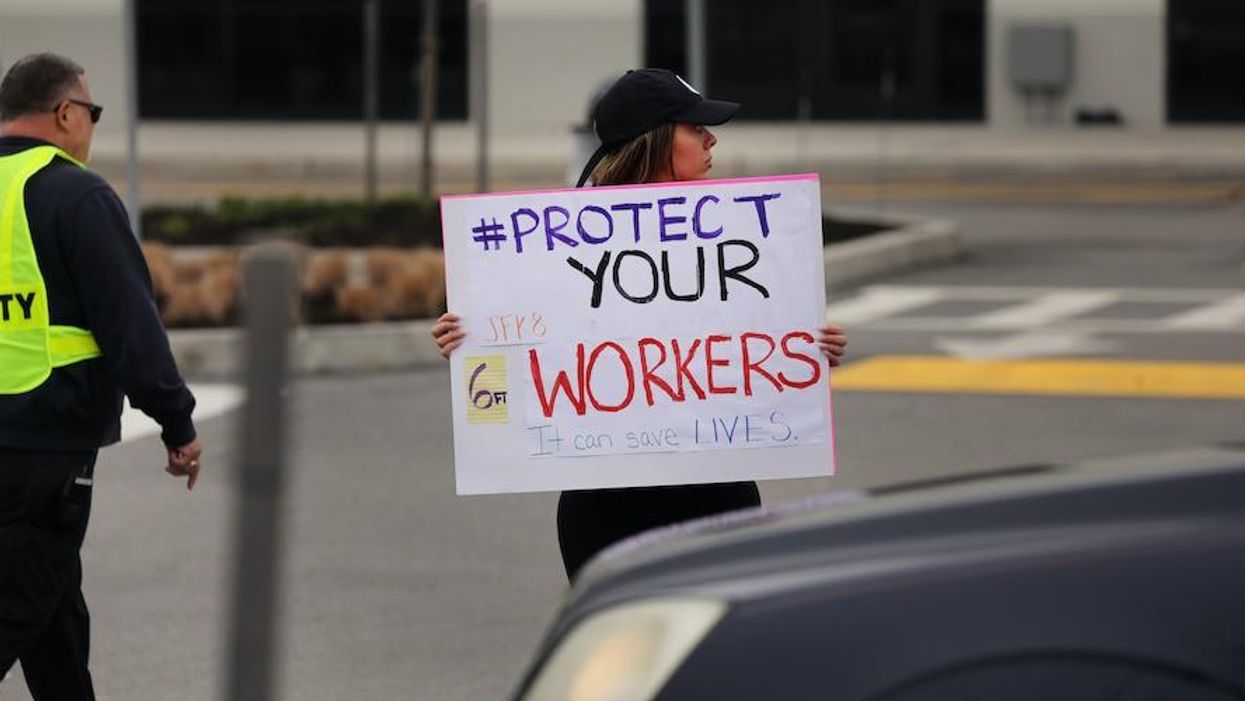
Workers at some of the nation's biggest companies including Amazon and Target are preparing to symbolically lock arms Friday for a May 1 strike and demand better protections on the frontlines of the coronavirus pandemic.
Among the lead organizers of the action, Motherboard reported Wednesday, is Chris Smalls, the Amazon worker who was fired last month from his job at a fulfillment center in Staten Island after organizing a protest.
"We formed an alliance between a bunch of different companies because we all have one common goal which is to save the lives of workers and communities," Smalls told Motherboard.
"Right now isn't the time to open up the economy," Smalls added. "Amazon is a breeding ground [for this virus] which is spreading right now through multiple facilities."
Adam Ryan, who works at a Target store in Virgina, is another lead organizer of the May Day action. He explained to Motherboard that the goal of the strike is "to shut down industry across the board and push back with large numbers against the right-wing groups that want to risk our lives by reopening the economy."
As Motherboard reported:
While the mass strike action might not be enough to shut down society, the collective action certainly echoes the calls for a general strike--a coordinated work stoppage across businesses and industries in pursuit of a common goal--the likes of which have not been seen in the United States since World War II.
The workers are demanding their profitable employers provide increased pay and paid leave, health insurance for all workers, and for Covid-19 affected stores to be shut. The workers are also calling on customers to show solidarity by not shopping at the stores on May 1, according to a flier shared on social media.
The Intercept also reported on the upcoming strike, with Daniel Medina writing Tuesday:
The May 1 strike is the latest in a wave of actions led by union and nonunion front-line workers. Last month, Amazon workers in New York City and more than 10,000 Instacart workers across the country staged a walkout.
Whole Foods employees led a national sickout on March 31, while upwards of 800 workers skipped their shifts at a Colorado meatpacking plant as coronavirus cases were confirmed among employees. Sanitation workers in Pittsburgh and bus drivers in Detroit both staged wildcat strikes.
"These workers have been exploited so shamelessly for so long by these companies while performing incredibly important but largely invisible labor," said Stephen Brier, a labor historian and professor at the CUNY School of Labor and Urban Studies. "All of a sudden, they're deemed essential workers in a pandemic, giving them tremendous leverage and power if they organize collectively."
"May 1 is a celebration of working people around the world," Margaret Kimberley wrote Wednesday at Black Agenda Report. "It is the perfect moment to begin the fight for economic justice which has accelerated due to the COVID-19 pandemic."
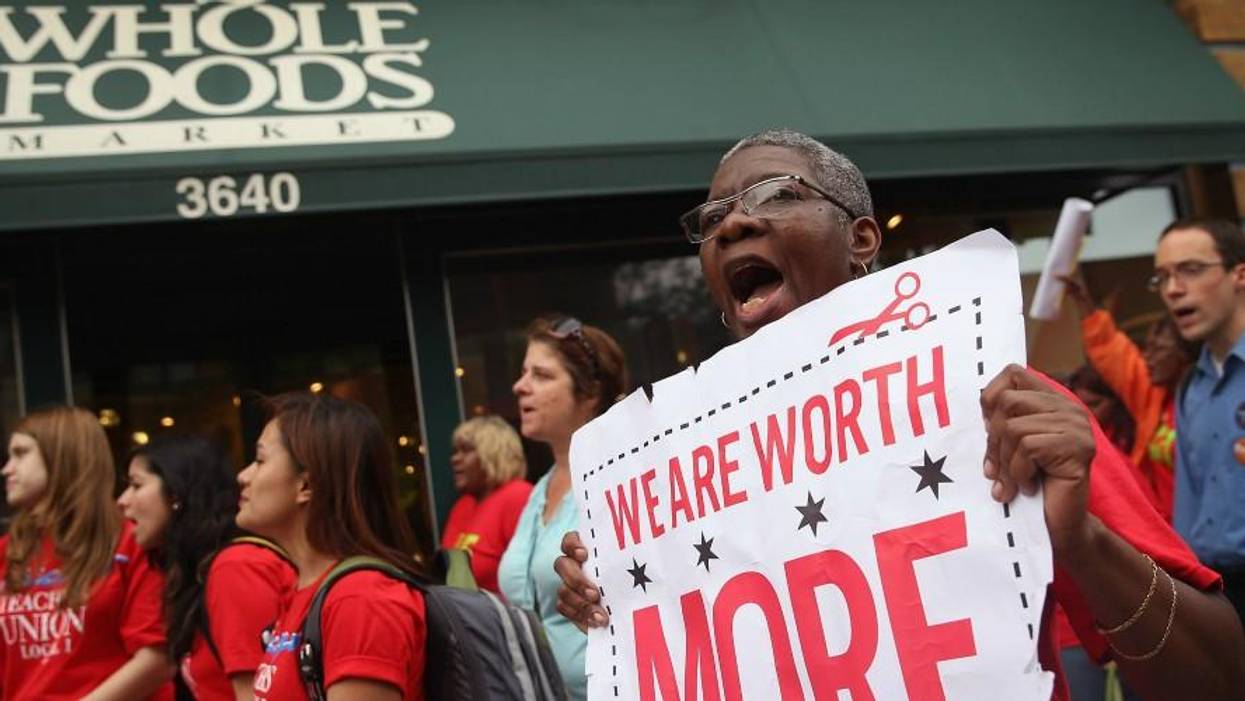
Progressives on Monday criticized Whole Foods, the grocery chain owned by Amazon, for using a heat map to track potential union activity at its stores across the U.S.--relying on data around racial diversity, "loyalty," and labor complaints as indicators that affect how the corporation scores the sites.
"This is infuriating but it's also a testament to the urgency and importance of essential workers unionizing," tweeted The Atlantic's Adam Serwer.
Business Insider's Hayley Peterson on Monday broke the "legitimately explosive news" of the heat map and scoring system being used at the company's 510 stores nationwide.
According to Peterson's reporting:
The stores' individual risk scores are calculated from more than two dozen metrics, including employee "loyalty," turnover, and racial diversity; "tipline" calls to human resources; proximity to a union office; and violations recorded by the Occupational Safety and Health Administration.
The map also tracks local economic and demographic factors such as the unemployment rate in a store's location and the percentage of families in the area living below the poverty line.
Whole Foods and Amazon have resisted unionization efforts even as the coronavirus pandemic has amped up worker frustrations and led to strikes and actions around the country. Workers are increasingly fed up with inadequate safety standards and access to protective equipment at the essential grocery stores and retail distribution centers.
As Common Dreams reported on April 15, Whole Foods and Amazon owner Jeff Bezos, the richest man in the world, has already made $24 billion in 2020 as the pandemic rages around the country and the world.
Progressives reacted to the news of the heat map with outrage, with Vice reporter Ashwin Rodrigues referring to the tactic as "minority report union busting."
Journalist Ben Norton on Twitter echoed the apocalyptic fiction theme.
"We are living in a real-life dystopia," said Norton, adding, "This is some evil science fiction shit."

When billionaire Jeff Bezos cut health benefits on September 13 for part-time workers at his grocery store Whole Foods the richest man in the world saved the equivalent of what he makes from his vast fortune in just a few hours.
That's according to an analysis from Decision Data's "Data in the News" series, which found that Bezos could cover the entirety of annual benefits for part-time employees who work less than 30 hours a week with what he makes from stocks and investments in just a fraction of a day.
"Doing a quick calculation with existing publicly available numbers shows that Bezos makes more money than the cost of an entire year of benefits for these 1,900 employees in somewhere between 2-6 hours," the study says.
The analysis used an estimate that Whole Foods would contribute between $5,000 and $15,000 annually per employee for benefits. At the middle of that range, $10,000, that comes to $19 million a year.
Bezos makes just under $9 million an hour, according to a 2019 Business Insider analysis, which would mean he makes enough money in a little over two hours to cover the benefits he cut. Decision Data used an earlier study which found Bezos makes $4.5 million an hour to conclude he would need approximately four and a half hours to cover the cost.
"CEO worth more than $110 billion cuts health care for 2,000 workers after raking in $9 million an hour," tweeted economist Robert Reich, citing the 2019 Business Insider figure.
The disconnect between Bezos' wealth and the cost of the benefits was remarked on by a number of observers.
"Jeff Bezos makes $3,182 a second," said Jacobin writer Luke Savage.
Presidential candidate and former Secretary of Housing and Urban Development Julian Castro called the move "shameful" and noted that Bezos' crown jewel, online retailer Amazon, pays nothing in taxes.
"Amazon pays zero dollars in federal income taxes," Castro tweeted. "Jeff Bezos is the richest man in modern history, and yet they continue to degrade the rights of their workers."

Amazon founder Jeff Bezos on Thursday cut benefits for part-time workers at his grocery chain Whole Foods, drawing criticism from the left for a move that could leave thousands of people without health insurance.
"Jeff Bezos is the richest man in the world," Boston-based activist Jonathan Cohn said on Twitter. "This is disgusting."
"Recall that one of Bezos's first acts as publisher of the Washington Post was to cut his staff's retirement benefits."
--writer Elon Green
Business Insider reporter Hayley Peterson broke the story. The decision will affect 1,900 of the business's 95,000 workers--the ones who work part-time, or around 20 hours a week.
"We are providing team members with resources to find alternative healthcare coverage options, or to explore full-time, healthcare-eligible positions starting at 30 hours per week," a Whole Foods spokesperson told Peterson. "All Whole Foods Market team members continue to receive employment benefits including a 20% in-store discount."
One employee, who has been working for the company for 15 years but felt anonymity was necessary to avoid retribution for speaking out, said she was devastated by the news.
"I am in shock," said the employee. "I've worked here 15 years. This is why I keep the job--because of my benefits."
Producer Jennifer Solotaroff took to Twitter to tell her story of being a Whole Foods employee and to explain to her audience the importance of benefits for the company's part-time staff.
"I worked at Whole Foods and it was the kind of job where people were able to work and go about their life," said Solotaroff. "Employees were taken care of and you could feel it--the morale was great, it was a diverse environment, and employees felt supported. So much of that had to do with coverage."
The news of Bezos's decision didn't come as a surprise to writer Elon Green.
"Recall that one of Bezos's first acts as publisher of The Washington Post was to cut his staff's retirement benefits," Green tweeted.
The move came less than a month after Bezos signed a pledge to invest in workers, The Verge explained:
Last month, Amazon joined a number of other tech companies and Fortune 500 firms in signing a letter outlining the purpose of a corporation as something not just designed to return shareholder value, but also to serve employees and the community. "Each of our stakeholders is essential," the pledge read. "We commit to deliver value to all of them, for the future success of our companies, our communities and our country."
That disconnect between words and actions, Business Insider columnist Bob Bryan said, proves there's no substitute for solidarity.
"The Whole Foods decision is not just hypocritical of Bezos, but also proves why workers should never put too much trust in kind words from CEOs and instead push for lasting changes to uphold their interests and those of their coworkers," Bryan wrote.
Are you ready to divest from Amazon Prime? How about Whole Foods?
If the idea makes you break into a nervous cold sweat, no worries. You don't need to divest from either.
Yet.
That's the idea behind non-profit Threshold's new campaign, Cancel Prime.
The idea is for people to pledge to cancel their Prime accounts and stop shopping at Whole Foods--when there is a critical mass of people who will divest together.
"It's a way for people to take collective action, so that it will likely work," says Kipchoge Spencer, Threshold's founder.
Founded in August 2018, Threshold has developed a platform that enables people to pledge to take action, and, when enough people pledge, calls upon them to take action.
When a mass of consumers quit Amazon and its subsidiaries together, Amazon will notice--and, perhaps, pay attention to some consumer-demanded changes.
Think of it as a potentially effective replacement for the lone boycott of a particular place, or for online activism that revolves around sharing petitions on Facebook, or airing and sharing daily grievances on Twitter as if every day were Festivus.
"Engaging in activism is so uninspiring and disempowering" these days, says Spencer. "I think there's this common format with digital activism, which starts with a petition designed to get you angry or sad or donate money. And it's effective to some degree to build organizational power, to build mailing lists. But it's cynical because those petitions almost always fail."
Inspired by the progressive issues of the day receiving support--but not much action--Spencer came up with the Threshold strategy. "More than 50 percent of people think we should do something about climate change, but I wondered why we aren't able to achieve something supported by the majority of people, especially in a democracy. We wanted to develop a way that would motivate people more and more by inspiration, that this is probably going to work," says Spencer.
Spencer suggests one of the reasons more action isn't being taken on climate change is that the user experience of engaging in activism is "so uninspiring and disempowering, that it basically prevents a critical mass of people from taking action. People get burned out and turned off."
He uses the example of a petition you might receive from a friend, asking you to protest something the EPA is doing. There is a zero percent chance it will inspire change at the EPA, but you still sign, perhaps out of guilt--and that's your first disempowering action. You're never told it doesn't work, but you intuitively know it didn't. Worse, you're asked to spam your friends with it, which serves the organization's purpose to grow its mailing list, and spreads the disempowerment around.
"I don't want to be broadly critical of the progressive advocacy world, but this is a failure in the system, because people sign a petition, they feel bad, then they feel worse, and then they feel completely disempowered," says Spencer.
Hence, Threshold, which doesn't ask you to do anything besides pledge--until a critical mass is reached. If a critical mass isn't reached, you're not asked to do anything.
"Many people love Amazon. It's revered," he concedes. "They use it all the time and depend on it. Asking them to quit is significant."
With the Cancel Prime campaign, you're not asked to "put any skin in the game, unless the game is likely to go your way," Spencer says. It's like "Kickstarter for activism."
What's really important, says Spencer, is for people to understand that when they're asked to make a sacrifice, it will work.
Much has been written about the ethical, environmental, and labor horrors of Amazon, and yet it maintains its hold over the lives of Americans. A big part of Cancel Prime is the education component--not just why to divest, but how to divest.
The "why" list is long, and might differ from person to person. Some people who might agree with the principles motivating Cancel Prime may still feel Amazon is a necessary part of their lives and there is no desire to divest. Spencer says, "that's okay. My perspective on activism isn't that we need to spend a lot of energy on convincing people. It's convincing people who already are convinced to take action collectively together."
For Spencer, among other reasons, Amazon is "morally offensive [because] they make so much money, and some of their workers are living in poverty, with widely reported medical issues that aren't treated well. You're one of the richest companies in the history of the universe. You won capitalism. Now start treating people well."
It's also appalling they pay no taxes, make $11 billion dollars, and get a tax rebate. "That seems pretty egregious," says Spencer.
Then there's Amazon's "support for infrastructure that supports ICE," which is currently separating children from their families in the ongoing immigration crackdown. "That just feels completely unconscionable," Spencer says. "It's getting uncomfortable to think I'm buying something from Amazon while they support the infrastructure of ICE. It's not just incidental, but it's critically important to ICE's mission. I think there's a place to take a stand there."
Amazon also clearly takes advantage of the public's goodwill to win tax breaks--just look at the massive data grab that the war for HQ2 created. "They should be positive forces in communities instead of wrecking them," says Spencer. "They have a big opportunity to be a global leader because of how much wealth they have."
What's more is Amazon has an opportunity to be a global leader around climate, energy, and plastics. But it's not. In fact, Amazon is not only failing to fulfill even a quarter of its renewable energy commitment, but actually growing in energy demand.
Over half of all U.S. households are Prime members--more than 100 million Americans. Amazon is also a big player in entertainment, with its hand in film, television and Twitch. Its fingers pull the strings of search engines, digital assistants, the cloud, logistics, pharmaceuticals, banking, fashion, Whole Foods, and real-world retail, in addition to tech and actual book sales (where Amazon got its start), and an overall, overwhelming share of e-commerce.
Considering their reach and wealth, there are countless things the company can do to have a positive climate impact instead of a negative one--yet it doesn't.
Meanwhile, Amazon keeps growing, aiming to be the infrastructure for all commerce as we know it. Stacy Mitchell at the Institute for Local Self-Reliance calls it the Amazon tax, where if you choose to buy through a third party, it's still through Amazon.
Amazon, Mitchell told Chris Hayes at NBC, is "like a gatekeeper. Essentially you've got to ride their rails to market. They can decide what the terms are, they can use the data they gather on what you're doing to out-compete you and to undermine you as a competitor. They can levy a kind of tax on your trade. Essentially what Jeff Bezos has set up by owning the pipelines ... It's not just the platform... by owning the pipelines, what Amazon can do is it can decide, okay, here are the most lucrative streams of consumer spending. Then, for all the other stuff in the economy that they don't really want to deal with or that isn't that profitable... let other sellers do that. [Amazon will] just levy a tax on their trade. Every transaction they do," says Mitchell, Amazon gets a cut. As Amazon's power grows, Amazon is going to get a bigger and bigger cut, she adds.
"That doesn't feel very safe to have a healthy economy," says Spencer.
Traditionally in the United States, we've valued competition.
Also traditionally, the United States has frowned upon the idea of one entity controlling everything in commerce. If it was the U.S. government, for example, that owned and operated all the platforms Amazon does, people would be outraged, perhaps even shouting words like "communists!" at the government. And yet, it might be argued that even communist countries don't rely on their governments as heavily as the U.S. consumer has come to rely on Amazon.
Which brings us to another point: Are we citizens first, or are we consumers first?
That might be yet another question America as a nation and as a people need to grapple with.
In the interim, if we do want to take action that Amazon will notice and perhaps even make changes for, the harmonization of consumer action might be key. But what's a consumer to do when their lives are so intertwined with Amazon's?
Threshold has a guide online to much of what Amazon owns and alternatives to each one. Some, arguably, have their shortcomings, but switching to them when the time is right might be worth it to make a point. (Spencer hopes this part of the campaign will be crowdsourced, for optimum impact both in terms of divestment from Amazon and reinvestment in healthy companies in line with individual values.)
"It only takes 3.5% of the population to make a change," says Spencer, referencing a study by Erica Chenoweth, of Harvard Kennedy School. "In every single instance, where it mobilized at least 3.5%, it won."
"That's one of the most inspiring pieces of data there is," he says. "We don't need 50%. We don't need 60%. We need 3.5%. Really, that's what it boils down to in our job as movement organizers. We're putting it out in front, because we think it's important for people to know."
When mass divestment from Amazon does occur, Spencer expects the company to take the issues of the people seriously and do better, online and in the communities in which they operate. "If they were to do that, it would be a victory, in terms of influencing their direction and impact on the world. And it would be a victory for people power."
Spencer himself hasn't completely divested from Amazon, choosing to wait until critical mass is reached. "I've gone from a very-frequent to an almost-never Amazon shopper. It's made my life better," says Spencer. "I think it's intrinsically valuable to align my values and my lifestyle; not supporting a company that harms so many things I care about is a simple way to do that and feel more whole."
In addition, says Spencer, "Although I've been a longtime critic of consumer culture, the truth is that I found myself pushing Bezos' 'buy now' button multiple times a week. Consumerism is a disease. Buying things gives you a shot of endorphins. The more you do it, the more you need to do it to get the hit. I wouldn't have easily admitted this was happening to me; but when I started avoiding Amazon so I could research alternatives in earnest, I realized that I had broken a cycle and my overall level of buying dropped significantly."
There's no shame in confessing an Amazon habit. With Threshold's pledge, there's no reason to give it up cold turkey either. And when it is time to quit, knowing you're doing it with tens of thousands of other people will create support and inspiration to stick with it.
In addition, by getting off the Amazon habit, "I'm not dealing with the pain of having over-packaged crap show up at my door and triggering guilt about wasting money, abusing the planet, and being a victim of my own base impulses," says Spencer.
"Instead, I'm back to my old self who normally gives long and due consideration to anything I buy, and that makes me happier." An interesting personal revelation to have.
Has Amazon changed who you are?
"The dream is this kind of activism will inspire all companies" and politics, to do better, says Spencer. "Amazon is just a stepping stone in our theory of change."
This article was produced by Local Peace Economy, a project of the Independent Media Institute.

While Amazon caved to massive public pressure last fall and raised all company wages to at least $15 per hour--including at its subsidiary Whole Foods Market--in the months since, workers at the popular grocery chain have had their hours cut, negating their raises.
"Just about every person on our team has complained about their hours being cut. Some have had to look for other jobs as they can't make ends meet."
--Whole Foods worker in California
The Guardian reported on the cuts Wednesday, citing interviews with workers at Whole Foods stores in Illinois, California, Maryland, and Oregon, as well as emails and schedules the employees shared with the paper.
Workers who remained unnamed due to fears of retaliation said internal emails show the cuts to employees' hours have come at the direction of regional management.
An employee in Illinois, who provided schedules from November 1--when the wage increase took effect--through the end of January, said that part-time workers' at their location saw weekly hours reduced from an average of 30 to 21 while full-time workers saw an average drop from 37.5 to 34.5 hours per week.
"At my store all full-time team members are 36 to 38 hours per week now," said a worker in Oregon. "So what workers do if they want a full 40 hours is take a little bit of their paid time off each week to fill their hours to 40. Doing the same thing myself."
Meanwhile, in Maryland, an employee said regional management has cut full-time workers' hours from 40 to 36 per week. "This hours cut makes that raise pointless as people are losing more than they gained and we rely on working full shifts," the worker said.
The cuts have taken a toll on both workers' paychecks and workplace environment, a California-based employee said, which carries over to customers:
Things that have made it more noticeable are the long lines, the need to call for cashier and bagging assistance, and customers not being able to find help in certain departments because not enough are scheduled, and we are a big store...
Just about every person on our team has complained about their hours being cut. Some have had to look for other jobs as they can't make ends meet.
"There are many team members working at Whole Foods today whose total compensation is actually less than what it was before the wage increase due to these labor reductions," a spokesperson for Whole Worker--which started organizing for a Whole Foods employee union a shortly before Amazon's wage hike--told the Guardian.
Whole Foods and Amazon did not respond to the paper's multiple requests for comment. However, this is far from the first time the high-end grocery chain and its parent company--owned by the richest man in the world, Jeff Bezos--have come under fire for anti-worker practices.
Frustration with Whole Foods' well established anti-worker reputation and Amazon's 2017 takeover led to the union push, which Amazon has tried to quash. A training video that teaches management how to detect "early warning signs of potential organizing" leaked to the media in late September.
In early October, Amazon announced it would raise workers' hourly wages. That came less than a month after Sen. Bernie Sanders (I-Vt.) and Rep. Ro Khanna (D-Calif.) introduced the cleverly named Stop Bad Employers by Zeroing Out Subsidies (BEZOS) Act, which would force hugely profitable companies such as Amazon and Walmart to pay a corporate welfare tax that matches the amount of public assistance their employees receive.
Whole Foods workers' ongoing fight to be paid enough money to survive comes amid mounting national pressure to raise wages. Just last month, Illinois became the fifth state to require a $15 hourly minimum wage. In January, Sanders and Rep. Bobby Scott (D-Va.) introduced the Raise the Wage Act of 2019, which, according to the Economic Policy Institute, would boost the incomes of nearly 40 million Americans across the country.

Whole Foods Market employees are seeking a union to battle anti-worker tactics by Amazon--which acquired the grocery chain last year and is run by the richest man in the world--warning that the company is "self cannibalizing" and "they want us to become robots."
"Store teams used to make more. We had much better pay and were taking more money on our paychecks than we were making from our hourly wage when the company was successful, when it wasn't self cannibalizing, when everybody had the tools to do their job."
--Whole Foods worker"No one trusts Amazon and there are fears in upper management that Amazon will clean house if sales rates aren't hit," a founder of the Whole Worker community told the Guardian in an article published Monday. "They're squeezing all they can out of the workers."
Those interviewed didn't want their names printed, according to the Guardian, because they fear retaliation from managers trained watch for "warning signs" of organizing, such as employees socializing outside of work or using what the company called "union words" like "living wage."
Unnamed employees from stores in multiple states shared how Amazon's acquisition of Whole Foods has impacted them and their work environments:
Even before the Amazon acquisition, Whole Foods had a history of union-busting and implemented policies such as the order-to-shelf system, which critics say aims to make workers "interchangeable." But those who spoke to the Guardian and members of the Whole Worker community argue that some of Amazon's moves have been bad for both employees and business.
"Local and specialty products have been cut and replaced with more conventional mainstream ones, and regional marketing and sign making has been removed," a California worker told the Guardian. "We are losing the shopper and team members who helped make us who we were."
"Corporations keep getting tax incentives, but when you don't raise wages and you need two jobs just to make a living, what's the point? We're not getting anywhere as a society."
--Whole Foods organizerAn Illinois-based employee who helps coordinate the Whole Worker community noted: "We work for the wealthiest man in the world and our stores can't afford to hire. If you actually want to build sales and increase market share, you need to spend the money to get it done."
"Corporations keep getting tax incentives, but when you don't raise wages and you need two jobs just to make a living, what's the point?" the Illinois employee added. "We're not getting anywhere as a society.
While Amazon attempts to quash organizing in Whole Foods stores nationwide--assuring managers in a training video that leaked last week that the law "protects" them when sharing "opinions" such as "unions are lying, cheating rats" to discourage workers from forming a union--efforts continue to improve working and living conditions for Whole Foods and Amazon employees.
Noting that "over the past year, layoffs, and the consolidation of store level positions at Whole Foods Market have upset the livelihood of team members, stirred anxiety, and lowered [morale] within stores," the Whole Worker community emailed employees on Sept. 6 to call for the formation of a union, warning that "there will continue to be layoffs in 2019 and beyond as Amazon aims to aggressively trim our labor force before it expands with new technology and labor models."
With a clear jab at Amazon chief executive Jeff Bezos, Sen. Bernie Sanders (I-Vt.) and Rep. Ro Khanna (D-Calif.) last month introduced the Stop BEZOS Act, which would impose a "corporate welfare tax" on major corporations to pay for the public assistance their employees require due to low wages and inadequate benefits.
Praising Scottish First Minister Nicola Sturgeon's recent decision to pull millions of dollars in grants from Amazon unless it pays workers in the country a living wage, Sanders on Monday called for the U.S. government to pursue the same tactic: