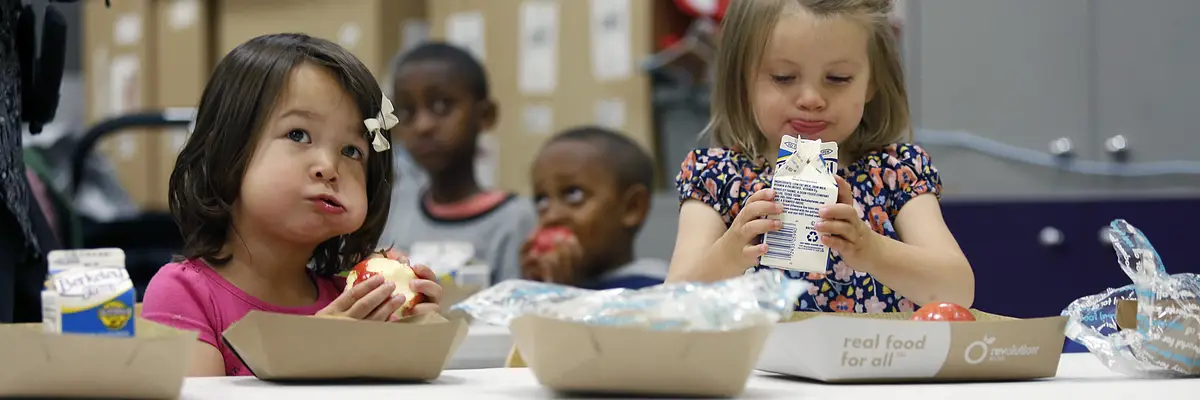
Kids have lunch at the children's center of the main library in San Francisco, California.
‘Obviously Going to Increase Hunger’: Trump SNAP Cuts Imperil Free School Meals for Millions of Kids
"Without congressional action to reverse the SNAP cuts, children will lose critical food benefits that help families keep hunger at bay."
Millions of children across the United States are at risk of losing access to free school meals due to the unprecedented federal nutrition aid cuts that President Donald Trump signed into law last summer.
The 2025 Republican budget law enacted the largest cuts to the Supplemental Nutrition Assistance Program (SNAP) since its inception more than six decades ago. The cuts have already pushed SNAP enrollment to its lowest level in 17 years, with roughly five million people—including 1.5 million kids—losing aid. Because school districts across the US use SNAP participation rolls to automatically sign children up for free school meals, kids who lose federal aid are at risk of also losing access to free school-time meals.
“Cuts to SNAP are not going to stop at the grocery store,” Clarissa Hayes, deputy director of child nutrition programs and policy at the Food Research & Action Center (FRAC), told Stateline earlier this week. “They really are going to threaten children’s access to school meals, which is obviously going to increase hunger at home and in the classroom, and is going to have that negative ripple effect across children’s health and academic performance.”
FRAC estimated in a recent report that a record 55,362 schools nationwide "offered breakfast and lunch to all their students through the Community Eligibility Provision (CEP)" during the 2025-2026 school year.
But the number of children who are directly certified for free school meals determines schools' eligibility for CEP as well as the federal reimbursement schools receive under the program, meaning huge declines in SNAP participation could result in schools losing eligibility for CEP or leave them unable to afford it.
Students who are no longer automatically enrolled in free school meal programs will have to apply, an often confusing process that requires family income documentation and other paperwork hurdles.
“Without congressional action to reverse the SNAP cuts, children will lose critical food benefits that help families keep hunger at bay, and the progress we have made on Healthy School Meals for All could unravel,” said Crystal FitzSimons, the president of FRAC, which estimates that nearly 28 million children attended a CEP school during the 2025-2026 school year.
A survey released last month by the No Kid Hungry campaign found that close to 60% of parents said "their child wouldn’t have enough to eat if it weren’t for the meals they receive during the school day," underscoring the potentially devastating impact of a large-scale loss of access to school breakfast, lunch, and snacks.
"An overwhelming majority (89%) indicate that school meals take some pressure off their family when it comes to feeding their children," the campaign said.
Democratic members of Congress are increasingly sounding the alarm over the 2025 GOP budget law's impact on school meals as the new school year begins.
US Rep. Raja Krishnamoorthi (D-Ill.) wrote in a letter to the US Department of Agriculture last week that "no child should lose access to breakfast or lunch at school because a parent was unable to satisfy a new bureaucratic requirement for food assistance."
"And no school should be forced to jeopardize its meal program because federal policy has made it harder to identify children who qualify for assistance," Krishnamoorthi added.
We are at a crossroads
This country and this world are at a monumental crossroads. In a few short weeks, US voters will have an opportunity to beat back the forces of fascism and confront the billionaires who are rigging the economy, our media system, and our democracy, making it increasingly impossible for ordinary people to get by. We’re not just talking about the election. We’re talking about what must be done once these fascist elements are vanquished from power. We need a bolder set of solutions than what either major party has so far been willing to offer and a working-class movement ready to fight like hell for it. Trump didn't emerge from nowhere. The conditions that fueled MAGA authoritarianism were created by decades of radical neoliberal economic policies and a corrupt political system dominated by corporate interests. They slashed taxes on the super-rich, promising that the benefits would trickle down. They said giveaways to the corporate titans would make life more affordable for the rest of us. It was all bullshit. And when a bitter, betrayed populace searches for someone to blame, right-wing demagogues have little trouble finding scapegoats. People know when they're being lied to, but you won't hear any of this from the corporate media. Only independent journalism—powered and funded by people who believe in building a better world—can deliver truly trustworthy daily news. Our Fall Campaign is underway, and we need your help. To power our newsroom through the rest of the year, we need to raise $125,000 by midnight on October 31. So if you share our vision, please contribute whatever you can to sustain our work. |
Millions of children across the United States are at risk of losing access to free school meals due to the unprecedented federal nutrition aid cuts that President Donald Trump signed into law last summer.
The 2025 Republican budget law enacted the largest cuts to the Supplemental Nutrition Assistance Program (SNAP) since its inception more than six decades ago. The cuts have already pushed SNAP enrollment to its lowest level in 17 years, with roughly five million people—including 1.5 million kids—losing aid. Because school districts across the US use SNAP participation rolls to automatically sign children up for free school meals, kids who lose federal aid are at risk of also losing access to free school-time meals.
“Cuts to SNAP are not going to stop at the grocery store,” Clarissa Hayes, deputy director of child nutrition programs and policy at the Food Research & Action Center (FRAC), told Stateline earlier this week. “They really are going to threaten children’s access to school meals, which is obviously going to increase hunger at home and in the classroom, and is going to have that negative ripple effect across children’s health and academic performance.”
FRAC estimated in a recent report that a record 55,362 schools nationwide "offered breakfast and lunch to all their students through the Community Eligibility Provision (CEP)" during the 2025-2026 school year.
But the number of children who are directly certified for free school meals determines schools' eligibility for CEP as well as the federal reimbursement schools receive under the program, meaning huge declines in SNAP participation could result in schools losing eligibility for CEP or leave them unable to afford it.
Students who are no longer automatically enrolled in free school meal programs will have to apply, an often confusing process that requires family income documentation and other paperwork hurdles.
“Without congressional action to reverse the SNAP cuts, children will lose critical food benefits that help families keep hunger at bay, and the progress we have made on Healthy School Meals for All could unravel,” said Crystal FitzSimons, the president of FRAC, which estimates that nearly 28 million children attended a CEP school during the 2025-2026 school year.
A survey released last month by the No Kid Hungry campaign found that close to 60% of parents said "their child wouldn’t have enough to eat if it weren’t for the meals they receive during the school day," underscoring the potentially devastating impact of a large-scale loss of access to school breakfast, lunch, and snacks.
"An overwhelming majority (89%) indicate that school meals take some pressure off their family when it comes to feeding their children," the campaign said.
Democratic members of Congress are increasingly sounding the alarm over the 2025 GOP budget law's impact on school meals as the new school year begins.
US Rep. Raja Krishnamoorthi (D-Ill.) wrote in a letter to the US Department of Agriculture last week that "no child should lose access to breakfast or lunch at school because a parent was unable to satisfy a new bureaucratic requirement for food assistance."
"And no school should be forced to jeopardize its meal program because federal policy has made it harder to identify children who qualify for assistance," Krishnamoorthi added.
Millions of children across the United States are at risk of losing access to free school meals due to the unprecedented federal nutrition aid cuts that President Donald Trump signed into law last summer.
The 2025 Republican budget law enacted the largest cuts to the Supplemental Nutrition Assistance Program (SNAP) since its inception more than six decades ago. The cuts have already pushed SNAP enrollment to its lowest level in 17 years, with roughly five million people—including 1.5 million kids—losing aid. Because school districts across the US use SNAP participation rolls to automatically sign children up for free school meals, kids who lose federal aid are at risk of also losing access to free school-time meals.
“Cuts to SNAP are not going to stop at the grocery store,” Clarissa Hayes, deputy director of child nutrition programs and policy at the Food Research & Action Center (FRAC), told Stateline earlier this week. “They really are going to threaten children’s access to school meals, which is obviously going to increase hunger at home and in the classroom, and is going to have that negative ripple effect across children’s health and academic performance.”
FRAC estimated in a recent report that a record 55,362 schools nationwide "offered breakfast and lunch to all their students through the Community Eligibility Provision (CEP)" during the 2025-2026 school year.
But the number of children who are directly certified for free school meals determines schools' eligibility for CEP as well as the federal reimbursement schools receive under the program, meaning huge declines in SNAP participation could result in schools losing eligibility for CEP or leave them unable to afford it.
Students who are no longer automatically enrolled in free school meal programs will have to apply, an often confusing process that requires family income documentation and other paperwork hurdles.
“Without congressional action to reverse the SNAP cuts, children will lose critical food benefits that help families keep hunger at bay, and the progress we have made on Healthy School Meals for All could unravel,” said Crystal FitzSimons, the president of FRAC, which estimates that nearly 28 million children attended a CEP school during the 2025-2026 school year.
A survey released last month by the No Kid Hungry campaign found that close to 60% of parents said "their child wouldn’t have enough to eat if it weren’t for the meals they receive during the school day," underscoring the potentially devastating impact of a large-scale loss of access to school breakfast, lunch, and snacks.
"An overwhelming majority (89%) indicate that school meals take some pressure off their family when it comes to feeding their children," the campaign said.
Democratic members of Congress are increasingly sounding the alarm over the 2025 GOP budget law's impact on school meals as the new school year begins.
US Rep. Raja Krishnamoorthi (D-Ill.) wrote in a letter to the US Department of Agriculture last week that "no child should lose access to breakfast or lunch at school because a parent was unable to satisfy a new bureaucratic requirement for food assistance."
"And no school should be forced to jeopardize its meal program because federal policy has made it harder to identify children who qualify for assistance," Krishnamoorthi added.