SUBSCRIBE TO OUR FREE NEWSLETTER
Daily news & progressive opinion—funded by the people, not the corporations—delivered straight to your inbox.
5
#000000
#FFFFFF
To donate by check, phone, or other method, see our More Ways to Give page.
Daily news & progressive opinion—funded by the people, not the corporations—delivered straight to your inbox.
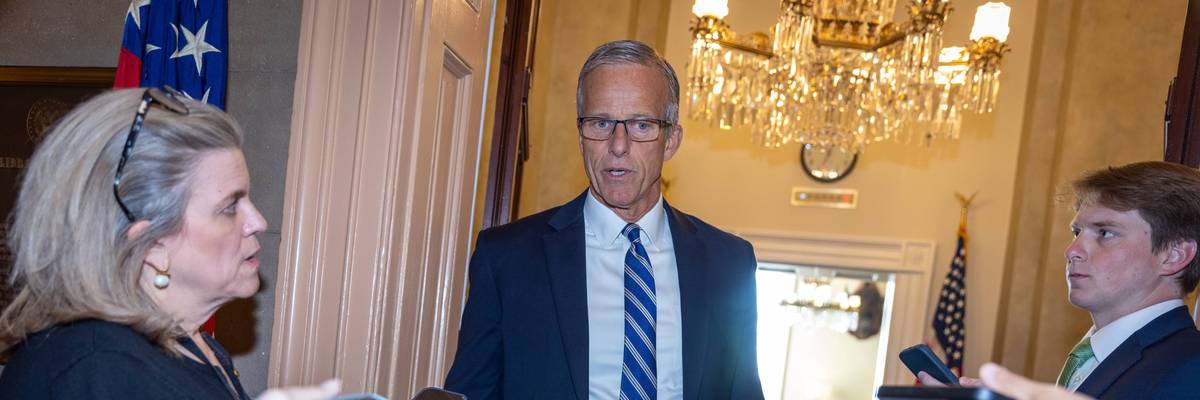
Senate Majority Leader John Thune (R-SD) speaks to reporters on June 4, 2026.
"Clear majorities of Americans across the nation, and in Congress, do not want the government bypassing the courts to hoover up our private, personal data."
Privacy advocates celebrated Friday after a Republican-led effort to extend warrantless spying powers failed to advance in the US Senate in the early hours of the morning, with seven GOP lawmakers joining every Democrat except Sen. John Fetterman in opposition.
The failed vote was another stumble for supporters of renewing Section 702 of the Foreign Intelligence Surveillance Act (FISA), which lets the federal government surveil the electronic communications of noncitizens located outside the US. The authority is set to lapse next Friday.
Advocates have long demanded reforms to the law, noting that US intelligence agencies have relentlessly abused it to spy on Americans.
Sean Vitka, executive director of Demand Progress, called Friday's vote a "resounding defeat for opponents of privacy," arguing it "shows that there is no path forward for FISA without a warrant requirement."
"Clear majorities of Americans across the nation, and in Congress, do not want the government bypassing the courts to hoover up our private, personal data," said Vitka. "If the White House and congressional leadership want to renew FISA, they have to stop ignoring this obvious fact and allow votes on real privacy reforms."
Elizabeth Goitein, co-director of the Liberty and National Security Program at the Brennan Center for Justice, called the vote "an interim victory" but warned that some senators "who would have voted to advance the bill changed their vote" due to President Donald Trump's selection of loyalist Bill Pulte to serve as acting director of national intelligence—a choice that drew bipartisan backlash.
Sen. Mark Warner (D-Va.), who supports extending Section 702 spying powers, voted against advancing the FISA legislation on Friday after decrying Pulte as an "enormously bad choice" who is "grossly unqualified."
Goitein noted that Pulte, who currently heads the Federal Housing Finance Agency (FHFA), is currently "under investigation by the nonpartisan Government Accountability Office for misusing his position and his access to government records to trigger dubious charges of mortgage fraud against Trump’s perceived political enemies."
"If Pulte can do that with the limited access to Americans’ information he has as head of the [FHFA], imagine what he could do with all the authorities and capabilities of the intelligence community—including, of course, Section 702," she added. "What wouldn’t make sense? Handing Section 702 to whomever Trump could nominate in Pulte’s place without ensuring that they can’t use it as a tool for domestic spying."
Dear Common Dreams reader, It’s been nearly 30 years since I co-founded Common Dreams with my late wife, Lina Newhouser. We had the radical notion that journalism should serve the public good, not corporate profits. It was clear to us from the outset what it would take to build such a project. No paid advertisements. No corporate sponsors. No millionaire publisher telling us what to think or do. Many people said we wouldn't last a year, but we proved those doubters wrong. Together with a tremendous team of journalists and dedicated staff, we built an independent media outlet free from the constraints of profits and corporate control. Our mission has always been simple: To inform. To inspire. To ignite change for the common good. Building Common Dreams was not easy. Our survival was never guaranteed. When you take on the most powerful forces—Wall Street greed, fossil fuel industry destruction, Big Tech lobbyists, and uber-rich oligarchs who have spent billions upon billions rigging the economy and democracy in their favor—the only bulwark you have is supporters who believe in your work. But here’s the urgent message from me today. It's never been this bad out there. And it's never been this hard to keep us going. At the very moment Common Dreams is most needed, the threats we face are intensifying. We need your support now more than ever. We don't accept corporate advertising and never will. We don't have a paywall because we don't think people should be blocked from critical news based on their ability to pay. Everything we do is funded by the donations of readers like you. When everyone does the little they can afford, we are strong. But if that support retreats or dries up, so do we. Will you donate now to make sure Common Dreams not only survives but thrives? —Craig Brown, Co-founder |
Privacy advocates celebrated Friday after a Republican-led effort to extend warrantless spying powers failed to advance in the US Senate in the early hours of the morning, with seven GOP lawmakers joining every Democrat except Sen. John Fetterman in opposition.
The failed vote was another stumble for supporters of renewing Section 702 of the Foreign Intelligence Surveillance Act (FISA), which lets the federal government surveil the electronic communications of noncitizens located outside the US. The authority is set to lapse next Friday.
Advocates have long demanded reforms to the law, noting that US intelligence agencies have relentlessly abused it to spy on Americans.
Sean Vitka, executive director of Demand Progress, called Friday's vote a "resounding defeat for opponents of privacy," arguing it "shows that there is no path forward for FISA without a warrant requirement."
"Clear majorities of Americans across the nation, and in Congress, do not want the government bypassing the courts to hoover up our private, personal data," said Vitka. "If the White House and congressional leadership want to renew FISA, they have to stop ignoring this obvious fact and allow votes on real privacy reforms."
Elizabeth Goitein, co-director of the Liberty and National Security Program at the Brennan Center for Justice, called the vote "an interim victory" but warned that some senators "who would have voted to advance the bill changed their vote" due to President Donald Trump's selection of loyalist Bill Pulte to serve as acting director of national intelligence—a choice that drew bipartisan backlash.
Sen. Mark Warner (D-Va.), who supports extending Section 702 spying powers, voted against advancing the FISA legislation on Friday after decrying Pulte as an "enormously bad choice" who is "grossly unqualified."
Goitein noted that Pulte, who currently heads the Federal Housing Finance Agency (FHFA), is currently "under investigation by the nonpartisan Government Accountability Office for misusing his position and his access to government records to trigger dubious charges of mortgage fraud against Trump’s perceived political enemies."
"If Pulte can do that with the limited access to Americans’ information he has as head of the [FHFA], imagine what he could do with all the authorities and capabilities of the intelligence community—including, of course, Section 702," she added. "What wouldn’t make sense? Handing Section 702 to whomever Trump could nominate in Pulte’s place without ensuring that they can’t use it as a tool for domestic spying."
Privacy advocates celebrated Friday after a Republican-led effort to extend warrantless spying powers failed to advance in the US Senate in the early hours of the morning, with seven GOP lawmakers joining every Democrat except Sen. John Fetterman in opposition.
The failed vote was another stumble for supporters of renewing Section 702 of the Foreign Intelligence Surveillance Act (FISA), which lets the federal government surveil the electronic communications of noncitizens located outside the US. The authority is set to lapse next Friday.
Advocates have long demanded reforms to the law, noting that US intelligence agencies have relentlessly abused it to spy on Americans.
Sean Vitka, executive director of Demand Progress, called Friday's vote a "resounding defeat for opponents of privacy," arguing it "shows that there is no path forward for FISA without a warrant requirement."
"Clear majorities of Americans across the nation, and in Congress, do not want the government bypassing the courts to hoover up our private, personal data," said Vitka. "If the White House and congressional leadership want to renew FISA, they have to stop ignoring this obvious fact and allow votes on real privacy reforms."
Elizabeth Goitein, co-director of the Liberty and National Security Program at the Brennan Center for Justice, called the vote "an interim victory" but warned that some senators "who would have voted to advance the bill changed their vote" due to President Donald Trump's selection of loyalist Bill Pulte to serve as acting director of national intelligence—a choice that drew bipartisan backlash.
Sen. Mark Warner (D-Va.), who supports extending Section 702 spying powers, voted against advancing the FISA legislation on Friday after decrying Pulte as an "enormously bad choice" who is "grossly unqualified."
Goitein noted that Pulte, who currently heads the Federal Housing Finance Agency (FHFA), is currently "under investigation by the nonpartisan Government Accountability Office for misusing his position and his access to government records to trigger dubious charges of mortgage fraud against Trump’s perceived political enemies."
"If Pulte can do that with the limited access to Americans’ information he has as head of the [FHFA], imagine what he could do with all the authorities and capabilities of the intelligence community—including, of course, Section 702," she added. "What wouldn’t make sense? Handing Section 702 to whomever Trump could nominate in Pulte’s place without ensuring that they can’t use it as a tool for domestic spying."