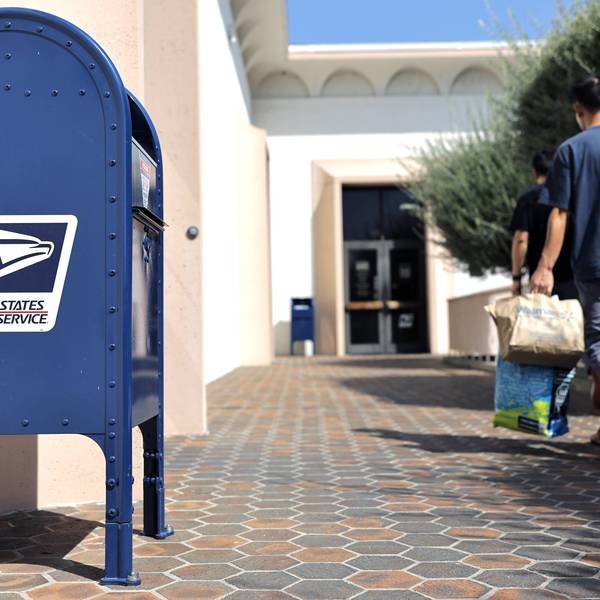
A sign outside the United States Postal Service Baltimore Processing and Distribution Center is seen in Baltimore, Maryland on August 17, 2020.
Warning of Partisan Takeover, Senate Democrat Demands Freeze on Trump Postal Board Nominees
"This imbalance in representation would be unprecedented and would undermine public confidence in the board’s ability to serve the public interest above any partisan political aims."
Sen. Gary Peters on Wednesday warned that the independence of the United States Postal Service Board of Governors is at risk thanks to President Donald Trump.
Peters (D-Mich.), the ranking member of the Senate Homeland Security and Governmental Affairs Committee, called for a pause on efforts to confirm two Trump USPS nominees until the president puts forth a Democratic nominee to maintain partisan balance on the board.
In a letter to Sen. Rand Paul (R-Ky.), chairman of the committee, Peters said it appeared as though Trump was trying to stack the deck of the board by only nominating Republicans to serve.
"Congress designed the Board of Governors to represent the public interest, and enacted specific requirements regarding governors’ qualifications and political affiliations," wrote Peters. "The statute authorizing the board dictates that no more than five of the nine Senate-confirmed governors be members of the same political party."
Peters said that, if Trump kept refusing to make any Democratic nominations, it would eventually result in Republicans having a five-to-one advantage on the board.
"This imbalance in representation would be unprecedented," said Peters, "and would undermine public confidence in the board’s ability to serve the public interest above any partisan political aims."
The Save the Post Office Coalition on Tuesday sent a letter to senators urging them to reject Jeffrey Brodsky and William Gallo, Trump's two nominees to the board, whom they argued "do not have a record of public service" and "do not reflect the public interest in protecting the public service mission of the Postal Service."
"Mr. Brodsky and Mr. Gallo are wealthy businessmen with close ties to President Trump who both come from corporate insider backgrounds," the coalition emphasized. "They lack the qualifications needed to lead the nation’s oldest and most cherished public institution."
Control of the USPS Board of Governors has taken on particular importance given Trump's efforts to use the Postal Service as a weapon against mail-in voting.
In March, the president signed an executive order that instructed the USPS to not deliver ballots in any states that have not given the federal government access to its voter lists. A federal court earlier this month blocked implementation of the Trump order, which is being challenged legally by congressional Democrats and all 23 Democratic state attorneys general.
On Wednesday, a federal judge in Massachusetts ruled that a coalition of eight nonprofit groups involved in voter education and advocacy have valid constitutional and statutory claims in their lawsuit against the Trump mail-in voting executive order.
Specifically, the court found that some of the groups' members may be directly harmed by the Trump order "because those members include individuals who must rely on mail voting as they live overseas, reside out of state, have disabilities, or are unable to travel to the polls and vote in person."
We are at a crossroads
This country and this world are at a monumental crossroads. In a few short weeks, US voters will have an opportunity to beat back the forces of fascism and confront the billionaires who are rigging the economy, our media system, and our democracy, making it increasingly impossible for ordinary people to get by. We’re not just talking about the election. We’re talking about what must be done once these fascist elements are vanquished from power. We need a bolder set of solutions than what either major party has so far been willing to offer and a working-class movement ready to fight like hell for it. Trump didn't emerge from nowhere. The conditions that fueled MAGA authoritarianism were created by decades of radical neoliberal economic policies and a corrupt political system dominated by corporate interests. They slashed taxes on the super-rich, promising that the benefits would trickle down. They said giveaways to the corporate titans would make life more affordable for the rest of us. It was all bullshit. And when a bitter, betrayed populace searches for someone to blame, right-wing demagogues have little trouble finding scapegoats. People know when they're being lied to, but you won't hear any of this from the corporate media. Only independent journalism—powered and funded by people who believe in building a better world—can deliver truly trustworthy daily news. Our Fall Campaign is underway, and we need your help. To power our newsroom through the rest of the year, we need to raise $125,000 by midnight on October 31. So if you share our vision, please contribute whatever you can to sustain our work. |
Sen. Gary Peters on Wednesday warned that the independence of the United States Postal Service Board of Governors is at risk thanks to President Donald Trump.
Peters (D-Mich.), the ranking member of the Senate Homeland Security and Governmental Affairs Committee, called for a pause on efforts to confirm two Trump USPS nominees until the president puts forth a Democratic nominee to maintain partisan balance on the board.
In a letter to Sen. Rand Paul (R-Ky.), chairman of the committee, Peters said it appeared as though Trump was trying to stack the deck of the board by only nominating Republicans to serve.
"Congress designed the Board of Governors to represent the public interest, and enacted specific requirements regarding governors’ qualifications and political affiliations," wrote Peters. "The statute authorizing the board dictates that no more than five of the nine Senate-confirmed governors be members of the same political party."
Peters said that, if Trump kept refusing to make any Democratic nominations, it would eventually result in Republicans having a five-to-one advantage on the board.
"This imbalance in representation would be unprecedented," said Peters, "and would undermine public confidence in the board’s ability to serve the public interest above any partisan political aims."
The Save the Post Office Coalition on Tuesday sent a letter to senators urging them to reject Jeffrey Brodsky and William Gallo, Trump's two nominees to the board, whom they argued "do not have a record of public service" and "do not reflect the public interest in protecting the public service mission of the Postal Service."
"Mr. Brodsky and Mr. Gallo are wealthy businessmen with close ties to President Trump who both come from corporate insider backgrounds," the coalition emphasized. "They lack the qualifications needed to lead the nation’s oldest and most cherished public institution."
Control of the USPS Board of Governors has taken on particular importance given Trump's efforts to use the Postal Service as a weapon against mail-in voting.
In March, the president signed an executive order that instructed the USPS to not deliver ballots in any states that have not given the federal government access to its voter lists. A federal court earlier this month blocked implementation of the Trump order, which is being challenged legally by congressional Democrats and all 23 Democratic state attorneys general.
On Wednesday, a federal judge in Massachusetts ruled that a coalition of eight nonprofit groups involved in voter education and advocacy have valid constitutional and statutory claims in their lawsuit against the Trump mail-in voting executive order.
Specifically, the court found that some of the groups' members may be directly harmed by the Trump order "because those members include individuals who must rely on mail voting as they live overseas, reside out of state, have disabilities, or are unable to travel to the polls and vote in person."
- ‘Yeah, That’s Illegal’: USPS Chief Says States Won't Receive Mail Ballots Unless They Hand Voter Rolls to Trump ›
- 'Fire This Guy': DeJoy Gives Himself an 'A,' Asks Congress for Money to Further Slow Mail ›
- 'Aggressive Step' Toward Privatization as Trump Picks FedEx Board Member to Lead USPS ›
Sen. Gary Peters on Wednesday warned that the independence of the United States Postal Service Board of Governors is at risk thanks to President Donald Trump.
Peters (D-Mich.), the ranking member of the Senate Homeland Security and Governmental Affairs Committee, called for a pause on efforts to confirm two Trump USPS nominees until the president puts forth a Democratic nominee to maintain partisan balance on the board.
In a letter to Sen. Rand Paul (R-Ky.), chairman of the committee, Peters said it appeared as though Trump was trying to stack the deck of the board by only nominating Republicans to serve.
"Congress designed the Board of Governors to represent the public interest, and enacted specific requirements regarding governors’ qualifications and political affiliations," wrote Peters. "The statute authorizing the board dictates that no more than five of the nine Senate-confirmed governors be members of the same political party."
Peters said that, if Trump kept refusing to make any Democratic nominations, it would eventually result in Republicans having a five-to-one advantage on the board.
"This imbalance in representation would be unprecedented," said Peters, "and would undermine public confidence in the board’s ability to serve the public interest above any partisan political aims."
The Save the Post Office Coalition on Tuesday sent a letter to senators urging them to reject Jeffrey Brodsky and William Gallo, Trump's two nominees to the board, whom they argued "do not have a record of public service" and "do not reflect the public interest in protecting the public service mission of the Postal Service."
"Mr. Brodsky and Mr. Gallo are wealthy businessmen with close ties to President Trump who both come from corporate insider backgrounds," the coalition emphasized. "They lack the qualifications needed to lead the nation’s oldest and most cherished public institution."
Control of the USPS Board of Governors has taken on particular importance given Trump's efforts to use the Postal Service as a weapon against mail-in voting.
In March, the president signed an executive order that instructed the USPS to not deliver ballots in any states that have not given the federal government access to its voter lists. A federal court earlier this month blocked implementation of the Trump order, which is being challenged legally by congressional Democrats and all 23 Democratic state attorneys general.
On Wednesday, a federal judge in Massachusetts ruled that a coalition of eight nonprofit groups involved in voter education and advocacy have valid constitutional and statutory claims in their lawsuit against the Trump mail-in voting executive order.
Specifically, the court found that some of the groups' members may be directly harmed by the Trump order "because those members include individuals who must rely on mail voting as they live overseas, reside out of state, have disabilities, or are unable to travel to the polls and vote in person."
- ‘Yeah, That’s Illegal’: USPS Chief Says States Won't Receive Mail Ballots Unless They Hand Voter Rolls to Trump ›
- 'Fire This Guy': DeJoy Gives Himself an 'A,' Asks Congress for Money to Further Slow Mail ›
- 'Aggressive Step' Toward Privatization as Trump Picks FedEx Board Member to Lead USPS ›