SUBSCRIBE TO OUR FREE NEWSLETTER
Daily news & progressive opinion—funded by the people, not the corporations—delivered straight to your inbox.
5
#000000
#FFFFFF
To donate by check, phone, or other method, see our More Ways to Give page.
Daily news & progressive opinion—funded by the people, not the corporations—delivered straight to your inbox.
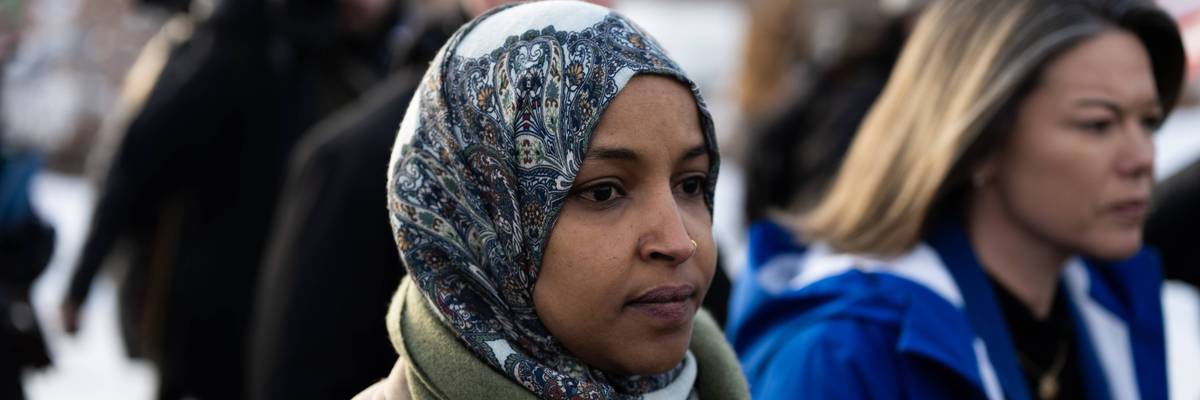
Democratic Congresswomen Ilhan Omar and Angie Craig of Minnesota arrive outside the regional headquarters of US Immigration and Customs Enforcement (ICE) in Minneapolis on January 10, 2026.
"Our bill will force ICE to pay the price for the damage they’ve left in their wake and ensure that these devastating operations can never be repeated," said the Minneapolis congresswoman.
On January 10, days after US Immigration and Customs Enforcement agents fatally shot US citizen and mother of three Renee Nicole Good in Minneapolis, US Rep. Ilhan Omar stood in the bitter cold of her home city, surrounded by a crowd of angry residents who'd taken to the streets.
It was just over a month into the Trump administration's "Operation Metro Surge"—a campaign that would come to be marked by the staggering scale of racial profiling that led to the arrests of US citizens, brazen defiance of court orders, and stunning displays of force, including two more shootings, one of them fatal.
Of the thousands of armed and masked agents who'd arrived to inflict terror upon the Twin Cities, Omar (D-Minn.) declared, "We are going to make sure that these people pay for what they have done to us." A cheer erupted from the crowd.
On Thursday, Omar introduced a piece of legislation aimed at fulfilling that promise. Titled the Make ICE Pay Act, the bill would block the roughly $140 billion allocated to immigration enforcement in last year's massive Republican budget law and redirect it to recovery efforts in communities reeling from ICE sieges.
"For over a year, ICE has been tearing through our nation, leading racist terror campaigns that have caused devastating damage to our cities, to our businesses, and to the lives of our constituents," Omar said.
"In Minneapolis, Operation Metro Surge cost our community nearly $700 million," she said, citing an estimate by the city of Minneapolis. "We have a moral responsibility to end this abuse of power. Our bill will force ICE to pay the price for the damage they’ve left in their wake and ensure that these devastating operations can never be repeated."
The Trump administration has used this funding to construct an enormous network of detention camps that have often held people in squalid conditions without contact with their loved ones or lawyers and to launch a hiring blitz that has swelled the agency's ranks with poorly vetted recruits, some of whom have gone on to commit deadly abuses of their newfound power.
It has also been used to supercharge ICE's footprint nationwide. With 51,000 arrests, August was the third consecutive month in which the agency set detention records.
And more than ever, the agency has gone after immigrants without criminal records, as well as asylum seekers, green card and visa holders, and Haitian and Syrian immigrants the administration abruptly stripped of Temporary Protected Status.
Through the US Department of Housing and Urban Development, Omar's bill would redirect this funding to states and cities on the receiving end of ICE abuses.
It would be used to provide them with economic relief, reimburse them for extra costs and lost economic activity resulting from raids, support schools and colleges that were disrupted, and provide mental health and social support to those affected.
Funds could also be allocated to support record-keeping and investigations into immigration agencies' conduct and to commissions that allow members of the public to testify about their experiences.
In addition to Minnesota, Omar's bill identifies several other localities that would be eligible for funding after being besieged by ICE, including California, Illinois, Louisiana, Maine, North Carolina, and Oregon, where numerous incidents of misconduct have also been documented.
The legislation is co-sponsored by Rep. Jesús "Chuy" García (D-Ill.), Rep. Rashida Tlaib (D-Mich.), Rep. Chellie Pingree (D-Maine), Rep. Sydney Kamlager-Dove (D-Calif.), Rep. Janelle Bynum (D-Ore.), and Rep. Angie Craig (D-Minn.).
Dear Common Dreams reader, It’s been nearly 30 years since I co-founded Common Dreams with my late wife, Lina Newhouser. We had the radical notion that journalism should serve the public good, not corporate profits. It was clear to us from the outset what it would take to build such a project. No paid advertisements. No corporate sponsors. No millionaire publisher telling us what to think or do. Many people said we wouldn't last a year, but we proved those doubters wrong. Together with a tremendous team of journalists and dedicated staff, we built an independent media outlet free from the constraints of profits and corporate control. Our mission has always been simple: To inform. To inspire. To ignite change for the common good. Building Common Dreams was not easy. Our survival was never guaranteed. When you take on the most powerful forces—Wall Street greed, fossil fuel industry destruction, Big Tech lobbyists, and uber-rich oligarchs who have spent billions upon billions rigging the economy and democracy in their favor—the only bulwark you have is supporters who believe in your work. But here’s the urgent message from me today. It's never been this bad out there. And it's never been this hard to keep us going. At the very moment Common Dreams is most needed, the threats we face are intensifying. We need your support now more than ever. We don't accept corporate advertising and never will. We don't have a paywall because we don't think people should be blocked from critical news based on their ability to pay. Everything we do is funded by the donations of readers like you. When everyone does the little they can afford, we are strong. But if that support retreats or dries up, so do we. Will you donate now to make sure Common Dreams not only survives but thrives? —Craig Brown, Co-founder |
On January 10, days after US Immigration and Customs Enforcement agents fatally shot US citizen and mother of three Renee Nicole Good in Minneapolis, US Rep. Ilhan Omar stood in the bitter cold of her home city, surrounded by a crowd of angry residents who'd taken to the streets.
It was just over a month into the Trump administration's "Operation Metro Surge"—a campaign that would come to be marked by the staggering scale of racial profiling that led to the arrests of US citizens, brazen defiance of court orders, and stunning displays of force, including two more shootings, one of them fatal.
Of the thousands of armed and masked agents who'd arrived to inflict terror upon the Twin Cities, Omar (D-Minn.) declared, "We are going to make sure that these people pay for what they have done to us." A cheer erupted from the crowd.
On Thursday, Omar introduced a piece of legislation aimed at fulfilling that promise. Titled the Make ICE Pay Act, the bill would block the roughly $140 billion allocated to immigration enforcement in last year's massive Republican budget law and redirect it to recovery efforts in communities reeling from ICE sieges.
"For over a year, ICE has been tearing through our nation, leading racist terror campaigns that have caused devastating damage to our cities, to our businesses, and to the lives of our constituents," Omar said.
"In Minneapolis, Operation Metro Surge cost our community nearly $700 million," she said, citing an estimate by the city of Minneapolis. "We have a moral responsibility to end this abuse of power. Our bill will force ICE to pay the price for the damage they’ve left in their wake and ensure that these devastating operations can never be repeated."
The Trump administration has used this funding to construct an enormous network of detention camps that have often held people in squalid conditions without contact with their loved ones or lawyers and to launch a hiring blitz that has swelled the agency's ranks with poorly vetted recruits, some of whom have gone on to commit deadly abuses of their newfound power.
It has also been used to supercharge ICE's footprint nationwide. With 51,000 arrests, August was the third consecutive month in which the agency set detention records.
And more than ever, the agency has gone after immigrants without criminal records, as well as asylum seekers, green card and visa holders, and Haitian and Syrian immigrants the administration abruptly stripped of Temporary Protected Status.
Through the US Department of Housing and Urban Development, Omar's bill would redirect this funding to states and cities on the receiving end of ICE abuses.
It would be used to provide them with economic relief, reimburse them for extra costs and lost economic activity resulting from raids, support schools and colleges that were disrupted, and provide mental health and social support to those affected.
Funds could also be allocated to support record-keeping and investigations into immigration agencies' conduct and to commissions that allow members of the public to testify about their experiences.
In addition to Minnesota, Omar's bill identifies several other localities that would be eligible for funding after being besieged by ICE, including California, Illinois, Louisiana, Maine, North Carolina, and Oregon, where numerous incidents of misconduct have also been documented.
The legislation is co-sponsored by Rep. Jesús "Chuy" García (D-Ill.), Rep. Rashida Tlaib (D-Mich.), Rep. Chellie Pingree (D-Maine), Rep. Sydney Kamlager-Dove (D-Calif.), Rep. Janelle Bynum (D-Ore.), and Rep. Angie Craig (D-Minn.).
On January 10, days after US Immigration and Customs Enforcement agents fatally shot US citizen and mother of three Renee Nicole Good in Minneapolis, US Rep. Ilhan Omar stood in the bitter cold of her home city, surrounded by a crowd of angry residents who'd taken to the streets.
It was just over a month into the Trump administration's "Operation Metro Surge"—a campaign that would come to be marked by the staggering scale of racial profiling that led to the arrests of US citizens, brazen defiance of court orders, and stunning displays of force, including two more shootings, one of them fatal.
Of the thousands of armed and masked agents who'd arrived to inflict terror upon the Twin Cities, Omar (D-Minn.) declared, "We are going to make sure that these people pay for what they have done to us." A cheer erupted from the crowd.
On Thursday, Omar introduced a piece of legislation aimed at fulfilling that promise. Titled the Make ICE Pay Act, the bill would block the roughly $140 billion allocated to immigration enforcement in last year's massive Republican budget law and redirect it to recovery efforts in communities reeling from ICE sieges.
"For over a year, ICE has been tearing through our nation, leading racist terror campaigns that have caused devastating damage to our cities, to our businesses, and to the lives of our constituents," Omar said.
"In Minneapolis, Operation Metro Surge cost our community nearly $700 million," she said, citing an estimate by the city of Minneapolis. "We have a moral responsibility to end this abuse of power. Our bill will force ICE to pay the price for the damage they’ve left in their wake and ensure that these devastating operations can never be repeated."
The Trump administration has used this funding to construct an enormous network of detention camps that have often held people in squalid conditions without contact with their loved ones or lawyers and to launch a hiring blitz that has swelled the agency's ranks with poorly vetted recruits, some of whom have gone on to commit deadly abuses of their newfound power.
It has also been used to supercharge ICE's footprint nationwide. With 51,000 arrests, August was the third consecutive month in which the agency set detention records.
And more than ever, the agency has gone after immigrants without criminal records, as well as asylum seekers, green card and visa holders, and Haitian and Syrian immigrants the administration abruptly stripped of Temporary Protected Status.
Through the US Department of Housing and Urban Development, Omar's bill would redirect this funding to states and cities on the receiving end of ICE abuses.
It would be used to provide them with economic relief, reimburse them for extra costs and lost economic activity resulting from raids, support schools and colleges that were disrupted, and provide mental health and social support to those affected.
Funds could also be allocated to support record-keeping and investigations into immigration agencies' conduct and to commissions that allow members of the public to testify about their experiences.
In addition to Minnesota, Omar's bill identifies several other localities that would be eligible for funding after being besieged by ICE, including California, Illinois, Louisiana, Maine, North Carolina, and Oregon, where numerous incidents of misconduct have also been documented.
The legislation is co-sponsored by Rep. Jesús "Chuy" García (D-Ill.), Rep. Rashida Tlaib (D-Mich.), Rep. Chellie Pingree (D-Maine), Rep. Sydney Kamlager-Dove (D-Calif.), Rep. Janelle Bynum (D-Ore.), and Rep. Angie Craig (D-Minn.).