SUBSCRIBE TO OUR FREE NEWSLETTER
Daily news & progressive opinion—funded by the people, not the corporations—delivered straight to your inbox.
5
#000000
#FFFFFF
To donate by check, phone, or other method, see our More Ways to Give page.
Daily news & progressive opinion—funded by the people, not the corporations—delivered straight to your inbox.
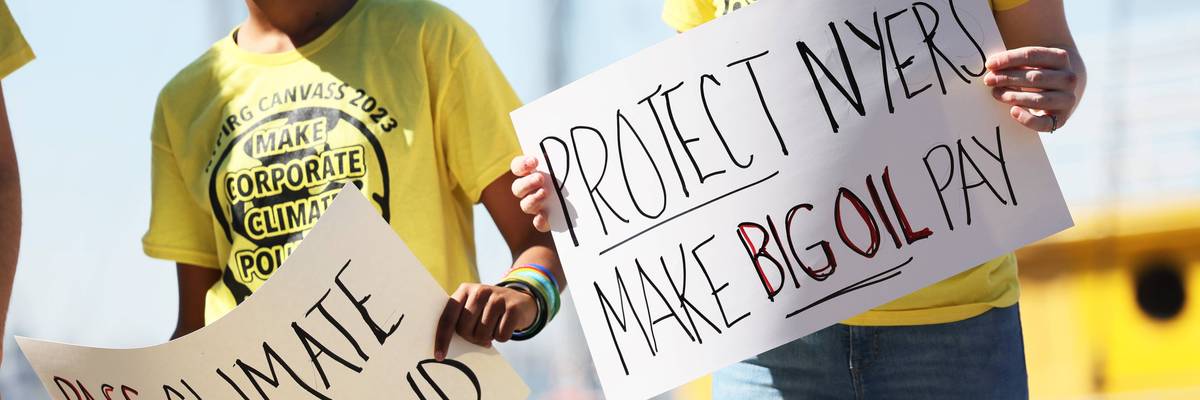
People hold signs during a press conference on the Climate Change Superfund Act at Pier 17 on May 26, 2023 in New York City.
“If allowed to stand, this wrongheaded ruling would shift $75 billion in planned climate-resilience funding from major fossil fuel polluters onto New York taxpayers,” said one advocate.
Climate advocates on Monday called on New York Attorney General Letitia James to appeal a ruling by a federal judge that found the state's superfund law, aimed at holding fossil fuel companies accountable for the weather disasters they cause, was unenforceable—"a bad decision," as campaigner Jamie Henn said, "based off a controversial ruling."
Henn, co-founder of 350.org and director of Fossil Free Media, said that "a cabal of Big Oil lawyers, Republican attorneys general, and Trump administration stooges just convinced a federal judge to strike down" the law, which was signed in 2024 by Democratic Gov. Kathy Hochul and would require oil and gas companies in New York to contribute about $3 billion annually—$75 billion total—to a superfund starting in 2028.
That sum would be divided among the companies according to their greenhouse gas emissions, which cause planetary heating and the hurricanes, flooding, and other extreme weather disasters that are associated with it.
Companies that have been found responsible for at least 1 billion tons of fossil fuel emissions between 2000-18 would be required to contribute to the fund, which would be used to rebuild infrastructure and help communities adapt to more frequent extreme weather events.
Chief Judge Brenda Sannes of the US District Court for the Northern District of New York ruled that a federal appeals court's earlier decision in City of New York v. Chevron Corp., in which the city's lawsuit against oil companies for climate damages was thrown out, was relevant to the Climate Change Superfund Act.
Sannes, who was appointed by former President Barack Obama, also said in her ruling that the state law is not authorized by the Clean Air Act and is preempted by federal law.
Henn said that after 22 Republican states joined industry groups and the US Chamber of Commerce in suing over the law, the judge "fell for Big Oil's argument that because of a precedent set by a controversial ruling involving the City of New York, the superfund program was preempted by the Clean Air Act."
"But that's bogus," said Henn. "The superfund program does nothing to regulate future emissions, it's just asking polluters to pay for a small share of the damages caused by their past pollution."
A judge in Vermont is expected to rule soon on the state's superfund law, which was the first in the nation. Sixteen states in all have proposed similar laws.
"This is far from the last word on the legality of climate superfund bills," said Henn.
Maya Golden-Krasner, deputy director of the Climate Law Institute at the Center for Biological Diversity, urged other states to "move forward with fair legislation that makes polluters pay for their damage."
"With the Trump administration gutting climate protections," she said, the campaign for superfund laws in states including California "is gaining momentum every day" despite the legal setback.
“If allowed to stand, this wrongheaded ruling would shift $75 billion in planned climate-resilience funding from major fossil fuel polluters onto New York taxpayers,” said Golden-Krasner.
Henn also said that the push to hold fossil fuel giants accountable for the damages their emissions cause "isn't going away."
"Eighty percent of voters think the fossil fuel industry should pay their fair share of climate damages," said Henn. "As disasters increase (and oil profits keep skyrocketing), the call to make polluters pay will only grow louder."
Dear Common Dreams reader, It’s been nearly 30 years since I co-founded Common Dreams with my late wife, Lina Newhouser. We had the radical notion that journalism should serve the public good, not corporate profits. It was clear to us from the outset what it would take to build such a project. No paid advertisements. No corporate sponsors. No millionaire publisher telling us what to think or do. Many people said we wouldn't last a year, but we proved those doubters wrong. Together with a tremendous team of journalists and dedicated staff, we built an independent media outlet free from the constraints of profits and corporate control. Our mission has always been simple: To inform. To inspire. To ignite change for the common good. Building Common Dreams was not easy. Our survival was never guaranteed. When you take on the most powerful forces—Wall Street greed, fossil fuel industry destruction, Big Tech lobbyists, and uber-rich oligarchs who have spent billions upon billions rigging the economy and democracy in their favor—the only bulwark you have is supporters who believe in your work. But here’s the urgent message from me today. It's never been this bad out there. And it's never been this hard to keep us going. At the very moment Common Dreams is most needed, the threats we face are intensifying. We need your support now more than ever. We don't accept corporate advertising and never will. We don't have a paywall because we don't think people should be blocked from critical news based on their ability to pay. Everything we do is funded by the donations of readers like you. When everyone does the little they can afford, we are strong. But if that support retreats or dries up, so do we. Will you donate now to make sure Common Dreams not only survives but thrives? —Craig Brown, Co-founder |
Climate advocates on Monday called on New York Attorney General Letitia James to appeal a ruling by a federal judge that found the state's superfund law, aimed at holding fossil fuel companies accountable for the weather disasters they cause, was unenforceable—"a bad decision," as campaigner Jamie Henn said, "based off a controversial ruling."
Henn, co-founder of 350.org and director of Fossil Free Media, said that "a cabal of Big Oil lawyers, Republican attorneys general, and Trump administration stooges just convinced a federal judge to strike down" the law, which was signed in 2024 by Democratic Gov. Kathy Hochul and would require oil and gas companies in New York to contribute about $3 billion annually—$75 billion total—to a superfund starting in 2028.
That sum would be divided among the companies according to their greenhouse gas emissions, which cause planetary heating and the hurricanes, flooding, and other extreme weather disasters that are associated with it.
Companies that have been found responsible for at least 1 billion tons of fossil fuel emissions between 2000-18 would be required to contribute to the fund, which would be used to rebuild infrastructure and help communities adapt to more frequent extreme weather events.
Chief Judge Brenda Sannes of the US District Court for the Northern District of New York ruled that a federal appeals court's earlier decision in City of New York v. Chevron Corp., in which the city's lawsuit against oil companies for climate damages was thrown out, was relevant to the Climate Change Superfund Act.
Sannes, who was appointed by former President Barack Obama, also said in her ruling that the state law is not authorized by the Clean Air Act and is preempted by federal law.
Henn said that after 22 Republican states joined industry groups and the US Chamber of Commerce in suing over the law, the judge "fell for Big Oil's argument that because of a precedent set by a controversial ruling involving the City of New York, the superfund program was preempted by the Clean Air Act."
"But that's bogus," said Henn. "The superfund program does nothing to regulate future emissions, it's just asking polluters to pay for a small share of the damages caused by their past pollution."
A judge in Vermont is expected to rule soon on the state's superfund law, which was the first in the nation. Sixteen states in all have proposed similar laws.
"This is far from the last word on the legality of climate superfund bills," said Henn.
Maya Golden-Krasner, deputy director of the Climate Law Institute at the Center for Biological Diversity, urged other states to "move forward with fair legislation that makes polluters pay for their damage."
"With the Trump administration gutting climate protections," she said, the campaign for superfund laws in states including California "is gaining momentum every day" despite the legal setback.
“If allowed to stand, this wrongheaded ruling would shift $75 billion in planned climate-resilience funding from major fossil fuel polluters onto New York taxpayers,” said Golden-Krasner.
Henn also said that the push to hold fossil fuel giants accountable for the damages their emissions cause "isn't going away."
"Eighty percent of voters think the fossil fuel industry should pay their fair share of climate damages," said Henn. "As disasters increase (and oil profits keep skyrocketing), the call to make polluters pay will only grow louder."
Climate advocates on Monday called on New York Attorney General Letitia James to appeal a ruling by a federal judge that found the state's superfund law, aimed at holding fossil fuel companies accountable for the weather disasters they cause, was unenforceable—"a bad decision," as campaigner Jamie Henn said, "based off a controversial ruling."
Henn, co-founder of 350.org and director of Fossil Free Media, said that "a cabal of Big Oil lawyers, Republican attorneys general, and Trump administration stooges just convinced a federal judge to strike down" the law, which was signed in 2024 by Democratic Gov. Kathy Hochul and would require oil and gas companies in New York to contribute about $3 billion annually—$75 billion total—to a superfund starting in 2028.
That sum would be divided among the companies according to their greenhouse gas emissions, which cause planetary heating and the hurricanes, flooding, and other extreme weather disasters that are associated with it.
Companies that have been found responsible for at least 1 billion tons of fossil fuel emissions between 2000-18 would be required to contribute to the fund, which would be used to rebuild infrastructure and help communities adapt to more frequent extreme weather events.
Chief Judge Brenda Sannes of the US District Court for the Northern District of New York ruled that a federal appeals court's earlier decision in City of New York v. Chevron Corp., in which the city's lawsuit against oil companies for climate damages was thrown out, was relevant to the Climate Change Superfund Act.
Sannes, who was appointed by former President Barack Obama, also said in her ruling that the state law is not authorized by the Clean Air Act and is preempted by federal law.
Henn said that after 22 Republican states joined industry groups and the US Chamber of Commerce in suing over the law, the judge "fell for Big Oil's argument that because of a precedent set by a controversial ruling involving the City of New York, the superfund program was preempted by the Clean Air Act."
"But that's bogus," said Henn. "The superfund program does nothing to regulate future emissions, it's just asking polluters to pay for a small share of the damages caused by their past pollution."
A judge in Vermont is expected to rule soon on the state's superfund law, which was the first in the nation. Sixteen states in all have proposed similar laws.
"This is far from the last word on the legality of climate superfund bills," said Henn.
Maya Golden-Krasner, deputy director of the Climate Law Institute at the Center for Biological Diversity, urged other states to "move forward with fair legislation that makes polluters pay for their damage."
"With the Trump administration gutting climate protections," she said, the campaign for superfund laws in states including California "is gaining momentum every day" despite the legal setback.
“If allowed to stand, this wrongheaded ruling would shift $75 billion in planned climate-resilience funding from major fossil fuel polluters onto New York taxpayers,” said Golden-Krasner.
Henn also said that the push to hold fossil fuel giants accountable for the damages their emissions cause "isn't going away."
"Eighty percent of voters think the fossil fuel industry should pay their fair share of climate damages," said Henn. "As disasters increase (and oil profits keep skyrocketing), the call to make polluters pay will only grow louder."