5
#000000
#FFFFFF
To donate by check, phone, or other method, see our More Ways to Give page.
Daily news & progressive opinion—funded by the people, not the corporations—delivered straight to your inbox.
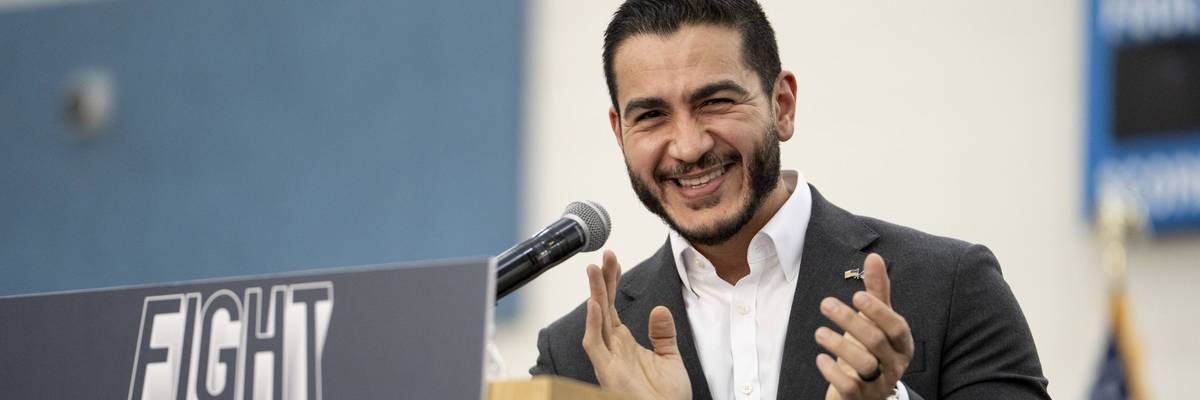
Democratic US Senate candidate Abdul El-Sayed speaks at Sen. Bernie Sanders' (I-Vt.) "Fight Oligarchy" tour on May 3, 2026 at Mumford High School in Detroit.
“With everyday costs getting higher and higher, it is clear that we need a system like Medicare for All," said the director of the group behind a new survey.
Nearly half of Michiganders surveyed for a poll published this week said they're struggling to pay for groceries and gas because of the high and rising cost of health insurance, underscoring an affordability crisis that Democratic US Senate candidate Abdul El-Sayed has cited as one of the reasons why the United States needs Medicare for All.
Forty-nine percent of Michigan voters queried by Progress Michigan and Public Policy Polling said the cost of health insurance affects their ability to afford basic necessities at least some of the time. Twenty-four percent said it happens “all the time,” while another 25% said it happens “sometimes.” Among Black Michiganders, the figures were substantially higher, with 34% reporting the problem occurs all the time and 31% saying it happens sometimes.
“Half of Michigan is already struggling with the cost of health insurance,” Progress Michigan executive director Justin Mendoza said Thursday in a statement. “With everyday costs getting higher and higher, it is clear that we need a system like Medicare for All to help Michiganders improve their health and afford their lives.”
El-Sayed, a physician and former Detroit health official, has made universal healthcare one of the three policy pillars of his campaign, alongside getting money "out of politics” and putting it "in your pocket.”
At a Monday "Students vs. Billionaires" town hall at Western Michigan University in Kalamazoo, El-Sayed argued that healthcare should be treated as a basic public investment rather than a commodity.
"You need good healthcare. You need a good education. We need childcare. We need good roads and bridges," he said. "We don’t need to send our money to big corporations to subsidize them, we need to be invested in people so they have the human capital to be able to do all the things as they graduate and come out. That's how the system should work."
El-Sayed has also repeatedly highlighted the plight of families who are insured but still cannot afford care because their deductibles are prohibitively expensive, and others who worry what will happen to their families' healthcare if they lose their jobs—an increasingly likely prospect as artificial intelligence usurps human workers.
“Medicare for All would allow us to actually provide every single person cradle-to-grave insurance,” El-Sayed said in a recent CBS interview, “without having to worry about losing it” after changing jobs, losing employment, getting married, or reaching retirement age.
The health insurance affordability crisis is likely to worsen in 2027. Healthinsurance.org reports that insurers are proposing a median increase of roughly 15% for individual market premiums nationwide, with Michigan insurers seeking an average 14.2% increase. The final rates could change before approval.
“Imagine not having to pay that," El-Sayed told CBS.
A new New York Times/Siena poll of Michigan voters found that 57% of respondents believe El-Sayed would do a better job on healthcare than Republican opponent Mike Rogers. Only 33% said Rogers would do a better job. Among all surveyed women, 67% said El-Sayed would be better for healthcare.
The overwhelming majority of voters ages 18-29 (86%) and Black voters (82%) agreed. Just 4% of Black respondents said Rogers would be better on healthcare. Among young voters, none—0%—said Rogers is the better choice for healthcare.
Dear Common Dreams reader, It’s been nearly 30 years since I co-founded Common Dreams with my late wife, Lina Newhouser. We had the radical notion that journalism should serve the public good, not corporate profits. It was clear to us from the outset what it would take to build such a project. No paid advertisements. No corporate sponsors. No millionaire publisher telling us what to think or do. Many people said we wouldn't last a year, but we proved those doubters wrong. Together with a tremendous team of journalists and dedicated staff, we built an independent media outlet free from the constraints of profits and corporate control. Our mission has always been simple: To inform. To inspire. To ignite change for the common good. Building Common Dreams was not easy. Our survival was never guaranteed. When you take on the most powerful forces—Wall Street greed, fossil fuel industry destruction, Big Tech lobbyists, and uber-rich oligarchs who have spent billions upon billions rigging the economy and democracy in their favor—the only bulwark you have is supporters who believe in your work. But here’s the urgent message from me today. It's never been this bad out there. And it's never been this hard to keep us going. At the very moment Common Dreams is most needed, the threats we face are intensifying. We need your support now more than ever. We don't accept corporate advertising and never will. We don't have a paywall because we don't think people should be blocked from critical news based on their ability to pay. Everything we do is funded by the donations of readers like you. When everyone does the little they can afford, we are strong. But if that support retreats or dries up, so do we. Will you donate now to make sure Common Dreams not only survives but thrives? —Craig Brown, Co-founder |
Nearly half of Michiganders surveyed for a poll published this week said they're struggling to pay for groceries and gas because of the high and rising cost of health insurance, underscoring an affordability crisis that Democratic US Senate candidate Abdul El-Sayed has cited as one of the reasons why the United States needs Medicare for All.
Forty-nine percent of Michigan voters queried by Progress Michigan and Public Policy Polling said the cost of health insurance affects their ability to afford basic necessities at least some of the time. Twenty-four percent said it happens “all the time,” while another 25% said it happens “sometimes.” Among Black Michiganders, the figures were substantially higher, with 34% reporting the problem occurs all the time and 31% saying it happens sometimes.
“Half of Michigan is already struggling with the cost of health insurance,” Progress Michigan executive director Justin Mendoza said Thursday in a statement. “With everyday costs getting higher and higher, it is clear that we need a system like Medicare for All to help Michiganders improve their health and afford their lives.”
El-Sayed, a physician and former Detroit health official, has made universal healthcare one of the three policy pillars of his campaign, alongside getting money "out of politics” and putting it "in your pocket.”
At a Monday "Students vs. Billionaires" town hall at Western Michigan University in Kalamazoo, El-Sayed argued that healthcare should be treated as a basic public investment rather than a commodity.
"You need good healthcare. You need a good education. We need childcare. We need good roads and bridges," he said. "We don’t need to send our money to big corporations to subsidize them, we need to be invested in people so they have the human capital to be able to do all the things as they graduate and come out. That's how the system should work."
El-Sayed has also repeatedly highlighted the plight of families who are insured but still cannot afford care because their deductibles are prohibitively expensive, and others who worry what will happen to their families' healthcare if they lose their jobs—an increasingly likely prospect as artificial intelligence usurps human workers.
“Medicare for All would allow us to actually provide every single person cradle-to-grave insurance,” El-Sayed said in a recent CBS interview, “without having to worry about losing it” after changing jobs, losing employment, getting married, or reaching retirement age.
The health insurance affordability crisis is likely to worsen in 2027. Healthinsurance.org reports that insurers are proposing a median increase of roughly 15% for individual market premiums nationwide, with Michigan insurers seeking an average 14.2% increase. The final rates could change before approval.
“Imagine not having to pay that," El-Sayed told CBS.
A new New York Times/Siena poll of Michigan voters found that 57% of respondents believe El-Sayed would do a better job on healthcare than Republican opponent Mike Rogers. Only 33% said Rogers would do a better job. Among all surveyed women, 67% said El-Sayed would be better for healthcare.
The overwhelming majority of voters ages 18-29 (86%) and Black voters (82%) agreed. Just 4% of Black respondents said Rogers would be better on healthcare. Among young voters, none—0%—said Rogers is the better choice for healthcare.
Nearly half of Michiganders surveyed for a poll published this week said they're struggling to pay for groceries and gas because of the high and rising cost of health insurance, underscoring an affordability crisis that Democratic US Senate candidate Abdul El-Sayed has cited as one of the reasons why the United States needs Medicare for All.
Forty-nine percent of Michigan voters queried by Progress Michigan and Public Policy Polling said the cost of health insurance affects their ability to afford basic necessities at least some of the time. Twenty-four percent said it happens “all the time,” while another 25% said it happens “sometimes.” Among Black Michiganders, the figures were substantially higher, with 34% reporting the problem occurs all the time and 31% saying it happens sometimes.
“Half of Michigan is already struggling with the cost of health insurance,” Progress Michigan executive director Justin Mendoza said Thursday in a statement. “With everyday costs getting higher and higher, it is clear that we need a system like Medicare for All to help Michiganders improve their health and afford their lives.”
El-Sayed, a physician and former Detroit health official, has made universal healthcare one of the three policy pillars of his campaign, alongside getting money "out of politics” and putting it "in your pocket.”
At a Monday "Students vs. Billionaires" town hall at Western Michigan University in Kalamazoo, El-Sayed argued that healthcare should be treated as a basic public investment rather than a commodity.
"You need good healthcare. You need a good education. We need childcare. We need good roads and bridges," he said. "We don’t need to send our money to big corporations to subsidize them, we need to be invested in people so they have the human capital to be able to do all the things as they graduate and come out. That's how the system should work."
El-Sayed has also repeatedly highlighted the plight of families who are insured but still cannot afford care because their deductibles are prohibitively expensive, and others who worry what will happen to their families' healthcare if they lose their jobs—an increasingly likely prospect as artificial intelligence usurps human workers.
“Medicare for All would allow us to actually provide every single person cradle-to-grave insurance,” El-Sayed said in a recent CBS interview, “without having to worry about losing it” after changing jobs, losing employment, getting married, or reaching retirement age.
The health insurance affordability crisis is likely to worsen in 2027. Healthinsurance.org reports that insurers are proposing a median increase of roughly 15% for individual market premiums nationwide, with Michigan insurers seeking an average 14.2% increase. The final rates could change before approval.
“Imagine not having to pay that," El-Sayed told CBS.
A new New York Times/Siena poll of Michigan voters found that 57% of respondents believe El-Sayed would do a better job on healthcare than Republican opponent Mike Rogers. Only 33% said Rogers would do a better job. Among all surveyed women, 67% said El-Sayed would be better for healthcare.
The overwhelming majority of voters ages 18-29 (86%) and Black voters (82%) agreed. Just 4% of Black respondents said Rogers would be better on healthcare. Among young voters, none—0%—said Rogers is the better choice for healthcare.