5
#000000
#FFFFFF
To donate by check, phone, or other method, see our More Ways to Give page.
Daily news & progressive opinion—funded by the people, not the corporations—delivered straight to your inbox.
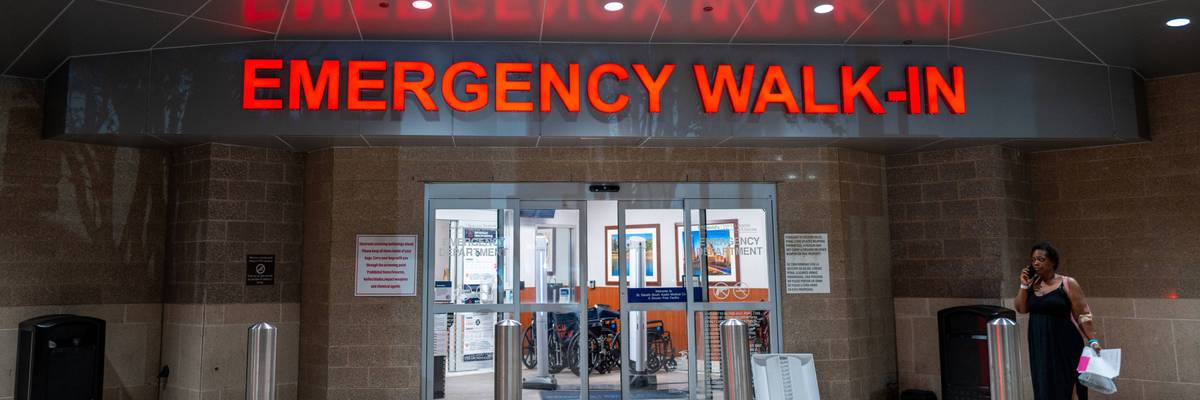
A person waits outside of the St. David's South Austin Medical Center on September 3, 2026 in Austin, Texas.
One expert said the Medicaid cuts "will certainly result in layoffs, may result in hospital closures, and will definitely hurt people’s health."
With changes to Medicaid mandated by Republicans' 2025 budget law set to take effect next year, experts are warning that the impacts could be devastating for rural areas in states such as Kentucky and Nebraska.
A report published by The Guardian on Friday highlighted how the cuts to Medicaid in the One Big Beautiful Bill Act are expected to impact Kentucky, where 250,000 residents are estimated to be at risk of losing their coverage and 35 hospitals are at risk of closure.
Dustin Pugel, policy director at the Kentucky Center for Economic Policy, told The Guardian that the Bluegrass State is particularly vulnerable to Republicans' Medicaid cuts, which the Congressional Budget Office projects will kick millions of Americans off their health coverage nationwide.
"These hospitals are very dependent on Medicaid," Pugel explained. "It makes up a really significant part of the economy, particularly in eastern Kentucky. If you look at just Medicaid payments to providers in Kentucky’s 5th congressional district, those payments make up 13.5% of the GDP there."
Pugel pointed to the work requirements in the GOP budget law as especially burdensome for many rural residents, emphasizing that they could send local economies into a tailspin.
"In some of these counties, over two-thirds of their residents are covered by Medicaid," he explained. "If they start losing coverage, particularly where there isn’t a lot of jobs—where people aren’t able to adhere to the work requirement or don’t have broadband so reporting their hours is difficult, you’re looking at a really significant economic headwind. That will certainly result in layoffs, may result in hospital closures, and will definitely hurt people’s health."
A Wednesday report from KFF Health News noted that Nebraska got an early start in implementing the Medicaid work requirements, resulting in 7% of Nebraska Medicaid enrollees who were subject to the new rules losing coverage. Additionally, KFF reported, 14% of new Medicaid applicants were denied coverage thanks to the work requirement rules.
KFF also found that "92% of cases in which existing enrollees lost coverage were due to procedural or paperwork issues rather than state determinations that they did not meet the new work rules," while "many enrollees lost coverage because they did not respond to the state's outreach."
Amy Behnke, CEO of the Health Center Association of Nebraska, told KFF that the increased number of procedural denials for Medicaid seen over the last few months is "definitely a red-flag warning" that many people are needlessly losing their coverage.
As Nebraska Public Media reported on Tuesday, the Nebraska Hospital Association has been sounding the alarm about how these cuts will impact the fiscal health of state healthcare facilities, warning that they "threaten the financial stability of rural hospitals and ultimately harm patient access to essential services across the state."
Jeremy Nordquist, president of the Nebraska Hospital Association, told Nebraska Public Media that the healthcare system under the new Medicaid rules is suffering "a death by 1,000 cuts."
"It really has the potential," Nordquist added, "to be a devastating blow to our already vulnerable healthcare infrastructure here in the state."
This country and this world are at a monumental crossroads. US voters have an opportunity to beat back the forces of fascism and confront the billionaires who are rigging the economy, our media system, and our democracy, making it increasingly impossible for ordinary people to get by. We’re not just talking about the election. We’re talking about what must be done once these fascist elements are vanquished from power. We need a bolder set of solutions than what either major party has so far been willing to offer and a working-class movement ready to fight like hell for it. Trump didn't emerge from nowhere. The conditions that fueled MAGA authoritarianism were created by decades of radical neoliberal economic policies and a corrupt political system dominated by corporate interests. They slashed taxes on the super-rich, promising that the benefits would trickle down. They said giveaways to the corporate titans would make life more affordable for the rest of us. It was all bullshit. And when a bitter, betrayed populace searches for someone to blame, right-wing demagogues have little trouble finding scapegoats. People know when they're being lied to, but you won't hear any of this from the corporate media. Only independent journalism—powered and funded by people who believe in building a better world—can deliver truly trustworthy daily news. If you share our vision, please contribute whatever you can to sustain our work. |
With changes to Medicaid mandated by Republicans' 2025 budget law set to take effect next year, experts are warning that the impacts could be devastating for rural areas in states such as Kentucky and Nebraska.
A report published by The Guardian on Friday highlighted how the cuts to Medicaid in the One Big Beautiful Bill Act are expected to impact Kentucky, where 250,000 residents are estimated to be at risk of losing their coverage and 35 hospitals are at risk of closure.
Dustin Pugel, policy director at the Kentucky Center for Economic Policy, told The Guardian that the Bluegrass State is particularly vulnerable to Republicans' Medicaid cuts, which the Congressional Budget Office projects will kick millions of Americans off their health coverage nationwide.
"These hospitals are very dependent on Medicaid," Pugel explained. "It makes up a really significant part of the economy, particularly in eastern Kentucky. If you look at just Medicaid payments to providers in Kentucky’s 5th congressional district, those payments make up 13.5% of the GDP there."
Pugel pointed to the work requirements in the GOP budget law as especially burdensome for many rural residents, emphasizing that they could send local economies into a tailspin.
"In some of these counties, over two-thirds of their residents are covered by Medicaid," he explained. "If they start losing coverage, particularly where there isn’t a lot of jobs—where people aren’t able to adhere to the work requirement or don’t have broadband so reporting their hours is difficult, you’re looking at a really significant economic headwind. That will certainly result in layoffs, may result in hospital closures, and will definitely hurt people’s health."
A Wednesday report from KFF Health News noted that Nebraska got an early start in implementing the Medicaid work requirements, resulting in 7% of Nebraska Medicaid enrollees who were subject to the new rules losing coverage. Additionally, KFF reported, 14% of new Medicaid applicants were denied coverage thanks to the work requirement rules.
KFF also found that "92% of cases in which existing enrollees lost coverage were due to procedural or paperwork issues rather than state determinations that they did not meet the new work rules," while "many enrollees lost coverage because they did not respond to the state's outreach."
Amy Behnke, CEO of the Health Center Association of Nebraska, told KFF that the increased number of procedural denials for Medicaid seen over the last few months is "definitely a red-flag warning" that many people are needlessly losing their coverage.
As Nebraska Public Media reported on Tuesday, the Nebraska Hospital Association has been sounding the alarm about how these cuts will impact the fiscal health of state healthcare facilities, warning that they "threaten the financial stability of rural hospitals and ultimately harm patient access to essential services across the state."
Jeremy Nordquist, president of the Nebraska Hospital Association, told Nebraska Public Media that the healthcare system under the new Medicaid rules is suffering "a death by 1,000 cuts."
"It really has the potential," Nordquist added, "to be a devastating blow to our already vulnerable healthcare infrastructure here in the state."