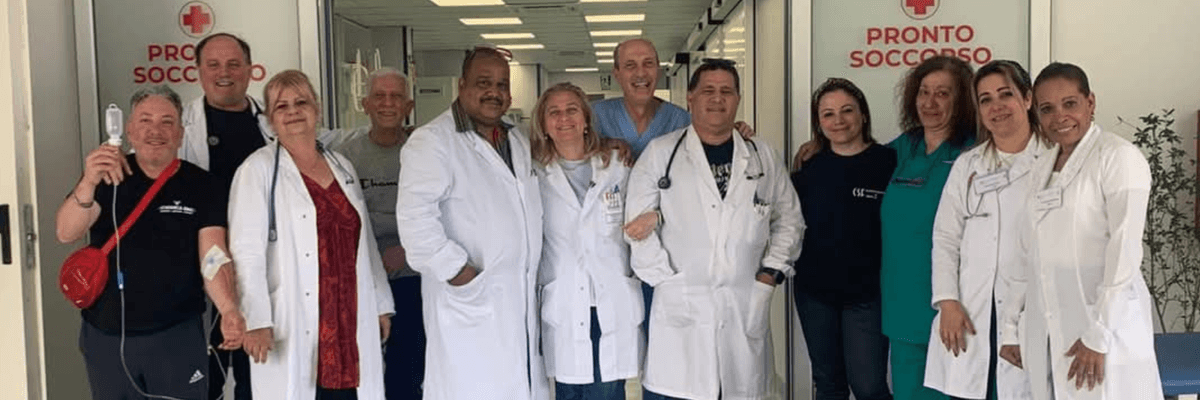
Members of the Cuban medical mission to Calabria pose for a photo with their Italian colleagues in Cosenza, Italy on May 23, 2025.
8,000+ Italian Medical Professionals Sign Open Letter Decrying US Blockade of Cuba
"Italy is indebted to Cuba," the letter states. "Every day of silence has a cost in human lives."
As of Wednesday, more than 8,000 Italian medical and scientific professionals have signed an open letter acknowledging their indebtedness to Cuban doctors and condemning the tightening of the 65-year US embargo on Cuba by President Donald Trump as he threatens "take" the island.
"Over the decades, Cuba has built a health system that was considered an international model, capable of guaranteeing universal access to care even in limited resource conditions. Since 1963, more than 600,000 Cuban health workers have served in more than 160 countries, including Italy," states the letter addressed to Italian Prime Minister Giorgia Meloni and Health Minister Orazio Schillaci.
"That system is currently in a state of collapse," the letter continues. "Survival in childhood cancers has fallen from 80% to 65% due to the lack of first-line drugs."
The publication notes that "96,000 people—almost 1% of the population—including 11,000 children are on the waiting list for surgery. If the situation does not change, the list could affect 160,000 patients by the end of 2026. Over 300 pediatric surgeries per week are compromised by shortages of drugs, oxygen, anesthetics, and consumables."
"The crisis has its roots in a combination of factors that have progressively worsened," the letter continues. "The tightening of the economic embargo during the first Trump administration, Covid-19, and, since January 2026, the near-total blockade of energy supplies following the Venezuelan crisis have deprived the island of fuel, electricity, and access to international drug and medical device markets."
A report published in April by researchers at the Center for Economic Policy and Research confirmed an “unprecedented increase” in Cuba’s infant mortality rate, which soared 148% between 2018 and 2025.
Report co-author Joe Sammut said that “the blockade has had a particularly dire effect on Cuba’s healthcare infrastructure, with frequent power outages" exacerbated by the US oil blockade "interrupting the use of critical equipment for the treatment of patients, including incubators for premature babies, and ventilators to help sick newborns breathe."
The United Nations General Assembly has overwhelmingly condemned the broader US embargo—which Cuba’s government says has cost the island's economy more than $1 trillion over seven decades—33 times.
"The collapse of a health system is not just a local tragedy: It is a violation of fundamental human rights that requires a response from the global community, beyond any political assessment of the Cuban regime," the Italian letter argues.
"Italy cannot remain indifferent or silent, also because it is indebted to Cuba for the help received during the Covid-19 pandemic and for the current work of Cuban doctors in the Calabria Region to guarantee the functioning of the local health service," the publication adds.
The Trump administration has been pressuring Italy to curb its use of Cuban doctors, who are essential to Calabria's healthcare system.
"It is the duty of the global health community—doctors, researchers, institutions, scientific journals—but also of the civil community to act without ambiguity, in compliance with the fundamental principles of humanitarian law," the letter concludes. "Every day of silence has a cost in human lives."
We are at a crossroads
This country and this world are at a monumental crossroads. In a few short weeks, US voters will have an opportunity to beat back the forces of fascism and confront the billionaires who are rigging the economy, our media system, and our democracy, making it increasingly impossible for ordinary people to get by. We’re not just talking about the election. We’re talking about what must be done once these fascist elements are vanquished from power. We need a bolder set of solutions than what either major party has so far been willing to offer and a working-class movement ready to fight like hell for it. Trump didn't emerge from nowhere. The conditions that fueled MAGA authoritarianism were created by decades of radical neoliberal economic policies and a corrupt political system dominated by corporate interests. They slashed taxes on the super-rich, promising that the benefits would trickle down. They said giveaways to the corporate titans would make life more affordable for the rest of us. It was all bullshit. And when a bitter, betrayed populace searches for someone to blame, right-wing demagogues have little trouble finding scapegoats. People know when they're being lied to, but you won't hear any of this from the corporate media. Only independent journalism—powered and funded by people who believe in building a better world—can deliver truly trustworthy daily news. Our Fall Campaign is underway, and we need your help. To power our newsroom through the rest of the year, we need to raise $125,000 by midnight on October 31. So if you share our vision, please contribute whatever you can to sustain our work. |
As of Wednesday, more than 8,000 Italian medical and scientific professionals have signed an open letter acknowledging their indebtedness to Cuban doctors and condemning the tightening of the 65-year US embargo on Cuba by President Donald Trump as he threatens "take" the island.
"Over the decades, Cuba has built a health system that was considered an international model, capable of guaranteeing universal access to care even in limited resource conditions. Since 1963, more than 600,000 Cuban health workers have served in more than 160 countries, including Italy," states the letter addressed to Italian Prime Minister Giorgia Meloni and Health Minister Orazio Schillaci.
"That system is currently in a state of collapse," the letter continues. "Survival in childhood cancers has fallen from 80% to 65% due to the lack of first-line drugs."
The publication notes that "96,000 people—almost 1% of the population—including 11,000 children are on the waiting list for surgery. If the situation does not change, the list could affect 160,000 patients by the end of 2026. Over 300 pediatric surgeries per week are compromised by shortages of drugs, oxygen, anesthetics, and consumables."
"The crisis has its roots in a combination of factors that have progressively worsened," the letter continues. "The tightening of the economic embargo during the first Trump administration, Covid-19, and, since January 2026, the near-total blockade of energy supplies following the Venezuelan crisis have deprived the island of fuel, electricity, and access to international drug and medical device markets."
A report published in April by researchers at the Center for Economic Policy and Research confirmed an “unprecedented increase” in Cuba’s infant mortality rate, which soared 148% between 2018 and 2025.
Report co-author Joe Sammut said that “the blockade has had a particularly dire effect on Cuba’s healthcare infrastructure, with frequent power outages" exacerbated by the US oil blockade "interrupting the use of critical equipment for the treatment of patients, including incubators for premature babies, and ventilators to help sick newborns breathe."
The United Nations General Assembly has overwhelmingly condemned the broader US embargo—which Cuba’s government says has cost the island's economy more than $1 trillion over seven decades—33 times.
"The collapse of a health system is not just a local tragedy: It is a violation of fundamental human rights that requires a response from the global community, beyond any political assessment of the Cuban regime," the Italian letter argues.
"Italy cannot remain indifferent or silent, also because it is indebted to Cuba for the help received during the Covid-19 pandemic and for the current work of Cuban doctors in the Calabria Region to guarantee the functioning of the local health service," the publication adds.
The Trump administration has been pressuring Italy to curb its use of Cuban doctors, who are essential to Calabria's healthcare system.
"It is the duty of the global health community—doctors, researchers, institutions, scientific journals—but also of the civil community to act without ambiguity, in compliance with the fundamental principles of humanitarian law," the letter concludes. "Every day of silence has a cost in human lives."
As of Wednesday, more than 8,000 Italian medical and scientific professionals have signed an open letter acknowledging their indebtedness to Cuban doctors and condemning the tightening of the 65-year US embargo on Cuba by President Donald Trump as he threatens "take" the island.
"Over the decades, Cuba has built a health system that was considered an international model, capable of guaranteeing universal access to care even in limited resource conditions. Since 1963, more than 600,000 Cuban health workers have served in more than 160 countries, including Italy," states the letter addressed to Italian Prime Minister Giorgia Meloni and Health Minister Orazio Schillaci.
"That system is currently in a state of collapse," the letter continues. "Survival in childhood cancers has fallen from 80% to 65% due to the lack of first-line drugs."
The publication notes that "96,000 people—almost 1% of the population—including 11,000 children are on the waiting list for surgery. If the situation does not change, the list could affect 160,000 patients by the end of 2026. Over 300 pediatric surgeries per week are compromised by shortages of drugs, oxygen, anesthetics, and consumables."
"The crisis has its roots in a combination of factors that have progressively worsened," the letter continues. "The tightening of the economic embargo during the first Trump administration, Covid-19, and, since January 2026, the near-total blockade of energy supplies following the Venezuelan crisis have deprived the island of fuel, electricity, and access to international drug and medical device markets."
A report published in April by researchers at the Center for Economic Policy and Research confirmed an “unprecedented increase” in Cuba’s infant mortality rate, which soared 148% between 2018 and 2025.
Report co-author Joe Sammut said that “the blockade has had a particularly dire effect on Cuba’s healthcare infrastructure, with frequent power outages" exacerbated by the US oil blockade "interrupting the use of critical equipment for the treatment of patients, including incubators for premature babies, and ventilators to help sick newborns breathe."
The United Nations General Assembly has overwhelmingly condemned the broader US embargo—which Cuba’s government says has cost the island's economy more than $1 trillion over seven decades—33 times.
"The collapse of a health system is not just a local tragedy: It is a violation of fundamental human rights that requires a response from the global community, beyond any political assessment of the Cuban regime," the Italian letter argues.
"Italy cannot remain indifferent or silent, also because it is indebted to Cuba for the help received during the Covid-19 pandemic and for the current work of Cuban doctors in the Calabria Region to guarantee the functioning of the local health service," the publication adds.
The Trump administration has been pressuring Italy to curb its use of Cuban doctors, who are essential to Calabria's healthcare system.
"It is the duty of the global health community—doctors, researchers, institutions, scientific journals—but also of the civil community to act without ambiguity, in compliance with the fundamental principles of humanitarian law," the letter concludes. "Every day of silence has a cost in human lives."