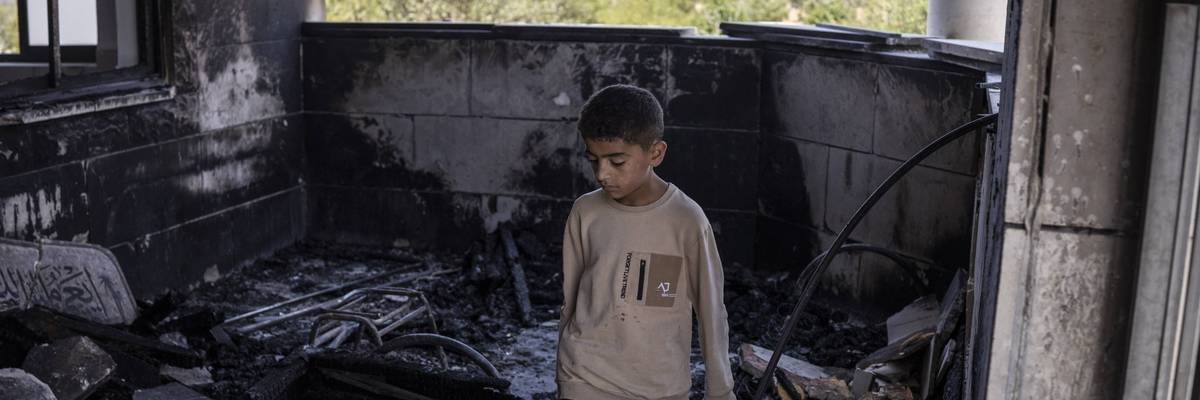
A young Palestinian boy is seen at a mosque allegedly burned by Israeli settlers in the village of Qusra, south of Nablus in the Israeli-occupied West Bank on July 26, 2026.
As Netanyahu Prepares to Meet Trump, Explosion of Israeli Settler Violence Draws International Condemnation
"Governments need to act urgently so that the Israeli government does not continue to act as if it has a green light to commit further atrocities," said a researcher at Human Rights Watch.
As Israeli Prime Minister Benjamin Netanyahu prepares to meet with US President Donald Trump this week, Israeli soldiers stormed into several villages across the occupied West Bank on Monday, expanding a rolling campaign of violence waged by illegal settlers in recent days.
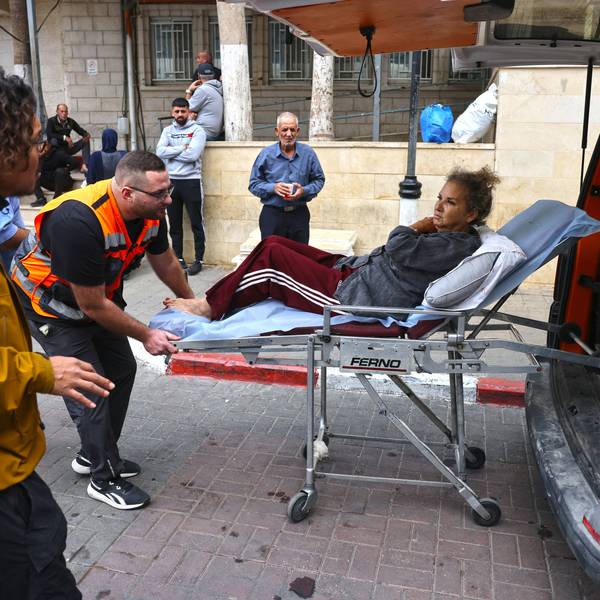
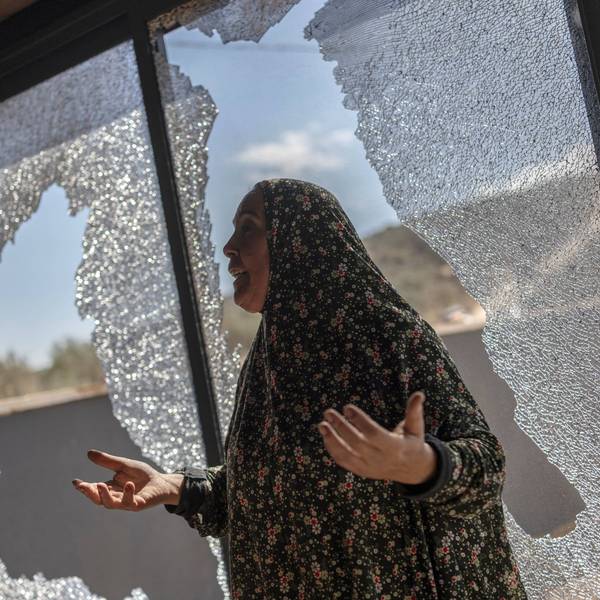
Over the weekend, armed settlers rampaged across more than a dozen Palestinian communities, torching homes and farmland, vandalizing buildings and cars, and burning a pair of mosques in Qusra and Kour.
They were acts of retaliation after two armed Israelis were killed while helping dozens of settlers carry out what Palestinian physician and political leader Mustafa Barghouti described as a “terrorist attack” in the village of Tell, near Nablus in the northern West Bank. That assault killed four Palestinians.
Tell was one of dozens of Palestinian communities to be attacked in recent weeks as part of a campaign of escalating settler violence egged on by the Israeli government as it seeks to cement total control over the West Bank.
More than 150 settler attacks involving killings or property damage have been documented in the West Bank so far this month, according to the United Nations Office for the Coordination of Humanitarian Affairs (UNOCHA).
The Palestinian Health Ministry reports that 21 Palestinians have been killed by settlers this year, already more than were killed in all of 2025.
While the Israeli military has said it was working with police to investigate the desecration of the two mosques, which were burned and spray-painted with graffiti calling for "revenge" and "blood," settlers have almost never faced accountability in Israeli courts.
This weekend's violence, meanwhile, has been openly egged on by members of Netanyahu's government, which ordered more troops into the territory, where they have raided over 20 towns as of Monday morning.
Finance Minister Bezalel Smotrich, an architect of Israel's accelerating settlement construction, said Tell should “look like the refugee camps in Nablus and Tulkarem,” referring to West Bank villages devastated by Israeli home demolitions that displaced tens of thousands of Palestinians last year.
Security Minister Itamar Ben-Gvir said the town should be treated like the village of Beit Hanoun in Gaza, which has largely been reduced to rubble by Israeli attacks. He also said he’d demand that Israel bomb and bulldoze Palestinian homes.
The military said it arrested at least 130 Palestinians across the West Bank over the weekend, while just two Israeli settlers tied to extremist violence have been arrested, with no details released about charges or what attack they were involved in.
Nida Ibrahim, a reporter for Al Jazeera, said on Monday this was typical: “Israeli settlers continue their attacks against Palestinians, mostly in their homes, at night, intimidating them. And what happens is that usually Israeli forces would come in and instead of curbing these settlers, they would conduct arrests in the occupied West Bank among Palestinians."
She said Palestinians felt like they had "no one to protect them,” while "the Israeli settlers have the support of the Israeli army and have the impunity to continue attacking Palestinians without any accountability.”
Shaiel Ben-Ephraim, an Israeli analyst who specializes in settlement policy, argued that settlers' confrontations with Palestinians were meant to provoke retaliation and a military response that allows them to deepen Israeli control of the territory.
"What everyone needs to understand is that the settlers in the West Bank intentionally cause these violent confrontations," Ben-Ephraim wrote on social media. "Ninety-nine percent of the time, the Palestinian victims don't even react. Then in the 1% when they do, the IDF treats it as terrorism and starts killing and arresting the victims and giving the land to the settlers."
"This is a method," he said. "It will not stop until there is nothing left."
This weekend's escalation was met with renewed international outcry from governments and human rights groups who demanded accountability for illegal settlers and the officials enabling them.
Francesca Albanese, the UN’s special rapporteur on the occupied Palestinian Territories, described the ongoing attacks against Palestinians as “pogroms against defenseless civilians.”
Sarah Sanbar, an Israel-Palestine researcher for Human Rights Watch, said this weekend's conflagration occurred because "the Israeli government didn’t prevent the settler attacks on Tell village, so now it needs to stop settler reprisals and escalating military action that will make a bad situation worse."
She added that "governments need to act urgently so that the Israeli government does not continue to act as if it has a green light to commit further atrocities.”
Jordan's foreign ministry condemned the “escalating settler terrorism" in the West Bank, while the state of Qatar said the attacks were a "flagrant violation of international law and international legitimacy resolutions."
The European Union issued a more muted statement, without naming Israel or mentioning the involvement of illegal settlers and instead calling on "all parties to avoid inflammatory language."
Spain, meanwhile, was much more direct, calling out "violence perpetrated by Israeli settlers, who continue to act with impunity" and calling on Israel to "reverse its policies of settlement expansion and of shielding settler violence."
As of Monday morning, the Trump administration has remained silent on the violent events of the past weekend, beyond a generic State Department statement condemning violence “by any party."
This is consistent with its policy of unrestrained military support for Israel and legitimation of its project to settle occupied Palestine in violation of international law.
Nabil Fahmy, the secretary general of the Arab League, urged Trump to push Netanyahu this week to restrain “the Israeli government’s extremist ambitions,” including its implementation of a “de facto annexation in the West Bank.”
Nearly 600 Israeli military, police, and intelligence officials with the group Commanders for Israel Security likewise urged Trump to pressure Netanyahu to rein in the violence, saying it was in the interest of US and Israeli security.
"Unless arrested swiftly and decisively, escalating violence in the West Bank is poised to ignite the region and carries severe ramifications for both Israeli security and US regional interests," wrote former IDF Chief of Staff, Retired Maj. Gen. Matan Vilnai in an open letter sent to the president on Monday. "It is no secret that certain members of our current government orchestrate much of this chaos, including by shielding their followers—who are armed and driven by messianic impulses—from the law and its enforcement."
We are at a crossroads
This country and this world are at a monumental crossroads. In a few short weeks, US voters will have an opportunity to beat back the forces of fascism and confront the billionaires who are rigging the economy, our media system, and our democracy, making it increasingly impossible for ordinary people to get by. We’re not just talking about the election. We’re talking about what must be done once these fascist elements are vanquished from power. We need a bolder set of solutions than what either major party has so far been willing to offer and a working-class movement ready to fight like hell for it. Trump didn't emerge from nowhere. The conditions that fueled MAGA authoritarianism were created by decades of radical neoliberal economic policies and a corrupt political system dominated by corporate interests. They slashed taxes on the super-rich, promising that the benefits would trickle down. They said giveaways to the corporate titans would make life more affordable for the rest of us. It was all bullshit. And when a bitter, betrayed populace searches for someone to blame, right-wing demagogues have little trouble finding scapegoats. People know when they're being lied to, but you won't hear any of this from the corporate media. Only independent journalism—powered and funded by people who believe in building a better world—can deliver truly trustworthy daily news. Our Fall Campaign is underway, and we need your help. To power our newsroom through the rest of the year, we need to raise $125,000 by midnight on October 31. So if you share our vision, please contribute whatever you can to sustain our work. |
As Israeli Prime Minister Benjamin Netanyahu prepares to meet with US President Donald Trump this week, Israeli soldiers stormed into several villages across the occupied West Bank on Monday, expanding a rolling campaign of violence waged by illegal settlers in recent days.
Over the weekend, armed settlers rampaged across more than a dozen Palestinian communities, torching homes and farmland, vandalizing buildings and cars, and burning a pair of mosques in Qusra and Kour.
They were acts of retaliation after two armed Israelis were killed while helping dozens of settlers carry out what Palestinian physician and political leader Mustafa Barghouti described as a “terrorist attack” in the village of Tell, near Nablus in the northern West Bank. That assault killed four Palestinians.
Tell was one of dozens of Palestinian communities to be attacked in recent weeks as part of a campaign of escalating settler violence egged on by the Israeli government as it seeks to cement total control over the West Bank.
More than 150 settler attacks involving killings or property damage have been documented in the West Bank so far this month, according to the United Nations Office for the Coordination of Humanitarian Affairs (UNOCHA).
The Palestinian Health Ministry reports that 21 Palestinians have been killed by settlers this year, already more than were killed in all of 2025.
While the Israeli military has said it was working with police to investigate the desecration of the two mosques, which were burned and spray-painted with graffiti calling for "revenge" and "blood," settlers have almost never faced accountability in Israeli courts.
This weekend's violence, meanwhile, has been openly egged on by members of Netanyahu's government, which ordered more troops into the territory, where they have raided over 20 towns as of Monday morning.
Finance Minister Bezalel Smotrich, an architect of Israel's accelerating settlement construction, said Tell should “look like the refugee camps in Nablus and Tulkarem,” referring to West Bank villages devastated by Israeli home demolitions that displaced tens of thousands of Palestinians last year.
Security Minister Itamar Ben-Gvir said the town should be treated like the village of Beit Hanoun in Gaza, which has largely been reduced to rubble by Israeli attacks. He also said he’d demand that Israel bomb and bulldoze Palestinian homes.
The military said it arrested at least 130 Palestinians across the West Bank over the weekend, while just two Israeli settlers tied to extremist violence have been arrested, with no details released about charges or what attack they were involved in.
Nida Ibrahim, a reporter for Al Jazeera, said on Monday this was typical: “Israeli settlers continue their attacks against Palestinians, mostly in their homes, at night, intimidating them. And what happens is that usually Israeli forces would come in and instead of curbing these settlers, they would conduct arrests in the occupied West Bank among Palestinians."
She said Palestinians felt like they had "no one to protect them,” while "the Israeli settlers have the support of the Israeli army and have the impunity to continue attacking Palestinians without any accountability.”
Shaiel Ben-Ephraim, an Israeli analyst who specializes in settlement policy, argued that settlers' confrontations with Palestinians were meant to provoke retaliation and a military response that allows them to deepen Israeli control of the territory.
"What everyone needs to understand is that the settlers in the West Bank intentionally cause these violent confrontations," Ben-Ephraim wrote on social media. "Ninety-nine percent of the time, the Palestinian victims don't even react. Then in the 1% when they do, the IDF treats it as terrorism and starts killing and arresting the victims and giving the land to the settlers."
"This is a method," he said. "It will not stop until there is nothing left."
This weekend's escalation was met with renewed international outcry from governments and human rights groups who demanded accountability for illegal settlers and the officials enabling them.
Francesca Albanese, the UN’s special rapporteur on the occupied Palestinian Territories, described the ongoing attacks against Palestinians as “pogroms against defenseless civilians.”
Sarah Sanbar, an Israel-Palestine researcher for Human Rights Watch, said this weekend's conflagration occurred because "the Israeli government didn’t prevent the settler attacks on Tell village, so now it needs to stop settler reprisals and escalating military action that will make a bad situation worse."
She added that "governments need to act urgently so that the Israeli government does not continue to act as if it has a green light to commit further atrocities.”
Jordan's foreign ministry condemned the “escalating settler terrorism" in the West Bank, while the state of Qatar said the attacks were a "flagrant violation of international law and international legitimacy resolutions."
The European Union issued a more muted statement, without naming Israel or mentioning the involvement of illegal settlers and instead calling on "all parties to avoid inflammatory language."
Spain, meanwhile, was much more direct, calling out "violence perpetrated by Israeli settlers, who continue to act with impunity" and calling on Israel to "reverse its policies of settlement expansion and of shielding settler violence."
As of Monday morning, the Trump administration has remained silent on the violent events of the past weekend, beyond a generic State Department statement condemning violence “by any party."
This is consistent with its policy of unrestrained military support for Israel and legitimation of its project to settle occupied Palestine in violation of international law.
Nabil Fahmy, the secretary general of the Arab League, urged Trump to push Netanyahu this week to restrain “the Israeli government’s extremist ambitions,” including its implementation of a “de facto annexation in the West Bank.”
Nearly 600 Israeli military, police, and intelligence officials with the group Commanders for Israel Security likewise urged Trump to pressure Netanyahu to rein in the violence, saying it was in the interest of US and Israeli security.
"Unless arrested swiftly and decisively, escalating violence in the West Bank is poised to ignite the region and carries severe ramifications for both Israeli security and US regional interests," wrote former IDF Chief of Staff, Retired Maj. Gen. Matan Vilnai in an open letter sent to the president on Monday. "It is no secret that certain members of our current government orchestrate much of this chaos, including by shielding their followers—who are armed and driven by messianic impulses—from the law and its enforcement."
- 'A State-Sponsored Lynching, Funded by the US': Israeli Settlers Kill Palestinian-American in West Bank ›
- 'This Is a Pogrom': Omar Slams Continued US Military Aid for Israel Amid Settler Violence ›
- Machine Gun-Toting Israeli Settlers Detain Ro Khanna During Trip to Occupied West Bank ›
- Smotrich Demands More West Bank Ethnic Cleansing After Deadly Palestinian Resistance ›
- Opinion | How Village Resistance Disrupted Israel’s West Bank Strategy | Common Dreams ›
- At UN Security Council, Officials Say Israeli Settler Violence Has Brought West Bank to 'Breaking Point' | Common Dreams ›
- Amnesty, UN Office Condemn Israeli Settlers' Siege of Palestinian Homes in West Bank | Common Dreams ›
As Israeli Prime Minister Benjamin Netanyahu prepares to meet with US President Donald Trump this week, Israeli soldiers stormed into several villages across the occupied West Bank on Monday, expanding a rolling campaign of violence waged by illegal settlers in recent days.
Over the weekend, armed settlers rampaged across more than a dozen Palestinian communities, torching homes and farmland, vandalizing buildings and cars, and burning a pair of mosques in Qusra and Kour.
They were acts of retaliation after two armed Israelis were killed while helping dozens of settlers carry out what Palestinian physician and political leader Mustafa Barghouti described as a “terrorist attack” in the village of Tell, near Nablus in the northern West Bank. That assault killed four Palestinians.
Tell was one of dozens of Palestinian communities to be attacked in recent weeks as part of a campaign of escalating settler violence egged on by the Israeli government as it seeks to cement total control over the West Bank.
More than 150 settler attacks involving killings or property damage have been documented in the West Bank so far this month, according to the United Nations Office for the Coordination of Humanitarian Affairs (UNOCHA).
The Palestinian Health Ministry reports that 21 Palestinians have been killed by settlers this year, already more than were killed in all of 2025.
While the Israeli military has said it was working with police to investigate the desecration of the two mosques, which were burned and spray-painted with graffiti calling for "revenge" and "blood," settlers have almost never faced accountability in Israeli courts.
This weekend's violence, meanwhile, has been openly egged on by members of Netanyahu's government, which ordered more troops into the territory, where they have raided over 20 towns as of Monday morning.
Finance Minister Bezalel Smotrich, an architect of Israel's accelerating settlement construction, said Tell should “look like the refugee camps in Nablus and Tulkarem,” referring to West Bank villages devastated by Israeli home demolitions that displaced tens of thousands of Palestinians last year.
Security Minister Itamar Ben-Gvir said the town should be treated like the village of Beit Hanoun in Gaza, which has largely been reduced to rubble by Israeli attacks. He also said he’d demand that Israel bomb and bulldoze Palestinian homes.
The military said it arrested at least 130 Palestinians across the West Bank over the weekend, while just two Israeli settlers tied to extremist violence have been arrested, with no details released about charges or what attack they were involved in.
Nida Ibrahim, a reporter for Al Jazeera, said on Monday this was typical: “Israeli settlers continue their attacks against Palestinians, mostly in their homes, at night, intimidating them. And what happens is that usually Israeli forces would come in and instead of curbing these settlers, they would conduct arrests in the occupied West Bank among Palestinians."
She said Palestinians felt like they had "no one to protect them,” while "the Israeli settlers have the support of the Israeli army and have the impunity to continue attacking Palestinians without any accountability.”
Shaiel Ben-Ephraim, an Israeli analyst who specializes in settlement policy, argued that settlers' confrontations with Palestinians were meant to provoke retaliation and a military response that allows them to deepen Israeli control of the territory.
"What everyone needs to understand is that the settlers in the West Bank intentionally cause these violent confrontations," Ben-Ephraim wrote on social media. "Ninety-nine percent of the time, the Palestinian victims don't even react. Then in the 1% when they do, the IDF treats it as terrorism and starts killing and arresting the victims and giving the land to the settlers."
"This is a method," he said. "It will not stop until there is nothing left."
This weekend's escalation was met with renewed international outcry from governments and human rights groups who demanded accountability for illegal settlers and the officials enabling them.
Francesca Albanese, the UN’s special rapporteur on the occupied Palestinian Territories, described the ongoing attacks against Palestinians as “pogroms against defenseless civilians.”
Sarah Sanbar, an Israel-Palestine researcher for Human Rights Watch, said this weekend's conflagration occurred because "the Israeli government didn’t prevent the settler attacks on Tell village, so now it needs to stop settler reprisals and escalating military action that will make a bad situation worse."
She added that "governments need to act urgently so that the Israeli government does not continue to act as if it has a green light to commit further atrocities.”
Jordan's foreign ministry condemned the “escalating settler terrorism" in the West Bank, while the state of Qatar said the attacks were a "flagrant violation of international law and international legitimacy resolutions."
The European Union issued a more muted statement, without naming Israel or mentioning the involvement of illegal settlers and instead calling on "all parties to avoid inflammatory language."
Spain, meanwhile, was much more direct, calling out "violence perpetrated by Israeli settlers, who continue to act with impunity" and calling on Israel to "reverse its policies of settlement expansion and of shielding settler violence."
As of Monday morning, the Trump administration has remained silent on the violent events of the past weekend, beyond a generic State Department statement condemning violence “by any party."
This is consistent with its policy of unrestrained military support for Israel and legitimation of its project to settle occupied Palestine in violation of international law.
Nabil Fahmy, the secretary general of the Arab League, urged Trump to push Netanyahu this week to restrain “the Israeli government’s extremist ambitions,” including its implementation of a “de facto annexation in the West Bank.”
Nearly 600 Israeli military, police, and intelligence officials with the group Commanders for Israel Security likewise urged Trump to pressure Netanyahu to rein in the violence, saying it was in the interest of US and Israeli security.
"Unless arrested swiftly and decisively, escalating violence in the West Bank is poised to ignite the region and carries severe ramifications for both Israeli security and US regional interests," wrote former IDF Chief of Staff, Retired Maj. Gen. Matan Vilnai in an open letter sent to the president on Monday. "It is no secret that certain members of our current government orchestrate much of this chaos, including by shielding their followers—who are armed and driven by messianic impulses—from the law and its enforcement."
- 'A State-Sponsored Lynching, Funded by the US': Israeli Settlers Kill Palestinian-American in West Bank ›
- 'This Is a Pogrom': Omar Slams Continued US Military Aid for Israel Amid Settler Violence ›
- Machine Gun-Toting Israeli Settlers Detain Ro Khanna During Trip to Occupied West Bank ›
- Smotrich Demands More West Bank Ethnic Cleansing After Deadly Palestinian Resistance ›
- Opinion | How Village Resistance Disrupted Israel’s West Bank Strategy | Common Dreams ›
- At UN Security Council, Officials Say Israeli Settler Violence Has Brought West Bank to 'Breaking Point' | Common Dreams ›
- Amnesty, UN Office Condemn Israeli Settlers' Siege of Palestinian Homes in West Bank | Common Dreams ›