SUBSCRIBE TO OUR FREE NEWSLETTER
Daily news & progressive opinion—funded by the people, not the corporations—delivered straight to your inbox.
5
#000000
#FFFFFF
To donate by check, phone, or other method, see our More Ways to Give page.
Daily news & progressive opinion—funded by the people, not the corporations—delivered straight to your inbox.
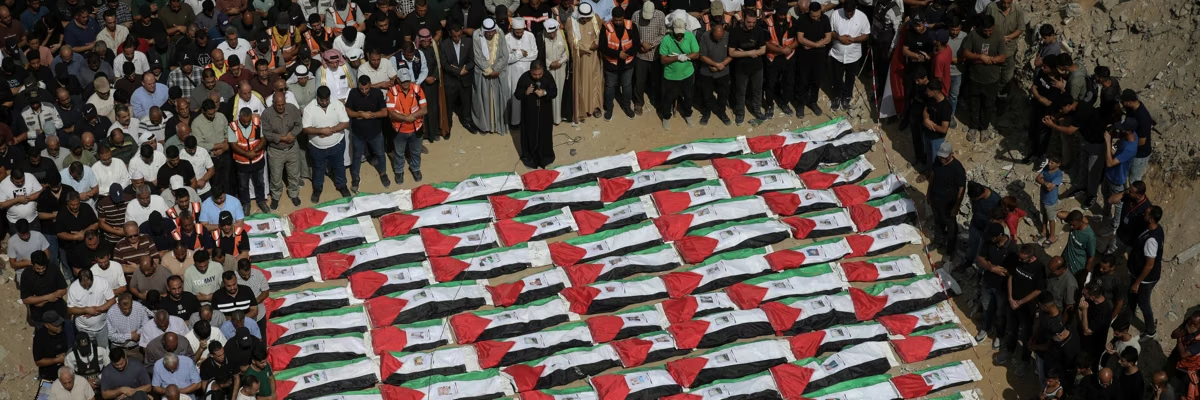
People gather at the Sheikh Radwan cemetery in Gaza City, Gaza, Palestine on October 1, 2026, to conduct mass funeral prayers and burials for more than 100 Palestinians whose bodies were retrieved from the rubble of residential buildings in the southern Yarmouk neighborhood years after they were killed in Israeli airstrikes.
"You can't authorize the potential killing of 300 civilians... and still tell the public we did everything we could to avoid harming innocent people," said one veteran.
Former Israeli military and intelligence personnel affirmed that rules for targeting confirmed and alleged Hamas members in Gaza were dramatically loosened after the October 7, 2023 attack, allowing strikes expected to kill hundreds of Palestinian civilians to target even low-ranking members of the Palestinian resistance group, according to a report published Monday.
In a paywalled article published by Haaretz, Israel's oldest daily newspaper, Yaniv Kubovich gathered testimonies from former Israel Defense Forces intelligence personnel that add to the body of evidence from Israeli whistleblowers, military officials, and investigative journalists documenting how the IDF expanded its targeting practices during its devastating US-backed annihilation of Gaza, which has killed or wounded more than 250,000 Palestinians in the coastal exclave over the past three years.
One change described by some of those interviewed by Kubovich was "the opening of the intelligence apparatus to untrained personnel."
"People arrived at military intelligence who weren't from the unit, reservists who'd never even served in intelligence, brought in from all sorts of places," said one veteran, identified as "A."
"They sat in the Targeting Directorate looking for the most insignificant targets, the small fry, so they could kill them," A added. "Anyone displaying Hamas symbols on Facebook or identifying themselves as Hamas was marked as a target. Some were Hamas members, some were fighters too, but they really were small fry."
Another veteran, "D," who was assigned to a strike cell—units that coordinate drone and other aerial attacks—said: "Suddenly, the IDF was striking even the lowest of the low indiscriminately, and everyone had forgotten about conserving ammunition. We were striking Hamas drivers. That's how far it went."
Kubovich wrote that "a recurring theme in the accounts is the gap between a target's importance, the scale of the strike and the civilian toll deemed acceptable."
For example, on October 31, 2023, IDF warplanes dropped 2,000-pound "bunker-buster" bombs supplied by the United States on the densely populated Jabalia refugee camp in northern Gaza in order to kill one Hamas commander, Ibrahmi Biari.
"We knew Biari was underground, beneath several large buildings, but we couldn't pinpoint which building he was under," said D. "So they chose several buildings that were still occupied and decided to bring down all the buildings above the tunnel he was in. We didn't initiate an evacuation because it was important to kill him before he could get away."
A, who was also involved in the mission, said the decision to bomb the buildings was referred to the IDF chief of staff for approval, since intelligence officials estimated that there would be hundreds of civilian casualties. The IDF calculated that roughly 100 people would be killed or wounded in the proposed attack.
"We couldn't get any more intelligence to pinpoint his exact location," said veteran D. "They told us, 'He's killing soldiers right now. We have to strike him,' out of concern for the troops on the ground, and in the end the strike was approved. They really wanted to kill this guy."
Hamas said that 400 people were killed or wounded in the attack.
"Among other things, we relied on figures coming from Hamas, which we considered relatively plausible, even if they weren't 100% accurate," veteran A told Kubovich. "As time went on, we realized the death toll was around 250. I remember being stunned that we were bringing down several densely populated buildings, killing and injuring hundreds of people, to kill a battalion commander who, just a few weeks earlier, hadn't even been someone we were supposed to gather intelligence on."
The UK-based civilian casualty monitor Airwars said that at least 126 civilians, including 69 children, were killed in the attack, which wiped out whole families.
"You can't authorize the potential killing of 300 civilians for a battalion commander, or the killing of 20 civilians for every Hamas truck driver, and still tell the public we did everything we could to avoid harming innocent people," Nadav Weiman, executive director of the IDF veterans' group Breaking the Silence, told Kubovich.
Referring to the Jabalia massacre, D said: "I can't say this particular strike is what really messes with my head. What's much harder for me is the system of strike after strike after strike, with collateral damage running into dozens of people, sometimes hundreds. Being part of a system like that bothers me more than taking part in any particular strike."
The veterans' accounts raise further questions about Israel's repeated assertions that its military operations have been conducted in accordance with international humanitarian law, which requires parties in armed conflicts to distinguish between civilians and combatants and prohibits attacks expected to cause excessive civilian harm relative to the anticipated concrete and direct military advantage.
Those claims stand in stark contrast with statements by Prime Minister Benjamin Netanyahu and other senior Israeli officials, who began calling for the genocidal destruction of Gaza and its 2.2 million people in the immediate aftermath of the Hamas-led attack of October 7, 2023.
Netanyahu and Yoav Gallant—his former defense minister who ordered the “complete siege” of Gaza, explaining that “we are fighting human animals, and we are acting accordingly"—are currently fugitives from the International Criminal Court in The Hague, where they are wanted for alleged crimes against humanity and war crimes, including murder and forced starvation.
The International Court of Justice (ICJ), also in The Hague, is currently conducting a genocide case against Israel filed by South Africa and formally supported by more than 15 nations. While a ruling in the case isn’t expected until at least 2029, a United Nations commission of inquiry, the International Association of Genocide Scholars, and other experts—including many Israeli and international Jewish academics, jurists, human rights campaigners, and others—have already concluded that Israel is committing genocide in Gaza.
The new Haaretz investigation adds to the body of reporting on Israel's loosened rules of engagement and their disastrous implications for Gaza civilians, including a December 2024 New York Times exposé involving interviews with over 100 IDF soldiers and veterans, Israeli officials, dozens of airstrike victims, and experts on the law and conduct of war.
Kubovich's revelations also come as the documentary NAZA, directed by Israeli journalists and filmmakers Yuval Abraham and Rachel Szor, brings testimony from Israeli military and intelligence insiders to international audiences. The film features 24 anonymized insiders describing the surveillance, artificial intelligence-assisted targeting, and military procedures used during the assault on Gaza.
IDF veteran testimonies are consistent with earlier investigations into the IDF's use of artificial intelligence to generate targets at extraordinary speed, often with limited human scrutiny.
In April 2024, Abraham reported for +972 Magazine and Local Call that the military used an AI system called Lavender to identify suspected Hamas and Palestinian Islamic Jihad operatives. The investigation found that the IDF initially authorized officers to accept civilian casualty estimates of up to 15 or 20 people for each low-ranking alleged militant targeted, and more than 100 civilians for certain senior Hamas officials.
“The IDF bombed them in homes without hesitation, as a first option,” one intelligence officer told the outlets. “It's much easier to bomb a family's home. The system is built to look for them in these situations.”
The investigation also found that officers were permitted to rely on Lavender's recommendations without thoroughly checking the underlying intelligence.
Former IDF Chief of Staff Herzi Halevi has also acknowledged the enormous human toll of the war.
“This is not a gentle war; we took the gloves off from the first minute,” Halevi said during a September 2025 speech to residents of Ein Habor, adding that “not once” has any legal authority “limited” his wartime conduct.
Implicitly confirming Gaza Health Ministry casualty figures—which then stood at around 220,000 Palestinians killed or wounded—Halevi said that “over 10%” of Gaza’s population of approximately 2.2 million had been "killed or injured” since October 2023.
In August 2025, Abraham and Emma Graham-Harrison, The Guardian's senior international affairs correspondent, revealed that classified IDF intelligence data suggested that 5 in 6 Palestinians, or 83% of people, killed by Israeli forces through the first 19 months of the war were civilians.
Current and former IDF troops have accused their own of deliberately shooting Palestinian civilians, including children, sometimes out of sheer boredom. Palestinian and international volunteer medical professionals have also described what they say is the deliberate shooting of Gazans, including children, more than 21,500 of whom have been killed by Israeli bombs and bullets—with more victims added to that grim total with every passing day.
Dear Common Dreams reader, It’s been nearly 30 years since I co-founded Common Dreams with my late wife, Lina Newhouser. We had the radical notion that journalism should serve the public good, not corporate profits. It was clear to us from the outset what it would take to build such a project. No paid advertisements. No corporate sponsors. No millionaire publisher telling us what to think or do. Many people said we wouldn't last a year, but we proved those doubters wrong. Together with a tremendous team of journalists and dedicated staff, we built an independent media outlet free from the constraints of profits and corporate control. Our mission has always been simple: To inform. To inspire. To ignite change for the common good. Building Common Dreams was not easy. Our survival was never guaranteed. When you take on the most powerful forces—Wall Street greed, fossil fuel industry destruction, Big Tech lobbyists, and uber-rich oligarchs who have spent billions upon billions rigging the economy and democracy in their favor—the only bulwark you have is supporters who believe in your work. But here’s the urgent message from me today. It's never been this bad out there. And it's never been this hard to keep us going. At the very moment Common Dreams is most needed, the threats we face are intensifying. We need your support now more than ever. We don't accept corporate advertising and never will. We don't have a paywall because we don't think people should be blocked from critical news based on their ability to pay. Everything we do is funded by the donations of readers like you. When everyone does the little they can afford, we are strong. But if that support retreats or dries up, so do we. Will you donate now to make sure Common Dreams not only survives but thrives? —Craig Brown, Co-founder |
Former Israeli military and intelligence personnel affirmed that rules for targeting confirmed and alleged Hamas members in Gaza were dramatically loosened after the October 7, 2023 attack, allowing strikes expected to kill hundreds of Palestinian civilians to target even low-ranking members of the Palestinian resistance group, according to a report published Monday.
In a paywalled article published by Haaretz, Israel's oldest daily newspaper, Yaniv Kubovich gathered testimonies from former Israel Defense Forces intelligence personnel that add to the body of evidence from Israeli whistleblowers, military officials, and investigative journalists documenting how the IDF expanded its targeting practices during its devastating US-backed annihilation of Gaza, which has killed or wounded more than 250,000 Palestinians in the coastal exclave over the past three years.
One change described by some of those interviewed by Kubovich was "the opening of the intelligence apparatus to untrained personnel."
"People arrived at military intelligence who weren't from the unit, reservists who'd never even served in intelligence, brought in from all sorts of places," said one veteran, identified as "A."
"They sat in the Targeting Directorate looking for the most insignificant targets, the small fry, so they could kill them," A added. "Anyone displaying Hamas symbols on Facebook or identifying themselves as Hamas was marked as a target. Some were Hamas members, some were fighters too, but they really were small fry."
Another veteran, "D," who was assigned to a strike cell—units that coordinate drone and other aerial attacks—said: "Suddenly, the IDF was striking even the lowest of the low indiscriminately, and everyone had forgotten about conserving ammunition. We were striking Hamas drivers. That's how far it went."
Kubovich wrote that "a recurring theme in the accounts is the gap between a target's importance, the scale of the strike and the civilian toll deemed acceptable."
For example, on October 31, 2023, IDF warplanes dropped 2,000-pound "bunker-buster" bombs supplied by the United States on the densely populated Jabalia refugee camp in northern Gaza in order to kill one Hamas commander, Ibrahmi Biari.
"We knew Biari was underground, beneath several large buildings, but we couldn't pinpoint which building he was under," said D. "So they chose several buildings that were still occupied and decided to bring down all the buildings above the tunnel he was in. We didn't initiate an evacuation because it was important to kill him before he could get away."
A, who was also involved in the mission, said the decision to bomb the buildings was referred to the IDF chief of staff for approval, since intelligence officials estimated that there would be hundreds of civilian casualties. The IDF calculated that roughly 100 people would be killed or wounded in the proposed attack.
"We couldn't get any more intelligence to pinpoint his exact location," said veteran D. "They told us, 'He's killing soldiers right now. We have to strike him,' out of concern for the troops on the ground, and in the end the strike was approved. They really wanted to kill this guy."
Hamas said that 400 people were killed or wounded in the attack.
"Among other things, we relied on figures coming from Hamas, which we considered relatively plausible, even if they weren't 100% accurate," veteran A told Kubovich. "As time went on, we realized the death toll was around 250. I remember being stunned that we were bringing down several densely populated buildings, killing and injuring hundreds of people, to kill a battalion commander who, just a few weeks earlier, hadn't even been someone we were supposed to gather intelligence on."
The UK-based civilian casualty monitor Airwars said that at least 126 civilians, including 69 children, were killed in the attack, which wiped out whole families.
"You can't authorize the potential killing of 300 civilians for a battalion commander, or the killing of 20 civilians for every Hamas truck driver, and still tell the public we did everything we could to avoid harming innocent people," Nadav Weiman, executive director of the IDF veterans' group Breaking the Silence, told Kubovich.
Referring to the Jabalia massacre, D said: "I can't say this particular strike is what really messes with my head. What's much harder for me is the system of strike after strike after strike, with collateral damage running into dozens of people, sometimes hundreds. Being part of a system like that bothers me more than taking part in any particular strike."
The veterans' accounts raise further questions about Israel's repeated assertions that its military operations have been conducted in accordance with international humanitarian law, which requires parties in armed conflicts to distinguish between civilians and combatants and prohibits attacks expected to cause excessive civilian harm relative to the anticipated concrete and direct military advantage.
Those claims stand in stark contrast with statements by Prime Minister Benjamin Netanyahu and other senior Israeli officials, who began calling for the genocidal destruction of Gaza and its 2.2 million people in the immediate aftermath of the Hamas-led attack of October 7, 2023.
Netanyahu and Yoav Gallant—his former defense minister who ordered the “complete siege” of Gaza, explaining that “we are fighting human animals, and we are acting accordingly"—are currently fugitives from the International Criminal Court in The Hague, where they are wanted for alleged crimes against humanity and war crimes, including murder and forced starvation.
The International Court of Justice (ICJ), also in The Hague, is currently conducting a genocide case against Israel filed by South Africa and formally supported by more than 15 nations. While a ruling in the case isn’t expected until at least 2029, a United Nations commission of inquiry, the International Association of Genocide Scholars, and other experts—including many Israeli and international Jewish academics, jurists, human rights campaigners, and others—have already concluded that Israel is committing genocide in Gaza.
The new Haaretz investigation adds to the body of reporting on Israel's loosened rules of engagement and their disastrous implications for Gaza civilians, including a December 2024 New York Times exposé involving interviews with over 100 IDF soldiers and veterans, Israeli officials, dozens of airstrike victims, and experts on the law and conduct of war.
Kubovich's revelations also come as the documentary NAZA, directed by Israeli journalists and filmmakers Yuval Abraham and Rachel Szor, brings testimony from Israeli military and intelligence insiders to international audiences. The film features 24 anonymized insiders describing the surveillance, artificial intelligence-assisted targeting, and military procedures used during the assault on Gaza.
IDF veteran testimonies are consistent with earlier investigations into the IDF's use of artificial intelligence to generate targets at extraordinary speed, often with limited human scrutiny.
In April 2024, Abraham reported for +972 Magazine and Local Call that the military used an AI system called Lavender to identify suspected Hamas and Palestinian Islamic Jihad operatives. The investigation found that the IDF initially authorized officers to accept civilian casualty estimates of up to 15 or 20 people for each low-ranking alleged militant targeted, and more than 100 civilians for certain senior Hamas officials.
“The IDF bombed them in homes without hesitation, as a first option,” one intelligence officer told the outlets. “It's much easier to bomb a family's home. The system is built to look for them in these situations.”
The investigation also found that officers were permitted to rely on Lavender's recommendations without thoroughly checking the underlying intelligence.
Former IDF Chief of Staff Herzi Halevi has also acknowledged the enormous human toll of the war.
“This is not a gentle war; we took the gloves off from the first minute,” Halevi said during a September 2025 speech to residents of Ein Habor, adding that “not once” has any legal authority “limited” his wartime conduct.
Implicitly confirming Gaza Health Ministry casualty figures—which then stood at around 220,000 Palestinians killed or wounded—Halevi said that “over 10%” of Gaza’s population of approximately 2.2 million had been "killed or injured” since October 2023.
In August 2025, Abraham and Emma Graham-Harrison, The Guardian's senior international affairs correspondent, revealed that classified IDF intelligence data suggested that 5 in 6 Palestinians, or 83% of people, killed by Israeli forces through the first 19 months of the war were civilians.
Current and former IDF troops have accused their own of deliberately shooting Palestinian civilians, including children, sometimes out of sheer boredom. Palestinian and international volunteer medical professionals have also described what they say is the deliberate shooting of Gazans, including children, more than 21,500 of whom have been killed by Israeli bombs and bullets—with more victims added to that grim total with every passing day.
Former Israeli military and intelligence personnel affirmed that rules for targeting confirmed and alleged Hamas members in Gaza were dramatically loosened after the October 7, 2023 attack, allowing strikes expected to kill hundreds of Palestinian civilians to target even low-ranking members of the Palestinian resistance group, according to a report published Monday.
In a paywalled article published by Haaretz, Israel's oldest daily newspaper, Yaniv Kubovich gathered testimonies from former Israel Defense Forces intelligence personnel that add to the body of evidence from Israeli whistleblowers, military officials, and investigative journalists documenting how the IDF expanded its targeting practices during its devastating US-backed annihilation of Gaza, which has killed or wounded more than 250,000 Palestinians in the coastal exclave over the past three years.
One change described by some of those interviewed by Kubovich was "the opening of the intelligence apparatus to untrained personnel."
"People arrived at military intelligence who weren't from the unit, reservists who'd never even served in intelligence, brought in from all sorts of places," said one veteran, identified as "A."
"They sat in the Targeting Directorate looking for the most insignificant targets, the small fry, so they could kill them," A added. "Anyone displaying Hamas symbols on Facebook or identifying themselves as Hamas was marked as a target. Some were Hamas members, some were fighters too, but they really were small fry."
Another veteran, "D," who was assigned to a strike cell—units that coordinate drone and other aerial attacks—said: "Suddenly, the IDF was striking even the lowest of the low indiscriminately, and everyone had forgotten about conserving ammunition. We were striking Hamas drivers. That's how far it went."
Kubovich wrote that "a recurring theme in the accounts is the gap between a target's importance, the scale of the strike and the civilian toll deemed acceptable."
For example, on October 31, 2023, IDF warplanes dropped 2,000-pound "bunker-buster" bombs supplied by the United States on the densely populated Jabalia refugee camp in northern Gaza in order to kill one Hamas commander, Ibrahmi Biari.
"We knew Biari was underground, beneath several large buildings, but we couldn't pinpoint which building he was under," said D. "So they chose several buildings that were still occupied and decided to bring down all the buildings above the tunnel he was in. We didn't initiate an evacuation because it was important to kill him before he could get away."
A, who was also involved in the mission, said the decision to bomb the buildings was referred to the IDF chief of staff for approval, since intelligence officials estimated that there would be hundreds of civilian casualties. The IDF calculated that roughly 100 people would be killed or wounded in the proposed attack.
"We couldn't get any more intelligence to pinpoint his exact location," said veteran D. "They told us, 'He's killing soldiers right now. We have to strike him,' out of concern for the troops on the ground, and in the end the strike was approved. They really wanted to kill this guy."
Hamas said that 400 people were killed or wounded in the attack.
"Among other things, we relied on figures coming from Hamas, which we considered relatively plausible, even if they weren't 100% accurate," veteran A told Kubovich. "As time went on, we realized the death toll was around 250. I remember being stunned that we were bringing down several densely populated buildings, killing and injuring hundreds of people, to kill a battalion commander who, just a few weeks earlier, hadn't even been someone we were supposed to gather intelligence on."
The UK-based civilian casualty monitor Airwars said that at least 126 civilians, including 69 children, were killed in the attack, which wiped out whole families.
"You can't authorize the potential killing of 300 civilians for a battalion commander, or the killing of 20 civilians for every Hamas truck driver, and still tell the public we did everything we could to avoid harming innocent people," Nadav Weiman, executive director of the IDF veterans' group Breaking the Silence, told Kubovich.
Referring to the Jabalia massacre, D said: "I can't say this particular strike is what really messes with my head. What's much harder for me is the system of strike after strike after strike, with collateral damage running into dozens of people, sometimes hundreds. Being part of a system like that bothers me more than taking part in any particular strike."
The veterans' accounts raise further questions about Israel's repeated assertions that its military operations have been conducted in accordance with international humanitarian law, which requires parties in armed conflicts to distinguish between civilians and combatants and prohibits attacks expected to cause excessive civilian harm relative to the anticipated concrete and direct military advantage.
Those claims stand in stark contrast with statements by Prime Minister Benjamin Netanyahu and other senior Israeli officials, who began calling for the genocidal destruction of Gaza and its 2.2 million people in the immediate aftermath of the Hamas-led attack of October 7, 2023.
Netanyahu and Yoav Gallant—his former defense minister who ordered the “complete siege” of Gaza, explaining that “we are fighting human animals, and we are acting accordingly"—are currently fugitives from the International Criminal Court in The Hague, where they are wanted for alleged crimes against humanity and war crimes, including murder and forced starvation.
The International Court of Justice (ICJ), also in The Hague, is currently conducting a genocide case against Israel filed by South Africa and formally supported by more than 15 nations. While a ruling in the case isn’t expected until at least 2029, a United Nations commission of inquiry, the International Association of Genocide Scholars, and other experts—including many Israeli and international Jewish academics, jurists, human rights campaigners, and others—have already concluded that Israel is committing genocide in Gaza.
The new Haaretz investigation adds to the body of reporting on Israel's loosened rules of engagement and their disastrous implications for Gaza civilians, including a December 2024 New York Times exposé involving interviews with over 100 IDF soldiers and veterans, Israeli officials, dozens of airstrike victims, and experts on the law and conduct of war.
Kubovich's revelations also come as the documentary NAZA, directed by Israeli journalists and filmmakers Yuval Abraham and Rachel Szor, brings testimony from Israeli military and intelligence insiders to international audiences. The film features 24 anonymized insiders describing the surveillance, artificial intelligence-assisted targeting, and military procedures used during the assault on Gaza.
IDF veteran testimonies are consistent with earlier investigations into the IDF's use of artificial intelligence to generate targets at extraordinary speed, often with limited human scrutiny.
In April 2024, Abraham reported for +972 Magazine and Local Call that the military used an AI system called Lavender to identify suspected Hamas and Palestinian Islamic Jihad operatives. The investigation found that the IDF initially authorized officers to accept civilian casualty estimates of up to 15 or 20 people for each low-ranking alleged militant targeted, and more than 100 civilians for certain senior Hamas officials.
“The IDF bombed them in homes without hesitation, as a first option,” one intelligence officer told the outlets. “It's much easier to bomb a family's home. The system is built to look for them in these situations.”
The investigation also found that officers were permitted to rely on Lavender's recommendations without thoroughly checking the underlying intelligence.
Former IDF Chief of Staff Herzi Halevi has also acknowledged the enormous human toll of the war.
“This is not a gentle war; we took the gloves off from the first minute,” Halevi said during a September 2025 speech to residents of Ein Habor, adding that “not once” has any legal authority “limited” his wartime conduct.
Implicitly confirming Gaza Health Ministry casualty figures—which then stood at around 220,000 Palestinians killed or wounded—Halevi said that “over 10%” of Gaza’s population of approximately 2.2 million had been "killed or injured” since October 2023.
In August 2025, Abraham and Emma Graham-Harrison, The Guardian's senior international affairs correspondent, revealed that classified IDF intelligence data suggested that 5 in 6 Palestinians, or 83% of people, killed by Israeli forces through the first 19 months of the war were civilians.
Current and former IDF troops have accused their own of deliberately shooting Palestinian civilians, including children, sometimes out of sheer boredom. Palestinian and international volunteer medical professionals have also described what they say is the deliberate shooting of Gazans, including children, more than 21,500 of whom have been killed by Israeli bombs and bullets—with more victims added to that grim total with every passing day.