
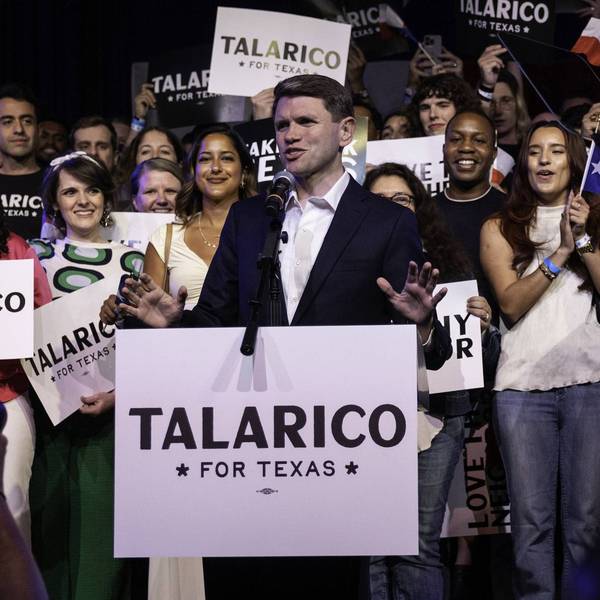

An ad released by the conservative group Citizens for Sanity portrays James Talarico, the Democratic nominee for US Senate in Texas, wearing a dress on June 9, 2026.
Trump-Aligned PAC Drops Six Figures in Texas on 'AI Brainrot' Ad Putting Talarico in a Dress
"We need to make this type of undisclosed AI political advertising illegal yesterday," one tech journalist said.
Republicans are once again using artificial intelligence to attack US Senate candidate James Talarico. This time, they're spending big to air an ad featuring the Democratic nominee for Texas in a dress singing a song about transgender children.
It follows a previous video posted by the Senate GOP's official social media channels in March featuring an uncanny AI rendering of Talarico reading what they described as "extreme statements" he'd previously made on X (then known as Twitter) discussing his views on religion and support for the LGBTQ+ community.
Now, a Trump-aligned dark money group known as Citizens for Sanity is taking it even further. According to a report from The Daily Caller on Tuesday, the group has spent "six figures" on an ad campaign portraying the Texas state representative in a dress singing a parody of "My Favorite Things" from The Sound of Music about trans kids.
“Boys in white dresses with blue satin sashes. Girls dosed with hormones til they grow mustaches. Changing the gender of all your offspring. These are a few of my favorite things," Talarico is shown belting out in the ad.
The ad references comments made by Talarico in 2023 in which he celebrated the trans youth who had shown up, along with other activists, at the Texas state capitol to hold a protest in opposition to Senate Bill 14, which sought to ban transition-related medical care for transgender minors, part of a wave of hundreds of pieces of legislation proposed across the US attacking LGBTQ+ individuals.
Speaking on a podcast, Talarico said: “I love—I’m just going to say this because it’s on my mind—the trans children who showed up yesterday at the state Capitol to advocate for their humanity. They shouldn’t have to, but it was an inspiration to watch.”
As Talarico became the Democratic nominee in Texas, where he'll face off against Republican Attorney General Ken Paxton in November, official Republican channels have spliced the comments to portray Talarico as a creep.
One post in March, from the Republican National Committee Research account on X with 1.3 million views, quotes the interaction dishonestly, as follows:
HOST: "Something that you love that's not family or friends?"
TALARICO: "Trans children."
The ad is in line with others put out by Citizens for Sanity in 2022, when it spent a staggering $93 million attacking Democrats in swing districts. As The Guardian explained in 2024:
The group... flooded the airwaves in battleground states and swing districts with deeply offensive and often misleading ads. Some ads targeted LGBTQ+ rights and attacked “Biden and his radical allies” for supporting “the woke left’s war on girls’ sports” and the “woke war on our children”. Others pictured Latino immigrants and characterized them as criminals “draining your paychecks, wrecking your schools, ruining your hospitals [and] threatening your family”, declaring that “Joe Biden and the Democrats have erased our southern border.”
With AI deepfakes playing an increasing role in political campaigning—especially among Republicans—the group is discovering new frontiers for misinformation in this year's election.
The 15-second spot it plans to roll out across Texas makes no indication of the fact that it was generated with AI, nor of the fact that Talarico never actually uttered any of the words in the song.
Like many other states, Texas has a law prohibiting the use of AI deepfakes to deceive voters during elections. However, it would not apply to this ad, since it is limited to state races and only applies within 30 days before the vote.
Lawmakers in the state have introduced legislation to strengthen the law by scrapping the 30-day rule and requiring disclosures on paid political content generated with AI. But despite some bipartisan support, the reforms failed to pass through the GOP-controlled Legislature.
While this new Talarico ad would be unlikely to fool most voters, others—like the one released by the Senate GOP in March—are already realistic enough to influence even savvy viewers, explained Sandra Cai, the founder of Plurall AI, an AI deepfake and fraud detection platform.
"By the time a viewer questions what they saw, the impression is already made," she said in a social media post. "The 2026 midterms laid bare an uncomfortable truth: Disclosure labels are easy to miss and easy to ignore. The tools to produce these ads are cheap, fast, and widely available. Regulation remains a patchwork, often applying only in the final weeks before an election."
On the left, the Talarico ad has led to familiar bewilderment that such misleading material has not been outlawed.
"We need to make this type of undisclosed AI political advertising illegal yesterday," said the liberal tech journalist Taylor Lorenz.
And while some Talarico opponents boasted that they were "going to win the midterms by programming boomers with AI brainrot ads," others on the right said they were also disturbed by the trend.
"James Talarico is awful," said Frank DeVito, senior counsel at the right-wing Napa Legal Institute. "But this use of AI to generate a video of a political opponent saying or doing what he did not really say or do is not good."
We are at a crossroads
This country and this world are at a monumental crossroads. In a few short weeks, US voters will have an opportunity to beat back the forces of fascism and confront the billionaires who are rigging the economy, our media system, and our democracy, making it increasingly impossible for ordinary people to get by. We’re not just talking about the election. We’re talking about what must be done once these fascist elements are vanquished from power. We need a bolder set of solutions than what either major party has so far been willing to offer and a working-class movement ready to fight like hell for it. Trump didn't emerge from nowhere. The conditions that fueled MAGA authoritarianism were created by decades of radical neoliberal economic policies and a corrupt political system dominated by corporate interests. They slashed taxes on the super-rich, promising that the benefits would trickle down. They said giveaways to the corporate titans would make life more affordable for the rest of us. It was all bullshit. And when a bitter, betrayed populace searches for someone to blame, right-wing demagogues have little trouble finding scapegoats. People know when they're being lied to, but you won't hear any of this from the corporate media. Only independent journalism—powered and funded by people who believe in building a better world—can deliver truly trustworthy daily news. Our Fall Campaign is underway, and we need your help. To power our newsroom through the rest of the year, we need to raise $125,000 by midnight on October 31. So if you share our vision, please contribute whatever you can to sustain our work. |
Republicans are once again using artificial intelligence to attack US Senate candidate James Talarico. This time, they're spending big to air an ad featuring the Democratic nominee for Texas in a dress singing a song about transgender children.
It follows a previous video posted by the Senate GOP's official social media channels in March featuring an uncanny AI rendering of Talarico reading what they described as "extreme statements" he'd previously made on X (then known as Twitter) discussing his views on religion and support for the LGBTQ+ community.
Now, a Trump-aligned dark money group known as Citizens for Sanity is taking it even further. According to a report from The Daily Caller on Tuesday, the group has spent "six figures" on an ad campaign portraying the Texas state representative in a dress singing a parody of "My Favorite Things" from The Sound of Music about trans kids.
“Boys in white dresses with blue satin sashes. Girls dosed with hormones til they grow mustaches. Changing the gender of all your offspring. These are a few of my favorite things," Talarico is shown belting out in the ad.
The ad references comments made by Talarico in 2023 in which he celebrated the trans youth who had shown up, along with other activists, at the Texas state capitol to hold a protest in opposition to Senate Bill 14, which sought to ban transition-related medical care for transgender minors, part of a wave of hundreds of pieces of legislation proposed across the US attacking LGBTQ+ individuals.
Speaking on a podcast, Talarico said: “I love—I’m just going to say this because it’s on my mind—the trans children who showed up yesterday at the state Capitol to advocate for their humanity. They shouldn’t have to, but it was an inspiration to watch.”
As Talarico became the Democratic nominee in Texas, where he'll face off against Republican Attorney General Ken Paxton in November, official Republican channels have spliced the comments to portray Talarico as a creep.
One post in March, from the Republican National Committee Research account on X with 1.3 million views, quotes the interaction dishonestly, as follows:
HOST: "Something that you love that's not family or friends?"
TALARICO: "Trans children."
The ad is in line with others put out by Citizens for Sanity in 2022, when it spent a staggering $93 million attacking Democrats in swing districts. As The Guardian explained in 2024:
The group... flooded the airwaves in battleground states and swing districts with deeply offensive and often misleading ads. Some ads targeted LGBTQ+ rights and attacked “Biden and his radical allies” for supporting “the woke left’s war on girls’ sports” and the “woke war on our children”. Others pictured Latino immigrants and characterized them as criminals “draining your paychecks, wrecking your schools, ruining your hospitals [and] threatening your family”, declaring that “Joe Biden and the Democrats have erased our southern border.”
With AI deepfakes playing an increasing role in political campaigning—especially among Republicans—the group is discovering new frontiers for misinformation in this year's election.
The 15-second spot it plans to roll out across Texas makes no indication of the fact that it was generated with AI, nor of the fact that Talarico never actually uttered any of the words in the song.
Like many other states, Texas has a law prohibiting the use of AI deepfakes to deceive voters during elections. However, it would not apply to this ad, since it is limited to state races and only applies within 30 days before the vote.
Lawmakers in the state have introduced legislation to strengthen the law by scrapping the 30-day rule and requiring disclosures on paid political content generated with AI. But despite some bipartisan support, the reforms failed to pass through the GOP-controlled Legislature.
While this new Talarico ad would be unlikely to fool most voters, others—like the one released by the Senate GOP in March—are already realistic enough to influence even savvy viewers, explained Sandra Cai, the founder of Plurall AI, an AI deepfake and fraud detection platform.
"By the time a viewer questions what they saw, the impression is already made," she said in a social media post. "The 2026 midterms laid bare an uncomfortable truth: Disclosure labels are easy to miss and easy to ignore. The tools to produce these ads are cheap, fast, and widely available. Regulation remains a patchwork, often applying only in the final weeks before an election."
On the left, the Talarico ad has led to familiar bewilderment that such misleading material has not been outlawed.
"We need to make this type of undisclosed AI political advertising illegal yesterday," said the liberal tech journalist Taylor Lorenz.
And while some Talarico opponents boasted that they were "going to win the midterms by programming boomers with AI brainrot ads," others on the right said they were also disturbed by the trend.
"James Talarico is awful," said Frank DeVito, senior counsel at the right-wing Napa Legal Institute. "But this use of AI to generate a video of a political opponent saying or doing what he did not really say or do is not good."
- 'Billionaires Are Waging War Against the Rest of Us': James Talarico Responds to Class Warfare Accusations ›
- Trump Calls for GOP to Ram Through AI Regulation Ban in Must-Pass Military Spending Bill ›
- Majority of Democrats, Independents Want Leaders to Fight GOP Attacks on AI Rules ›
- 'This Should Be Illegal': Senate GOP Uses AI Deepfake to Attack Talarico ›
- Possibly 'Best Political Ad Yet This Season' Shows Texas Republican Ken Paxton's 2012 Pen Theft | Common Dreams ›
- 'ScanDuel!' Latest Talarico Ad Targets Paxton's History of Outrageous Scandals | Common Dreams ›
Republicans are once again using artificial intelligence to attack US Senate candidate James Talarico. This time, they're spending big to air an ad featuring the Democratic nominee for Texas in a dress singing a song about transgender children.
It follows a previous video posted by the Senate GOP's official social media channels in March featuring an uncanny AI rendering of Talarico reading what they described as "extreme statements" he'd previously made on X (then known as Twitter) discussing his views on religion and support for the LGBTQ+ community.
Now, a Trump-aligned dark money group known as Citizens for Sanity is taking it even further. According to a report from The Daily Caller on Tuesday, the group has spent "six figures" on an ad campaign portraying the Texas state representative in a dress singing a parody of "My Favorite Things" from The Sound of Music about trans kids.
“Boys in white dresses with blue satin sashes. Girls dosed with hormones til they grow mustaches. Changing the gender of all your offspring. These are a few of my favorite things," Talarico is shown belting out in the ad.
The ad references comments made by Talarico in 2023 in which he celebrated the trans youth who had shown up, along with other activists, at the Texas state capitol to hold a protest in opposition to Senate Bill 14, which sought to ban transition-related medical care for transgender minors, part of a wave of hundreds of pieces of legislation proposed across the US attacking LGBTQ+ individuals.
Speaking on a podcast, Talarico said: “I love—I’m just going to say this because it’s on my mind—the trans children who showed up yesterday at the state Capitol to advocate for their humanity. They shouldn’t have to, but it was an inspiration to watch.”
As Talarico became the Democratic nominee in Texas, where he'll face off against Republican Attorney General Ken Paxton in November, official Republican channels have spliced the comments to portray Talarico as a creep.
One post in March, from the Republican National Committee Research account on X with 1.3 million views, quotes the interaction dishonestly, as follows:
HOST: "Something that you love that's not family or friends?"
TALARICO: "Trans children."
The ad is in line with others put out by Citizens for Sanity in 2022, when it spent a staggering $93 million attacking Democrats in swing districts. As The Guardian explained in 2024:
The group... flooded the airwaves in battleground states and swing districts with deeply offensive and often misleading ads. Some ads targeted LGBTQ+ rights and attacked “Biden and his radical allies” for supporting “the woke left’s war on girls’ sports” and the “woke war on our children”. Others pictured Latino immigrants and characterized them as criminals “draining your paychecks, wrecking your schools, ruining your hospitals [and] threatening your family”, declaring that “Joe Biden and the Democrats have erased our southern border.”
With AI deepfakes playing an increasing role in political campaigning—especially among Republicans—the group is discovering new frontiers for misinformation in this year's election.
The 15-second spot it plans to roll out across Texas makes no indication of the fact that it was generated with AI, nor of the fact that Talarico never actually uttered any of the words in the song.
Like many other states, Texas has a law prohibiting the use of AI deepfakes to deceive voters during elections. However, it would not apply to this ad, since it is limited to state races and only applies within 30 days before the vote.
Lawmakers in the state have introduced legislation to strengthen the law by scrapping the 30-day rule and requiring disclosures on paid political content generated with AI. But despite some bipartisan support, the reforms failed to pass through the GOP-controlled Legislature.
While this new Talarico ad would be unlikely to fool most voters, others—like the one released by the Senate GOP in March—are already realistic enough to influence even savvy viewers, explained Sandra Cai, the founder of Plurall AI, an AI deepfake and fraud detection platform.
"By the time a viewer questions what they saw, the impression is already made," she said in a social media post. "The 2026 midterms laid bare an uncomfortable truth: Disclosure labels are easy to miss and easy to ignore. The tools to produce these ads are cheap, fast, and widely available. Regulation remains a patchwork, often applying only in the final weeks before an election."
On the left, the Talarico ad has led to familiar bewilderment that such misleading material has not been outlawed.
"We need to make this type of undisclosed AI political advertising illegal yesterday," said the liberal tech journalist Taylor Lorenz.
And while some Talarico opponents boasted that they were "going to win the midterms by programming boomers with AI brainrot ads," others on the right said they were also disturbed by the trend.
"James Talarico is awful," said Frank DeVito, senior counsel at the right-wing Napa Legal Institute. "But this use of AI to generate a video of a political opponent saying or doing what he did not really say or do is not good."
- 'Billionaires Are Waging War Against the Rest of Us': James Talarico Responds to Class Warfare Accusations ›
- Trump Calls for GOP to Ram Through AI Regulation Ban in Must-Pass Military Spending Bill ›
- Majority of Democrats, Independents Want Leaders to Fight GOP Attacks on AI Rules ›
- 'This Should Be Illegal': Senate GOP Uses AI Deepfake to Attack Talarico ›
- Possibly 'Best Political Ad Yet This Season' Shows Texas Republican Ken Paxton's 2012 Pen Theft | Common Dreams ›
- 'ScanDuel!' Latest Talarico Ad Targets Paxton's History of Outrageous Scandals | Common Dreams ›