SUBSCRIBE TO OUR FREE NEWSLETTER
Daily news & progressive opinion—funded by the people, not the corporations—delivered straight to your inbox.
5
#000000
#FFFFFF
To donate by check, phone, or other method, see our More Ways to Give page.
Daily news & progressive opinion—funded by the people, not the corporations—delivered straight to your inbox.

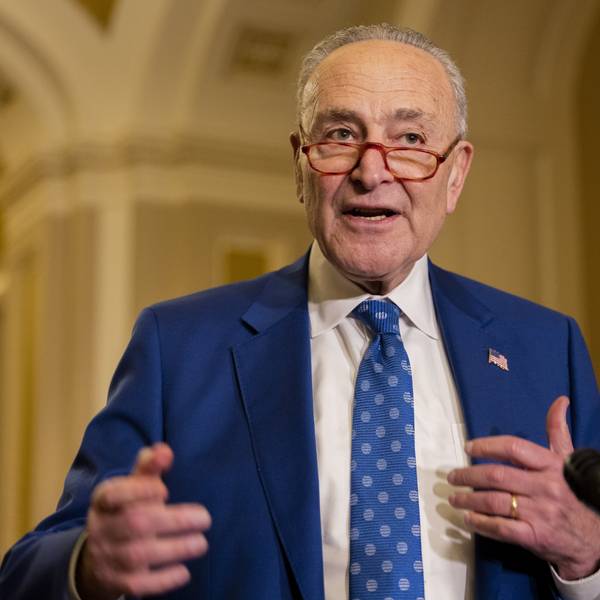
US Sen. Chris Van Hollen (D-Md.) speaks during a forum in the Dirksen Senate Office on July 27, 2026, in Washington, DC.
"This measure was a ruse, promoted by House Speaker Mike Johnson, to make it appear that congressional Republicans were tackling an ethical quagmire when, in fact, it would have accomplished very little."
Democrats in the Senate have blocked what they described as a loophole-laden Republican-led bill to ban members of Congress from purchasing stocks.
Sen. Tom Cotton (R-Ark.) blasted his Democratic colleagues on Wednesday after they declined to give the votes necessary to advance the bill—known as the Stop Insider Trading Act—past the Senate filibuster.
"The Democrats who blocked it went back on their word to protect their own wallets—they should be ashamed of themselves," Cotton said.
But Democrats described the bill, which passed the Republican-controlled House of Representatives in July, as a sham. Sen. Dick Durbin (D-Ill.) said the bill "does not adequately ban congressional stock trading," and described it as "meaningless messaging."
While the bill would have prohibited members of Congress, their spouses, and dependent children from buying stocks, it would not have required them to divest the hundreds of millions of dollars worth of stock they already own.
It also would have exempted President Donald Trump and other executive branch employees. During his second term in office, Trump has made around 30,000 securities trades since returning to office. Bloomberg estimated, based on public disclosures, that he'd made more than 21,000 trades worth between $600 million and $1.86 billion in 2025 alone.
The bill passed by House Republicans also attached a national photo ID requirement for voting as well as additional identification requirements for vote-by-mail, which voting rights advocates argued could disenfranchise millions of eligible voters who do not possess a valid photo ID.
"This measure was a ruse, promoted by House Speaker Mike Johnson (R-La.), to make it appear that congressional Republicans were tackling an ethical quagmire when, in fact, it would have accomplished very little," said Craig Holman, government affairs lobbyist for Public Citizen.
Democrats have argued that the watered-down Republican proposal was meant to sap momentum from stronger bills, amid broad public demand for a stock trading ban.
Holman noted that "there was serious legislation to stop congressional insider trading, but Johnson would not bring up any of the serious proposals for a floor vote."
A bipartisan bill that has stalled in the House would have required members of Congress to divest stock they currently own. Meanwhile, the GOP-controlled House Rules Committee blocked a Democratic proposal that would have made the president and vice president subject to the ban.
"Let’s be clear: I support a total ban on Congress members trading stock," said Sen. Chris Van Hollen (D-Md.) on Wednesday. "But Republicans are trying to package a fraudulent version of that with a bill to disenfranchise American voters."
"This is politics at its worst," he said. "Put a real ban on the floor if you’re serious."
This country and this world are at a monumental crossroads. US voters have an opportunity to beat back the forces of fascism and confront the billionaires who are rigging the economy, our media system, and our democracy, making it increasingly impossible for ordinary people to get by. We’re not just talking about the election. We’re talking about what must be done once these fascist elements are vanquished from power. We need a bolder set of solutions than what either major party has so far been willing to offer and a working-class movement ready to fight like hell for it. Trump didn't emerge from nowhere. The conditions that fueled MAGA authoritarianism were created by decades of radical neoliberal economic policies and a corrupt political system dominated by corporate interests. They slashed taxes on the super-rich, promising that the benefits would trickle down. They said giveaways to the corporate titans would make life more affordable for the rest of us. It was all bullshit. And when a bitter, betrayed populace searches for someone to blame, right-wing demagogues have little trouble finding scapegoats. People know when they're being lied to, but you won't hear any of this from the corporate media. Only independent journalism—powered and funded by people who believe in building a better world—can deliver truly trustworthy daily news. If you share our vision, please contribute whatever you can to sustain our work. |
Democrats in the Senate have blocked what they described as a loophole-laden Republican-led bill to ban members of Congress from purchasing stocks.
Sen. Tom Cotton (R-Ark.) blasted his Democratic colleagues on Wednesday after they declined to give the votes necessary to advance the bill—known as the Stop Insider Trading Act—past the Senate filibuster.
"The Democrats who blocked it went back on their word to protect their own wallets—they should be ashamed of themselves," Cotton said.
But Democrats described the bill, which passed the Republican-controlled House of Representatives in July, as a sham. Sen. Dick Durbin (D-Ill.) said the bill "does not adequately ban congressional stock trading," and described it as "meaningless messaging."
While the bill would have prohibited members of Congress, their spouses, and dependent children from buying stocks, it would not have required them to divest the hundreds of millions of dollars worth of stock they already own.
It also would have exempted President Donald Trump and other executive branch employees. During his second term in office, Trump has made around 30,000 securities trades since returning to office. Bloomberg estimated, based on public disclosures, that he'd made more than 21,000 trades worth between $600 million and $1.86 billion in 2025 alone.
The bill passed by House Republicans also attached a national photo ID requirement for voting as well as additional identification requirements for vote-by-mail, which voting rights advocates argued could disenfranchise millions of eligible voters who do not possess a valid photo ID.
"This measure was a ruse, promoted by House Speaker Mike Johnson (R-La.), to make it appear that congressional Republicans were tackling an ethical quagmire when, in fact, it would have accomplished very little," said Craig Holman, government affairs lobbyist for Public Citizen.
Democrats have argued that the watered-down Republican proposal was meant to sap momentum from stronger bills, amid broad public demand for a stock trading ban.
Holman noted that "there was serious legislation to stop congressional insider trading, but Johnson would not bring up any of the serious proposals for a floor vote."
A bipartisan bill that has stalled in the House would have required members of Congress to divest stock they currently own. Meanwhile, the GOP-controlled House Rules Committee blocked a Democratic proposal that would have made the president and vice president subject to the ban.
"Let’s be clear: I support a total ban on Congress members trading stock," said Sen. Chris Van Hollen (D-Md.) on Wednesday. "But Republicans are trying to package a fraudulent version of that with a bill to disenfranchise American voters."
"This is politics at its worst," he said. "Put a real ban on the floor if you’re serious."