SUBSCRIBE TO OUR FREE NEWSLETTER
Daily news & progressive opinion—funded by the people, not the corporations—delivered straight to your inbox.
5
#000000
#FFFFFF
To donate by check, phone, or other method, see our More Ways to Give page.
Daily news & progressive opinion—funded by the people, not the corporations—delivered straight to your inbox.
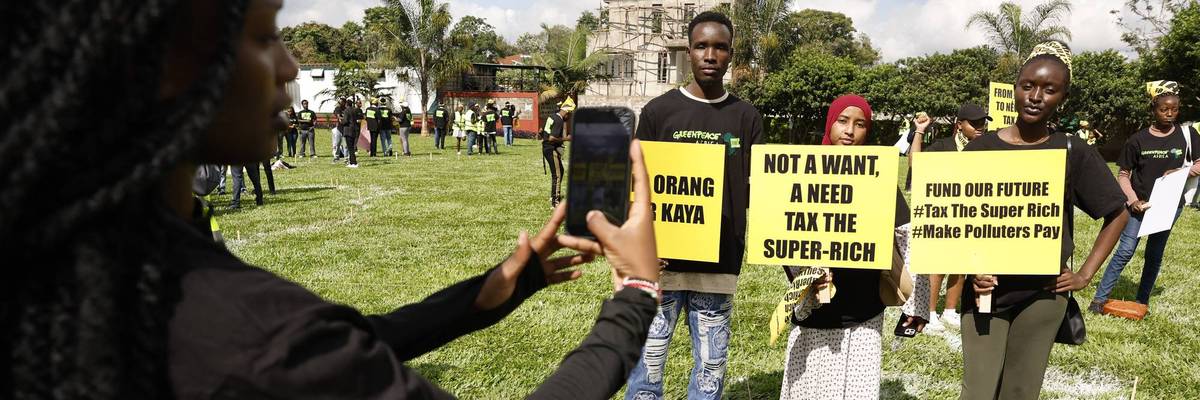
More than 300 Greenpeace Africa volunteers gathered in Nairobi on November 8, 2025, to create a giant human banner of the African continent ahead of the United Nations Tax Convention negotiations.
A Greenpeace representative urged governments to recognize the "once-in-a-generation opportunity to make those most responsible for the climate, nature, and inequality crises we are facing pay their share.”
As world governments meet at the United Nations for another round of negotiations on a first-of-its-kind "Global Tax Treaty," economic justice campaigners are urging them to think big or risk leaving on the table trillions of dollars that could help alleviate global inequality and the climate crisis.
The fifth round of negotiations for the treaty began in New York on Monday, with countries ironing out its language line by line as they seek a global framework to more fairly tax the rich and multinational corporations and crack down on tax avoidance.
Jenny Ricks, the general secretary of the Fight Inequality Alliance—a global coalition of anti-inequality groups—said the framework, which was first conceived in 2022 at the urging of poorer nations in Africa, "aims to make global tax governance more inclusive, transparent, and equitable, shifting it away from the Organization for Economic Cooperation and Development (OECD) and giving the global majority a genuine say in rules that have long been set by wealthy states."
The first drafts of the proposed tax convention were released in late July in advance of this month's negotiations. Advocates at Greenpeace International, however, argue that they contain many gaps that fail to adequately tax fossil fuel companies driving the climate crisis or other multinational corporations and extremely wealthy individuals.
In a briefing document released to media organizations, Greenpeace argued that the text lacks clear language linking taxation to sustainable development, despite it being demanded by 24 countries, and that it lacks provisions requiring polluters to bear the public cost of environmental damage.
The group also criticized the weakening of an article covering taxes on high-net-worth individuals, the lack of a minimum tax on multinational profits, and the absence of specific rules for taxing extractive industries such as oil, gas, and mining.
The oil and gas industry, the group pointed out, is in the midst of a boom, with companies reporting record profits as President Donald Trump's war against Iran drives global oil prices higher.
"The money is right there," said Nina Stros, Greenpeace International's global senior policy expert. "It is about time governments recognized this once-in-a-generation opportunity to make those most responsible for the climate, nature, and inequality crises we are facing pay their share, and reclaim trillions of dollars to invest in our shared future.”
An open letter from Tax and Fiscal Justice Asia, a group of over 50 civil society organizations across 13 Asian countries, emphasized many of the same concerns that the conference could end up merely affirming broad principles without creating concrete rules.
They said representatives of Asian nations at the negotiating table needed to push for a shift in taxing power away from wealthy countries where corporate headquarters are located and toward poorer ones where much of the workforce and resources are concentrated. They also argued for a move away from regressive consumption taxes that disproportionately fall on lower-income people.
"The majority of states in Asia were among the 125 states that voted in November 2023 to adopt a resolution for a UN Framework Convention on International Tax Cooperation (UNFCITC)," the letter said. "The vote has brought forth a historic opportunity to leave behind unjust systems and build a new global tax architecture."
Dear Common Dreams reader, It’s been nearly 30 years since I co-founded Common Dreams with my late wife, Lina Newhouser. We had the radical notion that journalism should serve the public good, not corporate profits. It was clear to us from the outset what it would take to build such a project. No paid advertisements. No corporate sponsors. No millionaire publisher telling us what to think or do. Many people said we wouldn't last a year, but we proved those doubters wrong. Together with a tremendous team of journalists and dedicated staff, we built an independent media outlet free from the constraints of profits and corporate control. Our mission has always been simple: To inform. To inspire. To ignite change for the common good. Building Common Dreams was not easy. Our survival was never guaranteed. When you take on the most powerful forces—Wall Street greed, fossil fuel industry destruction, Big Tech lobbyists, and uber-rich oligarchs who have spent billions upon billions rigging the economy and democracy in their favor—the only bulwark you have is supporters who believe in your work. But here’s the urgent message from me today. It's never been this bad out there. And it's never been this hard to keep us going. At the very moment Common Dreams is most needed, the threats we face are intensifying. We need your support now more than ever. We don't accept corporate advertising and never will. We don't have a paywall because we don't think people should be blocked from critical news based on their ability to pay. Everything we do is funded by the donations of readers like you. When everyone does the little they can afford, we are strong. But if that support retreats or dries up, so do we. Will you donate now to make sure Common Dreams not only survives but thrives? —Craig Brown, Co-founder |
As world governments meet at the United Nations for another round of negotiations on a first-of-its-kind "Global Tax Treaty," economic justice campaigners are urging them to think big or risk leaving on the table trillions of dollars that could help alleviate global inequality and the climate crisis.
The fifth round of negotiations for the treaty began in New York on Monday, with countries ironing out its language line by line as they seek a global framework to more fairly tax the rich and multinational corporations and crack down on tax avoidance.
Jenny Ricks, the general secretary of the Fight Inequality Alliance—a global coalition of anti-inequality groups—said the framework, which was first conceived in 2022 at the urging of poorer nations in Africa, "aims to make global tax governance more inclusive, transparent, and equitable, shifting it away from the Organization for Economic Cooperation and Development (OECD) and giving the global majority a genuine say in rules that have long been set by wealthy states."
The first drafts of the proposed tax convention were released in late July in advance of this month's negotiations. Advocates at Greenpeace International, however, argue that they contain many gaps that fail to adequately tax fossil fuel companies driving the climate crisis or other multinational corporations and extremely wealthy individuals.
In a briefing document released to media organizations, Greenpeace argued that the text lacks clear language linking taxation to sustainable development, despite it being demanded by 24 countries, and that it lacks provisions requiring polluters to bear the public cost of environmental damage.
The group also criticized the weakening of an article covering taxes on high-net-worth individuals, the lack of a minimum tax on multinational profits, and the absence of specific rules for taxing extractive industries such as oil, gas, and mining.
The oil and gas industry, the group pointed out, is in the midst of a boom, with companies reporting record profits as President Donald Trump's war against Iran drives global oil prices higher.
"The money is right there," said Nina Stros, Greenpeace International's global senior policy expert. "It is about time governments recognized this once-in-a-generation opportunity to make those most responsible for the climate, nature, and inequality crises we are facing pay their share, and reclaim trillions of dollars to invest in our shared future.”
An open letter from Tax and Fiscal Justice Asia, a group of over 50 civil society organizations across 13 Asian countries, emphasized many of the same concerns that the conference could end up merely affirming broad principles without creating concrete rules.
They said representatives of Asian nations at the negotiating table needed to push for a shift in taxing power away from wealthy countries where corporate headquarters are located and toward poorer ones where much of the workforce and resources are concentrated. They also argued for a move away from regressive consumption taxes that disproportionately fall on lower-income people.
"The majority of states in Asia were among the 125 states that voted in November 2023 to adopt a resolution for a UN Framework Convention on International Tax Cooperation (UNFCITC)," the letter said. "The vote has brought forth a historic opportunity to leave behind unjust systems and build a new global tax architecture."
As world governments meet at the United Nations for another round of negotiations on a first-of-its-kind "Global Tax Treaty," economic justice campaigners are urging them to think big or risk leaving on the table trillions of dollars that could help alleviate global inequality and the climate crisis.
The fifth round of negotiations for the treaty began in New York on Monday, with countries ironing out its language line by line as they seek a global framework to more fairly tax the rich and multinational corporations and crack down on tax avoidance.
Jenny Ricks, the general secretary of the Fight Inequality Alliance—a global coalition of anti-inequality groups—said the framework, which was first conceived in 2022 at the urging of poorer nations in Africa, "aims to make global tax governance more inclusive, transparent, and equitable, shifting it away from the Organization for Economic Cooperation and Development (OECD) and giving the global majority a genuine say in rules that have long been set by wealthy states."
The first drafts of the proposed tax convention were released in late July in advance of this month's negotiations. Advocates at Greenpeace International, however, argue that they contain many gaps that fail to adequately tax fossil fuel companies driving the climate crisis or other multinational corporations and extremely wealthy individuals.
In a briefing document released to media organizations, Greenpeace argued that the text lacks clear language linking taxation to sustainable development, despite it being demanded by 24 countries, and that it lacks provisions requiring polluters to bear the public cost of environmental damage.
The group also criticized the weakening of an article covering taxes on high-net-worth individuals, the lack of a minimum tax on multinational profits, and the absence of specific rules for taxing extractive industries such as oil, gas, and mining.
The oil and gas industry, the group pointed out, is in the midst of a boom, with companies reporting record profits as President Donald Trump's war against Iran drives global oil prices higher.
"The money is right there," said Nina Stros, Greenpeace International's global senior policy expert. "It is about time governments recognized this once-in-a-generation opportunity to make those most responsible for the climate, nature, and inequality crises we are facing pay their share, and reclaim trillions of dollars to invest in our shared future.”
An open letter from Tax and Fiscal Justice Asia, a group of over 50 civil society organizations across 13 Asian countries, emphasized many of the same concerns that the conference could end up merely affirming broad principles without creating concrete rules.
They said representatives of Asian nations at the negotiating table needed to push for a shift in taxing power away from wealthy countries where corporate headquarters are located and toward poorer ones where much of the workforce and resources are concentrated. They also argued for a move away from regressive consumption taxes that disproportionately fall on lower-income people.
"The majority of states in Asia were among the 125 states that voted in November 2023 to adopt a resolution for a UN Framework Convention on International Tax Cooperation (UNFCITC)," the letter said. "The vote has brought forth a historic opportunity to leave behind unjust systems and build a new global tax architecture."