SUBSCRIBE TO OUR FREE NEWSLETTER
Daily news & progressive opinion—funded by the people, not the corporations—delivered straight to your inbox.
5
#000000
#FFFFFF
To donate by check, phone, or other method, see our More Ways to Give page.
Daily news & progressive opinion—funded by the people, not the corporations—delivered straight to your inbox.
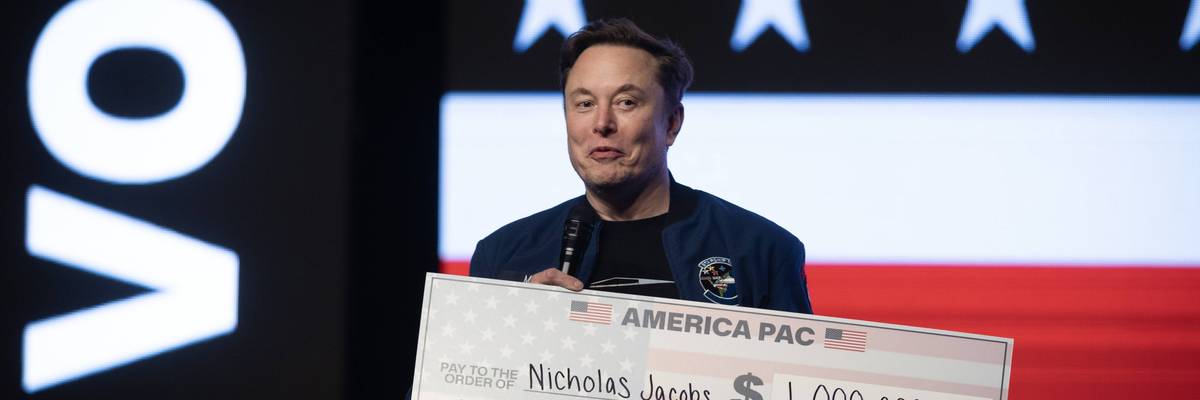
Billionaire businessman Elon Musk prepares to give $1,000,000 to a Wisconsin voter during a town hall meeting he was hosting at the KI Convention Center on March 30, 2025 in Green Bay, Wisconsin.
"Have I mentioned lately that oligarch-owned media consolidation is bad?" said one critic.
Filmmaker Alex Gibney's scathing four-hour documentary about SpaceX CEO Elon Musk has received rave reviews since its debut at the Venice Film Festival earlier this month, but it could soon be without an international distributor.
According to a Wednesday report from The Hollywood Reporter, Comcast-owned Universal Pictures, which holds distribution rights to the film outside the North American market, is getting "cold feet" about releasing it.
"The company has not dated the movie," explained The Hollywood Reporter, "has not communicated with the filmmaking team about its plans, and generally appears to be rethinking the release of a project that it once showed high enthusiasm for but is now politically sensitive for parts of the Trump administration."
Two sources told the publication that they wouldn't be surprised if Universal decided to not release the movie and returned its distribution rights to the filmmakers, even though doing so would require the studio to pay a kill fee.
The Hollywood Reporter noted, however, that it's unlikely that the film would be without an international distributor for long because "distributors in individual countries have been salivating over the film ever since the four-hour project began gaining buzz in recent weeks."
Slate culture writer Sam Adams pointed out in a social media post that independent distributor Bleecker Street "is holding steady on releasing Musk in the US, and actually moved up the opening to October 9."
Emmy Award-winning sports broadcaster Brian Webber noted that there is past precedent for Hollywood studios coming under pressure to not release a movie that is critical of a wealthy oligarch.
"William Randolph Hearst famously tried to... suppress Citizen Kane from being released," Webber explained in a social media post. "Hollywood had more guts in the 1940s—probably because there was real competition among the studios and not today's oligopoly problem."
Tech journalist Karl Bode reacted with dismay to news that Universal might spike its release of the documentary.
"Have I mentioned lately that oligarch-owned media consolidation is bad?" he asked rhetorically.
Dear Common Dreams reader, It’s been nearly 30 years since I co-founded Common Dreams with my late wife, Lina Newhouser. We had the radical notion that journalism should serve the public good, not corporate profits. It was clear to us from the outset what it would take to build such a project. No paid advertisements. No corporate sponsors. No millionaire publisher telling us what to think or do. Many people said we wouldn't last a year, but we proved those doubters wrong. Together with a tremendous team of journalists and dedicated staff, we built an independent media outlet free from the constraints of profits and corporate control. Our mission has always been simple: To inform. To inspire. To ignite change for the common good. Building Common Dreams was not easy. Our survival was never guaranteed. When you take on the most powerful forces—Wall Street greed, fossil fuel industry destruction, Big Tech lobbyists, and uber-rich oligarchs who have spent billions upon billions rigging the economy and democracy in their favor—the only bulwark you have is supporters who believe in your work. But here’s the urgent message from me today. It's never been this bad out there. And it's never been this hard to keep us going. At the very moment Common Dreams is most needed, the threats we face are intensifying. We need your support now more than ever. We don't accept corporate advertising and never will. We don't have a paywall because we don't think people should be blocked from critical news based on their ability to pay. Everything we do is funded by the donations of readers like you. When everyone does the little they can afford, we are strong. But if that support retreats or dries up, so do we. Will you donate now to make sure Common Dreams not only survives but thrives? —Craig Brown, Co-founder |
Filmmaker Alex Gibney's scathing four-hour documentary about SpaceX CEO Elon Musk has received rave reviews since its debut at the Venice Film Festival earlier this month, but it could soon be without an international distributor.
According to a Wednesday report from The Hollywood Reporter, Comcast-owned Universal Pictures, which holds distribution rights to the film outside the North American market, is getting "cold feet" about releasing it.
"The company has not dated the movie," explained The Hollywood Reporter, "has not communicated with the filmmaking team about its plans, and generally appears to be rethinking the release of a project that it once showed high enthusiasm for but is now politically sensitive for parts of the Trump administration."
Two sources told the publication that they wouldn't be surprised if Universal decided to not release the movie and returned its distribution rights to the filmmakers, even though doing so would require the studio to pay a kill fee.
The Hollywood Reporter noted, however, that it's unlikely that the film would be without an international distributor for long because "distributors in individual countries have been salivating over the film ever since the four-hour project began gaining buzz in recent weeks."
Slate culture writer Sam Adams pointed out in a social media post that independent distributor Bleecker Street "is holding steady on releasing Musk in the US, and actually moved up the opening to October 9."
Emmy Award-winning sports broadcaster Brian Webber noted that there is past precedent for Hollywood studios coming under pressure to not release a movie that is critical of a wealthy oligarch.
"William Randolph Hearst famously tried to... suppress Citizen Kane from being released," Webber explained in a social media post. "Hollywood had more guts in the 1940s—probably because there was real competition among the studios and not today's oligopoly problem."
Tech journalist Karl Bode reacted with dismay to news that Universal might spike its release of the documentary.
"Have I mentioned lately that oligarch-owned media consolidation is bad?" he asked rhetorically.
Filmmaker Alex Gibney's scathing four-hour documentary about SpaceX CEO Elon Musk has received rave reviews since its debut at the Venice Film Festival earlier this month, but it could soon be without an international distributor.
According to a Wednesday report from The Hollywood Reporter, Comcast-owned Universal Pictures, which holds distribution rights to the film outside the North American market, is getting "cold feet" about releasing it.
"The company has not dated the movie," explained The Hollywood Reporter, "has not communicated with the filmmaking team about its plans, and generally appears to be rethinking the release of a project that it once showed high enthusiasm for but is now politically sensitive for parts of the Trump administration."
Two sources told the publication that they wouldn't be surprised if Universal decided to not release the movie and returned its distribution rights to the filmmakers, even though doing so would require the studio to pay a kill fee.
The Hollywood Reporter noted, however, that it's unlikely that the film would be without an international distributor for long because "distributors in individual countries have been salivating over the film ever since the four-hour project began gaining buzz in recent weeks."
Slate culture writer Sam Adams pointed out in a social media post that independent distributor Bleecker Street "is holding steady on releasing Musk in the US, and actually moved up the opening to October 9."
Emmy Award-winning sports broadcaster Brian Webber noted that there is past precedent for Hollywood studios coming under pressure to not release a movie that is critical of a wealthy oligarch.
"William Randolph Hearst famously tried to... suppress Citizen Kane from being released," Webber explained in a social media post. "Hollywood had more guts in the 1940s—probably because there was real competition among the studios and not today's oligopoly problem."
Tech journalist Karl Bode reacted with dismay to news that Universal might spike its release of the documentary.
"Have I mentioned lately that oligarch-owned media consolidation is bad?" he asked rhetorically.