SUBSCRIBE TO OUR FREE NEWSLETTER
Daily news & progressive opinion—funded by the people, not the corporations—delivered straight to your inbox.
5
#000000
#FFFFFF
To donate by check, phone, or other method, see our More Ways to Give page.
Daily news & progressive opinion—funded by the people, not the corporations—delivered straight to your inbox.
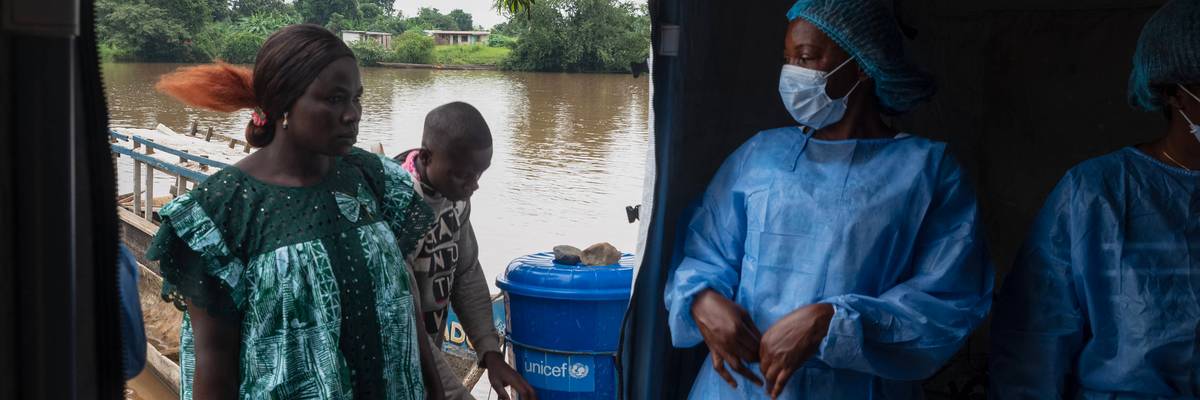
As Ebola cases rise in the Democratic Republic of Congo, the Central African Republic is tightening border controls. A traveler washes his hands before having his temperature taken by health workers at the M'Poko Bac landing stage, in Bimbo district southwest of Bangui, on October 28, 2026.
The response to the epidemic has been hindered by lack of community trust in authorities, poor infrastructure, and armed conflict.
Three months after the United Nations senior Ebola coordinator warned that the outbreak in the Democratic Republic of Congo was "growing exponentially," government data showed Thursday that confirmed cases have topped 12,000 and left over 5,900 people dead.
The epidemic's figures still rank behind the 2014-16 West African outbreak—which infected more than 28,600 people and killed over 11,000—but it is "the deadliest of Congo's 17 outbreaks and is on track to surpass the death toll" from a decade ago, according to The Associated Press, which published a series of graphs demonstrating how fast-growing this crisis is.
Since the outbreak—caused by the rare Bundibugyo virus—was declared in May, it has spread to eight of the DRC's 26 provinces. Africa Centers for Disease Control and Prevention data recently revealed that just 15% of new cases come from contacts known to health authorities, and a Reuters analysis of satellite imagery found the death toll may be underestimated in two hard-hit areas.
The World Health Organization (WHO) said last Friday that "no new cases have been reported from Kenya or Nigeria; and no new country has reported confirmed cases," but "the high-level transmission in the Democratic Republic of the Congo calls for continued need for readiness in the region, including cross-border surveillance, points of entry monitoring, timely case detection, and coordinated preparedness and response measures."
The response in the DRC has been hindered by lack of community trust in authorities, poor infrastructure, and armed conflict, particularly between the army and the Convention for the Popular Revolution (CRP)—one of dozens of militant groups in the resource-rich eastern part of the country, and led by Thomas Lubanga, who was convicted of conscripting child soldiers by the International Criminal Court in 2012.
Summarizing remarks from Dr. Catherine Smallwood, the WHO's incident manager in the DRC, the AP reported Wednesday that "the fighting between the army and rebel groups has prevented teams from reaching some communities, disrupted monitoring of people exposed to the virus, and left some treatment centers with fewer staff."
According to the AP:
Smallwood said that about a dozen people, including two WHO personnel and Congolese health officials, were evacuated to Bunia on Tuesday after three full days trapped in a hospital in Akwe, northeast of the provincial capital, amid intense crossfire.
“They were caught really in the crossfire, very intense fighting, and we managed to evacuate them,” Smallwood said.
WHO temporarily moved its Mongbwalu team and partner staff to Bunia after fighting disrupted road access, Smallwood said. Mongbwalu, a mining town northwest of Bunia, is where the outbreak was first detected in May.
The United Nations Organization Stabilization Mission in the Democratic Republic of the Congo (MONUSCO) said Wednesday that "the security situation has deteriorated significantly in several localities" due to clashes between DRC forces and the CRP, and Bangladeshi peacekeepers helped with that evacuation of health workers.
UN peacekeepers faced "significant logistical challenges," including "difficult terrain, poor road conditions, and the fragile state of a wooden bridge," before they reached the healthcare workers, who were evacuated by air to Bunia, MONUSCO noted.
"These healthcare workers, who are actively involved in the response to the Ebola outbreak, play a vital role in assisting communities already weakened by violence and displacement," the mission said. "This intervention is part of MONUSCO's support for Ebola response efforts, particularly through the protection of healthcare personnel and the facilitation of safe access to healthcare for populations affected by violence."
After the evacuation, WHO Director-General Tedros Adhanom Ghebreyesus thanked all those involved and stressed that "healthcare, health workers, Ebola responders, and humanitarian [aid] must be protected at all times!"
This country and this world are at a monumental crossroads. US voters have an opportunity to beat back the forces of fascism and confront the billionaires who are rigging the economy, our media system, and our democracy, making it increasingly impossible for ordinary people to get by. We’re not just talking about the election. We’re talking about what must be done once these fascist elements are vanquished from power. We need a bolder set of solutions than what either major party has so far been willing to offer and a working-class movement ready to fight like hell for it. Trump didn't emerge from nowhere. The conditions that fueled MAGA authoritarianism were created by decades of radical neoliberal economic policies and a corrupt political system dominated by corporate interests. They slashed taxes on the super-rich, promising that the benefits would trickle down. They said giveaways to the corporate titans would make life more affordable for the rest of us. It was all bullshit. And when a bitter, betrayed populace searches for someone to blame, right-wing demagogues have little trouble finding scapegoats. People know when they're being lied to, but you won't hear any of this from the corporate media. Only independent journalism—powered and funded by people who believe in building a better world—can deliver truly trustworthy daily news. If you share our vision, please contribute whatever you can to sustain our work. |
Three months after the United Nations senior Ebola coordinator warned that the outbreak in the Democratic Republic of Congo was "growing exponentially," government data showed Thursday that confirmed cases have topped 12,000 and left over 5,900 people dead.
The epidemic's figures still rank behind the 2014-16 West African outbreak—which infected more than 28,600 people and killed over 11,000—but it is "the deadliest of Congo's 17 outbreaks and is on track to surpass the death toll" from a decade ago, according to The Associated Press, which published a series of graphs demonstrating how fast-growing this crisis is.
Since the outbreak—caused by the rare Bundibugyo virus—was declared in May, it has spread to eight of the DRC's 26 provinces. Africa Centers for Disease Control and Prevention data recently revealed that just 15% of new cases come from contacts known to health authorities, and a Reuters analysis of satellite imagery found the death toll may be underestimated in two hard-hit areas.
The World Health Organization (WHO) said last Friday that "no new cases have been reported from Kenya or Nigeria; and no new country has reported confirmed cases," but "the high-level transmission in the Democratic Republic of the Congo calls for continued need for readiness in the region, including cross-border surveillance, points of entry monitoring, timely case detection, and coordinated preparedness and response measures."
The response in the DRC has been hindered by lack of community trust in authorities, poor infrastructure, and armed conflict, particularly between the army and the Convention for the Popular Revolution (CRP)—one of dozens of militant groups in the resource-rich eastern part of the country, and led by Thomas Lubanga, who was convicted of conscripting child soldiers by the International Criminal Court in 2012.
Summarizing remarks from Dr. Catherine Smallwood, the WHO's incident manager in the DRC, the AP reported Wednesday that "the fighting between the army and rebel groups has prevented teams from reaching some communities, disrupted monitoring of people exposed to the virus, and left some treatment centers with fewer staff."
According to the AP:
Smallwood said that about a dozen people, including two WHO personnel and Congolese health officials, were evacuated to Bunia on Tuesday after three full days trapped in a hospital in Akwe, northeast of the provincial capital, amid intense crossfire.
“They were caught really in the crossfire, very intense fighting, and we managed to evacuate them,” Smallwood said.
WHO temporarily moved its Mongbwalu team and partner staff to Bunia after fighting disrupted road access, Smallwood said. Mongbwalu, a mining town northwest of Bunia, is where the outbreak was first detected in May.
The United Nations Organization Stabilization Mission in the Democratic Republic of the Congo (MONUSCO) said Wednesday that "the security situation has deteriorated significantly in several localities" due to clashes between DRC forces and the CRP, and Bangladeshi peacekeepers helped with that evacuation of health workers.
UN peacekeepers faced "significant logistical challenges," including "difficult terrain, poor road conditions, and the fragile state of a wooden bridge," before they reached the healthcare workers, who were evacuated by air to Bunia, MONUSCO noted.
"These healthcare workers, who are actively involved in the response to the Ebola outbreak, play a vital role in assisting communities already weakened by violence and displacement," the mission said. "This intervention is part of MONUSCO's support for Ebola response efforts, particularly through the protection of healthcare personnel and the facilitation of safe access to healthcare for populations affected by violence."
After the evacuation, WHO Director-General Tedros Adhanom Ghebreyesus thanked all those involved and stressed that "healthcare, health workers, Ebola responders, and humanitarian [aid] must be protected at all times!"