SUBSCRIBE TO OUR FREE NEWSLETTER
Daily news & progressive opinion—funded by the people, not the corporations—delivered straight to your inbox.
5
#000000
#FFFFFF
To donate by check, phone, or other method, see our More Ways to Give page.
Daily news & progressive opinion—funded by the people, not the corporations—delivered straight to your inbox.
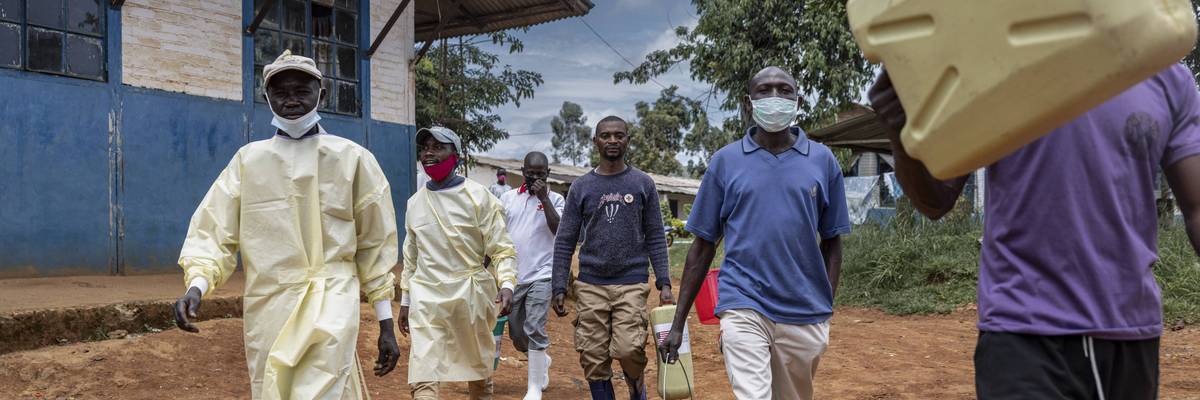
Health workers and local volunteers carry disinfectant containers and sanitation equipment on May 21, 2026 in Mongbwalu, Democratic Republic of Congo.
"The outbreak had a big head start, it is still way ahead of us, and we are playing catch-up," said WHO Director-General Tedros Adhanom Ghebreyesus.
The World Health Organization on Wednesday announced that the outbreak of Ebola in the Democratic Republic of Congo is on pace to become the deadliest in history.
In a press conference, WHO Director-General Tedros Adhanom Ghebreyesus said that the current Ebola epidemic is already the second-largest ever recorded, and "is moving faster than any previous Ebola outbreak."
"At its current pace," Tedros added, "it is on track to eclipse the West African Ebola outbreak of 2014 to 2016."
There have been more 4,400 confirmed cases and over 2,000 deaths during the current outbreak, with 80% of deaths occurring in the Ituri province in the northeastern corner of the country.
The WHO chief said he was particularly concerned that many deaths in the region are happening in communities instead of in treatment centers, which suggests there are "chains of transmission we don't know about" and need to be tracked down to contain the outbreak.
"The outbreak had a big head start," he said, "it is still way ahead of us, and we are playing catch-up."
Tedros also shared some encouraging news about the epidemic, highlighting nearly 900 Ebola patients who have recovered "even without specific therapeutics and vaccines," which he noted were still undergoing clinical trials.
"For the first time, two vaccines specifically designed against Ebola Bundibugyo virus have now entered phase one safety trials in humans," he said. "In addition, two new animal studies of the vaccine against Zaire ebolavirus—the more common species—have shown promising evidence of cross protection in animals. On that basis, WHO has recommended inclusion of the vaccine in a phase three trial, which we hope to start as soon as possible."
This country and this world are at a monumental crossroads. US voters have an opportunity to beat back the forces of fascism and confront the billionaires who are rigging the economy, our media system, and our democracy, making it increasingly impossible for ordinary people to get by. We’re not just talking about the election. We’re talking about what must be done once these fascist elements are vanquished from power. We need a bolder set of solutions than what either major party has so far been willing to offer and a working-class movement ready to fight like hell for it. Trump didn't emerge from nowhere. The conditions that fueled MAGA authoritarianism were created by decades of radical neoliberal economic policies and a corrupt political system dominated by corporate interests. They slashed taxes on the super-rich, promising that the benefits would trickle down. They said giveaways to the corporate titans would make life more affordable for the rest of us. It was all bullshit. And when a bitter, betrayed populace searches for someone to blame, right-wing demagogues have little trouble finding scapegoats. People know when they're being lied to, but you won't hear any of this from the corporate media. Only independent journalism—powered and funded by people who believe in building a better world—can deliver truly trustworthy daily news. If you share our vision, please contribute whatever you can to sustain our work. |
The World Health Organization on Wednesday announced that the outbreak of Ebola in the Democratic Republic of Congo is on pace to become the deadliest in history.
In a press conference, WHO Director-General Tedros Adhanom Ghebreyesus said that the current Ebola epidemic is already the second-largest ever recorded, and "is moving faster than any previous Ebola outbreak."
"At its current pace," Tedros added, "it is on track to eclipse the West African Ebola outbreak of 2014 to 2016."
There have been more 4,400 confirmed cases and over 2,000 deaths during the current outbreak, with 80% of deaths occurring in the Ituri province in the northeastern corner of the country.
The WHO chief said he was particularly concerned that many deaths in the region are happening in communities instead of in treatment centers, which suggests there are "chains of transmission we don't know about" and need to be tracked down to contain the outbreak.
"The outbreak had a big head start," he said, "it is still way ahead of us, and we are playing catch-up."
Tedros also shared some encouraging news about the epidemic, highlighting nearly 900 Ebola patients who have recovered "even without specific therapeutics and vaccines," which he noted were still undergoing clinical trials.
"For the first time, two vaccines specifically designed against Ebola Bundibugyo virus have now entered phase one safety trials in humans," he said. "In addition, two new animal studies of the vaccine against Zaire ebolavirus—the more common species—have shown promising evidence of cross protection in animals. On that basis, WHO has recommended inclusion of the vaccine in a phase three trial, which we hope to start as soon as possible."