

SUBSCRIBE TO OUR FREE NEWSLETTER
Daily news & progressive opinion—funded by the people, not the corporations—delivered straight to your inbox.
5
#000000
#FFFFFF
To donate by check, phone, or other method, see our More Ways to Give page.
Daily news & progressive opinion—funded by the people, not the corporations—delivered straight to your inbox.

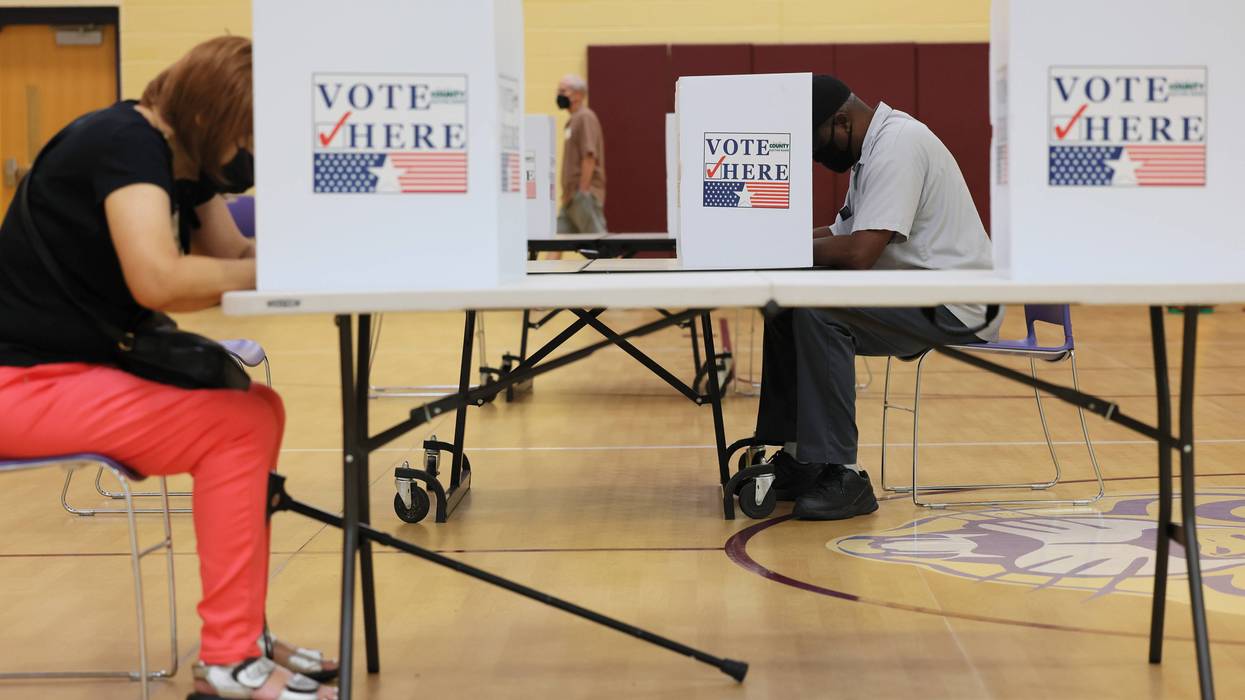
Voters also rejected an amendment that would have gradually eliminated the state’s income tax in what one Democratic mayor said would benefit the wealthy "while raising costs on hardworking families."
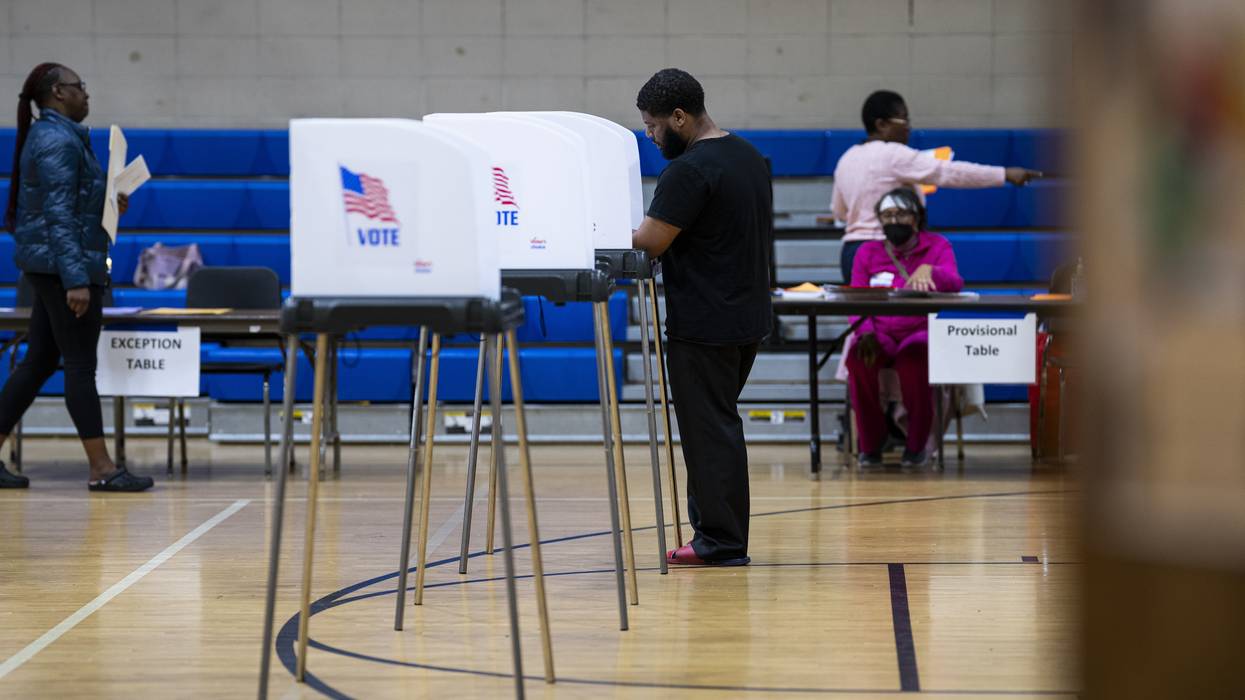
The Democratic mayor of Kansas City, Missouri was among those celebrating what he called the "TOTAL repudiation by Missouri voter of a core agenda of state GOP leadership" on Tuesday night after the state voted by a 60-point margin against Amendment 4, a measure backed by the Republican governor which would have weakened voters' ability to pass citizen-sponsored ballot initiatives.
"We took over control of the state of Missouri tonight, repudiating absolutely atrocious ideas," Mayor Quinton Lucas said in a video message addressing voters as election results came in. "Against millions of dollars, lots of special interests, Missouri voters are trouncing Amendment 4, which was going to take away our initiative petition rights, eliminate our ability to make sure we can get things done."
The Republican supermajority in the state Legislature and Gov. Mike Kehoe supported Amendment 4, which was spurred by the passage of a ballot initiative in 2024 that had added the right to abortion care to the Missouri Constitution.
The addition of the amendment to the constitution would have required a majority vote in each of the state's eight congressional districts in order to pass any future citizen-sponsored amendments, instead of a simply majority of voters across the state.
With more than 95% of votes counted on Wednesday morning, 80.3% of voters had rejected Amendment 4, while 19.7% had supported it.
The amendment would have created the highest threshold in the country for passing ballot initiatives like others that Missourians have passed in recent years, including ones that have legalized marijuana, raised the minimum wage, and expanding Medicaid coverage.
Opponents warned that under Amendment 4, an initiative could fail to pass even with as many as 95% of voters across the state supporting it.
The St. Louis American reported that the election result could signal voters' coming rejection of Amendment 3 in November, which would ban abortion in Missouri in most cases.
The state GOP suffered a similar defeat for Amendment 5, which would have gradually eliminated the state's income tax and replaced it with expanded sales and use taxes. Opponents warned the new tax scheme would have cost working families and lower-income Missourians more, with the average resident paying $500 more in taxes annually, according to the nonpartisan Missouri Budget Project—as high-income residents would have been required to contribute less to public spending.
“Tonight’s rejection of Amendment 5 is not only an immense failure for statewide leadership, but also a sign to out-of-state billionaire special interests that Missourians and most Americans have no interest in voodoo tax schemes that would spare civic responsibility for a few elites while raising costs on hardworking families in our state and our country,” Lucas said Tuesday night.
Mark Jones of the Missouri National Education Association—part of a broad coalition that opposed the amendment—told the Missouri Independent that "fundamentally, Missourians rejected the idea that they should pay for tax breaks for billionaires and then not be able to change to correct the legislature, not only on this issue but forever."
The Independent reported that Missouri Promise political action committee (PAC), which did not report any contributions from individual donors, raised $17.2 million in favor of Amendment 5. Opponents of Amendment 5 were outspent 4-to-1 on broadcast ads.
Another PAC, Protect Election Integrity, raised $132,100 and spent $28,653 through July 23 in support of Amendment 4. Freedom Principle Missouri/Missouri First PAC, also reported spending $45,551 in support of the measure.
State House Minority Leader Ashley Aune (D-14) said Missouri voters had "made clear they won’t let Republicans rewrite the rules to protect their own power and line the pockets of the ultrawealthy."
Referring to the abortion rights amendment that will be up for a vote in the general election, Aune added, "In November, voters have the chance to send another powerful message to Jefferson City Republicans: If you mess with Missourians’ rights, you will pay the political price.”
While Missouri's 1% would get major tax breaks, one tax policy expert said, "working families and seniors would be asked to make up the difference."
Tax policy experts warned Tuesday that passing Amendment 5 in Missouri next month could lead to middle-income residents paying hundreds of dollars more each year as wealthy households enjoy a tax cut worth tens of thousands.
If approved by voters on August 4, the legislatively referred constitutional amendment would: reduce Missouri's individual income tax, based on revenue growth, until it is eliminated; prohibit future state individual income taxes; decrease personal property and other local taxes when local revenues increase, but bar funding cuts to public schools; and limit expansions of sales and use taxes, unless they are used to lower income tax.
As The Kansas City Star detailed last week, Amendment 5 is a "top priority for Republican Gov. Mike Kehoe," and Missouri Promise PAC, the main campaign supporting it, received "$9.6 million from six organizations or groups that do not have to disclose their donors," also known as dark money.
While some of the campaign backers remain unknown to voters, the Institute on Taxation and Economic Policy (ITEP) in Washington, DC aimed to shed light on the specifics of the amendment's anticipated impact with its new policy brief.
"Amendment 5 asks Missouri voters to approve a tax shift without telling them which purchases will be taxed or how high sales taxes will rise," said ITEP analyst and brief author Eli Byerly-Duke. "What is clear is who would benefit: the wealthiest Missourians. Working families and seniors would be asked to make up the difference."
Missouri's individual income tax "makes up about 64% of the state's general fund and is the major funding source for state investments in infrastructure, schools, healthcare, public safety, and other services," the brief explains. "Low- and middle-income Missourians already pay a disproportionate share of the taxes to fund public services," and swapping income taxes for higher sales taxes "would shift even more of this responsibility from the state's highest-income individuals to teachers, farmers, truck drivers, and other middle-income Missourians."
Specifically, Byerly-Duke found that "middle-class Missourians with incomes of about $50,000 to $80,000 will pay $535 more in taxes if the personal income tax is eliminated and the sales tax expanded," all while Missouri's top 1%—or those with incomes of $689,300 and above—see an average tax break of $39,978.
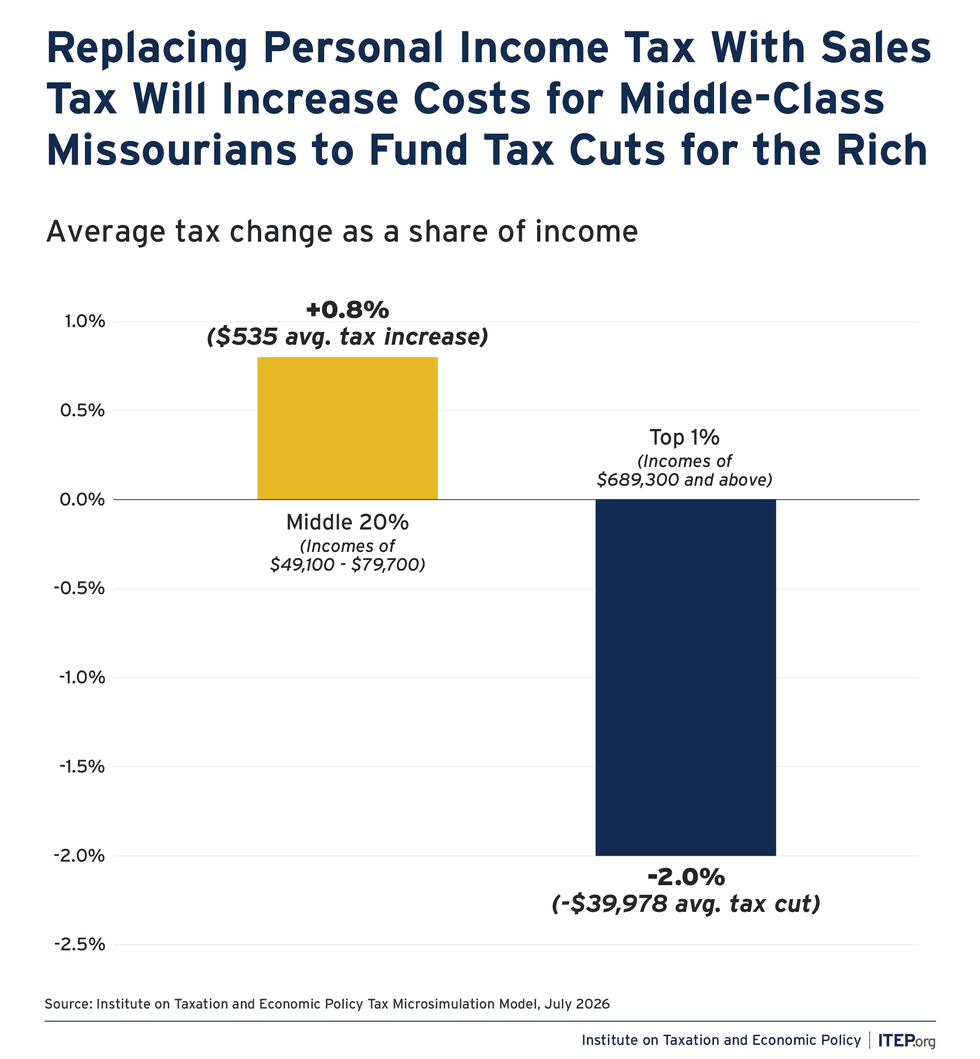
The brief also highlights that "neither the Missouri Legislature nor governor has explained exactly how they will expand sales taxes if it passes. They might increase the sales tax rate, or they might expand the sales tax to include purchases of services that are not currently taxed, such as home repair and insurance, car repair and financing, personal care services such as hair or nail care, or medical services. Taxing these items will cost middle-income households a larger share of their incomes than higher-income households, but middle-income families will not get a commensurate benefit from the income tax elimination."
"For senior citizens, active-duty military families, and military retirees, the impact would be even worse," the report continues. "That's because Social Security benefits, active-duty military pay, and military pensions are already exempt from Missouri income tax, so households for whom those are the sole source of income would get no benefit from Amendment 5. For a middle-class Missourian earning between $49,100 and $79,700, this would mean an increase of $1,600 in taxes every year. Overall, seniors alone would see a net tax increase of about $335 million and each pay $365 more, on average, each year."
The brief bolsters the case for voters to say "No on 5," as Protect MO Taxpayers encourages. The "no" campaign's website warns that the amendment "hits seniors, retirees, veterans, and disabled persons hardest. Those on tight fixed incomes may not pay income tax on their limited income, but they will certainly be hurt by higher sales taxes on goods they buy every day, such as groceries, medicine, and gas, and services they use every day, from haircuts to car repairs to healthcare and housing."
"Amendment 5 hits working families hardest of all, with higher sales and use taxes estimated by the nonpartisan Missouri Budget Project to cost the average Missouri family about $500 more in taxes per year overall," Protect MO Taxpayers' site says, also pointing to concerns that it will "increase the tough economic times in rural Missouri" and "make the economic struggle even harder for small businesses."
The proposal "is a severe hit for renters who are already struggling to make ends meet," and "crushes the dreams of Missourians who want to buy or sell a home," the site adds. "Amendment 5 hits active-duty military, who do not pay state income tax but will face higher prices off the base with sales taxes that could roughly triple. This will mean less retail business and economic harm in our neighboring military host communities."
"What voters are saying now is that democracy is sacred."
Organizers in Missouri on Sunday said they reached an important milestone in a campaign to put a constitutional amendment on the ballot this year that would stop Republican officials in the state from trying to sabotage ballot initiatives.
Respect Missouri Voters, a coalition aimed at protecting and strengthening the state's ballot initiative process, announced that it has delivered more than 367,000 signatures to the Missouri Secretary of State's office in favor of a constitutional amendment that enact two key policies to protect voter-passed laws.
First, as the Fairness Project summarized on Monday, it would "require that all future ballot measures in the state be summarized for voters in fair, clear, and easily understandable terms"; and second, it would demand "that any attempt by the Legislature to refer a voter-approved measure back to the ballot clear an 80% threshold in each chamber, a high bar designed to prevent politicians from undoing what voters have already decided."
The first part of the amendment is aimed at addressing problems created by Republican Missouri Secretary of State Denny Hoskins, who has repeatedly been taken to court for writing ballot initiative summaries that advocates say are misleading or provide incomplete information about what the initiatives would do.
As the Missouri Independent reported in February, a total of five summaries written by Hoskins have been thrown out by courts since October, as "judges at every level of Missouri’s court system have stepped in to block or rewrite ballot language" drafted by the secretary of state.
The second part of the amendment, meanwhile, was written in response to Republican legislators' efforts to overturn ballot initiatives passed in 2024 that legalized abortion in Missouri and established mandatory paid sick leave.
Kelly Hall, executive director of the Fairness Project, a key backer of Respect Missouri Voters, said the gathering of more than 367,000 signatures is "a promising milestone for Missouri voters and for direct democracy."
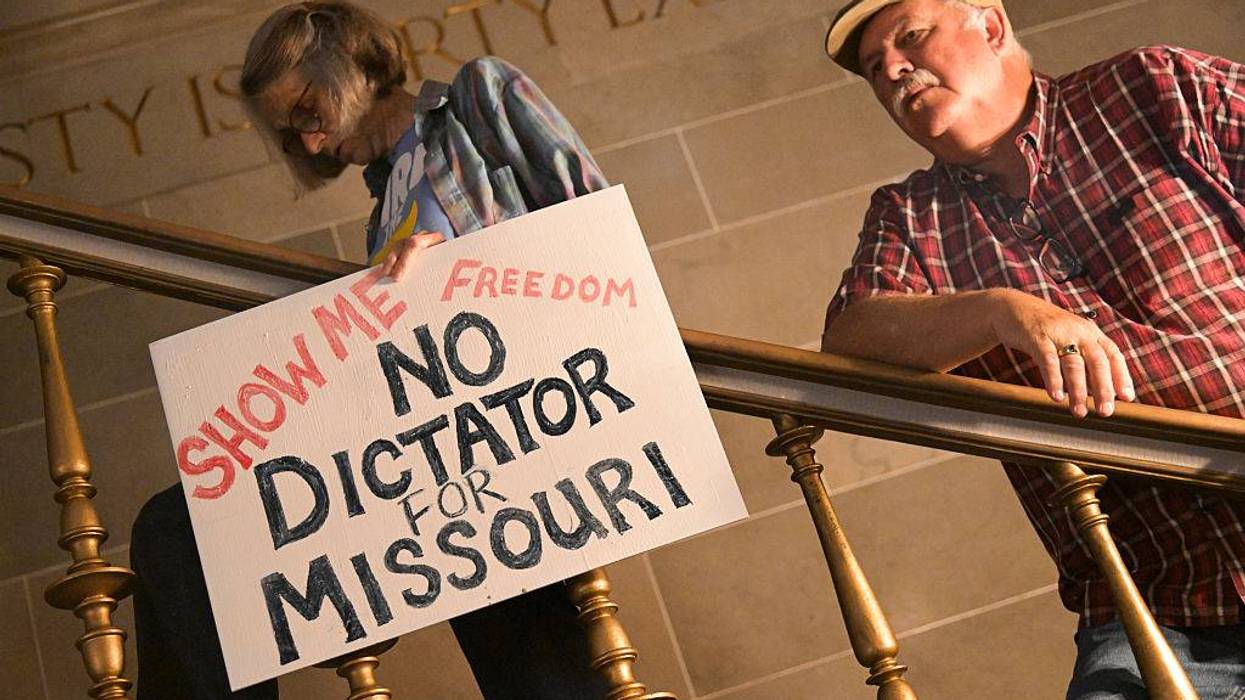
"Perhaps more than in any other state, voters in Missouri understand what is at stake,” Hall added. "It’s in Missouri that extremist politicians have worked overtime to undermine the will of their voters, whether it’s been fighting to reinstate a wildly unpopular ban on access to abortion care, gerrymandering congressional districts, or undermining the ballot measure process. What voters are saying now is that democracy is sacred."
However, it's not just Missouri where direct democracy is under attack. The Fairness Project reported last September that “extremist” legislators across the United States “escalated their efforts to dismantle the ballot measure process in 2025 by 95%.”
If and when other states replicate Florida’s hardball tactics against ballot measures, it would represent the greatest threat to direct democracy in years.
In February, the Florida Department of State determined that no citizen-initiated measures qualified for the Florida 2026 general election ballot. This was not an accident. This outcome is the culmination of a multi-year, multi-pronged attack on the ballot measure process in Florida, with the most draconian blow coming last May.
On May 2, 2025, the Florida legislature passed House Bill 1205, a law that restricts, criminalizes, and penalizes ballot initiative efforts in Florida. HB 1205 is a direct assault on Florida’s citizen-led constitutional amendment process—imposing vague, burdensome, and punitive restrictions that threaten to chill core political speech and discourage civic participation. Although there are several insidious provisions in this law—severe petition-related fines and penalties, restrictive circulation periods, and burdensome petition circulation training obligations, including for volunteers—one of the most damaging provisions only revealed its true nature weeks after the law went into effect.
Unique to the Florida ballot measure process, statewide initiative proponents are obligated to pay a verification fee for each petition they submit. Prior to HB 1205, the cost averaged about 87 cents per petition. On its face, this obligation was already unconstitutional. However, HB 1205 went even further, redefining the “actual cost” of signature verification and authorizing county supervisors to calculate the new per-petition cost, and begin collecting it from statewide ballot initiatives.
Starting on June 30, 2025, the county supervisors began posting their increased signature verification rates. Many newly posted fees are dramatically higher. For example, Lee County raised fees from $0.95 to $4.40 per petition, a 363% increase, while Gilchrist County raised fees from $0.10 to $2.77 per petition, a 2,670% increase. On average, Florida’s three largest counties increased fees to more than $3.77 per signature. As a result, it will now cost sponsors millions of dollars to verify enough petitions to qualify for the ballot. By comparison, no other state even comes close—the largest filing fee we are aware of is Montana’s fee of $3,700, which a court promptly struck down as unconstitutional under state law.
If the regressive policies of HB 1205 are left unchecked, other states will immediately adopt the same types of policies.
There is no question that Florida has been a breeding ground for bad legislation in recent years. Just to name a few—in 2005, Florida passed the first “stand your ground” law. Florida was one of the first states to ban “critical race theory” from its classrooms and was the first state to ban the AP African American studies course. Attacks on the ballot measure process have escalated in recent years, and there is no question that state legislatures look to one another for novel ideas to make the ballot measure process more restrictive. Once a restrictive policy is seen as permissible in one state, other states move quickly to adopt it for themselves. For instance, several states have tried to increase their ballot measure passage thresholds after Florida increased its threshold to 60%. Likewise, geographic circulation requirements, circulator registration and reporting obligations, and circulator payment restrictions have spread like wildfire across Republican-controlled states. Without a doubt, if the regressive policies of HB 1205 are left unchecked, other states will immediately adopt the same types of policies.
And yet, there is still hope. After HB 1205 passed last year, Florida Decides Healthcare, the Medicaid expansion initiative campaign, immediately filed a lawsuit in federal court arguing that HB 1205 is a direct assault on Florida’s citizen-led ballot measure process. That case went to trial on February 9, where the State attempted to defend its restrictions. If HB 1205 is allowed to stand, it will be prohibitively expensive for any initiative to get on the ballot in Florida. If and when other states replicate Florida’s hardball tactics against ballot measures, it would represent the greatest threat to direct democracy in years. Democracy advocates around the country should watch this trial closely, and we should all applaud Florida Decides Healthcare for standing up for their direct democracy rights.

While the current German government is rolling back or even boycotting climate action, Hamburg is showing the world that grassroots climate action is effective.
“This is a story of pure hope in times of climate roll-backs around the world.”
Young climate activists like Luisa Neubauer, cofounder of Fridays for Future in Hamburg, have good reason to celebrate: The city of Hamburg recently voted in favor of more ambitious climate action. Famously, Hamburg was where the Beatles took off. Now the city has another big project that could take off. Neubauer: “Germany’s second largest city has shown that citizens—after all—demand climate action and are willing to self-organize around a just transition.”
At a time when the climate crisis has seemingly been pushed aside by too many other crises, the decisive win of Hamburg’s “Zukunftsentscheid” (Decision about Our Future) at the ballot box on Sunday, October 12, was a win for a dramatically more ambitious climate action plan for the second-largest city in Germany. While the current German government is rolling back or even boycotting climate action, Hamburg is showing the world that grassroots climate action is effective. The new law will make climate policy more fair, more transparent, and more responsive to the needs of future generations. The result could be used as a blueprint by other cities in Germany and far beyond. American cities are perfectly positioned to adopt a similar plan. After all, Americans are actually much more familiar with ballot initiatives than Germans.
Hamburg’s over 1.9 million residents were asked to vote in favor of a binding referendum to require annual carbon dioxide reduction targets, with the goal of net-zero emissions moved up from 2045 to 2040, and requirements that all climate policies will have to be socially just. A majority of over 303,000 residents, or 53.2%, said yes; 43.6% of eligible voters participated in the decision.
While the federal government is indeed moving aggressively against climate action, ballot initiatives give power to the grassroots.
The revised bill, in typical German style comprehensively named “Klimaschutzverbesserungsgesetz” (climate protection improvement law) will require that the city administration must present an emissions estimate no later than six months after the end of every calendar year.
There is a lot in this new climate law that the wonky types among climate activists will love. On their website, proponents list the exact amount of tons of carbon (in thousands) the city will be permitted to emit each year until 2040. If the permissible total annual emissions for the previous calendar year have been exceeded, the government must take measures to offset the excess total annual emissions within five months. If the total emissions exceed or fall short of the permissible total annual emissions from the year in which the act comes into force, the difference shall be credited evenly to the remaining total annual emissions for the next five years until 2040 at the latest, thus greatly incentivizing ramped-up action and disincentivizing delay.
But the referendum’s emphasis on a just transition is also key: If climate action is to benefit everyone, not only those with large pockets who after all tend to also be the bigger emitters, measures taken to protect the climate must be designed in a socially acceptable way. The changes to the existing climate protection law will make climate protection more fair for all in Hamburg, impacting housing, energy, and transportation. Homeowners, for example, will be incentivized to retrofit their homes, but won’t be able to push the costs entirely onto their tenants. Public transit will be prioritized without penalizing those who commute by car.
By emphasizing transparency and predictability (“Planbarkeit”), the proponents also took the needs of companies into account that invest in climate protection initiatives. And because the referendum included legislation, the newly revised law will automatically go into effect within a month from this vote, i.e. on November 12, 2025.
Opponents were quick to complain that the new law would endanger jobs in the city. But over 100 businesses had written an open letter in support of the referendum, and the proponents include positive impacts on economic growth and job prospects for the city in their FAQ.
While the federal government is indeed moving aggressively against climate action, ballot initiatives give power to the grassroots. The climate movement in Hamburg had fought for two years to make this referendum happen. A group of volunteers from various backgrounds contributed to drafting and refining the text. Over 80 different organizations joined a broad alliance of supporters, including cultural and religious institutions, companies, and NGOs. Even the soccer club FC St. Pauli cosponsored the referendum. The chances were not high for it to win—typically, a referendum only wins once every 10 years.
Americans have lots of experience with the process of running ballot initiatives. Portland, Oregon, for example, ran a successful initiative that resulted in the establishment of the PCEF (Portland Clean Energy Fund), a smart move that has since brought hundreds of millions of dollars into the city’s coffers. Over 5,000 miles apart, Hamburg and Portland nevertheless have something in common: Hope-filled people power—sometimes a few frogs mix in…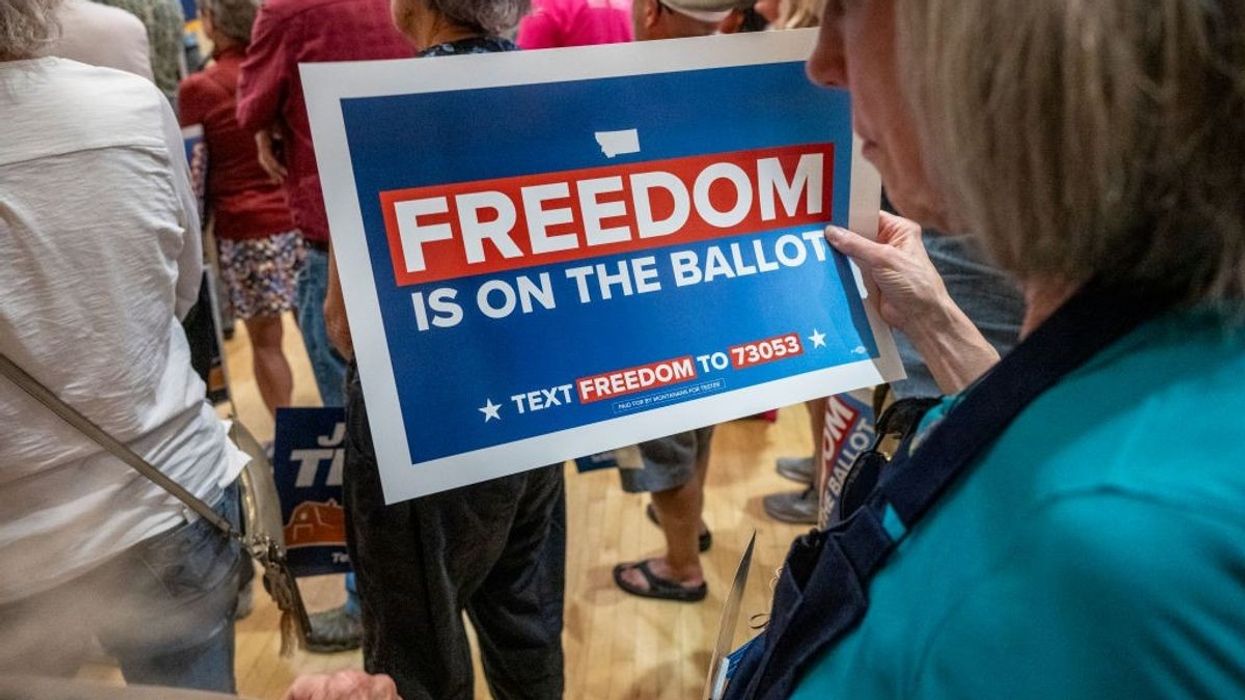
As Missouri House Republicans on Tuesday advanced a congressional map rigged for the GOP and new limits for citizen initiative petitions, an advocacy group that promotes progressive policies via direct democracy revealed that "extremist" legislators across the United States "escalated their efforts to dismantle the ballot measure process in 2025 by 95%."
The Fairness Project has "won 39 ballot measures to raise wages, protect abortion rights, stop predatory payday lenders, expand healthcare access, secure more paid time off, and other life-changing policies for more than 23 million people." The group's new report, Direct Democracy Under Assault, details recent GOP moves to thwart such progress.
"During the 2023 legislative session, 76 bills were introduced that would restrict or undermine the ballot initiative process, which was until then the highest number on record," according to the report. "For further perspective, only 33 ballot measure attack bills were tracked in 2017, and a grand total of 377 bills attacking ballot measure processes were proposed by state legislatures in the 23-year span between 2000 and 2023. To see 148 in a single year, 2025, is an extreme acceleration."
"Lawmakers have not just been toying with the idea of undermining ballot measure processes; they've been passing these attacks into law," the publication emphasizes. "As of June 2025, 51 bills altering the ballot measure process had already passed state houses. For comparison, the annual average of enacted attacks on direct democracy between 2018 and 2023 was 34 enacted bills. Once again, 2025 is a troubling outlier."
"The erosion of our democracy isn't just happening in the Oval Office; it's happening in our home states when politicians attack the ballot measure process."
This year's GOP-led efforts to limit direct democracy at the state level come as Republican US President Donald Trump has returned to power and swiftly engaged in various attacks on democracy, from gutting the federal government—including the voting rights unit at the Department of Justice—to issuing a series of unconstitutional executive orders.
"While citizens are rightfully focused on the horror unfolding in Washington, extremist politicians are taking advantage of the moment and attacking the most powerful tools voters have at their disposal to make their voices heard," said Kelly Hall, the Fairness Project's executive director. "The erosion of our democracy isn't just happening in the Oval Office; it's happening in our home states when politicians attack the ballot measure process and replace the will of the voters with their own political agendas."
State legislators have pursued a range of attacks on the ballot measure process. The report notes that "one common tactic—used in states like Ohio, Missouri, Florida, Arizona, and Arkansas—is raising the threshold for passage to a supermajority, making it harder for citizen-led initiatives to succeed."
"Other strategies include increasing signature requirements, imposing strict rules on how and where signatures can be gathered, limiting what issues a ballot measure can address, and imposing high costs on advocates attempting to use their direct democracy rights," the document continues.
Hall stressed that "this isn't reform; it's a calculated effort to strip voters of their constitutional right to shape policy."
While the project tracked bills across 15 states, the report gives special attention to eight "where especially aggressive efforts threaten to significantly erode voters' access to direct democracy." They are Arkansas, Florida, Missouri, Montana, North Dakota, Oklahoma, South Dakota, and Utah.
In Arkansas, for example, during the 2025 legislative session alone, state lawmakers imposed burdensome rules on local initiatives, "criminalized small mistakes," passed restrictions on ballot language, gave the attorney general veto power over petitions, and more. The report says that "taken together, these laws represent a coordinated and deeply undemocratic
effort to strip power from Arkansas voters and insulate elected officials from direct public accountability."
The League of Women Voters of Arkansas is fighting back, and in April filed a federal lawsuit against eight new laws that David Couch, the plaintiffs' lead attorney, said "weaponize bureaucracy to suppress citizen participation and violate the fundamental rights guaranteed by both the Arkansas and US Constitutions."
There's also litigation in Florida and Oklahoma, while in North Dakota, South Dakota, and Utah, voters will decide next year whether to raise the threshold for future constitutional amendments or citizen-initiated ballot measures from a simple majority to 60%.
"Every voter should be alarmed that politicians are systematically taking away our rights to make change through the ballot," said Hall. "This isn't a time to back down—in fact, these cowardly attacks only underscore the urgent need to defend ballot measures and, by extension, defend our democracy."
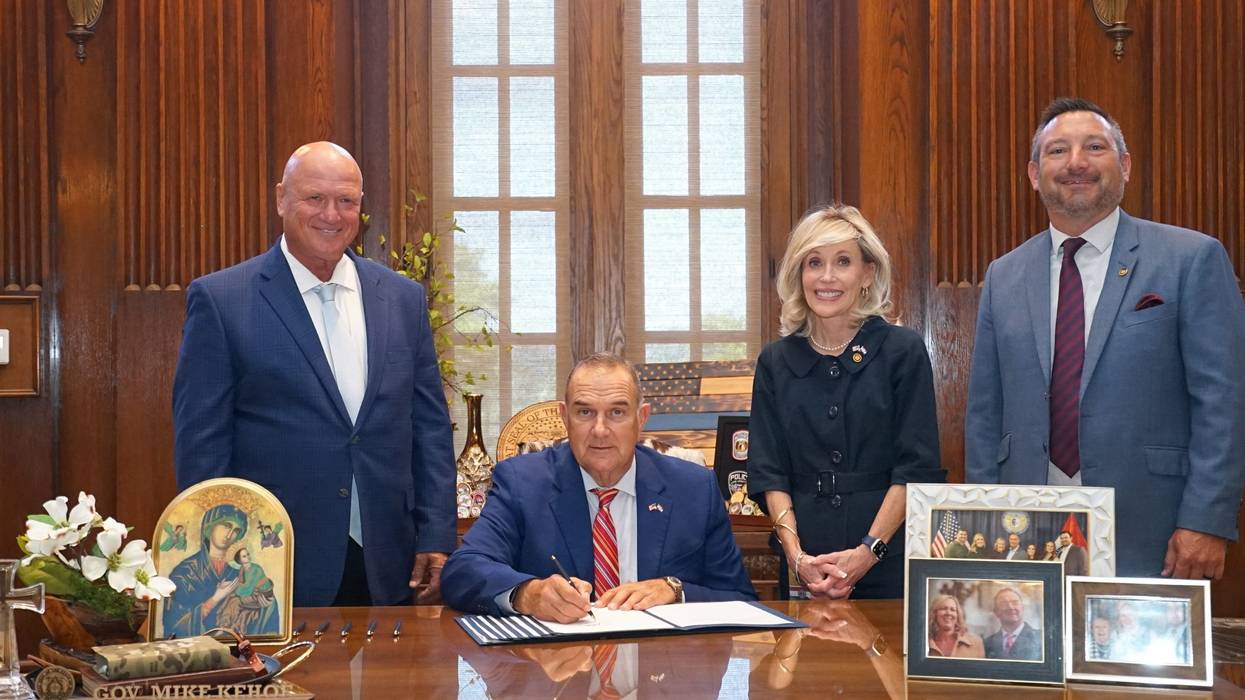
"The governor's action today demonstrates the absolute disdain Republicans have for working Missourians."
Missouri's Republican governor on Thursday signed legislation repealing the paid sick leave portion of a ballot measure that the state's voters approved with nearly 60% support in the 2024 election.
The short-lived provision, which will officially be repealed on August 28, required Missouri employers to provide workers with an hour of paid sick time for every 30 hours of work. Businesses with 15 or more employees were required to provide up to 56 hours of earned paid sick time per year, and businesses with fewer than 15 employees were required to provide at least 40 hours of paid sick time.
The Missouri Budget Project estimated before its passage that the ballot measure's paid sick leave benefits would reach 728,000 private-sector workers in the state.
The bill that Republican Gov. Mike Kehoe signed Thursday, known as H.B. 567, also restricts increases in the state's minimum wage. The voter-approved initiative called for raising the state's minimum wage to $15 an hour in 2026 and indexing it to inflation thereafter. H.B. 567 eliminates the inflation adjustment.
The Missouri Chamber of Commerce and Industry, a business lobbying group, characterized H.B. 567 as its top legislative priority. The bill was led by state Rep. Sherri Gallick (R-62) and state Sen. Mike Bernskoetter (R-6).
Kehoe's Facebook post announcing his signature was deluged with comments from Missourians decrying the governor's decision to overturn the will of the public.
"We the people collected signatures," wrote one commenter. "We voted. And we passed Prop A into law. Remember you work for us. How dare you reverse the voice of your people?! The people you took an oath to serve."
Missouri Jobs With Justice, which helped lead the campaign for the ballot measure, said in a statement that "with Governor Kehoe's decision to sign H.B. 567 into law, workers will again face increased economic insecurity when balancing being sick with maintaining their job."
The group noted that Kehoe's support for repealing paid sick leave came after he "recently called a special session to approve spending millions of taxpayer dollars to subsidize billionaire-owned stadiums." On Thursday, Kehoe also signed legislation slashing the state's capital gains tax.
"Simply put, Missouri workers and their families do not deserve to see their newly earned paid sick leave stripped away," said Missouri Jobs With Justice. "Not only is this a slap in the face to workers asking for an opportunity to earn paid sick leave, it’s an insult to over 57% of Missourians who voted for Proposition A in November."
Throughout the process of pushing H.B. 567 through the Legislature, Missouri Republicans openly voiced contempt for voters who supported the paid sick leave and minimum wage initiative. One GOP lawmaker, state Rep. Mitch Boggs, said, "Of course the people voted for it."
"It'd be like asking your teenager if he wanted a checkbook," said Boggs.
State Rep. Ashley Aune (D-14), the Democratic leader in the Missouri House, said Thursday that "the governor's action today demonstrates the absolute disdain Republicans have for working Missourians."
"But in stripping workers of their legal right to earned sick leave," Aune added, "the governor and his allies have probably guaranteed this issue will be back on the ballot next year as a constitutional amendment that will place worker protections beyond their reach."
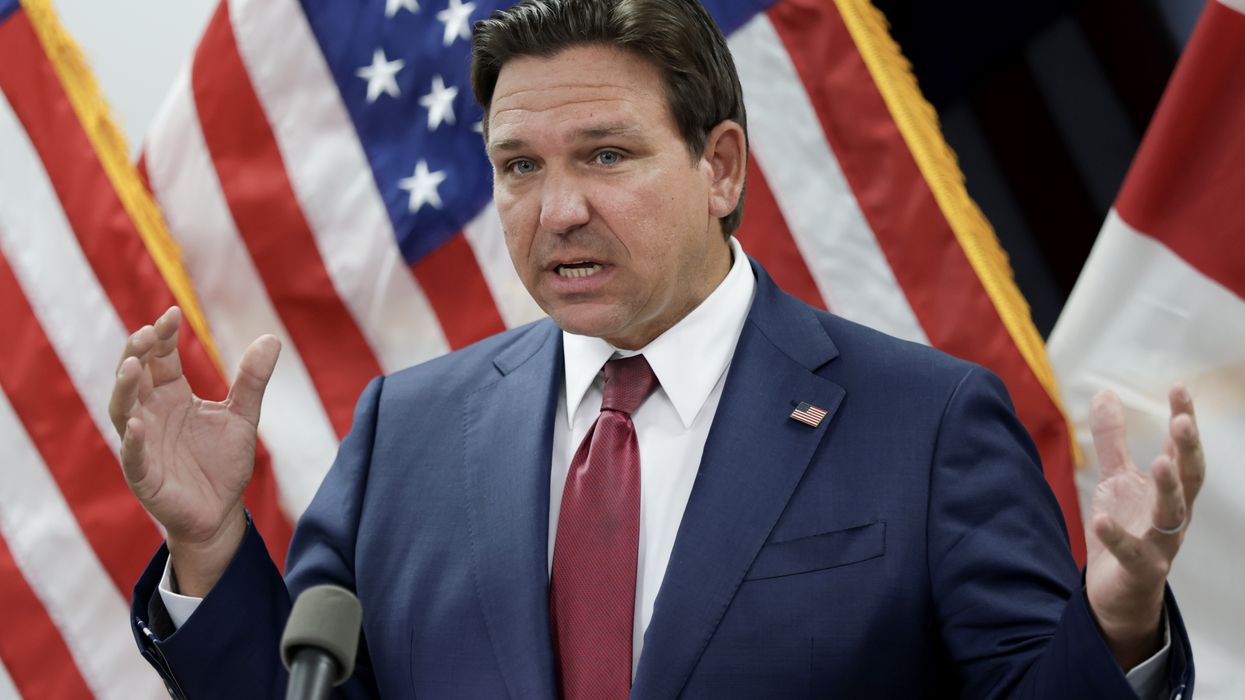
"We believe in democracy, and we believe that when politicians fail to act, the people have the right to step in," said the campaign manager of Florida Decides Healthcare, a plaintiff in the suit.
Florida Decides Healthcare, a political committee and nonprofit that is fighting for expanded Medicaid eligibility in the Sunshine State, on Sunday sued the Florida secretary of state and other state officials, challenging a law Republican Gov. Ron DeSantis signed last week that makes it tougher for citizens to get constitutional amendments on the ballot.
According to the lawsuit, which was filed in federal court, Florida Decides Healthcare (FDH) is working to qualify a ballot measure to appear on the 2026 general election ballot that, if voted through, would expand Medicaid coverage in Florida.
Provisions in H.B. 1205 include decreased time for organizers to submit signed petitions and increased monetary penalties for violations. The law also makes it a third-degree felony for anyone other than a registered petition circulator to collect or physically possess more than 25 signed petition forms beyond ones own and immediate family members.
"Because of H.B. 1205's punitive and onerous restrictions, set to go into effect in the middle of FDH's ongoing petition drive, the organization faces the real and imminent threat of being unable to continue its operations," according to the suit. "H.B. 1205 creates intolerable uncertainty, exposes FDH to ruinous civil and criminal penalties, and could ultimately force FDH to shut down its campaign entirely."
According to a statement from FDH, the lawsuit contends that the bill is a "direct assault" on the citizen-led constitutional amendment process in Florida, "a vital democratic tool that gives everyday Floridians the power to propose ballot initiatives."
H.B. 1205 creates "vague" and "punitive" restrictions around the process that will have a chilling impact on political speech and dissuade civic engagement, according to the group.
The Elias Law Group, a prominent Democratic law firm, and the Southern Poverty Law Center, a racial justice and legal advocacy group, are lending legal support to FDH.
This targeting of the citizens amendment process comes less than one year after two ballot initiatives in Florida narrowly failed. Amendment 4 sought to ensure the right to an abortion up until fetal viability. The measure narrowly failed, falling short of the 60% majority needed to pass, meaning Florida will remain under a six-week abortion ban. Amendment 3 sought to legalize marijuana and also failed. Groups backing the initiatives raised tens of millions of dollars.
According to the Orlando Sentinel, the DeSantis administration used public money to run ads targeting the initiatives, and defended the ad campaigns as educational.
"Floridians have a constitutional right to change policy themselves. State legislators have now effectively silenced their constituents, all in order to maintain their chokehold on policymaking," said Kelly Hall, executive director of the Fairness Project, in a statement on Tuesday. The Fairness Project was among the groups that backed Amendment 4 last fall.
"It's the ultimate cowardly act—for politicians to enact minority rule when they know their policies don't align with the will of the majority," Hall added. "Sadly, this is nothing new for DeSantis, who used extraordinarily undemocratic means to block the will of the people during the 2024 election."
Mitch Emerson, campaign manager for Florida Decides Healthcare, similarly called the law "cowardly." Emerson is also a plaintiff in the suit.
"It's not reform—it's repression. We are filing this lawsuit because we refuse to let them silence the people of Florida," said Emerson in a statement on Monday. "We believe in democracy, and we believe that when politicians fail to act, the people have the right to step in. Floridians are ready to vote for Medicaid expansion—and we intend to make sure they get that chance."
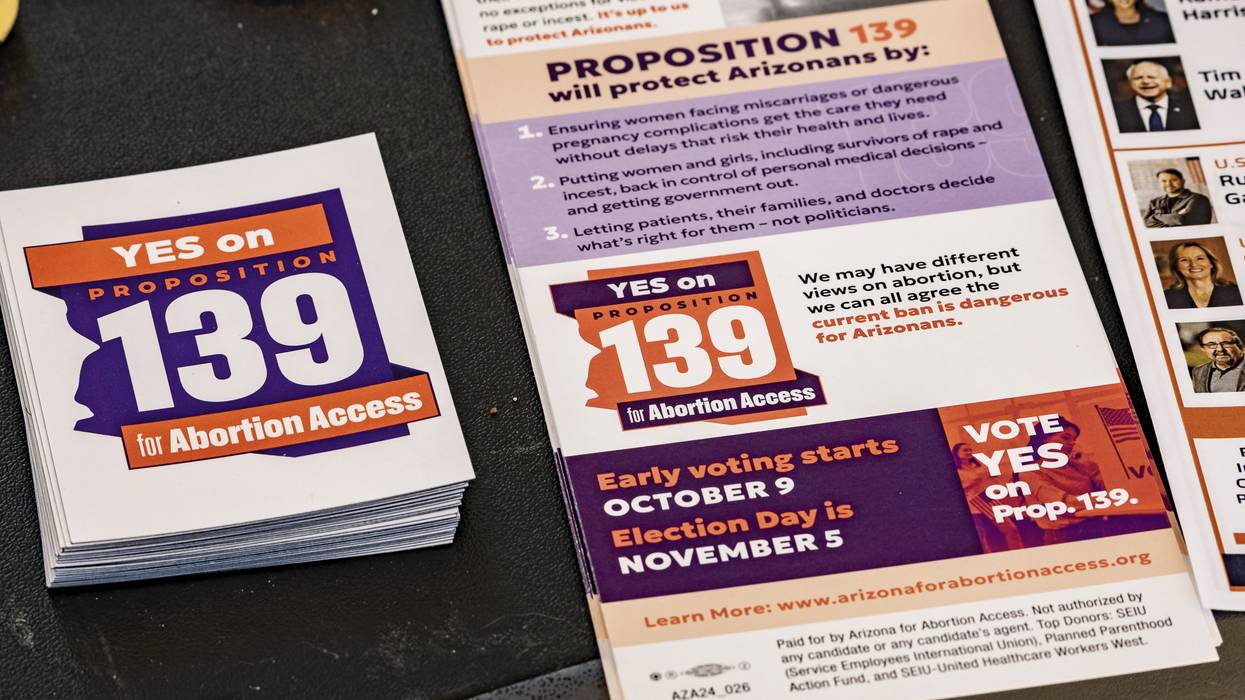
A recent report on citizen-driven initiatives found that people in red and blue states vote for policies that are egalitarian and economically redistributive.
On the evening of November 5, 2024, I sat at a gathering of organizers and volunteers from the campaign to pass Proposition 139, a citizen-driven initiative in Arizona seeking to enshrine abortion access in the state constitution.
After an hour or so of waiting with bated breath, the bulk of Arizona’s ballot initiative results had been counted and posted online. Our hard work had paid off! Prop 139 had amassed 66% voter support (a number that would decrease to a still impressive 61% by the final tally.) After a significant round of applause and the shedding of a few tears, the party settled into a pleasant thrum.
At first I expected shouting, screaming, and crying—we had won a massive victory! But I quickly understood that the celebration was more subdued than expected because the results were exactly what the lead organizers of the campaign hadanticipated: a win.
Healthcare Rising and Prop 139 won because they refused to partake in party politics and instead tailored their campaign toward fighting for issues that were resonant and supported in their constituency and across the political spectrum.
Ultimately, it was unsurprising that this initiative to enshrine abortion access passed in Arizona, despite voters in the state supporting anti-abortion candidate and now U.S. President Donald Trump, because reproductive freedom itself as a policy has proven to be overwhelmingly popular when put to a vote by the electorate.
A recent report from our team at the Center for Work and Democracy uses data from citizen-driven initiatives—ballot initiatives that are drafted, petitioned, and voted on by citizens themselves—from the last 15 years to see where patterns in voting emerge. Put very briefly, we found that people vote for policies that are egalitarian and economically redistributive.
Egalitarian measures—which equalize rights, resources, and decision-making power in society—pass at a rate of 65.63% across blue and red states alike. Initiatives supporting reproductive rights, for example, are considered egalitarian and prove to be extremely successful at the polls. Despite a difficult loss in Florida in the 2024 election and a complicated voting stalemate in Nebraska, abortion access has been protected by voters in 14 out of 17 cases since the fall of Roe v. Wade.
Redistributive measures are a subsect of egalitarian initiatives that specifically focus on the redistribution of wealth from the rich to the poor, like raising the minimum wage. With an even greater passage rate than other egalitarian measures, redistributive ballot measures clock in with an impressive win rate of 75%. In red states, this number rises all the way to a whopping 92% compared to 61.29% in blue states. (We found that blue states’ averages are skewed down by California’s initiative results, which are far less progressive than the state’s image.)
When Healthcare Rising Arizona and the other co-organizers of the campaign for Prop 139 set out to get the initiative on the ballot and enshrined in the state constitution, they knew that party politics were not going to help their cause. From day one, the campaign for 139 was clear that their organizing would be strictly nonpartisan because they knew that abortion as a policy was more popular than any individual Democratic candidates, despite those Democrats being vocally pro-choice.
The strategy worked. The Arizona for Abortion Access Act passed with 417,427 more votes than former Vice President Kamala Harris received in Arizona, proving that egalitarian policies like reproductive rights are simply more popular than pro-choice candidates.
Healthcare Rising and Prop 139 won because they refused to partake in party politics and instead tailored their campaign toward fighting for issues that were resonant and supported in their constituency and across the political spectrum.
Our data tells us that egalitarian and redistributive measures are exceedingly popular with red and blue voters alike. So if Republican and Democrat voters both want many of the same things—policies that equalize rights, break down wealth inequality, and support the decision-making power of everyday people—why won’t politicians just give the people what they want?
"Ballot measures have been a lifeline to working people," said one campaign leader. "Legislators are trying to systematically take that power away."
As Americans face the reality of President Donald Trump's second term and the mass firings, takeover of federal agencies by billionaire mogul Elon Musk, and looming trade war that have come with it, the direct democracy advocacy group Fairness Project warned of a "major attack" on voters' rights taking place at the state level across the country.
While many in the U.S. have been focused on the actions of the Trump administration, said the group in a Thursday statement, legislators in over 15 states have introduced more than 100 bills to stop citizen-led initiatives from being placed on ballots in upcoming elections—and to stop them from becoming law even if a majority of voters support the measures.
"We're sounding the alarm: Direct democracy is being threatened right under our noses," said Kelly Hall, executive director of the Fairness Project. "Ballot measures have been a lifeline to working people in red and purple states, allowing them to make change even when politicians fail to represent their interests. Legislators are trying to systematically take that power away."
The Fairness Project has supported dozens of successful ballot measure campaigns to expand healthcare access, raise minimum wages, and win paid time off policies for roughly 18 million people across the country.
The group was the biggest funder of abortion rights ballot measures in the last election cycle, working to ensure campaigners in Missouri and Arizona collected enough signatures to get questions about expanding abortion rights on ballots. Both ballot initiatives were approved by voters in November.
The Fairness Project was also involved in a 2023 campaign to stop a Republican-backed measure in Ohio that would have required a 60% supermajority to pass any future constitutional amendments.
In six of the states currently pushing attacks on ballot measures—Oklahoma, Arizona, Missouri, North Dakota, South Dakota, and Idaho—Republicans are making similar attempts to raise the threshold for passing ballot measures from a simple majority to 60%.
If they succeed in passing the proposals, said the Fairness Project, the GOP will be "effectively enacting minority rule."
Lawmakers are also advancing bills that would apply onerous signature requirements to the ballot measure process.
In Florida, Republican Gov. Ron DeSantis' proposed changes to ballot initiative laws include requiring individual voters to complete a petition in person at an election office or by mail in order to express support for a measure, instead of allowing sponsors to pay workers to collect signatures in public.
"They want to kill the process," Angelo Paparella, president of a group that has run several petition drives in the state, told Axios last month.
The Arkansas state Senate this month passed several bills regulating how citizen-led initiatives make it onto ballots, including one requiring canvassers to request a photo ID from signers; one requiring potential signers to read the ballot title of a petition or have it read aloud to them; and one requiring canvassers to file an affidavit certifying they complied with state law when collecting signatures.
"This is their playbook: When cowardly politicians know they can't win with voters on the issues, they try to change the rules of the game," Hall said Thursday.
Earlier this week, Mississippi voters once again lost out on the chance to place measures on statewide ballots, which was permitted in the state until the state Supreme Court struck down the ballot initiative process in 2021.
Lawmakers allowed a proposal to partially restore the process to die ahead of a legislative deadline.
"This means voters still have no direct way to propose new state laws, to change state laws, or to change the Constitution," reported Taylor Vance of Mississippi Today.
Hall said the Fairness Project will continue fighting attacks on representative direct democracy nationwide.
"Voters are paying attention to this widespread attack on their constitutional rights, and they're fighting back," said Hall. "Americans deserve leaders who respect our democracy."