
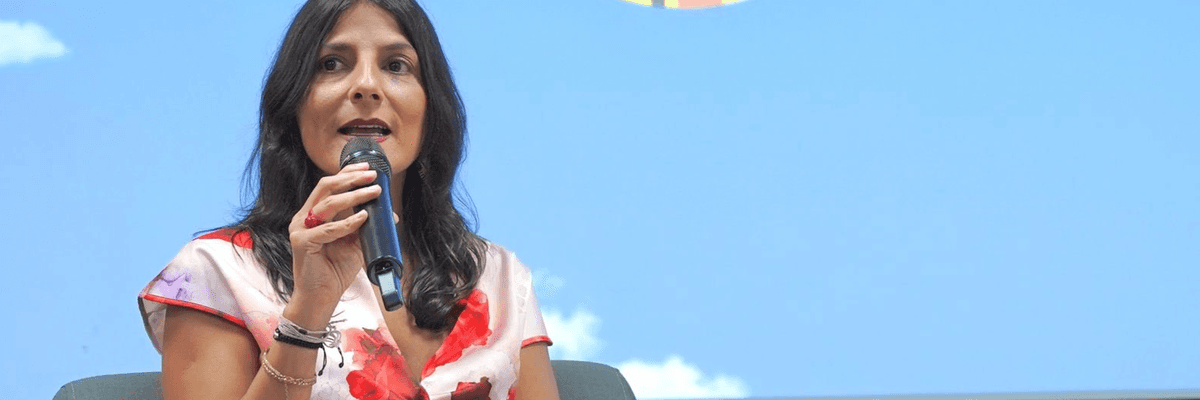
Colombian Environmental Minister Irene Vélez Torres speaks during the First Conference on Transitioning Away from Fossil Fuels, in Santa Marta, Colombia on April 24, 2026.
(Photo by Colombian Ministry of Environment and Sustainable Development/X)
'Leaving the US Behind,' 50+ Nations Gather in Colombia to 'Phase Out Fossil Fuels'
"Word on the street is NO fossil fuel lobbyists at the Santa Marta, Colombia 'Transition Away' conference," said one climate journalist.
Apr 24, 2026
Representatives of more than 50 countries on Friday kicked off the First Conference on Transitioning Away from Fossil Fuels in Colombia, a hopeful summit that comes amid a worsening global climate crisis and fossil fuel-producing nations' efforts to block a clean energy transition.
Organizers of the conference—which is taking place in the Caribbean city of Santa Marta and is co-hosted by the Netherlands—said participants aim to "initiate a concrete process through which a coalition of committed countries, subnational governments, and relevant stakeholders can identify and advance enabling pathways to implement a progressive transition away from fossil fuels, creating sustainable societies and economies."
"This process will be informed by the experience and perspectives of national and subnational governments, academia, Indigenous peoples, peoples of African descent, peasants, civil society, workers, the private sector, and other key actors at different stages of the transition," the organizers added.
The conference comes amid widespread disappointment and frustration over what climate defenders called a "shamefully weak" draft text—called the Multirão Decision—produced at last November's United Nations Climate Change Conference, or COP30, in Brazil. The final document removed all mentions of fossil fuels amid pressure from oil and gas-producing nations like the United States, Russia, and Saudi Arabia, and the presence of a record number of industry lobbyists.
“When multilateral processes move slowly, concrete alliances of the willing can take us a long way," German Chancellor Friedrich Merz said this week at the 17th Petersberg Climate Dialogue in Hesse state, where high-level representatives from around 40 countries discussed "concrete steps towards overcoming the climate crisis."
I've worked on #climate and fossil fuels for almost 30 years and the Santa Marta Conference is definitely one of the most hopeful things I've seen. Finally some governments are exploring solutions that meet the scale of the crisis. Good explainer 🧵👇
[image or embed]
— Patrick Reinsborough ❌👑 (@giantwhispers.bsky.social) April 24, 2026 at 7:57 AM
The Santa Marta conference, which will run through April 29, will focus on three main areas:
- Overcoming economic dependence on fossil fuels;
- Transforming energy supply and demand; and
- Advancing international cooperation and climate diplomacy.
Major fossil fuel producers including Angola, Australia, Brazil, Canada, Mexico, Nigeria, Norway, and the United Kingdom are among the 54 nations represented in Santa Marta.
Notably absent from the conference are some of the world's biggest greenhouse gas polluters, including the United States, China, Russia, India, and Japan. Their absence is fine with Colombian Environmental Minister Irene Vélez Torres, who told The Guardian that “this is not the space for them."
"We are not going to have boycotters or climate denialists at the table,” Vélez said.
Also missing by design are the legions of lobbyists who increasingly swarm COP conferences.
Word on the street is NO fossil fuel lobbyists at the Santa Marta, Colombia 'Transition Away' conference. But it does have some of the best climate scientists in the world for an advisory panel.
[image or embed]
— Bob Berwyn (@bberwyn.bsky.social) April 24, 2026 at 11:15 AM
Former Peruvian Environment Minister Manuel Pulgar-Vidal, who heads the World Wildlife Fund's global climate division, said in a statement that "changing the world’s dependence on fossil fuels isn’t a slow problem with a slow solution: We need a rapid, global shift to renewable power, smarter grids, and efficiency, so emissions fall fast and stay down."
"And we need a ‘coalition of the willing’ to show us the way," he added. "Santa Marta is an inflection point and an opportunity that we should not miss.”
The absence of the United States surprised no one, given the Trump administration and Republicans' promotion of oil, gas, and coal. Big Oil invested $445 million during the 2024 election cycle in efforts to elect Trump and other Republicans and promote fossil fuel-friendly policies.
Trump, who ran on a “drill, baby, drill” energy policy, has signed a series of executive orders aimed at boosting fossil fuel production, including by declaring a fake “energy emergency” in a push to fast-track permit approvals. He also tapped former fossil fuel executives to head the Department of Energy and Interior Department, which have pursued a policy of opening up more public lands and waters for fossil fuel development.
At the same time, the Trump administration dropped out of the Paris climate agreement for the second time and moved to roll back the modest climate progress achieved under former President Joe Biden.
Melinda Lewis—who directs the Global Trade Watch program at the consumer advocacy group Public Citizen—is attending the Santa Marta conference, where she is working to dismantle the investor-state dispute settlement (ISDS) system. The enforced mechanism empowers multinational corporations to sue governments before panels of corporate attorneys and has been denounced by opponents—especially those in the Global South—as a novel form of colonialism.
"While it is tragic that the United States government is failing to meet this critical moment for climate action, we are encouraged that the rest of the world has recognized that it’s high time to take bold action to remove the arcane ISDS extra-legal instrument buried in trade and investment treaties that has been used as a cudgel by fossil fuel and extractive industries to stymie government actions that might reduce their profits," Lewis said on Friday.
As Canadian researcher Joseph Bouchard recently wrote in a Common Dreams opinion piece, "Colombia is especially exposed" to ISDS harm, as "the country has 129 oil and gas projects covered by ISDS provisions, leaving it vulnerable to a wave of potential claims as it pursues its energy transition."
Lewis noted that Colombia's government, led by leftist President Gustavo Petro, "recently announced its intention to renounce its treaties that include ISDS as part of the full package of needed action to usher in a clean energy transition."
Indigenous leaders said more must be done to ensure a just transition.
“We are very concerned. We talk about a just transition, but in practice it is not true,” Oswaldo Muca, General Coordinator of the Organization of Indigenous Peoples of the Colombian Amazon, told Inter Press Service. “Mining continues. Extraction continues. Deforestation continues. The territories and Indigenous peoples continue suffering this problem, and it is becoming more serious every day."
Muca added that benefits from resource extraction "do not reach Indigenous territories, but they destroy the territory and leave the damage."
On Friday, more than 250 legal experts from around the world asserted that "phasing out fossil fuels is not a political choice—it is a legal obligation."
The jurists noted in an open letter that "the International Court of Justice (ICJ) unanimously confirmed that every state must use all means at its disposal to prevent significant harm to the climate system, including by avoiding the principal activities driving it: fossil fuel production and use."
The letter's signers include former Irish President Mary Robinson and Julian Aguon, an Indigenous human rights lawyer from Guam who played a key role in winning the ICJ climate case.
"The phaseout of fossil fuels is not just scientifically necessary to prevent catastrophic and irreversible harm to the climate system, all peoples, and ecosystems; it is legally required," they wrote. "It is also socially, economically, and environmentally beneficial for present and future generations."
Ultimately, countries participating in the Santa Marta conference will draw their own individual roadmaps with the help of scientists and other experts.
“If we think about it," said Vélez, "the conference is that turning point where, collectively, we decide to be on the right side of history."
An Urgent Message From Our Co-Founder
Dear Common Dreams reader, The U.S. is on a fast track to authoritarianism like nothing I've ever seen. Meanwhile, corporate news outlets are utterly capitulating to Trump, twisting their coverage to avoid drawing his ire while lining up to stuff cash in his pockets. That's why I believe that Common Dreams is doing the best and most consequential reporting that we've ever done. Our small but mighty team is a progressive reporting powerhouse, covering the news every day that the corporate media never will. Our mission has always been simple: To inform. To inspire. And to ignite change for the common good. Now here's the key piece that I want all our readers to understand: None of this would be possible without your financial support. That's not just some fundraising cliche. It's the absolute and literal truth. We don't accept corporate advertising and never will. We don't have a paywall because we don't think people should be blocked from critical news based on their ability to pay. Everything we do is funded by the donations of readers like you. Will you donate now to help power the nonprofit, independent reporting of Common Dreams? Thank you for being a vital member of our community. Together, we can keep independent journalism alive when it’s needed most. - Craig Brown, Co-founder |
Our work is licensed under Creative Commons (CC BY-NC-ND 3.0). Feel free to republish and share widely.
Representatives of more than 50 countries on Friday kicked off the First Conference on Transitioning Away from Fossil Fuels in Colombia, a hopeful summit that comes amid a worsening global climate crisis and fossil fuel-producing nations' efforts to block a clean energy transition.
Organizers of the conference—which is taking place in the Caribbean city of Santa Marta and is co-hosted by the Netherlands—said participants aim to "initiate a concrete process through which a coalition of committed countries, subnational governments, and relevant stakeholders can identify and advance enabling pathways to implement a progressive transition away from fossil fuels, creating sustainable societies and economies."
"This process will be informed by the experience and perspectives of national and subnational governments, academia, Indigenous peoples, peoples of African descent, peasants, civil society, workers, the private sector, and other key actors at different stages of the transition," the organizers added.
The conference comes amid widespread disappointment and frustration over what climate defenders called a "shamefully weak" draft text—called the Multirão Decision—produced at last November's United Nations Climate Change Conference, or COP30, in Brazil. The final document removed all mentions of fossil fuels amid pressure from oil and gas-producing nations like the United States, Russia, and Saudi Arabia, and the presence of a record number of industry lobbyists.
“When multilateral processes move slowly, concrete alliances of the willing can take us a long way," German Chancellor Friedrich Merz said this week at the 17th Petersberg Climate Dialogue in Hesse state, where high-level representatives from around 40 countries discussed "concrete steps towards overcoming the climate crisis."
I've worked on #climate and fossil fuels for almost 30 years and the Santa Marta Conference is definitely one of the most hopeful things I've seen. Finally some governments are exploring solutions that meet the scale of the crisis. Good explainer 🧵👇
[image or embed]
— Patrick Reinsborough ❌👑 (@giantwhispers.bsky.social) April 24, 2026 at 7:57 AM
The Santa Marta conference, which will run through April 29, will focus on three main areas:
- Overcoming economic dependence on fossil fuels;
- Transforming energy supply and demand; and
- Advancing international cooperation and climate diplomacy.
Major fossil fuel producers including Angola, Australia, Brazil, Canada, Mexico, Nigeria, Norway, and the United Kingdom are among the 54 nations represented in Santa Marta.
Notably absent from the conference are some of the world's biggest greenhouse gas polluters, including the United States, China, Russia, India, and Japan. Their absence is fine with Colombian Environmental Minister Irene Vélez Torres, who told The Guardian that “this is not the space for them."
"We are not going to have boycotters or climate denialists at the table,” Vélez said.
Also missing by design are the legions of lobbyists who increasingly swarm COP conferences.
Word on the street is NO fossil fuel lobbyists at the Santa Marta, Colombia 'Transition Away' conference. But it does have some of the best climate scientists in the world for an advisory panel.
[image or embed]
— Bob Berwyn (@bberwyn.bsky.social) April 24, 2026 at 11:15 AM
Former Peruvian Environment Minister Manuel Pulgar-Vidal, who heads the World Wildlife Fund's global climate division, said in a statement that "changing the world’s dependence on fossil fuels isn’t a slow problem with a slow solution: We need a rapid, global shift to renewable power, smarter grids, and efficiency, so emissions fall fast and stay down."
"And we need a ‘coalition of the willing’ to show us the way," he added. "Santa Marta is an inflection point and an opportunity that we should not miss.”
The absence of the United States surprised no one, given the Trump administration and Republicans' promotion of oil, gas, and coal. Big Oil invested $445 million during the 2024 election cycle in efforts to elect Trump and other Republicans and promote fossil fuel-friendly policies.
Trump, who ran on a “drill, baby, drill” energy policy, has signed a series of executive orders aimed at boosting fossil fuel production, including by declaring a fake “energy emergency” in a push to fast-track permit approvals. He also tapped former fossil fuel executives to head the Department of Energy and Interior Department, which have pursued a policy of opening up more public lands and waters for fossil fuel development.
At the same time, the Trump administration dropped out of the Paris climate agreement for the second time and moved to roll back the modest climate progress achieved under former President Joe Biden.
Melinda Lewis—who directs the Global Trade Watch program at the consumer advocacy group Public Citizen—is attending the Santa Marta conference, where she is working to dismantle the investor-state dispute settlement (ISDS) system. The enforced mechanism empowers multinational corporations to sue governments before panels of corporate attorneys and has been denounced by opponents—especially those in the Global South—as a novel form of colonialism.
"While it is tragic that the United States government is failing to meet this critical moment for climate action, we are encouraged that the rest of the world has recognized that it’s high time to take bold action to remove the arcane ISDS extra-legal instrument buried in trade and investment treaties that has been used as a cudgel by fossil fuel and extractive industries to stymie government actions that might reduce their profits," Lewis said on Friday.
As Canadian researcher Joseph Bouchard recently wrote in a Common Dreams opinion piece, "Colombia is especially exposed" to ISDS harm, as "the country has 129 oil and gas projects covered by ISDS provisions, leaving it vulnerable to a wave of potential claims as it pursues its energy transition."
Lewis noted that Colombia's government, led by leftist President Gustavo Petro, "recently announced its intention to renounce its treaties that include ISDS as part of the full package of needed action to usher in a clean energy transition."
Indigenous leaders said more must be done to ensure a just transition.
“We are very concerned. We talk about a just transition, but in practice it is not true,” Oswaldo Muca, General Coordinator of the Organization of Indigenous Peoples of the Colombian Amazon, told Inter Press Service. “Mining continues. Extraction continues. Deforestation continues. The territories and Indigenous peoples continue suffering this problem, and it is becoming more serious every day."
Muca added that benefits from resource extraction "do not reach Indigenous territories, but they destroy the territory and leave the damage."
On Friday, more than 250 legal experts from around the world asserted that "phasing out fossil fuels is not a political choice—it is a legal obligation."
The jurists noted in an open letter that "the International Court of Justice (ICJ) unanimously confirmed that every state must use all means at its disposal to prevent significant harm to the climate system, including by avoiding the principal activities driving it: fossil fuel production and use."
The letter's signers include former Irish President Mary Robinson and Julian Aguon, an Indigenous human rights lawyer from Guam who played a key role in winning the ICJ climate case.
"The phaseout of fossil fuels is not just scientifically necessary to prevent catastrophic and irreversible harm to the climate system, all peoples, and ecosystems; it is legally required," they wrote. "It is also socially, economically, and environmentally beneficial for present and future generations."
Ultimately, countries participating in the Santa Marta conference will draw their own individual roadmaps with the help of scientists and other experts.
“If we think about it," said Vélez, "the conference is that turning point where, collectively, we decide to be on the right side of history."
Representatives of more than 50 countries on Friday kicked off the First Conference on Transitioning Away from Fossil Fuels in Colombia, a hopeful summit that comes amid a worsening global climate crisis and fossil fuel-producing nations' efforts to block a clean energy transition.
Organizers of the conference—which is taking place in the Caribbean city of Santa Marta and is co-hosted by the Netherlands—said participants aim to "initiate a concrete process through which a coalition of committed countries, subnational governments, and relevant stakeholders can identify and advance enabling pathways to implement a progressive transition away from fossil fuels, creating sustainable societies and economies."
"This process will be informed by the experience and perspectives of national and subnational governments, academia, Indigenous peoples, peoples of African descent, peasants, civil society, workers, the private sector, and other key actors at different stages of the transition," the organizers added.
The conference comes amid widespread disappointment and frustration over what climate defenders called a "shamefully weak" draft text—called the Multirão Decision—produced at last November's United Nations Climate Change Conference, or COP30, in Brazil. The final document removed all mentions of fossil fuels amid pressure from oil and gas-producing nations like the United States, Russia, and Saudi Arabia, and the presence of a record number of industry lobbyists.
“When multilateral processes move slowly, concrete alliances of the willing can take us a long way," German Chancellor Friedrich Merz said this week at the 17th Petersberg Climate Dialogue in Hesse state, where high-level representatives from around 40 countries discussed "concrete steps towards overcoming the climate crisis."
I've worked on #climate and fossil fuels for almost 30 years and the Santa Marta Conference is definitely one of the most hopeful things I've seen. Finally some governments are exploring solutions that meet the scale of the crisis. Good explainer 🧵👇
[image or embed]
— Patrick Reinsborough ❌👑 (@giantwhispers.bsky.social) April 24, 2026 at 7:57 AM
The Santa Marta conference, which will run through April 29, will focus on three main areas:
- Overcoming economic dependence on fossil fuels;
- Transforming energy supply and demand; and
- Advancing international cooperation and climate diplomacy.
Major fossil fuel producers including Angola, Australia, Brazil, Canada, Mexico, Nigeria, Norway, and the United Kingdom are among the 54 nations represented in Santa Marta.
Notably absent from the conference are some of the world's biggest greenhouse gas polluters, including the United States, China, Russia, India, and Japan. Their absence is fine with Colombian Environmental Minister Irene Vélez Torres, who told The Guardian that “this is not the space for them."
"We are not going to have boycotters or climate denialists at the table,” Vélez said.
Also missing by design are the legions of lobbyists who increasingly swarm COP conferences.
Word on the street is NO fossil fuel lobbyists at the Santa Marta, Colombia 'Transition Away' conference. But it does have some of the best climate scientists in the world for an advisory panel.
[image or embed]
— Bob Berwyn (@bberwyn.bsky.social) April 24, 2026 at 11:15 AM
Former Peruvian Environment Minister Manuel Pulgar-Vidal, who heads the World Wildlife Fund's global climate division, said in a statement that "changing the world’s dependence on fossil fuels isn’t a slow problem with a slow solution: We need a rapid, global shift to renewable power, smarter grids, and efficiency, so emissions fall fast and stay down."
"And we need a ‘coalition of the willing’ to show us the way," he added. "Santa Marta is an inflection point and an opportunity that we should not miss.”
The absence of the United States surprised no one, given the Trump administration and Republicans' promotion of oil, gas, and coal. Big Oil invested $445 million during the 2024 election cycle in efforts to elect Trump and other Republicans and promote fossil fuel-friendly policies.
Trump, who ran on a “drill, baby, drill” energy policy, has signed a series of executive orders aimed at boosting fossil fuel production, including by declaring a fake “energy emergency” in a push to fast-track permit approvals. He also tapped former fossil fuel executives to head the Department of Energy and Interior Department, which have pursued a policy of opening up more public lands and waters for fossil fuel development.
At the same time, the Trump administration dropped out of the Paris climate agreement for the second time and moved to roll back the modest climate progress achieved under former President Joe Biden.
Melinda Lewis—who directs the Global Trade Watch program at the consumer advocacy group Public Citizen—is attending the Santa Marta conference, where she is working to dismantle the investor-state dispute settlement (ISDS) system. The enforced mechanism empowers multinational corporations to sue governments before panels of corporate attorneys and has been denounced by opponents—especially those in the Global South—as a novel form of colonialism.
"While it is tragic that the United States government is failing to meet this critical moment for climate action, we are encouraged that the rest of the world has recognized that it’s high time to take bold action to remove the arcane ISDS extra-legal instrument buried in trade and investment treaties that has been used as a cudgel by fossil fuel and extractive industries to stymie government actions that might reduce their profits," Lewis said on Friday.
As Canadian researcher Joseph Bouchard recently wrote in a Common Dreams opinion piece, "Colombia is especially exposed" to ISDS harm, as "the country has 129 oil and gas projects covered by ISDS provisions, leaving it vulnerable to a wave of potential claims as it pursues its energy transition."
Lewis noted that Colombia's government, led by leftist President Gustavo Petro, "recently announced its intention to renounce its treaties that include ISDS as part of the full package of needed action to usher in a clean energy transition."
Indigenous leaders said more must be done to ensure a just transition.
“We are very concerned. We talk about a just transition, but in practice it is not true,” Oswaldo Muca, General Coordinator of the Organization of Indigenous Peoples of the Colombian Amazon, told Inter Press Service. “Mining continues. Extraction continues. Deforestation continues. The territories and Indigenous peoples continue suffering this problem, and it is becoming more serious every day."
Muca added that benefits from resource extraction "do not reach Indigenous territories, but they destroy the territory and leave the damage."
On Friday, more than 250 legal experts from around the world asserted that "phasing out fossil fuels is not a political choice—it is a legal obligation."
The jurists noted in an open letter that "the International Court of Justice (ICJ) unanimously confirmed that every state must use all means at its disposal to prevent significant harm to the climate system, including by avoiding the principal activities driving it: fossil fuel production and use."
The letter's signers include former Irish President Mary Robinson and Julian Aguon, an Indigenous human rights lawyer from Guam who played a key role in winning the ICJ climate case.
"The phaseout of fossil fuels is not just scientifically necessary to prevent catastrophic and irreversible harm to the climate system, all peoples, and ecosystems; it is legally required," they wrote. "It is also socially, economically, and environmentally beneficial for present and future generations."
Ultimately, countries participating in the Santa Marta conference will draw their own individual roadmaps with the help of scientists and other experts.
“If we think about it," said Vélez, "the conference is that turning point where, collectively, we decide to be on the right side of history."
We've had enough. The 1% own and operate the corporate media. They are doing everything they can to defend the status quo, squash dissent and protect the wealthy and the powerful. The Common Dreams media model is different. We cover the news that matters to the 99%. Our mission? To inform. To inspire. To ignite change for the common good. How? Nonprofit. Independent. Reader-supported. Free to read. Free to republish. Free to share. With no advertising. No paywalls. No selling of your data. Thousands of small donations fund our newsroom and allow us to continue publishing. Can you chip in? We can't do it without you. Thank you.