


On the eve of the First Conference on Transitioning Away from Fossil Fuels in Colombia, Greenpeace Spain activists roughly 5,000 miles away unveiled an image of US President Trump vomiting oil into a black-stained fountain in Madrid's Plaza de Colón with a banner declaring, "No Oil, No War."
"We are saying no to oil and war!" said Greenpeace Spain climate and energy campaigner Pedro Zorrilla Miras in a Thursday statement. "Current conflicts prove that moving away from fossil fuels is an urgent necessity for security, well-being, and the climate."
Since returning to power last year with help from the fossil fuel industry, Trump has spent his second term attacking already inadequate US climate policies and trying to deliver on his promise to "drill, baby, drill," despite the harm that causes to the planet and its inhabitants.
After sending in US troops to abduct Venezuelan President Nicolás Maduro as part of an effort to take over the country's nationalized oil industry in January, Trump, alongside Israeli forces, began bombing Iran in February. Although there is now a fragile ceasefire in place, Iran responded to the US-Israeli attack by restricting ship traffic through the Strait of Hormuz, a key trade route, including for fertilizer and fossil fuels.
As fuel prices have soared, green groups—including Greenpeace—have called for a permanent end to the US and Israel's assault on Iran, a windfall profits tax for fossil fuel giants that have cashed in on the conflict, and making "food and energy secure for all." They have also argued that the war highlights the need for a just shift away from oil and gas.
"Instead of war, ending our reliance on fossil fuels is our best possible defense," said Zorrilla Miras. "That is why governments must show leadership at the Santa Marta conference to accelerate a just transition away from fossil fuels. We are calling for clear and ambitious action from Spain that matches its rhetoric and embraces pathways that show Spain can achieve a 99% decarbonization rate by 2040."
"Fossil fuel dependence is exposing countries to volatile global markets, where conflict, disruption, and political tensions rapidly translate into higher energy, food, and transport prices," the campaigner continued. "The Santa Marta summit is therefore a key political moment for leaders to progress the delivery of energy systems that are affordable, stable, and resilient in an increasingly uncertain world."
Colombia and the Netherlands are co-hosting the summit, which is set to run from Friday to Wednesday and is "intended to support practical action by those already prepared to move forward," according to organizers. "It does not seek to deliver a negotiated outcome, but rather to generate shared understanding and actionable guidance that can help accelerate a just, orderly, and equitable transition away from fossil fuels."
Standing on top of and around the visual of puking Trump in Madrid, Greenpeace activists carried signs calling for such a transition. The messages included: "Renewables, Power, Peace" in English, "No Oil, No War" in Portuguese, and "For a world free of fossil fuels" in Spanish.
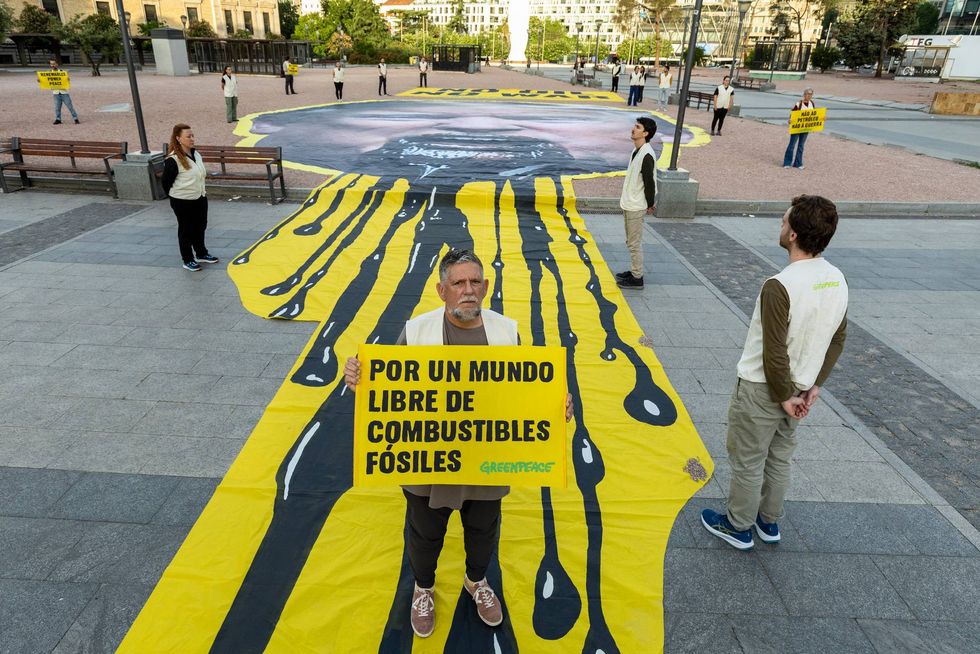 A Greenpeace Spain activist holds a sign that says "For a world free of fossil fuels" in Spanish during a protest in Madrid on April 23, 2026. (Photo by Pablo Blazquez/Greenpeace)
"In the midst of a fossil fuel-driven energy crisis, the Santa Marta meeting offers light on the horizon," said Greenpeace International climate politics expert Tracy Carty. "Rather than prolonging exposure to volatile and conflict-prone fossil fuels, governments must use this moment to accelerate a just transition to renewable energy that protects people from price shocks and builds long-term stability."
"The coalition of committed states coming together in Santa Marta has the potential to spark bolder national action and international cooperation," she noted. "That requires the development of national roadmaps for transitioning away from fossil fuels, including ambitious renewable energy targets, and to scale up predictable, accessible, and affordable climate finance to support developing countries in delivering a just transition."
On the eve of the First Conference on Transitioning Away from Fossil Fuels in Colombia, Greenpeace Spain activists roughly 5,000 miles away unveiled an image of US President Trump vomiting oil into a black-stained fountain in Madrid's Plaza de Colón with a banner declaring, "No Oil, No War."
"We are saying no to oil and war!" said Greenpeace Spain climate and energy campaigner Pedro Zorrilla Miras in a Thursday statement. "Current conflicts prove that moving away from fossil fuels is an urgent necessity for security, well-being, and the climate."
Since returning to power last year with help from the fossil fuel industry, Trump has spent his second term attacking already inadequate US climate policies and trying to deliver on his promise to "drill, baby, drill," despite the harm that causes to the planet and its inhabitants.
After sending in US troops to abduct Venezuelan President Nicolás Maduro as part of an effort to take over the country's nationalized oil industry in January, Trump, alongside Israeli forces, began bombing Iran in February. Although there is now a fragile ceasefire in place, Iran responded to the US-Israeli attack by restricting ship traffic through the Strait of Hormuz, a key trade route, including for fertilizer and fossil fuels.
As fuel prices have soared, green groups—including Greenpeace—have called for a permanent end to the US and Israel's assault on Iran, a windfall profits tax for fossil fuel giants that have cashed in on the conflict, and making "food and energy secure for all." They have also argued that the war highlights the need for a just shift away from oil and gas.
"Instead of war, ending our reliance on fossil fuels is our best possible defense," said Zorrilla Miras. "That is why governments must show leadership at the Santa Marta conference to accelerate a just transition away from fossil fuels. We are calling for clear and ambitious action from Spain that matches its rhetoric and embraces pathways that show Spain can achieve a 99% decarbonization rate by 2040."
"Fossil fuel dependence is exposing countries to volatile global markets, where conflict, disruption, and political tensions rapidly translate into higher energy, food, and transport prices," the campaigner continued. "The Santa Marta summit is therefore a key political moment for leaders to progress the delivery of energy systems that are affordable, stable, and resilient in an increasingly uncertain world."
Colombia and the Netherlands are co-hosting the summit, which is set to run from Friday to Wednesday and is "intended to support practical action by those already prepared to move forward," according to organizers. "It does not seek to deliver a negotiated outcome, but rather to generate shared understanding and actionable guidance that can help accelerate a just, orderly, and equitable transition away from fossil fuels."
Standing on top of and around the visual of puking Trump in Madrid, Greenpeace activists carried signs calling for such a transition. The messages included: "Renewables, Power, Peace" in English, "No Oil, No War" in Portuguese, and "For a world free of fossil fuels" in Spanish.
A Greenpeace Spain activist holds a sign that says "For a world free of fossil fuels" in Spanish during a protest in Madrid on April 23, 2026. (Photo by Pablo Blazquez/Greenpeace)
"In the midst of a fossil fuel-driven energy crisis, the Santa Marta meeting offers light on the horizon," said Greenpeace International climate politics expert Tracy Carty. "Rather than prolonging exposure to volatile and conflict-prone fossil fuels, governments must use this moment to accelerate a just transition to renewable energy that protects people from price shocks and builds long-term stability."
"The coalition of committed states coming together in Santa Marta has the potential to spark bolder national action and international cooperation," she noted. "That requires the development of national roadmaps for transitioning away from fossil fuels, including ambitious renewable energy targets, and to scale up predictable, accessible, and affordable climate finance to support developing countries in delivering a just transition."
- Global Energy Report Offers Choice for Humanity: Renewable Transition or 'Dystopian Future' Pushed by Trump ›
- ‘Reckless’ Countries to Extract More Than Double the Fossil Fuels Consistent With 1.5°C ›
- Fossil Fuel Production Cannot Expand as Part of a Fair Energy Transition, Urges New International Coalition ›
- 'Fossil Fuel Exit Strategy' Shows Transition to Renewable Future Totally Doable ›
- What the First Conference on Transitioning Away From Fossil Fuels Must Achieve - News & Opinion - The Commons ›
On the eve of the First Conference on Transitioning Away from Fossil Fuels in Colombia, Greenpeace Spain activists roughly 5,000 miles away unveiled an image of US President Trump vomiting oil into a black-stained fountain in Madrid's Plaza de Colón with a banner declaring, "No Oil, No War."
"We are saying no to oil and war!" said Greenpeace Spain climate and energy campaigner Pedro Zorrilla Miras in a Thursday statement. "Current conflicts prove that moving away from fossil fuels is an urgent necessity for security, well-being, and the climate."
Since returning to power last year with help from the fossil fuel industry, Trump has spent his second term attacking already inadequate US climate policies and trying to deliver on his promise to "drill, baby, drill," despite the harm that causes to the planet and its inhabitants.
After sending in US troops to abduct Venezuelan President Nicolás Maduro as part of an effort to take over the country's nationalized oil industry in January, Trump, alongside Israeli forces, began bombing Iran in February. Although there is now a fragile ceasefire in place, Iran responded to the US-Israeli attack by restricting ship traffic through the Strait of Hormuz, a key trade route, including for fertilizer and fossil fuels.
As fuel prices have soared, green groups—including Greenpeace—have called for a permanent end to the US and Israel's assault on Iran, a windfall profits tax for fossil fuel giants that have cashed in on the conflict, and making "food and energy secure for all." They have also argued that the war highlights the need for a just shift away from oil and gas.
"Instead of war, ending our reliance on fossil fuels is our best possible defense," said Zorrilla Miras. "That is why governments must show leadership at the Santa Marta conference to accelerate a just transition away from fossil fuels. We are calling for clear and ambitious action from Spain that matches its rhetoric and embraces pathways that show Spain can achieve a 99% decarbonization rate by 2040."
"Fossil fuel dependence is exposing countries to volatile global markets, where conflict, disruption, and political tensions rapidly translate into higher energy, food, and transport prices," the campaigner continued. "The Santa Marta summit is therefore a key political moment for leaders to progress the delivery of energy systems that are affordable, stable, and resilient in an increasingly uncertain world."
Colombia and the Netherlands are co-hosting the summit, which is set to run from Friday to Wednesday and is "intended to support practical action by those already prepared to move forward," according to organizers. "It does not seek to deliver a negotiated outcome, but rather to generate shared understanding and actionable guidance that can help accelerate a just, orderly, and equitable transition away from fossil fuels."
Standing on top of and around the visual of puking Trump in Madrid, Greenpeace activists carried signs calling for such a transition. The messages included: "Renewables, Power, Peace" in English, "No Oil, No War" in Portuguese, and "For a world free of fossil fuels" in Spanish.
A Greenpeace Spain activist holds a sign that says "For a world free of fossil fuels" in Spanish during a protest in Madrid on April 23, 2026. (Photo by Pablo Blazquez/Greenpeace)
"In the midst of a fossil fuel-driven energy crisis, the Santa Marta meeting offers light on the horizon," said Greenpeace International climate politics expert Tracy Carty. "Rather than prolonging exposure to volatile and conflict-prone fossil fuels, governments must use this moment to accelerate a just transition to renewable energy that protects people from price shocks and builds long-term stability."
"The coalition of committed states coming together in Santa Marta has the potential to spark bolder national action and international cooperation," she noted. "That requires the development of national roadmaps for transitioning away from fossil fuels, including ambitious renewable energy targets, and to scale up predictable, accessible, and affordable climate finance to support developing countries in delivering a just transition."
- Global Energy Report Offers Choice for Humanity: Renewable Transition or 'Dystopian Future' Pushed by Trump ›
- ‘Reckless’ Countries to Extract More Than Double the Fossil Fuels Consistent With 1.5°C ›
- Fossil Fuel Production Cannot Expand as Part of a Fair Energy Transition, Urges New International Coalition ›
- 'Fossil Fuel Exit Strategy' Shows Transition to Renewable Future Totally Doable ›
- What the First Conference on Transitioning Away From Fossil Fuels Must Achieve - News & Opinion - The Commons ›