SUBSCRIBE TO OUR FREE NEWSLETTER
Daily news & progressive opinion—funded by the people, not the corporations—delivered straight to your inbox.
5
#000000
#FFFFFF
To donate by check, phone, or other method, see our More Ways to Give page.
Daily news & progressive opinion—funded by the people, not the corporations—delivered straight to your inbox.
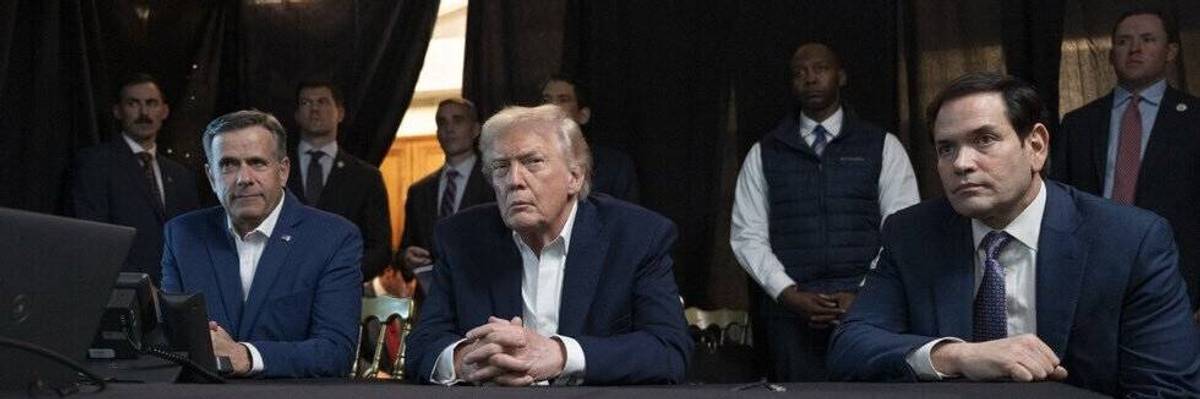
Central Intelligence Agency Director John Ratcliffe, President Donald Trump, and Secretary of State Marco Rubio watch Venezuelan President Nicolas Maduro's capture unfold from Washington, DC on January 3, 2026.
The revelation comes as the State Department "has been on a full-throttle media blitz," noted one writer, "painting Cuba as an espionage superpower and a threat to US national security."
After months of President Donald Trump threatening a US takeover of Cuba and ramping up a decadeslong economic assault of the island, The New York Times revealed Wednesday that the Central Intelligence Agency created a related task force, "setting in motion plans for a more concerted campaign to pressure the Cuban government to make the economic, political, and leadership changes."
"In 1960, the CIA established an earlier Cuba task force, whose members oversaw the failed, agency-backed invasion of Cuba the next year known as the Bay of Pigs," the newspaper noted. "The people briefed on the new task force said its mandate is more limited: to create fissures among the Cuban political elite, in hope of pressuring the Cubans to replace perceived anti-American hard-liners with more practical leaders more amenable to Mr. Trump's demands."
Despite the anonymous sources' claims about the differences from over a half-century ago, Eva Golinger, an American lawyer who wrote multiple books about former Venezuelan President Hugo Chávez, simply responded, "Bay of Pigs reloaded."
The Times article—on which the CIA declined to comment—came a day after Politico reported that "the US has increased its intelligence assets in Cuba in recent months as it pushes the country's communist regime to reform or fall from power, according to two people familiar with the Trump administration's plans for the island."
The agency also declined to comment on Politico's piece, which pointed out that "US military operations are often preceded by increased American intelligence activity. CIA efforts to track the whereabouts of Venezuelan leader Nicolas Maduro reportedly played a critical role this January in the successful US operation to capture him."
Sharing Politico's coverage on social media, Andrés Pertierra, a Cuba historian at the University of Wisconsin-Madison, said that it is "hard to say at this point to what degree this is theater aimed at rattling the cage in Havana or performing strength to Miami, on the one hand, or some kind of prelude to an actual escalation, on the other, given recent months of warnings of escalation that went nowhere."
Enrique "Ric" Prado, a Cuban exile who served in various posts at the CIA, "is convinced that Washington is preparing a definitive blow against the island regime," El País reported early Wednesday. He predicted, "Cuba is the next apple to fall from the tree."
This week's reporting followed the July release of a "McCarthyite" US Department of State document that was widely decried as an "attack on Americans' constitutional rights to free speech and assembly," as well as an attempt to justify an invasion of Cuba, where the Trump administration has fueled a humanitarian crisis.
"For nearly seven decades, the Cuban regime has waged a sustained campaign of subversion against the United States," the department's report begins, "that has infiltrated the highest reaches of the US government, recruited and cultivated generations of American activists, backed an unprecedented wave of left-wing terrorism on American soil, and carried out one of the most durable and damaging foreign intelligence penetrations in American history."
Promoting the publication on social media, US Secretary of State Marco Rubio—the son of Cuban immigrants and a longtime advocate of regime change on the island—claimed his department was "exposing the full history of Cuban espionage and subversion in our country."
During a Sunday interview with Fox News host Lara Trump, the president’s daughter-in-law, Rubio repeated claims from the report and called the island nation, about 90 miles south of Florida and home to roughly 10 million people, "an influence and espionage superpower." His comments drew criticism from Democrats in Congress, the Cuban foreign minister, and other experts.
This country and this world are at a monumental crossroads. US voters have an opportunity to beat back the forces of fascism and confront the billionaires who are rigging the economy, our media system, and our democracy, making it increasingly impossible for ordinary people to get by. We’re not just talking about the election. We’re talking about what must be done once these fascist elements are vanquished from power. We need a bolder set of solutions than what either major party has so far been willing to offer and a working-class movement ready to fight like hell for it. Trump didn't emerge from nowhere. The conditions that fueled MAGA authoritarianism were created by decades of radical neoliberal economic policies and a corrupt political system dominated by corporate interests. They slashed taxes on the super-rich, promising that the benefits would trickle down. They said giveaways to the corporate titans would make life more affordable for the rest of us. It was all bullshit. And when a bitter, betrayed populace searches for someone to blame, right-wing demagogues have little trouble finding scapegoats. People know when they're being lied to, but you won't hear any of this from the corporate media. Only independent journalism—powered and funded by people who believe in building a better world—can deliver truly trustworthy daily news. If you share our vision, please contribute whatever you can to sustain our work. |
After months of President Donald Trump threatening a US takeover of Cuba and ramping up a decadeslong economic assault of the island, The New York Times revealed Wednesday that the Central Intelligence Agency created a related task force, "setting in motion plans for a more concerted campaign to pressure the Cuban government to make the economic, political, and leadership changes."
"In 1960, the CIA established an earlier Cuba task force, whose members oversaw the failed, agency-backed invasion of Cuba the next year known as the Bay of Pigs," the newspaper noted. "The people briefed on the new task force said its mandate is more limited: to create fissures among the Cuban political elite, in hope of pressuring the Cubans to replace perceived anti-American hard-liners with more practical leaders more amenable to Mr. Trump's demands."
Despite the anonymous sources' claims about the differences from over a half-century ago, Eva Golinger, an American lawyer who wrote multiple books about former Venezuelan President Hugo Chávez, simply responded, "Bay of Pigs reloaded."
The Times article—on which the CIA declined to comment—came a day after Politico reported that "the US has increased its intelligence assets in Cuba in recent months as it pushes the country's communist regime to reform or fall from power, according to two people familiar with the Trump administration's plans for the island."
The agency also declined to comment on Politico's piece, which pointed out that "US military operations are often preceded by increased American intelligence activity. CIA efforts to track the whereabouts of Venezuelan leader Nicolas Maduro reportedly played a critical role this January in the successful US operation to capture him."
Sharing Politico's coverage on social media, Andrés Pertierra, a Cuba historian at the University of Wisconsin-Madison, said that it is "hard to say at this point to what degree this is theater aimed at rattling the cage in Havana or performing strength to Miami, on the one hand, or some kind of prelude to an actual escalation, on the other, given recent months of warnings of escalation that went nowhere."
Enrique "Ric" Prado, a Cuban exile who served in various posts at the CIA, "is convinced that Washington is preparing a definitive blow against the island regime," El País reported early Wednesday. He predicted, "Cuba is the next apple to fall from the tree."
This week's reporting followed the July release of a "McCarthyite" US Department of State document that was widely decried as an "attack on Americans' constitutional rights to free speech and assembly," as well as an attempt to justify an invasion of Cuba, where the Trump administration has fueled a humanitarian crisis.
"For nearly seven decades, the Cuban regime has waged a sustained campaign of subversion against the United States," the department's report begins, "that has infiltrated the highest reaches of the US government, recruited and cultivated generations of American activists, backed an unprecedented wave of left-wing terrorism on American soil, and carried out one of the most durable and damaging foreign intelligence penetrations in American history."
Promoting the publication on social media, US Secretary of State Marco Rubio—the son of Cuban immigrants and a longtime advocate of regime change on the island—claimed his department was "exposing the full history of Cuban espionage and subversion in our country."
During a Sunday interview with Fox News host Lara Trump, the president’s daughter-in-law, Rubio repeated claims from the report and called the island nation, about 90 miles south of Florida and home to roughly 10 million people, "an influence and espionage superpower." His comments drew criticism from Democrats in Congress, the Cuban foreign minister, and other experts.