SUBSCRIBE TO OUR FREE NEWSLETTER
Daily news & progressive opinion—funded by the people, not the corporations—delivered straight to your inbox.
5
#000000
#FFFFFF
To donate by check, phone, or other method, see our More Ways to Give page.
Daily news & progressive opinion—funded by the people, not the corporations—delivered straight to your inbox.
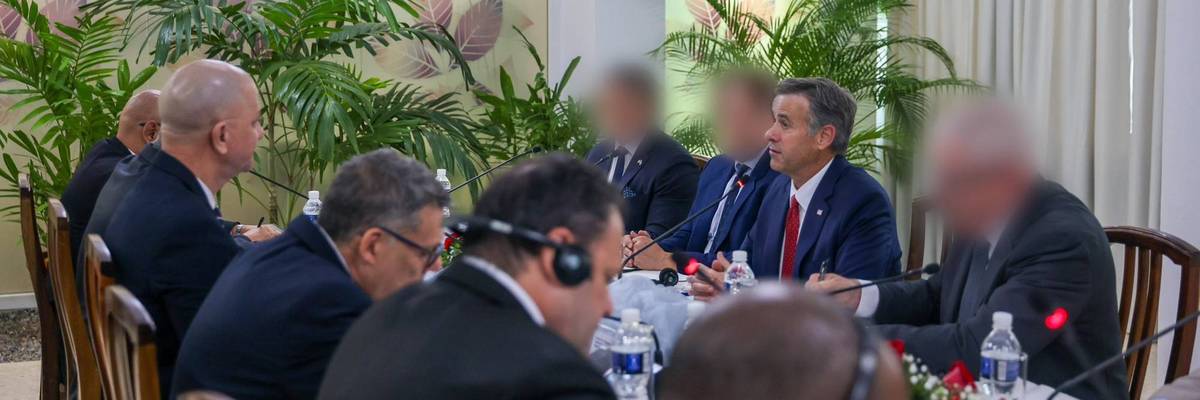
John Ratcliffe, director of the US Central Intelligence Agency, is pictured during a meeting with Cuban officials in Havana on May 14, 2026.
Democratic Rep. Pramila Jayapal called for an immediate end to the US blockade, warning that "we are contributing to immense suffering in Cuba and a worsening humanitarian crisis."
The director of the US Central Intelligence Agency met with Cuban officials in Havana on Thursday after the island nation's government said it had completely run out of fuel due to the Trump administration's oil blockade.
The CIA's X account posted photos of some of Director John Ratcliffe's meetings, blurring the faces of US intelligence officials who accompanied the agency chief. In a statement, the CIA said it met with Raúl Rodríguez Castro, the grandson of former Cuban President Raúl Castro; Interior Minister Lázaro Álvarez Casas; and the head of Cuba's intelligence services.
Havana, Cuba pic.twitter.com/7S7TtJPyf5
— CIA (@CIA) May 14, 2026
"This is one of the most sinister and ominous social media posts I've ever seen," legal scholar Maryam Jamshidi wrote in response to the CIA photos.
Ratcliffe, the highest-ranking Trump administration official to visit Cuba, decided to visit "to personally deliver President Donald Trump's message that the United States is prepared to seriously engage on economic and security issues, but only if Cuba makes fundamental changes," the CIA said.
A CIA official told NewsNation that "while the director emphasized that President Trump prefers dialogue, the Cubans should have no illusions that the President will not enforce red lines."
Trump has repeatedly threatened to seize Cuba by force, describing the island country as his next military target after Venezuela and Iran. Fears of an imminent military attack have grown in recent weeks amid Trump's belligerent rhetoric and surging US surveillance flights off Cuba's coast.
"I think I can do anything I want with [Cuba], if you want to know the truth," Trump told reporters in the Oval Office in March. "A very weakened nation."
"This failed policy needs to end immediately. Every day, we are contributing to immense suffering in Cuba and a worsening humanitarian crisis."
The spy chief's trip came a day after Cuba's energy minister announced that months after Trump imposed an oil blockade on the island, "we have absolutely no fuel oil, absolutely no diesel."
The same day, the US State Department dangled "$100 million in direct humanitarian assistance to the Cuban people." Cuban Foreign Minister Bruno Rodríguez Parrilla said Cuba's leadership is "willing to hear the details of the offer and the manner in which it would be implemented."
"We hope it is free of political maneuvers and attempts to exploit the shortages and suffering of a people under siege," he added. "The best aid that the US government could provide to the noble Cuban people at this or any time is to de-escalate the measures of the energy, economic, commercial, and financial blockade, intensified as never before in recent months, which severely affects all sectors of the Cuban economy and society."
Cuban President Miguel Díaz-Canel echoed that sentiment, writing in a Thursday social media post that "the damage could be alleviated in a much easier and more expeditious way by lifting or easing the blockade, as it is well known that the humanitarian situation is coldly calculated and induced."
Progressive lawmakers in the US are imploring the Trump administration to end US economic warfare against Cuba, engage diplomatically with the country, and drop any plans for a military assault.
Rep. Pramila Jayapal (D-Wash.), who has come under attack from Republican lawmakers for visiting Cuba in April, said Thursday that "Cuba has run out of diesel and fuel oil and is enduring some of the worst blackouts in decades because of the US’ cruel oil blockade."
"This failed policy needs to end immediately," said Jayapal. "Every day, we are contributing to immense suffering in Cuba and a worsening humanitarian crisis."
Dear Common Dreams reader, It’s been nearly 30 years since I co-founded Common Dreams with my late wife, Lina Newhouser. We had the radical notion that journalism should serve the public good, not corporate profits. It was clear to us from the outset what it would take to build such a project. No paid advertisements. No corporate sponsors. No millionaire publisher telling us what to think or do. Many people said we wouldn't last a year, but we proved those doubters wrong. Together with a tremendous team of journalists and dedicated staff, we built an independent media outlet free from the constraints of profits and corporate control. Our mission has always been simple: To inform. To inspire. To ignite change for the common good. Building Common Dreams was not easy. Our survival was never guaranteed. When you take on the most powerful forces—Wall Street greed, fossil fuel industry destruction, Big Tech lobbyists, and uber-rich oligarchs who have spent billions upon billions rigging the economy and democracy in their favor—the only bulwark you have is supporters who believe in your work. But here’s the urgent message from me today. It's never been this bad out there. And it's never been this hard to keep us going. At the very moment Common Dreams is most needed, the threats we face are intensifying. We need your support now more than ever. We don't accept corporate advertising and never will. We don't have a paywall because we don't think people should be blocked from critical news based on their ability to pay. Everything we do is funded by the donations of readers like you. When everyone does the little they can afford, we are strong. But if that support retreats or dries up, so do we. Will you donate now to make sure Common Dreams not only survives but thrives? —Craig Brown, Co-founder |
The director of the US Central Intelligence Agency met with Cuban officials in Havana on Thursday after the island nation's government said it had completely run out of fuel due to the Trump administration's oil blockade.
The CIA's X account posted photos of some of Director John Ratcliffe's meetings, blurring the faces of US intelligence officials who accompanied the agency chief. In a statement, the CIA said it met with Raúl Rodríguez Castro, the grandson of former Cuban President Raúl Castro; Interior Minister Lázaro Álvarez Casas; and the head of Cuba's intelligence services.
Havana, Cuba pic.twitter.com/7S7TtJPyf5
— CIA (@CIA) May 14, 2026
"This is one of the most sinister and ominous social media posts I've ever seen," legal scholar Maryam Jamshidi wrote in response to the CIA photos.
Ratcliffe, the highest-ranking Trump administration official to visit Cuba, decided to visit "to personally deliver President Donald Trump's message that the United States is prepared to seriously engage on economic and security issues, but only if Cuba makes fundamental changes," the CIA said.
A CIA official told NewsNation that "while the director emphasized that President Trump prefers dialogue, the Cubans should have no illusions that the President will not enforce red lines."
Trump has repeatedly threatened to seize Cuba by force, describing the island country as his next military target after Venezuela and Iran. Fears of an imminent military attack have grown in recent weeks amid Trump's belligerent rhetoric and surging US surveillance flights off Cuba's coast.
"I think I can do anything I want with [Cuba], if you want to know the truth," Trump told reporters in the Oval Office in March. "A very weakened nation."
"This failed policy needs to end immediately. Every day, we are contributing to immense suffering in Cuba and a worsening humanitarian crisis."
The spy chief's trip came a day after Cuba's energy minister announced that months after Trump imposed an oil blockade on the island, "we have absolutely no fuel oil, absolutely no diesel."
The same day, the US State Department dangled "$100 million in direct humanitarian assistance to the Cuban people." Cuban Foreign Minister Bruno Rodríguez Parrilla said Cuba's leadership is "willing to hear the details of the offer and the manner in which it would be implemented."
"We hope it is free of political maneuvers and attempts to exploit the shortages and suffering of a people under siege," he added. "The best aid that the US government could provide to the noble Cuban people at this or any time is to de-escalate the measures of the energy, economic, commercial, and financial blockade, intensified as never before in recent months, which severely affects all sectors of the Cuban economy and society."
Cuban President Miguel Díaz-Canel echoed that sentiment, writing in a Thursday social media post that "the damage could be alleviated in a much easier and more expeditious way by lifting or easing the blockade, as it is well known that the humanitarian situation is coldly calculated and induced."
Progressive lawmakers in the US are imploring the Trump administration to end US economic warfare against Cuba, engage diplomatically with the country, and drop any plans for a military assault.
Rep. Pramila Jayapal (D-Wash.), who has come under attack from Republican lawmakers for visiting Cuba in April, said Thursday that "Cuba has run out of diesel and fuel oil and is enduring some of the worst blackouts in decades because of the US’ cruel oil blockade."
"This failed policy needs to end immediately," said Jayapal. "Every day, we are contributing to immense suffering in Cuba and a worsening humanitarian crisis."
The director of the US Central Intelligence Agency met with Cuban officials in Havana on Thursday after the island nation's government said it had completely run out of fuel due to the Trump administration's oil blockade.
The CIA's X account posted photos of some of Director John Ratcliffe's meetings, blurring the faces of US intelligence officials who accompanied the agency chief. In a statement, the CIA said it met with Raúl Rodríguez Castro, the grandson of former Cuban President Raúl Castro; Interior Minister Lázaro Álvarez Casas; and the head of Cuba's intelligence services.
Havana, Cuba pic.twitter.com/7S7TtJPyf5
— CIA (@CIA) May 14, 2026
"This is one of the most sinister and ominous social media posts I've ever seen," legal scholar Maryam Jamshidi wrote in response to the CIA photos.
Ratcliffe, the highest-ranking Trump administration official to visit Cuba, decided to visit "to personally deliver President Donald Trump's message that the United States is prepared to seriously engage on economic and security issues, but only if Cuba makes fundamental changes," the CIA said.
A CIA official told NewsNation that "while the director emphasized that President Trump prefers dialogue, the Cubans should have no illusions that the President will not enforce red lines."
Trump has repeatedly threatened to seize Cuba by force, describing the island country as his next military target after Venezuela and Iran. Fears of an imminent military attack have grown in recent weeks amid Trump's belligerent rhetoric and surging US surveillance flights off Cuba's coast.
"I think I can do anything I want with [Cuba], if you want to know the truth," Trump told reporters in the Oval Office in March. "A very weakened nation."
"This failed policy needs to end immediately. Every day, we are contributing to immense suffering in Cuba and a worsening humanitarian crisis."
The spy chief's trip came a day after Cuba's energy minister announced that months after Trump imposed an oil blockade on the island, "we have absolutely no fuel oil, absolutely no diesel."
The same day, the US State Department dangled "$100 million in direct humanitarian assistance to the Cuban people." Cuban Foreign Minister Bruno Rodríguez Parrilla said Cuba's leadership is "willing to hear the details of the offer and the manner in which it would be implemented."
"We hope it is free of political maneuvers and attempts to exploit the shortages and suffering of a people under siege," he added. "The best aid that the US government could provide to the noble Cuban people at this or any time is to de-escalate the measures of the energy, economic, commercial, and financial blockade, intensified as never before in recent months, which severely affects all sectors of the Cuban economy and society."
Cuban President Miguel Díaz-Canel echoed that sentiment, writing in a Thursday social media post that "the damage could be alleviated in a much easier and more expeditious way by lifting or easing the blockade, as it is well known that the humanitarian situation is coldly calculated and induced."
Progressive lawmakers in the US are imploring the Trump administration to end US economic warfare against Cuba, engage diplomatically with the country, and drop any plans for a military assault.
Rep. Pramila Jayapal (D-Wash.), who has come under attack from Republican lawmakers for visiting Cuba in April, said Thursday that "Cuba has run out of diesel and fuel oil and is enduring some of the worst blackouts in decades because of the US’ cruel oil blockade."
"This failed policy needs to end immediately," said Jayapal. "Every day, we are contributing to immense suffering in Cuba and a worsening humanitarian crisis."