

SUBSCRIBE TO OUR FREE NEWSLETTER
Daily news & progressive opinion—funded by the people, not the corporations—delivered straight to your inbox.
5
#000000
#FFFFFF
To donate by check, phone, or other method, see our More Ways to Give page.
Daily news & progressive opinion—funded by the people, not the corporations—delivered straight to your inbox.

"We have said from the beginning, people, not politicians will be the final deciders on this DC power grab," said one campaigner. "We are moving forward to vote NO on Proposition A."
Although the US Supreme Court's right-wing supermajority on Friday greenlit President Donald Trump's voter purge database, it also helped deliver yet another blow to Missouri Republicans' push for a rigged congressional map.
"In 2022, the Missouri Legislature enacted a redistricting map for elections to the US House of Representatives. In 2025, the Missouri Legislature enacted a new map," says the high court's unsigned ruling. Like Republican legislators in other states, Missouri's lawmakers pursued the new districts in response to public pressure from the president.
"But under the Missouri Constitution as interpreted by the Supreme Court of Missouri, a new law such as the 2025 map does not take effect unless and until approved by voters in a referendum in the next election—at least where, as here, the number of voter signatures on the petition suffices to trigger a referendum," Friday's opinion explains.
Thus, on September 3, the document notes, "the Missouri Supreme Court ruled that the 2025 redistricting map 'is not the law and has never been the law' in Missouri—and will not take effect unless and until approved by Missouri voters by referendum in the 2026 election."
However, Missouri Republicans fought back. The following week, Justice Brett Kavanaugh—a Trump appointee and member of the court's right-wing supermajority—delivered the first blow to the 2025 map. Just days later, the full court agreed, again tossing the redrawn districts.
The high court reiterated its position for a third time on Friday, with no noted dissents: "In short, as a matter of state law, the 2022 map—not the 2025 map—must be used in the 2026 congressional election."
The justices also gave clear directions to the US District Court for the Eastern District of Missouri and the Court of Appeals for the 8th Circuit, stating that they "should not enjoin or otherwise prohibit the use of the 2022 map," and "should not order or otherwise require Missouri to use the 2025 map" in the November midterm elections.
Trump's Republican Party is trying to cling to control of both chambers of Congress in the face of the president's unpopular and illegal war on Iran, which has exacerbated the country's affordability crisis.
With early voting underway and Election Day less than six weeks away, the high court highlighted that "at this late date, ordering reversion to the 2025 map in the midst of an ongoing election would usher in electoral chaos."
Gov. Mike Kehoe—who last year called the special session to redraw the map and then signed House Bill 1—said that Friday's decision was "disappointing," but "nevertheless, Missouri will follow the court's order."
Meanwhile, Marina Jenkins, executive director of the National Redistricting Foundation, declared that "this victory is the final nail in the coffin of Missouri’s egregious mid-decade gerrymander for the 2026 midterms."
"Make no mistake: In the 2026 midterms, Missourians will not only vote on the Show Me State's 2022 congressional map, a map that keeps Kansas City together, but they will also have the opportunity to veto Republicans' egregious mid-decade gerrymander at the ballot box."
People Not Politicians Missouri, a campaign that has challenged the GOP map since it was passed a year ago and sought the latest intervention from the nation's top court, also welcomed its Friday decision.
"We are done with corrupt politicians trying to force their map into effect outside the process outlined in the Missouri Constitution," said the group's executive director, Richard von Glahn. "We have said from the beginning, people, not politicians will be the final deciders on this DC power grab. We are moving forward to vote NO on Proposition A."
Proposition A is the congressional map referendum. If enough voters oppose it, they can kill "the gerrymander that won't die," a map that targets the state's 5th Congressional District, currently held by Democratic US Rep. Emanuel Cleaver.
As The Associated Press reported Friday: "Cleaver was unopposed in the Democratic primary. Republican state Sen. Rick Brattin won a six-way Republican primary under the revised districts. They remain the candidates for the general election, even though the district boundaries have reverted to their prior lines."
Journalist Jamie Dupree called the Friday ruling a "loss for the GOP," adding that "the Missouri map will be 5R-2D instead of 6-1."
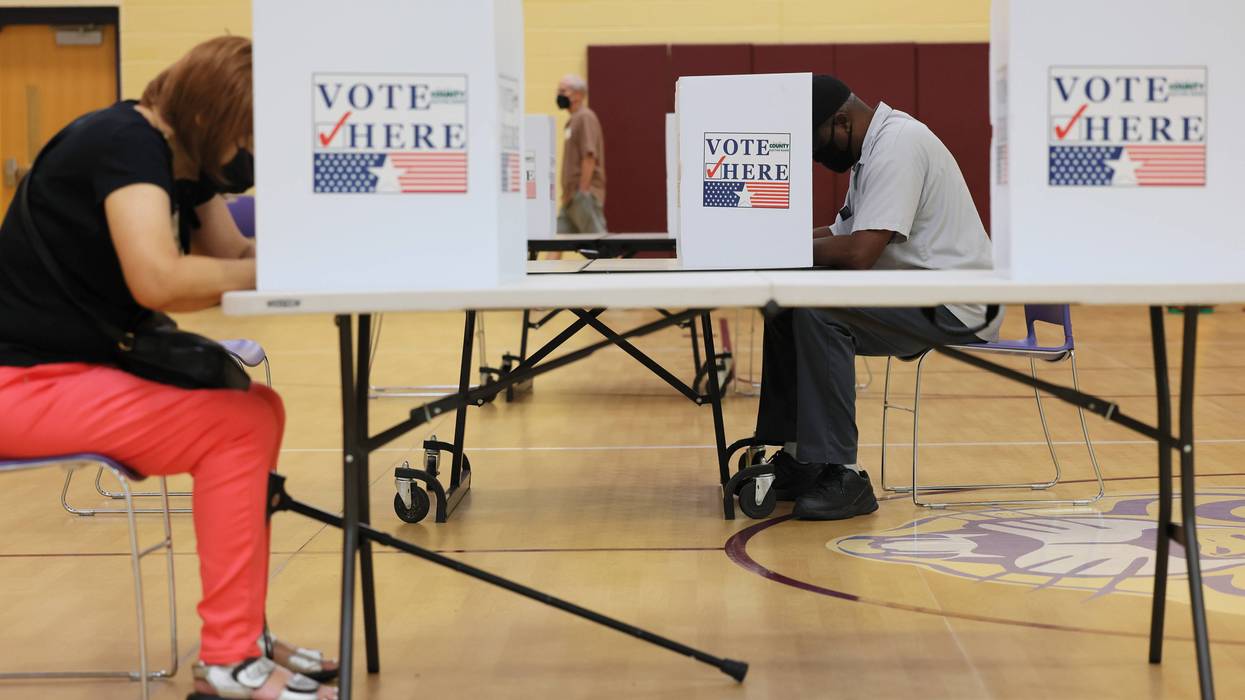
"Officials should stop wasting taxpayers' money on pointless legal action and instead focus on administering our elections," said the head of People Not Politicians Missouri.
Despite its right-wing supermajority, the US Supreme Court has twice struck down Missouri Republicans' rigged congressional districts for the November midterm elections, but after an appellate panel's Monday decision, the map fight is headed back to the justices.
Less than two weeks after the justices delivered their second blow to the Missouri GOP's gerrymandering effort with no noted dissents, a three-judge panel from the US Court of Appeals for the 8th Circuit ruled that the state's "current plan to use the 2022 map in the November 2026 general election violates the Constitution," and "only use of the 2025 map complies with the Constitution and federal law."
All three panel members were appointed by Republicans: Judge James Loken by former President George HW Bush, and Judges David Stras and Justin Smith by President Donald Trump. The Associated Press reported that "prior to his June appointment, Smith was an attorney who represented Trump as he unsuccessfully appealed a $5 million jury verdict in a lawsuit filed by the writer E. Jean Carroll to the US Supreme Court."
People Not Politicians Missouri, which has been battling the gerrymandering scheme since state lawmakers passed House Bill 1 during last September's special session, pledged to immediately file an emergency appeal with the nation's top court.
"Everyone is aligned on what is true. HB 1 is not the law and cannot be the law unless voters ratify it," said the campaign's executive director, Richard von Glahn, in a statement. "The Supreme Court of Missouri, the United States Supreme Court, the Missouri attorney general, Missouri secretary of state, and People Not Politicians all have agreed on this."
"Ballots have been printed, and Missourians have already voted," he stressed. "Thousands more will vote before this order seeks to take effect. Officials should stop wasting taxpayers' money on pointless legal action and instead focus on administering our elections. Missourians are already voting and will continue to vote no on Proposition A through November 3."
The 8th Circuit's decision also drew attention from beyond Missouri. Politico reporter Kyle Cheney said that "it's the gerrymander that won't die," while Democratic Texas Congressman Christian Menefee—whose state was the first to pass a new rigged map at Trump's request—declared that "this is outrageous."
"The Supreme Court already stepped in twice to block Missouri's rigged map," Menefee added. "Ballots are already in the mail. Now, at the eleventh hour, an appeals court is letting Missouri Republicans force that rigged map on voters anyway. All to erase a Kansas City district and silence Black and Brown voters. Catastrophic for confidence in our elections."
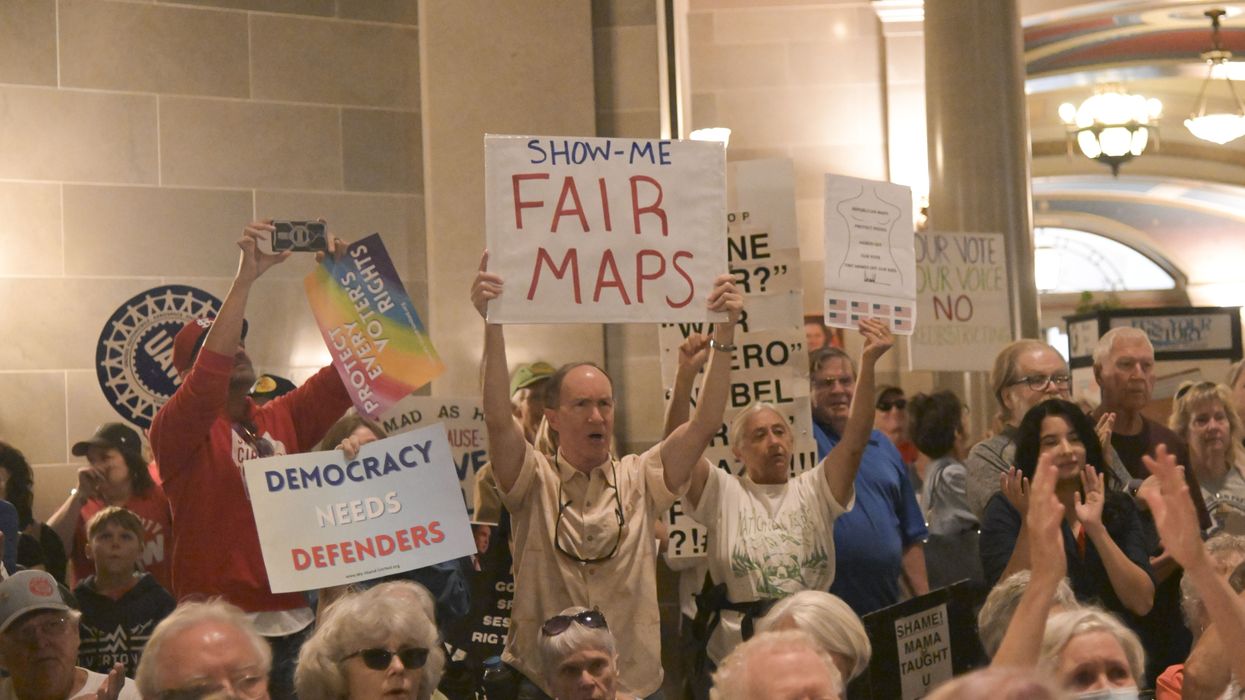
"The Missouri Supreme Court should throw the secretary of state in jail if this extremist continues to defy the law and multiple court orders," said US House Minority Leader Hakeem Jeffries.
Democracy defenders in Missouri and across the United States celebrated on Thursday after the US Supreme Court delivered its second blow to President Donald Trump's gerrymandering quest in as many days, tossing out the state GOP's desired congressional map.
The order had no noted dissents, despite the court's right-wing supermajority, which includes three Trump appointees. Among them is Justice Brett Kavanaugh, who had rejected the GOP's emergency effort to uphold the map on Tuesday evening, as US District Judge Stephen Clark, another appointee of the president, said that Missouri can't revert to its old map for the November midterms.
The high court's new order appears to allow the state to use the old map for the upcoming elections, in which Trump's Republican Party is trying to hold on to its narrow majorities in both chambers of Congress amid widespread voter dissatisfaction with an affordability crisis fueled by the president's tariff regime and illegal war on Iran.
On the heels of the Texas GOP's map-rigging effort last year, Missouri Republicans targeted the 5th Congressional District—currently held by Rep. Emanuel Cleaver (D), who has joined hundreds of thousands of state voters in opposing the new political lines.
Cleaver called Thursday's decision "a win for justice. A win for democracy. A win for the people of Missouri."
"It is my hope that state officials will start following court orders and end this shameful attempt to break Missouri law and silence Missouri voters," he said.
Opposition to the map has been spearheaded by the nonpartisan coalition People Not Politicians Missouri, whose executive director, Richard von Glahn, declared Thursday that "the law is the law, the Missouri Constitution is clear, as was the Missouri Supreme Court."
"Over 305,000 Missouri voters—Republicans, Democrats, and Independents—took action to block this political power grab last fall. People, not politicians, will have the final say when they vote NO on Proposition A this November," he continued, referring to a veto referendum on the GOP's map.
Von Glahn also took aim at Missouri's Republican secretary of state, Denny Hoskins, who faces a contempt hearing at the state's top court, saying that he "has shown that he cannot effectively do the job he was elected to do—administer elections."
"First he refused to certify a referendum the Missouri Supreme Court unanimously said he had no legal basis to block," Von Glahn explained. "Then, even after that court barred the 2025 map outright, he told local election officials to use it anyway, leaving election clerks scrambling with early voting two weeks away. That isn't leadership, it's chaos of his own making, and it's why he's now facing a contempt hearing in front of the very court whose order he chose to defy."
"Missourians don't need a secretary of state who manufactures confusion; they need one who follows the law," he added. "Denny Hoskins has had every chance to do that and chose not to. The courts have settled this, now it's up to Missouri voters to finish the job and vote NO on Proposition A."
US House Minority Leader Hakeem Jeffries (D-NY) also called out Hoskins after the Thursday decision, suggesting on social media that "the Missouri Supreme Court should throw the secretary of state in jail if this extremist continues to defy the law and multiple court orders."
"You lost," he said. "The people of Missouri have won. It's over."
The Missouri Supreme Court on Thursday found that Hoskins was in contempt of court for defying an order blocking the new map, but also that he is now in compliance because he directed the use of the 2022 districts.
This article has been updated with comment from US Rep. Emanuel Cleaver (D-Mo.) and Adam Cochran, and with the Missouri Supreme Court's decision.

"Over 305,000 Missouri voters, Republicans, Democrats, and Independents, took action to block this political power grab last fall."
A high-stakes legal fight over Missouri's congressional map was engulfed in chaos late Tuesday after the US Supreme Court and a lower federal court issued conflicting decisions on whether the state can use aggressively gerrymandered district lines that Republicans drew last year at the behest of President Donald Trump.
US Supreme Court Justice Brett Kavanaugh, a Trump nominee, issued an order rejecting Missouri's emergency effort to uphold the GOP-drawn map, which was used during the state's primary but has faced challenges from advocacy organizations and voters who say it is an "unconstitutional power grab." But in a parallel case, Trump-appointed District Judge Stephen Clark ruled that Missouri cannot revert to its old maps for the November midterms, a win for state Republicans who sued to keep the gerrymandered districts in place.
"Missourians deserve better than this Republican chaos. Plain and simple," the Missouri Democratic Party said in response to the court rulings. Clark's decision has been appealed to the 8th Circuit.
Late last year, more than 300,000 Missouri voters signed a petition aimed at forcing a November ballot referendum on the new gerrymandered map, which carved up the Kansas City district of Democratic Rep. Emanuel Cleaver. Missouri's Republican Secretary of State Denny Hoskins refused to add the referendum to the ballot, but the Missouri Supreme Court ruled last week that the referendum push was legal, retroactively freezing the new maps until voters get a say in November.
"Here's what we know right now: The referendum where voters get to decide the fate of this map IS on your ballot," said local reporter Mark Maxwell. "What we still don't know for sure: which district you vote in. Watch the appeals court tonight/tomorrow."
Richard von Glahn, executive director of People Not Politicians Missouri, said in a statement late Tuesday that "the Missouri constitution is clear, as was the Missouri Supreme Court."
"Over 305,000 Missouri voters, Republicans, Democrats, and Independents, took action to block this political power grab last fall," he added.
People Not Politicians, which sponsored the referendum petition, "filed a request Tuesday night with the state Supreme Court to hold Hoskins in contempt for attempting to use the new map," The Associated Press reported.
"An individual federal judge cannot overrule the Missouri Supreme Court,” attorney Chuck Hatfield, who represents People Not Politicians, told AP.
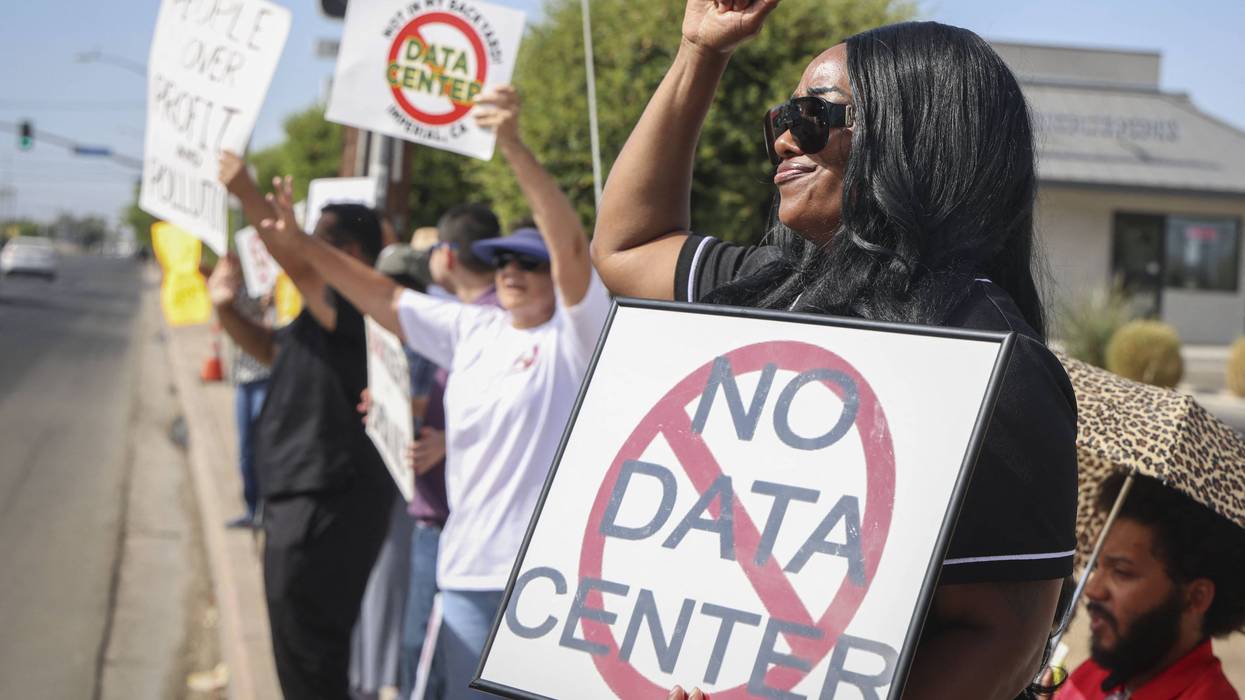
"It’s so sad what’s happened in our city, to see people being robbed of what they thought they had," said one data center opponent.
Residents in Independence, Missouri on Tuesday voted overwhelmingly to recall a city councilman—apparently over his vote to approve tax incentives for an artificial intelligence data center in the community.
In total, 68% of voters in the city's District 1 voted to recall Councilman John Perkins, with just 32% voting to let him stay in office.
According to KMBC News 9, Perkins had originally been elected to serve through June 2028, but he will now be forced to step down as soon as the results of the Tuesday election are certified.
The election marked the first time in Independence's history that a councilperson has been successfully recalled.
In an interview with Spectrum News Kansas City, Perkins expressed no regrets about his decision to approve the data center even though it led to him getting soundly rejected by voters.
"I still have a 40-hour-a-week job, I cut meat for Price Chopper," Perkins explained. "I've laid some really good foundation, so it was time to pass the baton."
The recall election of an Independence councilman is official: John Perkins of the city's first district is out. 68% of voters recalled Perkins. This ends a five-month long effort to remove him from office after he passed tax abatements for an AI data center. pic.twitter.com/fpeEd6fAhj
— Spectrum News Kansas City (@SpectrumNewsKC) September 2, 2026
Perkins was targeted by the recall campaign after he was one of five council members who voted to approve a $150 billion Nebius AI data center that is projected to take up 2.25 million square feet of land in the city.
Two other council members, Bridget McCandless and Jared Fears, were also voted out of office in April after voting in favor of tax incentives for the project.
Independence resident Elisa Breitenbach, an opponent of the planned data center, grew emotional during an interview with Fox 4 Kansas City when explaining her support for the recall campaign.
"It’s so sad what’s happened in our city," said Breitenbach, "to see people being robbed of what they thought they had."
Perkins' recall is just the latest sign of a nationwide backlash against AI data centers, which have been criticized for being major sources of pollution and for raising local utility bills by consuming so much power.
A poll conducted by Embold Research and published by Heatmap Pro last month showed that 75% of Americans now oppose building AI data centers in their area, including 61% registering strong opposition.
Data centers do have an ally in President Donald Trump, however, as he warned Americans this week that their communities will "end up being backwards and poor" if they reject the power-hungry AI facilities.
But McKenna Cobb, a resident who led the recall effort, said people in Independence had spoken loud and clear about their views on the data center—and were ignored by Perkins and other council members.
"There are hours of public testimony," she told KMBC News, "and they still voted in favor of billions of dollars in tax incentives."

Voters also rejected an amendment that would have gradually eliminated the state’s income tax in what one Democratic mayor said would benefit the wealthy "while raising costs on hardworking families."
The Democratic mayor of Kansas City, Missouri was among those celebrating what he called the "TOTAL repudiation by Missouri voter of a core agenda of state GOP leadership" on Tuesday night after the state voted by a 60-point margin against Amendment 4, a measure backed by the Republican governor which would have weakened voters' ability to pass citizen-sponsored ballot initiatives.
"We took over control of the state of Missouri tonight, repudiating absolutely atrocious ideas," Mayor Quinton Lucas said in a video message addressing voters as election results came in. "Against millions of dollars, lots of special interests, Missouri voters are trouncing Amendment 4, which was going to take away our initiative petition rights, eliminate our ability to make sure we can get things done."
The Republican supermajority in the state Legislature and Gov. Mike Kehoe supported Amendment 4, which was spurred by the passage of a ballot initiative in 2024 that had added the right to abortion care to the Missouri Constitution.
The addition of the amendment to the constitution would have required a majority vote in each of the state's eight congressional districts in order to pass any future citizen-sponsored amendments, instead of a simply majority of voters across the state.
With more than 95% of votes counted on Wednesday morning, 80.3% of voters had rejected Amendment 4, while 19.7% had supported it.
The amendment would have created the highest threshold in the country for passing ballot initiatives like others that Missourians have passed in recent years, including ones that have legalized marijuana, raised the minimum wage, and expanding Medicaid coverage.
Opponents warned that under Amendment 4, an initiative could fail to pass even with as many as 95% of voters across the state supporting it.
The St. Louis American reported that the election result could signal voters' coming rejection of Amendment 3 in November, which would ban abortion in Missouri in most cases.
The state GOP suffered a similar defeat for Amendment 5, which would have gradually eliminated the state's income tax and replaced it with expanded sales and use taxes. Opponents warned the new tax scheme would have cost working families and lower-income Missourians more, with the average resident paying $500 more in taxes annually, according to the nonpartisan Missouri Budget Project—as high-income residents would have been required to contribute less to public spending.
“Tonight’s rejection of Amendment 5 is not only an immense failure for statewide leadership, but also a sign to out-of-state billionaire special interests that Missourians and most Americans have no interest in voodoo tax schemes that would spare civic responsibility for a few elites while raising costs on hardworking families in our state and our country,” Lucas said Tuesday night.
Mark Jones of the Missouri National Education Association—part of a broad coalition that opposed the amendment—told the Missouri Independent that "fundamentally, Missourians rejected the idea that they should pay for tax breaks for billionaires and then not be able to change to correct the legislature, not only on this issue but forever."
The Independent reported that Missouri Promise political action committee (PAC), which did not report any contributions from individual donors, raised $17.2 million in favor of Amendment 5. Opponents of Amendment 5 were outspent 4-to-1 on broadcast ads.
Another PAC, Protect Election Integrity, raised $132,100 and spent $28,653 through July 23 in support of Amendment 4. Freedom Principle Missouri/Missouri First PAC, also reported spending $45,551 in support of the measure.
State House Minority Leader Ashley Aune (D-14) said Missouri voters had "made clear they won’t let Republicans rewrite the rules to protect their own power and line the pockets of the ultrawealthy."
Referring to the abortion rights amendment that will be up for a vote in the general election, Aune added, "In November, voters have the chance to send another powerful message to Jefferson City Republicans: If you mess with Missourians’ rights, you will pay the political price.”
"They knew this stuff was going to happen and are sending people back anyway."
"Deportation is a life-or-death matter."
That was one immigration attorney's response to the news this week that a couple who had lived in the St. Louis suburb of Overland, Missouri was found fatally shot in a sugarcane field near Retalhuleu, Guatemala, after the husband, Nixon Giovanni Pérez Paz, was deported there last year.
The couple's 14-month-old baby, Giovanni, was found crying next to the body of Pérez Paz's wife, Glendy Marisol González de la Cruz.
Pérez Paz, 43, and González de la Cruz, 25, showed signs of physical trauma and had apparently been bound and gagged before being killed. Police in Guatemala, where officials declared a state of emergency earlier this year over gang violence, are investigating the killings. Reuters reported that murders have spiked in the Central American country over the past week, with the government blaming organized crime.
In the US, observers including US Rep. Seth Moulton (D-Mass.) directed anger at the Trump administration, which has overseen a mass deportation campaign in which roughly 28,000 people were deported to Guatemala in the first six months of 2026, while hundreds of thousands more have been sent to other countries, including ones where they may face persecution, violence, and other security concerns.
"This is not immigration enforcement," said Moulton of President Donald Trump's deportation of Pérez Paz. "This is a body count. And every member of Congress and Senate enabling MAGA’s mass deportation police state owns it too."
According to St. Louis Public Radio, Pérez Paz and his brother were stopped by US Immigration and Customs Enforcement (ICE) agents in Overland as they were driving to their roofing jobs. The two brothers were "swarmed" by agents before being handcuffed and shackled and taken to a local jail.
The agents told them they had no warrant for their arrest, but that they were being deported for entering the country without authorization.
Pérez Paz's brother, Rolando Pérez Paz, told St. Louis Public Radio from Guatemala, where he was also deported, that they did not have legal status in the US and had fled poverty and violence in their home country.
A spokesperson for ICE told the outlet that Pérez Paz had been convicted twice for drunk driving in Overland and had a 2010 open-container charge in Palm Beach, Florida, which had been dropped by prosecutors. No records were found in Missouri's court database to support the claim about the drunk driving conviction.
Court records show Pérez Paz had pleaded guilty to driving without a valid driver’s license in May 2024 and had paid a fine for the traffic violation.
"This isn’t due process," said Moulton. "This isn’t deporting the worst of the worst or whatever lies MAGA campaigned on."
González de la Cruz was pregnant when Pérez Paz was deported and remained in Overland, giving birth to Giovanni in June 2025; they also had two older daughters. She eventually returned to Guatemala to reunite the family after financial struggles and fears of deportation mounted, according to a local immigrant rights group called Missouri Workers Center Fuerza—even though she had a court date set for 2027 for her asylum case.
"Glendy came to our Fuerza meetings three weeks after giving birth. She was working two jobs, bringing new members, showing up—even as her world was being torn apart," said the group in a Facebook post inviting community members to a candlelight vigil for the couple on August 2. "The cruelty of this administration meant her husband could not be by her side for the birth."
The couple was reported missing on July 20 after leaving their home to register a motorcycle. They had faced "several months of struggles with financial hardships, run-ins with the federal government, and violence" before their deaths.
Reuters reported that a red striped motorcycle was found at the scene outside Retalhuleu. Their children are in the custody of Pérez Paz's brother.
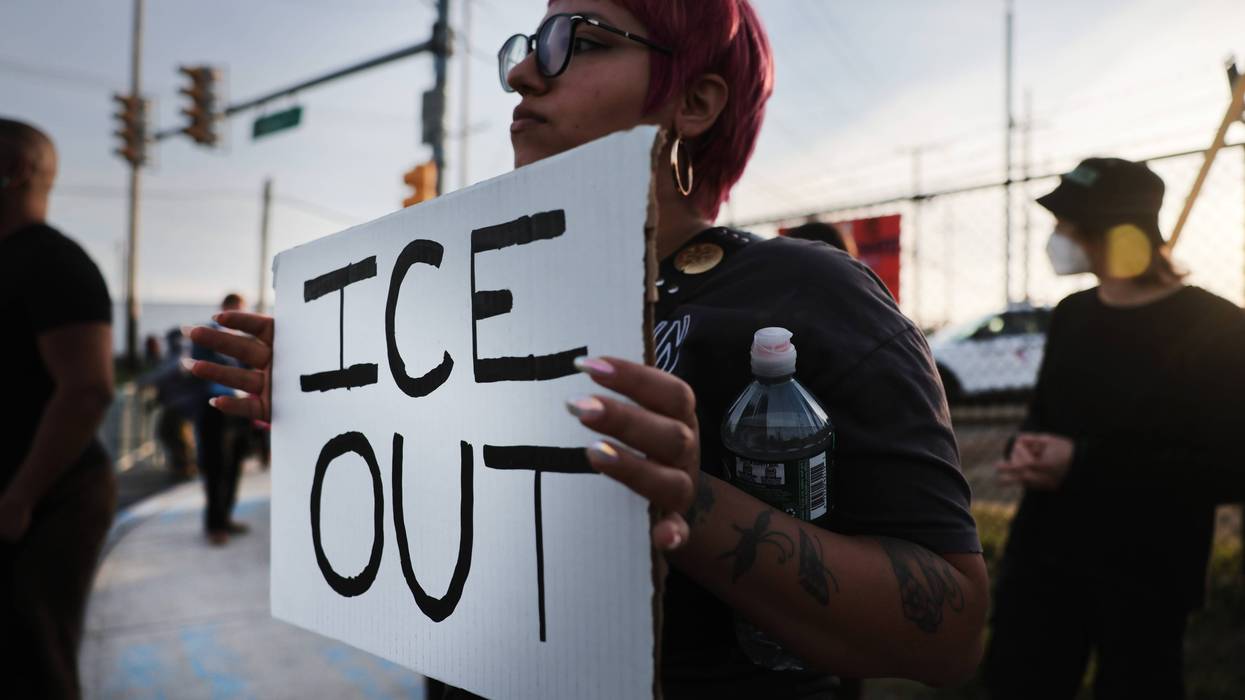
"They knew this stuff was going to happen and are sending people back anyway," said one St. Louis resident of the Trump administration's mass deportation campaign.
The deaths were reported as the White House directed ICE to ramp up operations targeting Haitians; Temporary Protected Status expired for Haitian refugees this week following a Supreme Court ruling last month. Hundreds of people could be forced onto deportation flights to the poverty-stricken country each week, according to the director-general of Haiti’s National Office of Migration. Like Guatemala, Haiti faces a crisis of violence by armed gangs.
While Missouri's 1% would get major tax breaks, one tax policy expert said, "working families and seniors would be asked to make up the difference."
Tax policy experts warned Tuesday that passing Amendment 5 in Missouri next month could lead to middle-income residents paying hundreds of dollars more each year as wealthy households enjoy a tax cut worth tens of thousands.
If approved by voters on August 4, the legislatively referred constitutional amendment would: reduce Missouri's individual income tax, based on revenue growth, until it is eliminated; prohibit future state individual income taxes; decrease personal property and other local taxes when local revenues increase, but bar funding cuts to public schools; and limit expansions of sales and use taxes, unless they are used to lower income tax.
As The Kansas City Star detailed last week, Amendment 5 is a "top priority for Republican Gov. Mike Kehoe," and Missouri Promise PAC, the main campaign supporting it, received "$9.6 million from six organizations or groups that do not have to disclose their donors," also known as dark money.
While some of the campaign backers remain unknown to voters, the Institute on Taxation and Economic Policy (ITEP) in Washington, DC aimed to shed light on the specifics of the amendment's anticipated impact with its new policy brief.
"Amendment 5 asks Missouri voters to approve a tax shift without telling them which purchases will be taxed or how high sales taxes will rise," said ITEP analyst and brief author Eli Byerly-Duke. "What is clear is who would benefit: the wealthiest Missourians. Working families and seniors would be asked to make up the difference."
Missouri's individual income tax "makes up about 64% of the state's general fund and is the major funding source for state investments in infrastructure, schools, healthcare, public safety, and other services," the brief explains. "Low- and middle-income Missourians already pay a disproportionate share of the taxes to fund public services," and swapping income taxes for higher sales taxes "would shift even more of this responsibility from the state's highest-income individuals to teachers, farmers, truck drivers, and other middle-income Missourians."
Specifically, Byerly-Duke found that "middle-class Missourians with incomes of about $50,000 to $80,000 will pay $535 more in taxes if the personal income tax is eliminated and the sales tax expanded," all while Missouri's top 1%—or those with incomes of $689,300 and above—see an average tax break of $39,978.
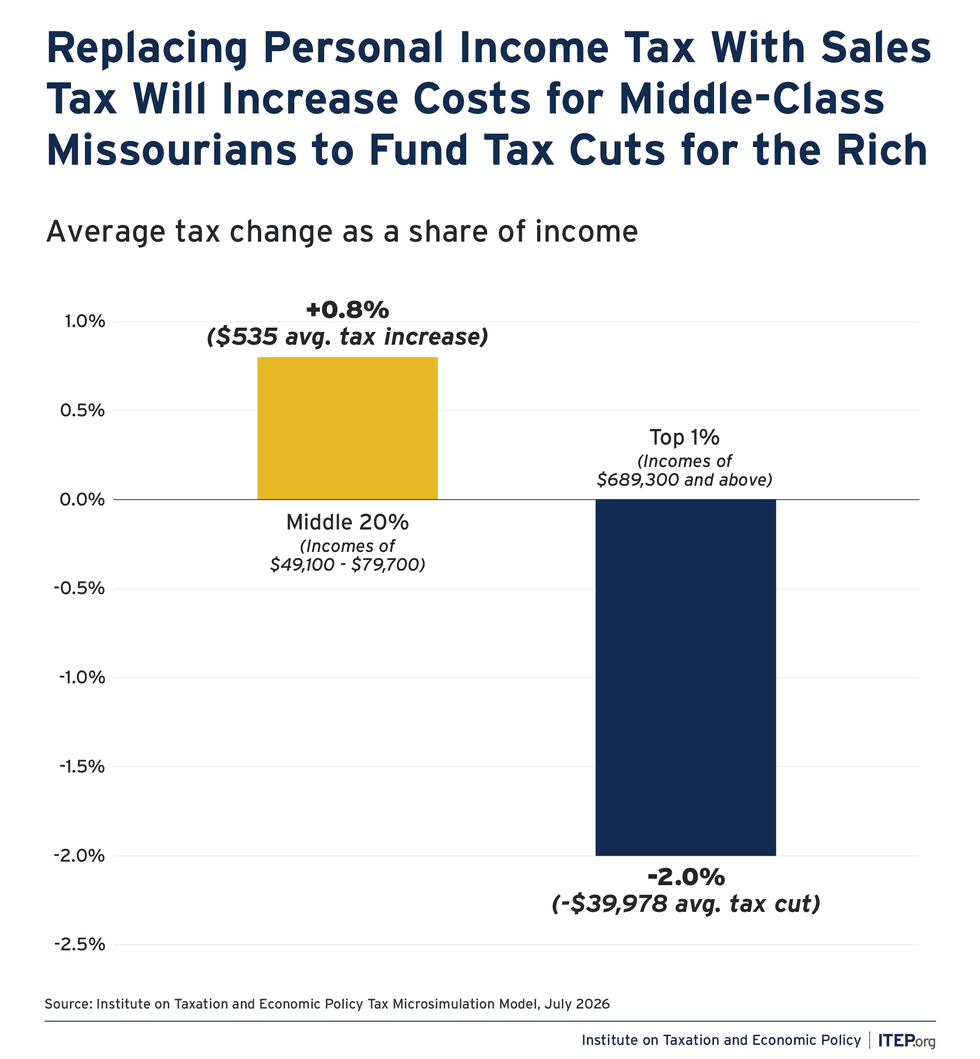
The brief also highlights that "neither the Missouri Legislature nor governor has explained exactly how they will expand sales taxes if it passes. They might increase the sales tax rate, or they might expand the sales tax to include purchases of services that are not currently taxed, such as home repair and insurance, car repair and financing, personal care services such as hair or nail care, or medical services. Taxing these items will cost middle-income households a larger share of their incomes than higher-income households, but middle-income families will not get a commensurate benefit from the income tax elimination."
"For senior citizens, active-duty military families, and military retirees, the impact would be even worse," the report continues. "That's because Social Security benefits, active-duty military pay, and military pensions are already exempt from Missouri income tax, so households for whom those are the sole source of income would get no benefit from Amendment 5. For a middle-class Missourian earning between $49,100 and $79,700, this would mean an increase of $1,600 in taxes every year. Overall, seniors alone would see a net tax increase of about $335 million and each pay $365 more, on average, each year."
The brief bolsters the case for voters to say "No on 5," as Protect MO Taxpayers encourages. The "no" campaign's website warns that the amendment "hits seniors, retirees, veterans, and disabled persons hardest. Those on tight fixed incomes may not pay income tax on their limited income, but they will certainly be hurt by higher sales taxes on goods they buy every day, such as groceries, medicine, and gas, and services they use every day, from haircuts to car repairs to healthcare and housing."
"Amendment 5 hits working families hardest of all, with higher sales and use taxes estimated by the nonpartisan Missouri Budget Project to cost the average Missouri family about $500 more in taxes per year overall," Protect MO Taxpayers' site says, also pointing to concerns that it will "increase the tough economic times in rural Missouri" and "make the economic struggle even harder for small businesses."
The proposal "is a severe hit for renters who are already struggling to make ends meet," and "crushes the dreams of Missourians who want to buy or sell a home," the site adds. "Amendment 5 hits active-duty military, who do not pay state income tax but will face higher prices off the base with sales taxes that could roughly triple. This will mean less retail business and economic harm in our neighboring military host communities."
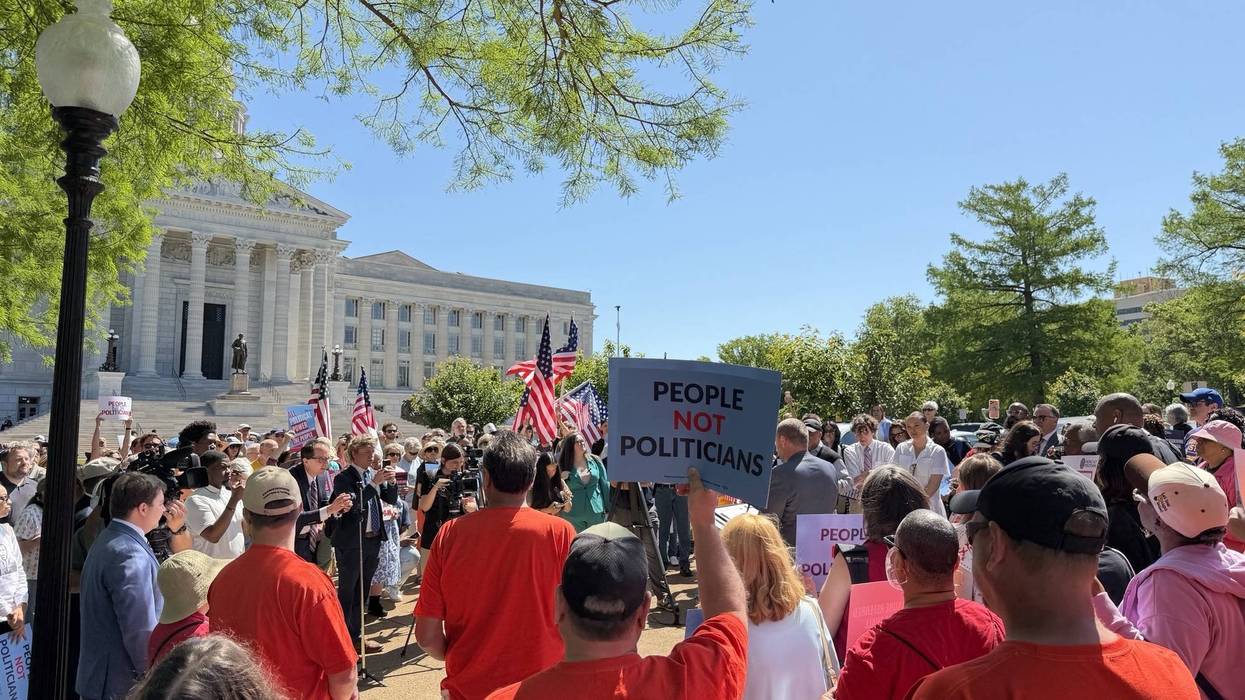
"MAGA loyalists are using every lever they control, from legislatures to courts, to rig the system and lock voters out of fair representation," said the National Democratic Redistricting Committee.
While five Republican South Carolina senators joined Democrats in blocking a GOP effort to advance President Donald Trump's national gerrymandering push in the state on Tuesday, the Missouri Supreme Court handed him a key win, approving a rigged congressional map forced through last year.
"MAGA loyalists are using every lever they control, from legislatures to courts, to rig the system and lock voters out of fair representation," said the National Democratic Redistricting Committee after Missouri's top court rejected multiple challenges to the map that targets the 5th Congressional District, currently represented by Democratic Rep. Emanuel Cleaver.
In one consolidated case, the court found that opponents of the map failed to show that it "clearly and undoubtedly violates the requirements of Article III, Section 45 of the Missouri Constitution."
Marina Jenkins, executive director of the National Redistricting Foundation, said in a statement that "the arguments in this case, which were presented before the Missouri Supreme Court just this morning, took less than an hour and elicited zero questions from the court for the lawyers for either the plaintiffs or defendants."
"While one might be inclined to hope that these justices managed to grapple with a highly complex, nuanced, and consequential issue in just six hours, it seems clear the justices were not interested in the day's proceedings and simply had their opinion already finalized even before this morning's argument," Jenkins continued. "With this decision, the Missouri Supreme Court has shown Missourians the lack of seriousness with which it takes cases that pertain to protecting their right to vote—a complete and dangerous abdication of the judiciary's role."
Another case stems from a political group that has collected signatures to force a referendum vote on the state's redistricting. The court found that the filing did not automatically suspend the map under the state constitution.
As KOMU reported Tuesday, People Not Politicians Missouri has submitted over 300,000 signatures to Secretary of State Denny Hoskins, but the Republican has not yet said whether his office will approve or reject its inclusion on the ballot.
"The secretary of state's own data confirms what more than 305,000 Missourians already made clear: This referendum is sufficient, and the people have a right to vote," Richard von Glahn, executive director of People Not Politicians Missouri, said in the statement after the state court's decisions on Tuesday.
"Today's ruling from the Supreme Court confirms this fact. A sufficient petition suspends the law the day it is turned in," he continued. "Unnecessary delays by politicians do not change this fact. If he continues to delay, then he is moving forward under a map that has been suspended by the people."
Missouri Republicans won’t stop trying to illegally rig our maps. We collected 305,968 signatures to put their rigged map to a vote of the people, and they still refuse to do their job.So my name is Laura, and I’m here to bully my government. #FairMaps #Missouri #moleg
[image or embed]
— Laura Burkhardt (@lauraannstl.bsky.social) May 12, 2026 at 12:04 PM
Meanwhile, in South Carolina—a state already known for Republican map-rigging—the state Senate voted 29-17, two votes short of the two-thirds majority needed to move forward on redistricting to help the GOP, despite Trump's public call to "GET IT DONE!"
Welcoming the result, the state's Senate Democrats said that it "sent a clear message that South Carolina should not be dragged into another unnecessary and divisive redistricting battle driven by Washington insiders."
"South Carolina rejected a politically motivated power grab orchestrated by a White House shaped by perpetually online New York City activists with little understanding of South Carolina," the Senate Democrats continued. "The people of this state expect us to focus on the real issues affecting their daily lives, not carry out an outside political agenda."
They pledged that "Senate Democrats will continue fighting for fair representation, transparency, and a government focused on the needs of South Carolina families rather than national political gamesmanship."
While the Republican-led Indiana state Senate similarly rejected a Trump-backed gerrymander last December, GOP legislators in Florida, North Carolina, Missouri, Tennessee, and Texas have caved to pressure from the president and enacted new maps ahead of November's midterm elections, in which Democrats hope to claim majorities in both chambers of Congress.
Tennessee's redistricting came after the right-wing US Supreme Court last month found that Louisiana's map was an "unconstitutional racial gerrymander" and gutted what remained of Section 2 of the Voting Rights Act. The nation's top court on Monday also paved a path for Alabama lawmakers to break up their state’s majority-Black district.
In response to GOP attacks on voting rights across the South, "All Roads Lead to the South," the No Kings coalition, community members, faith leaders, and other organizations are planning demonstrations at the Alabama State Capitol in Montgomery as well as Selma's Edmund Pettus Bridge on Saturday, May 16, with solidarity actions across the country.
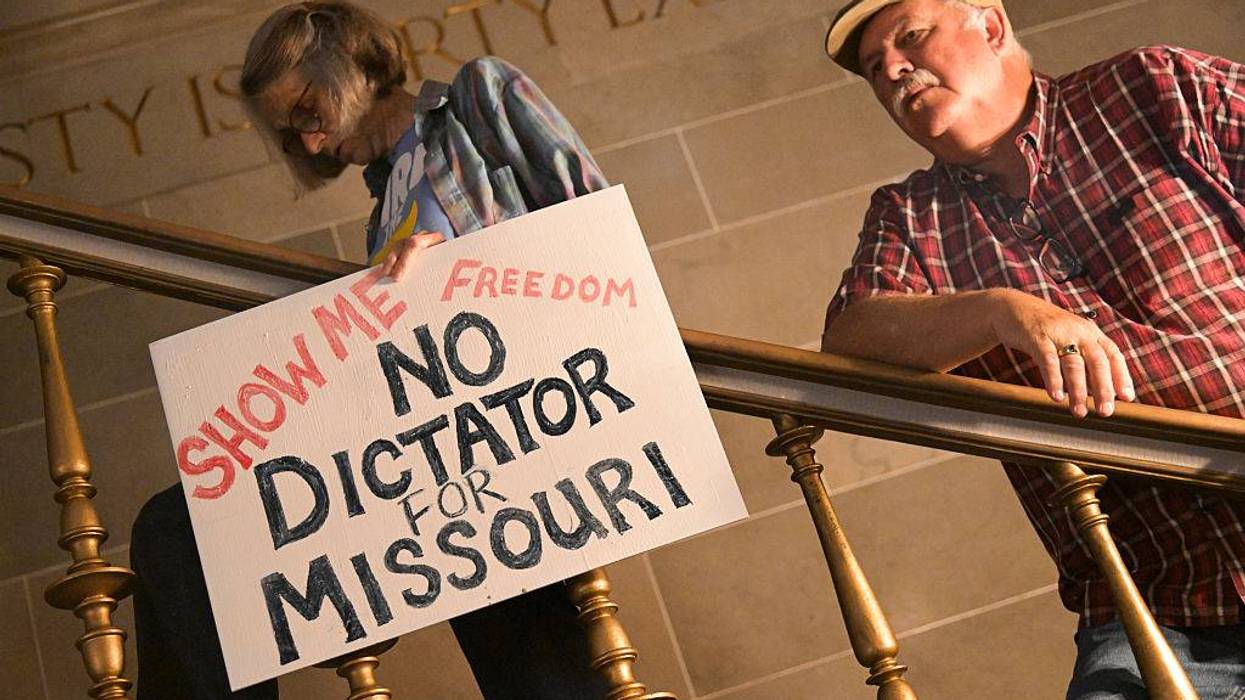
"What voters are saying now is that democracy is sacred."
Organizers in Missouri on Sunday said they reached an important milestone in a campaign to put a constitutional amendment on the ballot this year that would stop Republican officials in the state from trying to sabotage ballot initiatives.
Respect Missouri Voters, a coalition aimed at protecting and strengthening the state's ballot initiative process, announced that it has delivered more than 367,000 signatures to the Missouri Secretary of State's office in favor of a constitutional amendment that enact two key policies to protect voter-passed laws.
First, as the Fairness Project summarized on Monday, it would "require that all future ballot measures in the state be summarized for voters in fair, clear, and easily understandable terms"; and second, it would demand "that any attempt by the Legislature to refer a voter-approved measure back to the ballot clear an 80% threshold in each chamber, a high bar designed to prevent politicians from undoing what voters have already decided."
The first part of the amendment is aimed at addressing problems created by Republican Missouri Secretary of State Denny Hoskins, who has repeatedly been taken to court for writing ballot initiative summaries that advocates say are misleading or provide incomplete information about what the initiatives would do.
As the Missouri Independent reported in February, a total of five summaries written by Hoskins have been thrown out by courts since October, as "judges at every level of Missouri’s court system have stepped in to block or rewrite ballot language" drafted by the secretary of state.
The second part of the amendment, meanwhile, was written in response to Republican legislators' efforts to overturn ballot initiatives passed in 2024 that legalized abortion in Missouri and established mandatory paid sick leave.
Kelly Hall, executive director of the Fairness Project, a key backer of Respect Missouri Voters, said the gathering of more than 367,000 signatures is "a promising milestone for Missouri voters and for direct democracy."
"Perhaps more than in any other state, voters in Missouri understand what is at stake,” Hall added. "It’s in Missouri that extremist politicians have worked overtime to undermine the will of their voters, whether it’s been fighting to reinstate a wildly unpopular ban on access to abortion care, gerrymandering congressional districts, or undermining the ballot measure process. What voters are saying now is that democracy is sacred."
However, it's not just Missouri where direct democracy is under attack. The Fairness Project reported last September that “extremist” legislators across the United States “escalated their efforts to dismantle the ballot measure process in 2025 by 95%.”