SUBSCRIBE TO OUR FREE NEWSLETTER
Daily news & progressive opinion—funded by the people, not the corporations—delivered straight to your inbox.
5
#000000
#FFFFFF
To donate by check, phone, or other method, see our More Ways to Give page.
Daily news & progressive opinion—funded by the people, not the corporations—delivered straight to your inbox.
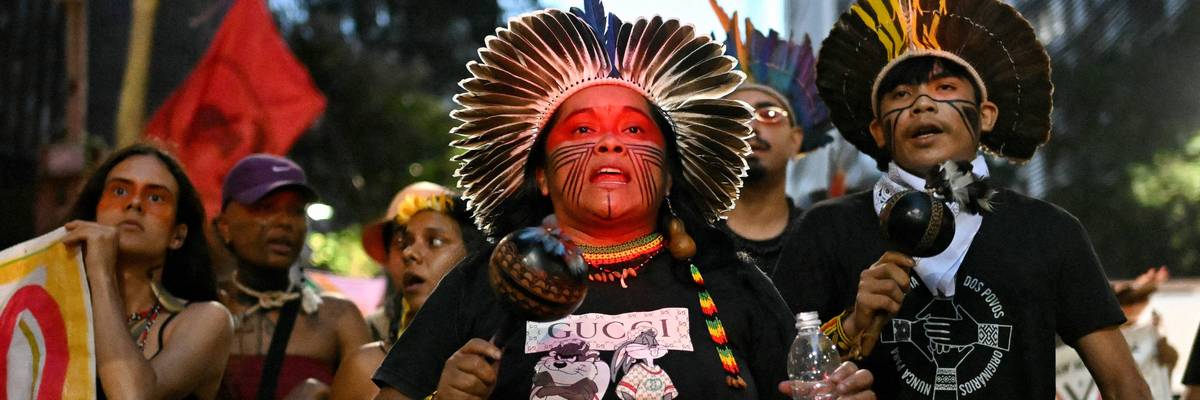
People take part in a protest calling for the demarcation and protection of Indigenous lands, in Rio de Janeiro, on November 4, 2026.
Brazilian President Luiz Inácio Lula da Silva is moving to demarcate scores of Indigenous territories by the end of the year—but many say the government needs to act faster amid deadly attacks.
A tribal leader from Brazil stressed on Monday, the opening day of the United Nations Climate Change Conference in Türkiye, that protecting Indigenous lands is a critical part of tackling the climate emergency, remarks that came as Brazil's government advances a plan to demarcate dozens of Indigenous territories amid surging violence against native people.
Joziléia Kaingang, co-founder and executive director of the National Network of Indigenous Women Warriors of Ancestral Wisdom (ANMIGA), told attendees of a session in COP31's Brazil Pavilion in Antalya that there are no real climate solutions without Indigenous participation.
"This means a very simple thing for us Indigenous peoples, something that our grandmothers have been saying for a long time and have known for a long time. Protecting Indigenous territory is indeed a climate policy," said Kaingang, who is a member of the Kaingang people of southern Brazil. "It is not charity, it is not compensation, it is a solution."
Kaingang hailed progress under the government of Brazilian President Luiz Inácio Lula da Silva, who was reelected last month with the support of 608 of the country's 658 Indigenous polling places. Lula's overwhelming support from Indigenous Brazilians is in no small part due to his government's substantial—yet tenuous—progress against illegal mining, logging, and other invasions of tribal lands.
Lula's policies marked a sharp reversal from former far-right President Jair Bolsonaro's deliberate dismantling of Indigenous territorial protections and other actions that lived up to his self-bestowed "Captain Chainsaw" moniker.
"The state withdrew invaders from our lands," Kaingang said. "The forest breathes again from the action of the last government of President Lula, and will continue to do so in this presidency in the next four years."
Kaingang continued:
In the Yanomami territory... 98% of illegal mining fell. This is important for all of us. Indigenous lands and local communities keep about a third of the carbon that humanity cannot lose.
And we want to say that we, Indigenous peoples, are here to celebrate the Brazilian government. We want to advance the roadmap to stop and reverse deforestation and forest degradation by 2030. But it is necessary that the roadmap brings the perspective of Indigenous peoples, of traditional communities, of our knowledge.
"Let's reaffirm that without demarcation, there is no climate solution," Kaingang added. "So let's keep demarcating the Indigenous territories so that we are the solution."
Brazil's government is preparing to approve dozens of additional Indigenous land demarcations before the end of 2026, Indigenous Peoples Minister Eloy Terena, who is a member of the Terena people, told Brasil de Fato on Sunday, as native communities face continuing deadly violence, land invasions, and encroachment by agribusiness interests.
During Lula’s third term, Brazil's government has recognized 20 Indigenous lands, declared 21 others, and established 31 reserves, according to the minister.
However, recent Indigenous land demarcation protests across Brazil have decried the government's failure to move faster in recognizing and protecting Indigenous territories amid ongoing violence.
Terena linked recent attacks against Guarani Kaiowá communities in Mato Grosso do Sul—including reported murders, vehicle attacks, and threats to poison drinking water—to the government's failure to secure their ancestral territories. He said that more than 150 technical working groups are advancing demarcation procedures, but warned that executive action alone cannot overcome entrenched political and judicial resistance, which is sustained by pressure from agribusiness and other destructive interests.
The minister added that the government seeks "to strengthen Indigenous organizations, the Indigenous movement, and communities. Because we understand that if eventually the democratic winds turn, we need to have a very committed society and very well-structured social movements."
This country and this world are at a monumental crossroads. US voters have an opportunity to beat back the forces of fascism and confront the billionaires who are rigging the economy, our media system, and our democracy, making it increasingly impossible for ordinary people to get by. We’re not just talking about the election. We’re talking about what must be done once these fascist elements are vanquished from power. We need a bolder set of solutions than what either major party has so far been willing to offer and a working-class movement ready to fight like hell for it. Trump didn't emerge from nowhere. The conditions that fueled MAGA authoritarianism were created by decades of radical neoliberal economic policies and a corrupt political system dominated by corporate interests. They slashed taxes on the super-rich, promising that the benefits would trickle down. They said giveaways to the corporate titans would make life more affordable for the rest of us. It was all bullshit. And when a bitter, betrayed populace searches for someone to blame, right-wing demagogues have little trouble finding scapegoats. People know when they're being lied to, but you won't hear any of this from the corporate media. Only independent journalism—powered and funded by people who believe in building a better world—can deliver truly trustworthy daily news. If you share our vision, please contribute whatever you can to sustain our work. |
A tribal leader from Brazil stressed on Monday, the opening day of the United Nations Climate Change Conference in Türkiye, that protecting Indigenous lands is a critical part of tackling the climate emergency, remarks that came as Brazil's government advances a plan to demarcate dozens of Indigenous territories amid surging violence against native people.
Joziléia Kaingang, co-founder and executive director of the National Network of Indigenous Women Warriors of Ancestral Wisdom (ANMIGA), told attendees of a session in COP31's Brazil Pavilion in Antalya that there are no real climate solutions without Indigenous participation.
"This means a very simple thing for us Indigenous peoples, something that our grandmothers have been saying for a long time and have known for a long time. Protecting Indigenous territory is indeed a climate policy," said Kaingang, who is a member of the Kaingang people of southern Brazil. "It is not charity, it is not compensation, it is a solution."
Kaingang hailed progress under the government of Brazilian President Luiz Inácio Lula da Silva, who was reelected last month with the support of 608 of the country's 658 Indigenous polling places. Lula's overwhelming support from Indigenous Brazilians is in no small part due to his government's substantial—yet tenuous—progress against illegal mining, logging, and other invasions of tribal lands.
Lula's policies marked a sharp reversal from former far-right President Jair Bolsonaro's deliberate dismantling of Indigenous territorial protections and other actions that lived up to his self-bestowed "Captain Chainsaw" moniker.
"The state withdrew invaders from our lands," Kaingang said. "The forest breathes again from the action of the last government of President Lula, and will continue to do so in this presidency in the next four years."
Kaingang continued:
In the Yanomami territory... 98% of illegal mining fell. This is important for all of us. Indigenous lands and local communities keep about a third of the carbon that humanity cannot lose.
And we want to say that we, Indigenous peoples, are here to celebrate the Brazilian government. We want to advance the roadmap to stop and reverse deforestation and forest degradation by 2030. But it is necessary that the roadmap brings the perspective of Indigenous peoples, of traditional communities, of our knowledge.
"Let's reaffirm that without demarcation, there is no climate solution," Kaingang added. "So let's keep demarcating the Indigenous territories so that we are the solution."
Brazil's government is preparing to approve dozens of additional Indigenous land demarcations before the end of 2026, Indigenous Peoples Minister Eloy Terena, who is a member of the Terena people, told Brasil de Fato on Sunday, as native communities face continuing deadly violence, land invasions, and encroachment by agribusiness interests.
During Lula’s third term, Brazil's government has recognized 20 Indigenous lands, declared 21 others, and established 31 reserves, according to the minister.
However, recent Indigenous land demarcation protests across Brazil have decried the government's failure to move faster in recognizing and protecting Indigenous territories amid ongoing violence.
Terena linked recent attacks against Guarani Kaiowá communities in Mato Grosso do Sul—including reported murders, vehicle attacks, and threats to poison drinking water—to the government's failure to secure their ancestral territories. He said that more than 150 technical working groups are advancing demarcation procedures, but warned that executive action alone cannot overcome entrenched political and judicial resistance, which is sustained by pressure from agribusiness and other destructive interests.
The minister added that the government seeks "to strengthen Indigenous organizations, the Indigenous movement, and communities. Because we understand that if eventually the democratic winds turn, we need to have a very committed society and very well-structured social movements."