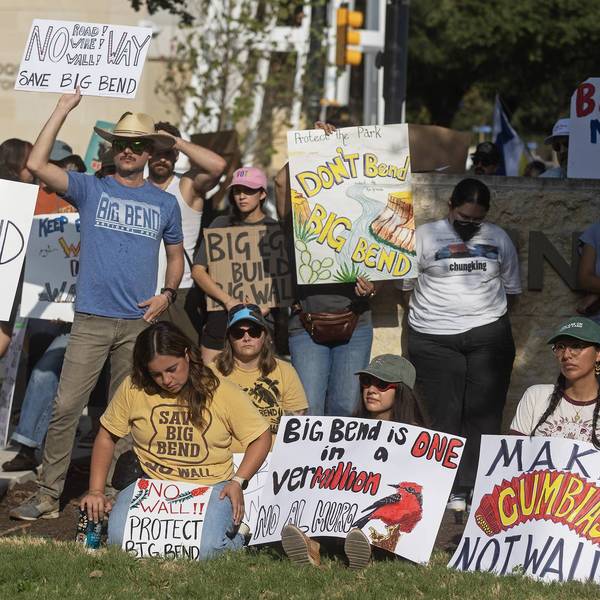
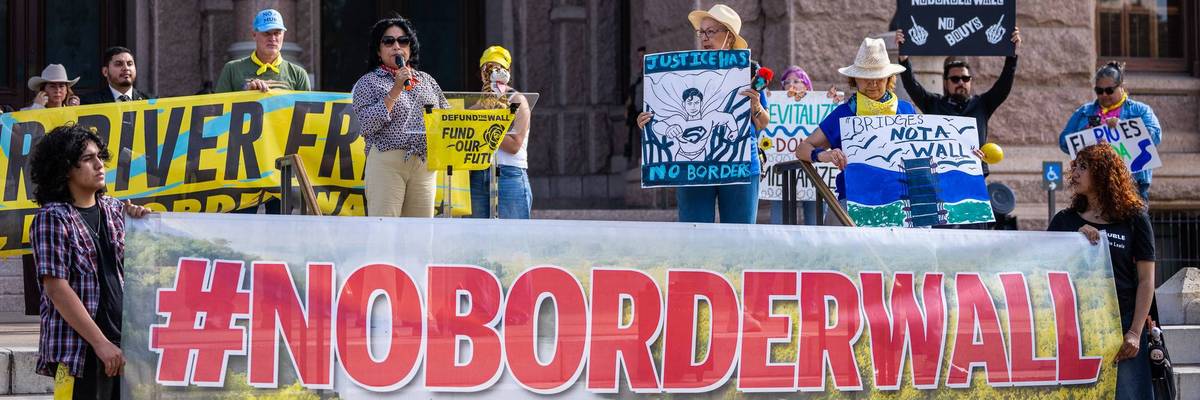
Gloria Galindo, from Friends of the Wildlife Corridor and Friends of Salineño, speaks at a rally against continued border wall expansion in the Big Bend region, hosted by the Texas Says No Border Wall coalition at the Texas State Capitol in Austin, on May 19, 2026.
Trump Admin Waives Environmental Laws for Border Barrier Construction in National Park
“These horrific plans are an affront to the millions of Americans who treasure Big Bend,” said one conservationist. “Politicians who’ve never set foot here are signing a death warrant for this wild and beautiful place.”
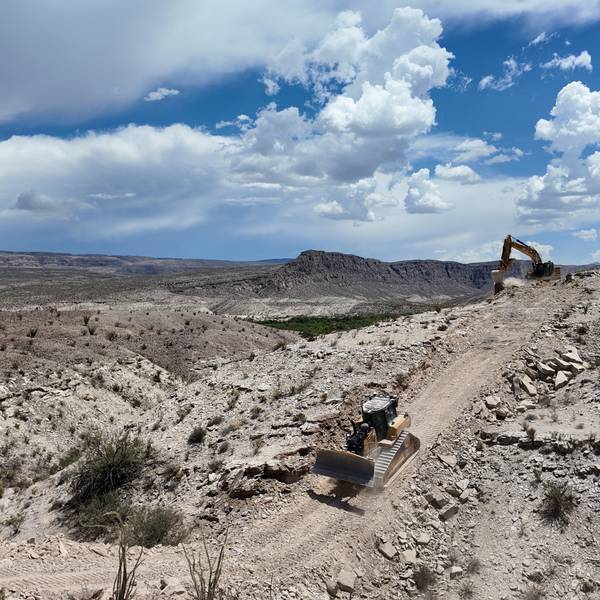
The Trump administration's revised waiver of dozens of environmental laws to expedite the construction of border roads and barriers through Big Bend National Park in southern Texas is set to take effect Tuesday, over the objection of Indigenous, migrant rights, and environmental groups.
Last month, the US Department of Homeland Security (DHS) initially published its determination that waivers from laws—including the National Park Service Organic Act, Endangered Species Act, and National Wild and Scenic Rivers Act—are needed "to ensure the expeditious construction of barriers and roads in the vicinity of the international land border in the state of Texas."
However, DHS said the project area description in its original notice of determination was "incorrect" and issued a revised notice with the correct geographical information, set to be published on Tuesday.
“The absolute disdain this administration has for our national parks is disgraceful, and now they’re targeting Texas’ most beloved national park,” Center for Biological Diversity national public lands advocate Laiken Jordahl said in a statement Monday.
“The only people benefiting from this destruction are the billionaire contractors set to pad their pockets while paving over our natural heritage and permanently locking a great American river behind hideous steel barriers," Jordahl added. "We won’t stop fighting for this crown-jewel national park and the Rio Grande.”
As CBD noted, DHS in May awarded $1.7 billion in contracts that include work on a "border wall through Big Bend.” Former Homeland Security Secretary Kristi Noem personally approved two contracts for SLSCO Ltd., a Texas-based company also under contract for the infamous Alligator Alcatraz camp for immigrants in Florida. The company is a major Republican donor and is accused in court of trafficking people and weapons across the border.
Last week, DHS awarded another $2.6 billion contract—the biggest border deal to date—for the Lower Canyons stretch of the portion of the Rio Grande that has "Wild and Scenic River" protections, and is downstream from the national park.
While running for president in 2016 and during his first term, Trump repeatedly vowed that Mexico would pay for the wall, for which US taxpayers and private donors have footed the bill. Only a small fraction of the wall has been completed.
While much of the border barrier consists of a 30-foot reinforced steel-bollard wall, the 118-mile portion of the Rio Grande running through Big Bend National Park currently has mostly natural barriers like the rivers, deep riparian canyons, mountains, other steep terrain, and the unforgiving Chihuahuan Desert.
Planning documents and maps from earlier this year suggested substantial border wall construction in the broader Big Bend region. Amid public outcry and opposition from politicians from across the political spectrum, US Customs and Border Protection (CBP) published a map showing no planned 30-foot wall inside Big Bend National Park. However, the map shows miles of planned barriers meant to stop vehicles but not people on foot, new patrol roads cut through the park, and more surveillance technology.
"The move marks the first time in American history that the federal government has cast aside a broad slate of environmental laws... in a national park," CBD said Monday.
Considerable ambiguity remains over the precise nature of the border barrier through Big Bend National Park. In April, CBD filed a lawsuit under the Freedom of Information Act "to obtain public records about construction plans in the area."
Indigenous peoples and their advocates have also opposed expanding the border barrier and have criticized DHS for waiving laws, including the Native American Graves Protection and Repatriation Act and the Archaeological and Historic Preservation Act, to enable the administration's plans.
David Keller, a noted archaeologist in the region, warned in a February interview with Big Bend Reporter that what he called “the military industrialization of one of the last, great, unspoiled places remaining in the United States of America" threatens millennia of Indigenous history stored in the soil and etched on rock faces.
The Trump administration's work on other portions of the border wall has blasted and bulldozed sacred Indigenous sites.
Late last month, seven former Big Bend National Park superintendents wrote to DHS Secretary Marywayne Mullin, urging him to reject the waiver of federal laws. CBD and over 130 advocacy groups and business2es have also called on Congress to block federal funding for any further border wall construction in the region, including Big Bend National Park and Big Bend Ranch State Park.
"If a border wall—or other unnecessary and highly destructive border infrastructure—is built inside Big Bend National Park, it would be the most egregious assault on the integrity of the entire National Park System since the construction of a dam in the Hetchy Hetchy Valley in Yosemite National Park more than a century ago," the former superintendents asserted.
Texas Public Radio reported Sunday that construction on the border wall in the Big Bend area is set to begin "within weeks."
"Shipments of what appear to be steel bollards have begun arriving in the region, and at least one 'man camp' housing facility for workers is being developed," the outlet said.
As the No Big Bend Wall Coalition notes, while CBP's Big Bend Sector represents 26.5% of the US-Mexico border, only about 1.3% of all border apprehensions happened there last year, belying Trump administration claims of "high illegal activity" in the area.
"Historically, the Big Bend Sector is the quietest part of the entire US border," the coalition said. "While federal rhetoric has described a 'national emergency' to justify waiving environmental protections and seizing private land, their own CBP data tells a different story."
We are at a crossroads
This country and this world are at a monumental crossroads. In a few short weeks, US voters will have an opportunity to beat back the forces of fascism and confront the billionaires who are rigging the economy, our media system, and our democracy, making it increasingly impossible for ordinary people to get by. We’re not just talking about the election. We’re talking about what must be done once these fascist elements are vanquished from power. We need a bolder set of solutions than what either major party has so far been willing to offer and a working-class movement ready to fight like hell for it. Trump didn't emerge from nowhere. The conditions that fueled MAGA authoritarianism were created by decades of radical neoliberal economic policies and a corrupt political system dominated by corporate interests. They slashed taxes on the super-rich, promising that the benefits would trickle down. They said giveaways to the corporate titans would make life more affordable for the rest of us. It was all bullshit. And when a bitter, betrayed populace searches for someone to blame, right-wing demagogues have little trouble finding scapegoats. People know when they're being lied to, but you won't hear any of this from the corporate media. Only independent journalism—powered and funded by people who believe in building a better world—can deliver truly trustworthy daily news. Our Fall Campaign is underway, and we need your help. To power our newsroom through the rest of the year, we need to raise $125,000 by midnight on October 31. So if you share our vision, please contribute whatever you can to sustain our work. |
The Trump administration's revised waiver of dozens of environmental laws to expedite the construction of border roads and barriers through Big Bend National Park in southern Texas is set to take effect Tuesday, over the objection of Indigenous, migrant rights, and environmental groups.
Last month, the US Department of Homeland Security (DHS) initially published its determination that waivers from laws—including the National Park Service Organic Act, Endangered Species Act, and National Wild and Scenic Rivers Act—are needed "to ensure the expeditious construction of barriers and roads in the vicinity of the international land border in the state of Texas."
However, DHS said the project area description in its original notice of determination was "incorrect" and issued a revised notice with the correct geographical information, set to be published on Tuesday.
“The absolute disdain this administration has for our national parks is disgraceful, and now they’re targeting Texas’ most beloved national park,” Center for Biological Diversity national public lands advocate Laiken Jordahl said in a statement Monday.
“The only people benefiting from this destruction are the billionaire contractors set to pad their pockets while paving over our natural heritage and permanently locking a great American river behind hideous steel barriers," Jordahl added. "We won’t stop fighting for this crown-jewel national park and the Rio Grande.”
As CBD noted, DHS in May awarded $1.7 billion in contracts that include work on a "border wall through Big Bend.” Former Homeland Security Secretary Kristi Noem personally approved two contracts for SLSCO Ltd., a Texas-based company also under contract for the infamous Alligator Alcatraz camp for immigrants in Florida. The company is a major Republican donor and is accused in court of trafficking people and weapons across the border.
Last week, DHS awarded another $2.6 billion contract—the biggest border deal to date—for the Lower Canyons stretch of the portion of the Rio Grande that has "Wild and Scenic River" protections, and is downstream from the national park.
While running for president in 2016 and during his first term, Trump repeatedly vowed that Mexico would pay for the wall, for which US taxpayers and private donors have footed the bill. Only a small fraction of the wall has been completed.
While much of the border barrier consists of a 30-foot reinforced steel-bollard wall, the 118-mile portion of the Rio Grande running through Big Bend National Park currently has mostly natural barriers like the rivers, deep riparian canyons, mountains, other steep terrain, and the unforgiving Chihuahuan Desert.
Planning documents and maps from earlier this year suggested substantial border wall construction in the broader Big Bend region. Amid public outcry and opposition from politicians from across the political spectrum, US Customs and Border Protection (CBP) published a map showing no planned 30-foot wall inside Big Bend National Park. However, the map shows miles of planned barriers meant to stop vehicles but not people on foot, new patrol roads cut through the park, and more surveillance technology.
"The move marks the first time in American history that the federal government has cast aside a broad slate of environmental laws... in a national park," CBD said Monday.
Considerable ambiguity remains over the precise nature of the border barrier through Big Bend National Park. In April, CBD filed a lawsuit under the Freedom of Information Act "to obtain public records about construction plans in the area."
Indigenous peoples and their advocates have also opposed expanding the border barrier and have criticized DHS for waiving laws, including the Native American Graves Protection and Repatriation Act and the Archaeological and Historic Preservation Act, to enable the administration's plans.
David Keller, a noted archaeologist in the region, warned in a February interview with Big Bend Reporter that what he called “the military industrialization of one of the last, great, unspoiled places remaining in the United States of America" threatens millennia of Indigenous history stored in the soil and etched on rock faces.
The Trump administration's work on other portions of the border wall has blasted and bulldozed sacred Indigenous sites.
Late last month, seven former Big Bend National Park superintendents wrote to DHS Secretary Marywayne Mullin, urging him to reject the waiver of federal laws. CBD and over 130 advocacy groups and business2es have also called on Congress to block federal funding for any further border wall construction in the region, including Big Bend National Park and Big Bend Ranch State Park.
"If a border wall—or other unnecessary and highly destructive border infrastructure—is built inside Big Bend National Park, it would be the most egregious assault on the integrity of the entire National Park System since the construction of a dam in the Hetchy Hetchy Valley in Yosemite National Park more than a century ago," the former superintendents asserted.
Texas Public Radio reported Sunday that construction on the border wall in the Big Bend area is set to begin "within weeks."
"Shipments of what appear to be steel bollards have begun arriving in the region, and at least one 'man camp' housing facility for workers is being developed," the outlet said.
As the No Big Bend Wall Coalition notes, while CBP's Big Bend Sector represents 26.5% of the US-Mexico border, only about 1.3% of all border apprehensions happened there last year, belying Trump administration claims of "high illegal activity" in the area.
"Historically, the Big Bend Sector is the quietest part of the entire US border," the coalition said. "While federal rhetoric has described a 'national emergency' to justify waiving environmental protections and seizing private land, their own CBP data tells a different story."
- 'Hell No,' Say Critics as Trump's Megabill Poised to Drastically Expand ICE's Dragnet ›
- Trump's Border Wall Isn't Just an Assault on Native Americans, It's an Assault on American History ›
- 'Devastating to Watch': Texas Democrats Condemn Destruction of Big Bend for Trump Border Wall | Common Dreams ›
- Amid Outrage, Trump Border Chief Halts Construction in Big Bend National Park | Common Dreams ›
- Don't Just Pause Trump Border Construction in Big Bend National Park, Say Conservationists, End It | Common Dreams ›
- Texas Landowners Challenge 'Legally and Factually Unsound' Trump Rationale for Big Bend Border Barrier | Common Dreams ›
- Conservationists Vow Court Fight as DHS Lifts Pause on Big Bend Border Construction | Common Dreams ›
The Trump administration's revised waiver of dozens of environmental laws to expedite the construction of border roads and barriers through Big Bend National Park in southern Texas is set to take effect Tuesday, over the objection of Indigenous, migrant rights, and environmental groups.
Last month, the US Department of Homeland Security (DHS) initially published its determination that waivers from laws—including the National Park Service Organic Act, Endangered Species Act, and National Wild and Scenic Rivers Act—are needed "to ensure the expeditious construction of barriers and roads in the vicinity of the international land border in the state of Texas."
However, DHS said the project area description in its original notice of determination was "incorrect" and issued a revised notice with the correct geographical information, set to be published on Tuesday.
“The absolute disdain this administration has for our national parks is disgraceful, and now they’re targeting Texas’ most beloved national park,” Center for Biological Diversity national public lands advocate Laiken Jordahl said in a statement Monday.
“The only people benefiting from this destruction are the billionaire contractors set to pad their pockets while paving over our natural heritage and permanently locking a great American river behind hideous steel barriers," Jordahl added. "We won’t stop fighting for this crown-jewel national park and the Rio Grande.”
As CBD noted, DHS in May awarded $1.7 billion in contracts that include work on a "border wall through Big Bend.” Former Homeland Security Secretary Kristi Noem personally approved two contracts for SLSCO Ltd., a Texas-based company also under contract for the infamous Alligator Alcatraz camp for immigrants in Florida. The company is a major Republican donor and is accused in court of trafficking people and weapons across the border.
Last week, DHS awarded another $2.6 billion contract—the biggest border deal to date—for the Lower Canyons stretch of the portion of the Rio Grande that has "Wild and Scenic River" protections, and is downstream from the national park.
While running for president in 2016 and during his first term, Trump repeatedly vowed that Mexico would pay for the wall, for which US taxpayers and private donors have footed the bill. Only a small fraction of the wall has been completed.
While much of the border barrier consists of a 30-foot reinforced steel-bollard wall, the 118-mile portion of the Rio Grande running through Big Bend National Park currently has mostly natural barriers like the rivers, deep riparian canyons, mountains, other steep terrain, and the unforgiving Chihuahuan Desert.
Planning documents and maps from earlier this year suggested substantial border wall construction in the broader Big Bend region. Amid public outcry and opposition from politicians from across the political spectrum, US Customs and Border Protection (CBP) published a map showing no planned 30-foot wall inside Big Bend National Park. However, the map shows miles of planned barriers meant to stop vehicles but not people on foot, new patrol roads cut through the park, and more surveillance technology.
"The move marks the first time in American history that the federal government has cast aside a broad slate of environmental laws... in a national park," CBD said Monday.
Considerable ambiguity remains over the precise nature of the border barrier through Big Bend National Park. In April, CBD filed a lawsuit under the Freedom of Information Act "to obtain public records about construction plans in the area."
Indigenous peoples and their advocates have also opposed expanding the border barrier and have criticized DHS for waiving laws, including the Native American Graves Protection and Repatriation Act and the Archaeological and Historic Preservation Act, to enable the administration's plans.
David Keller, a noted archaeologist in the region, warned in a February interview with Big Bend Reporter that what he called “the military industrialization of one of the last, great, unspoiled places remaining in the United States of America" threatens millennia of Indigenous history stored in the soil and etched on rock faces.
The Trump administration's work on other portions of the border wall has blasted and bulldozed sacred Indigenous sites.
Late last month, seven former Big Bend National Park superintendents wrote to DHS Secretary Marywayne Mullin, urging him to reject the waiver of federal laws. CBD and over 130 advocacy groups and business2es have also called on Congress to block federal funding for any further border wall construction in the region, including Big Bend National Park and Big Bend Ranch State Park.
"If a border wall—or other unnecessary and highly destructive border infrastructure—is built inside Big Bend National Park, it would be the most egregious assault on the integrity of the entire National Park System since the construction of a dam in the Hetchy Hetchy Valley in Yosemite National Park more than a century ago," the former superintendents asserted.
Texas Public Radio reported Sunday that construction on the border wall in the Big Bend area is set to begin "within weeks."
"Shipments of what appear to be steel bollards have begun arriving in the region, and at least one 'man camp' housing facility for workers is being developed," the outlet said.
As the No Big Bend Wall Coalition notes, while CBP's Big Bend Sector represents 26.5% of the US-Mexico border, only about 1.3% of all border apprehensions happened there last year, belying Trump administration claims of "high illegal activity" in the area.
"Historically, the Big Bend Sector is the quietest part of the entire US border," the coalition said. "While federal rhetoric has described a 'national emergency' to justify waiving environmental protections and seizing private land, their own CBP data tells a different story."
- 'Hell No,' Say Critics as Trump's Megabill Poised to Drastically Expand ICE's Dragnet ›
- Trump's Border Wall Isn't Just an Assault on Native Americans, It's an Assault on American History ›
- 'Devastating to Watch': Texas Democrats Condemn Destruction of Big Bend for Trump Border Wall | Common Dreams ›
- Amid Outrage, Trump Border Chief Halts Construction in Big Bend National Park | Common Dreams ›
- Don't Just Pause Trump Border Construction in Big Bend National Park, Say Conservationists, End It | Common Dreams ›
- Texas Landowners Challenge 'Legally and Factually Unsound' Trump Rationale for Big Bend Border Barrier | Common Dreams ›
- Conservationists Vow Court Fight as DHS Lifts Pause on Big Bend Border Construction | Common Dreams ›