SUBSCRIBE TO OUR FREE NEWSLETTER
Daily news & progressive opinion—funded by the people, not the corporations—delivered straight to your inbox.
5
#000000
#FFFFFF
To donate by check, phone, or other method, see our More Ways to Give page.
Daily news & progressive opinion—funded by the people, not the corporations—delivered straight to your inbox.
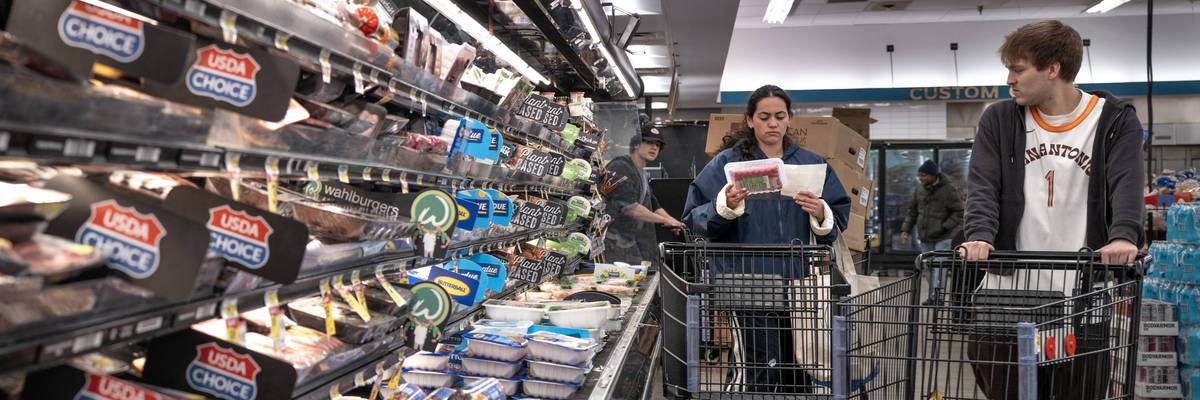
Consumers shop for meat on May 22, 2026 in Chicago, Illinois.
"Meanwhile, Trump wants to hike military spending to $1.5 trillion a year," said one observer.
Days after President Donald Trump made his latest dismissive remark about the cost of living and Americans' struggles to afford housing, new polling released Tuesday finds that nearly the entire voting public views the US as facing an affordability crisis and are increasingly pessimistic that the economy—and working people—will recover.
The Harris Poll, conducted on behalf of The Guardian newspaper, found that 57% of respondents believe the economy is still getting worse for Americans even after the US and Iran signed a peace deal last month to end the conflict started in February by the Trump administration and Israel—a war that sent oil prices soaring.
The average price of gas in the US is still $3.79 per gallon, despite the fact that Brent crude prices have fallen sharply.
Across party lines, about half of respondents said they are struggling to afford basic items like gas and groceries, and two-thirds of Americans, including nearly half of Republican voters, said they do not believe the Trump administration will improve the affordability crisis.
The poll was taken nearly a week after Trump, who ran on lowering costs for Americans, refused to sign affordable housing legislation, calling the bipartisan bill "a big yawn."
In May, as the administration was negotiating an end to the Iran War, Trump said that he did not “think about Americans’ financial situation,” even as the Middle East conflict he and Israel started hit family budgets hard.
A month earlier, he said the federal government "can’t take care of daycare" and healthcare programs for Americans, because it was focused on one thing and one thing only: "military protection."
According to the new survey, gas is at the top of the list of expenses that Americans are struggling to afford, with 52% saying they are having trouble keeping up with the cost. More than half of respondents also reported having trouble affording groceries, and 46% said they are struggling to make their loan payments and pay for utilities.
Trump ended the Biden administration's Saving on a Valuable Education (SAVE) program, terminating the income-based student loan repayment plan for millions of borrowers. A report by Democrats on the Joint Economic Committee in March also found that the average utility bill was up by $110, or 6.4%, over last year, following the Republican Party's elimination of tax credits for solar and wind power and as Trump pushed for the unregulated expansion of energy-sucking artificial intelligence data centers, despite warnings that they would drive up household utility bills.
The president's tariffs and his refusal to take on corporate consolidation in the meatpacking industry have also contributed to high grocery prices, recent analyses have found.
The Harris Poll found that 57% of Americans believe the economy is steadily getting worse, compared with 46% who said so in February. Just 16% said the economy is getting stronger, and only 27% of Republicans said the same. In February, 49% of Republican voters reported a positive outlook on the economy.
The survey also found that 54% of respondents said neither the Republican Party nor the Democratic Party has a solution to the growing affordability crisis.
However, the poll was taken on the heels of several electoral victories by progressive and democratic socialist candidates who have centered the needs of working families, demanded that billionaires pay their fair share in taxes, and called for Medicare for All and universal childcare—programs that would be similar to ones that are commonplace in other wealthy countries.
In New York City, Mayor Zohran Mamdani, a democratic socialist, has made strides toward a universal childcare program, a wealth tax, and a rent freeze for rent-stabilized housing units to address the economic inequality and cost-of-living crises.
On Monday, Trump claimed that "a social Democrat is a communist," in an apparent reference to democratic socialists like Mamdani and US House candidates Melat Kiros in Colorado's 1st District, Claire Valdez in New York's 7th District, and Darializa Avila Chevalier in New York's 13th District.
"If you look at the people that are running, it's crazy what they're doing," said Trump. "But we'll never let that happen to this country... There's no appetite for it."
But in The New York Times on Tuesday, Lindsay Owens of the progressive think tank Groundwork Collaborative suggested the recent elections prove there is, in fact, an "appetite" for candidates who recognize the affordability crisis, and prioritize solutions.
“The economic populist moment is here," she said.
Dear Common Dreams reader, It’s been nearly 30 years since I co-founded Common Dreams with my late wife, Lina Newhouser. We had the radical notion that journalism should serve the public good, not corporate profits. It was clear to us from the outset what it would take to build such a project. No paid advertisements. No corporate sponsors. No millionaire publisher telling us what to think or do. Many people said we wouldn't last a year, but we proved those doubters wrong. Together with a tremendous team of journalists and dedicated staff, we built an independent media outlet free from the constraints of profits and corporate control. Our mission has always been simple: To inform. To inspire. To ignite change for the common good. Building Common Dreams was not easy. Our survival was never guaranteed. When you take on the most powerful forces—Wall Street greed, fossil fuel industry destruction, Big Tech lobbyists, and uber-rich oligarchs who have spent billions upon billions rigging the economy and democracy in their favor—the only bulwark you have is supporters who believe in your work. But here’s the urgent message from me today. It's never been this bad out there. And it's never been this hard to keep us going. At the very moment Common Dreams is most needed, the threats we face are intensifying. We need your support now more than ever. We don't accept corporate advertising and never will. We don't have a paywall because we don't think people should be blocked from critical news based on their ability to pay. Everything we do is funded by the donations of readers like you. When everyone does the little they can afford, we are strong. But if that support retreats or dries up, so do we. Will you donate now to make sure Common Dreams not only survives but thrives? —Craig Brown, Co-founder |
Days after President Donald Trump made his latest dismissive remark about the cost of living and Americans' struggles to afford housing, new polling released Tuesday finds that nearly the entire voting public views the US as facing an affordability crisis and are increasingly pessimistic that the economy—and working people—will recover.
The Harris Poll, conducted on behalf of The Guardian newspaper, found that 57% of respondents believe the economy is still getting worse for Americans even after the US and Iran signed a peace deal last month to end the conflict started in February by the Trump administration and Israel—a war that sent oil prices soaring.
The average price of gas in the US is still $3.79 per gallon, despite the fact that Brent crude prices have fallen sharply.
Across party lines, about half of respondents said they are struggling to afford basic items like gas and groceries, and two-thirds of Americans, including nearly half of Republican voters, said they do not believe the Trump administration will improve the affordability crisis.
The poll was taken nearly a week after Trump, who ran on lowering costs for Americans, refused to sign affordable housing legislation, calling the bipartisan bill "a big yawn."
In May, as the administration was negotiating an end to the Iran War, Trump said that he did not “think about Americans’ financial situation,” even as the Middle East conflict he and Israel started hit family budgets hard.
A month earlier, he said the federal government "can’t take care of daycare" and healthcare programs for Americans, because it was focused on one thing and one thing only: "military protection."
According to the new survey, gas is at the top of the list of expenses that Americans are struggling to afford, with 52% saying they are having trouble keeping up with the cost. More than half of respondents also reported having trouble affording groceries, and 46% said they are struggling to make their loan payments and pay for utilities.
Trump ended the Biden administration's Saving on a Valuable Education (SAVE) program, terminating the income-based student loan repayment plan for millions of borrowers. A report by Democrats on the Joint Economic Committee in March also found that the average utility bill was up by $110, or 6.4%, over last year, following the Republican Party's elimination of tax credits for solar and wind power and as Trump pushed for the unregulated expansion of energy-sucking artificial intelligence data centers, despite warnings that they would drive up household utility bills.
The president's tariffs and his refusal to take on corporate consolidation in the meatpacking industry have also contributed to high grocery prices, recent analyses have found.
The Harris Poll found that 57% of Americans believe the economy is steadily getting worse, compared with 46% who said so in February. Just 16% said the economy is getting stronger, and only 27% of Republicans said the same. In February, 49% of Republican voters reported a positive outlook on the economy.
The survey also found that 54% of respondents said neither the Republican Party nor the Democratic Party has a solution to the growing affordability crisis.
However, the poll was taken on the heels of several electoral victories by progressive and democratic socialist candidates who have centered the needs of working families, demanded that billionaires pay their fair share in taxes, and called for Medicare for All and universal childcare—programs that would be similar to ones that are commonplace in other wealthy countries.
In New York City, Mayor Zohran Mamdani, a democratic socialist, has made strides toward a universal childcare program, a wealth tax, and a rent freeze for rent-stabilized housing units to address the economic inequality and cost-of-living crises.
On Monday, Trump claimed that "a social Democrat is a communist," in an apparent reference to democratic socialists like Mamdani and US House candidates Melat Kiros in Colorado's 1st District, Claire Valdez in New York's 7th District, and Darializa Avila Chevalier in New York's 13th District.
"If you look at the people that are running, it's crazy what they're doing," said Trump. "But we'll never let that happen to this country... There's no appetite for it."
But in The New York Times on Tuesday, Lindsay Owens of the progressive think tank Groundwork Collaborative suggested the recent elections prove there is, in fact, an "appetite" for candidates who recognize the affordability crisis, and prioritize solutions.
“The economic populist moment is here," she said.
Days after President Donald Trump made his latest dismissive remark about the cost of living and Americans' struggles to afford housing, new polling released Tuesday finds that nearly the entire voting public views the US as facing an affordability crisis and are increasingly pessimistic that the economy—and working people—will recover.
The Harris Poll, conducted on behalf of The Guardian newspaper, found that 57% of respondents believe the economy is still getting worse for Americans even after the US and Iran signed a peace deal last month to end the conflict started in February by the Trump administration and Israel—a war that sent oil prices soaring.
The average price of gas in the US is still $3.79 per gallon, despite the fact that Brent crude prices have fallen sharply.
Across party lines, about half of respondents said they are struggling to afford basic items like gas and groceries, and two-thirds of Americans, including nearly half of Republican voters, said they do not believe the Trump administration will improve the affordability crisis.
The poll was taken nearly a week after Trump, who ran on lowering costs for Americans, refused to sign affordable housing legislation, calling the bipartisan bill "a big yawn."
In May, as the administration was negotiating an end to the Iran War, Trump said that he did not “think about Americans’ financial situation,” even as the Middle East conflict he and Israel started hit family budgets hard.
A month earlier, he said the federal government "can’t take care of daycare" and healthcare programs for Americans, because it was focused on one thing and one thing only: "military protection."
According to the new survey, gas is at the top of the list of expenses that Americans are struggling to afford, with 52% saying they are having trouble keeping up with the cost. More than half of respondents also reported having trouble affording groceries, and 46% said they are struggling to make their loan payments and pay for utilities.
Trump ended the Biden administration's Saving on a Valuable Education (SAVE) program, terminating the income-based student loan repayment plan for millions of borrowers. A report by Democrats on the Joint Economic Committee in March also found that the average utility bill was up by $110, or 6.4%, over last year, following the Republican Party's elimination of tax credits for solar and wind power and as Trump pushed for the unregulated expansion of energy-sucking artificial intelligence data centers, despite warnings that they would drive up household utility bills.
The president's tariffs and his refusal to take on corporate consolidation in the meatpacking industry have also contributed to high grocery prices, recent analyses have found.
The Harris Poll found that 57% of Americans believe the economy is steadily getting worse, compared with 46% who said so in February. Just 16% said the economy is getting stronger, and only 27% of Republicans said the same. In February, 49% of Republican voters reported a positive outlook on the economy.
The survey also found that 54% of respondents said neither the Republican Party nor the Democratic Party has a solution to the growing affordability crisis.
However, the poll was taken on the heels of several electoral victories by progressive and democratic socialist candidates who have centered the needs of working families, demanded that billionaires pay their fair share in taxes, and called for Medicare for All and universal childcare—programs that would be similar to ones that are commonplace in other wealthy countries.
In New York City, Mayor Zohran Mamdani, a democratic socialist, has made strides toward a universal childcare program, a wealth tax, and a rent freeze for rent-stabilized housing units to address the economic inequality and cost-of-living crises.
On Monday, Trump claimed that "a social Democrat is a communist," in an apparent reference to democratic socialists like Mamdani and US House candidates Melat Kiros in Colorado's 1st District, Claire Valdez in New York's 7th District, and Darializa Avila Chevalier in New York's 13th District.
"If you look at the people that are running, it's crazy what they're doing," said Trump. "But we'll never let that happen to this country... There's no appetite for it."
But in The New York Times on Tuesday, Lindsay Owens of the progressive think tank Groundwork Collaborative suggested the recent elections prove there is, in fact, an "appetite" for candidates who recognize the affordability crisis, and prioritize solutions.
“The economic populist moment is here," she said.