SUBSCRIBE TO OUR FREE NEWSLETTER
Daily news & progressive opinion—funded by the people, not the corporations—delivered straight to your inbox.
5
#000000
#FFFFFF
To donate by check, phone, or other method, see our More Ways to Give page.


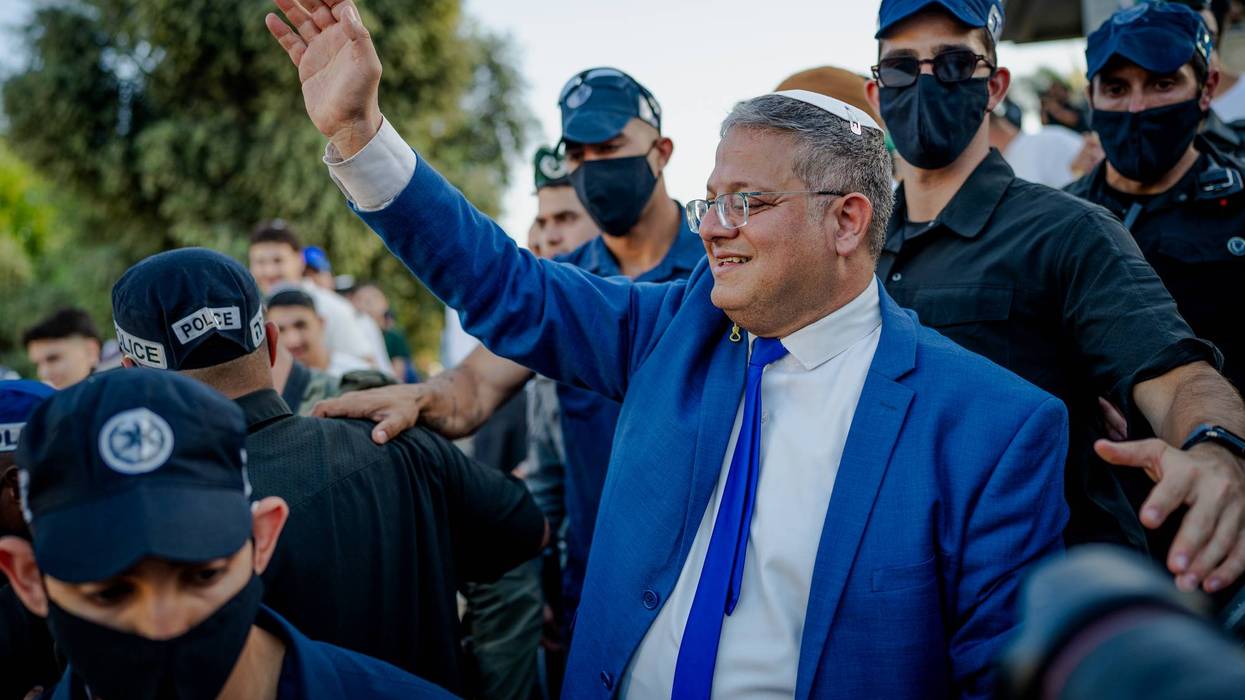
Israeli Environmental Minister Idit Silman signed a directive Wednesday reclassifying Nile crocodiles as "specially managed wild animals," a novel legal category enabling the government to keep them for security purposes.
Ben-Gvir, who heads the Israel Prison Service (IPS), said he was inspired by the Trump administration's recently closed Alligator Alcatraz immigrant detention center in Florida. He is seeking to first introduce crocodiles into a moat around Ketziot Prison in southern Israel.
While it is not certain that the plan will come to fruition, Ben-Gvir celebrated Silman's decree in a social media post showing him petting a crocodile, with the caption: "Cursed terrorist, thinking of trying to escape? Think again."
Palestinians have occasionally escaped from Israeli lockups, such as in September 2021, when six men used improvised tools, including spoons, to tunnel out of the high-security Gilboa Prison. All six escapees were caught within weeks.
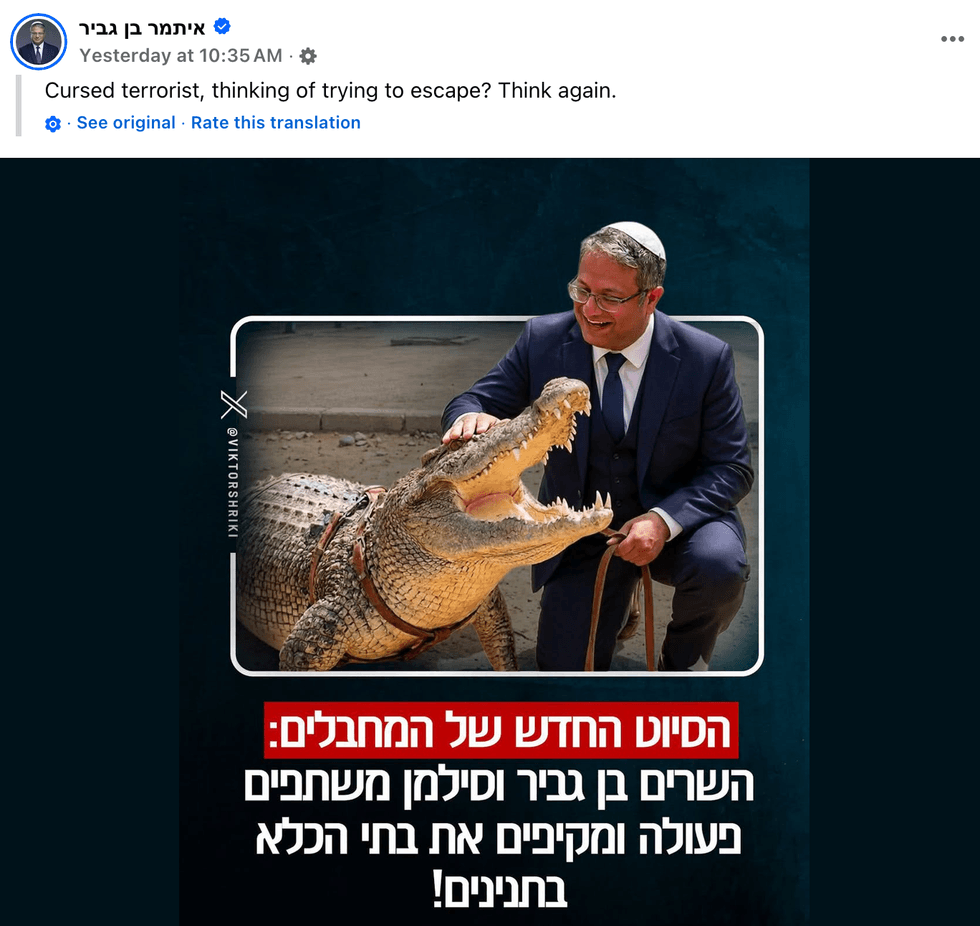 (Photo by Itamar Ben-Gvir/Facebook)
The move by Silman—who gained international notoriety by calling for the ethnic cleansing of all Palestinians from the Gaza Strip—came despite objections from her own ministry's legal adviser and the Nature and Parks Authority.
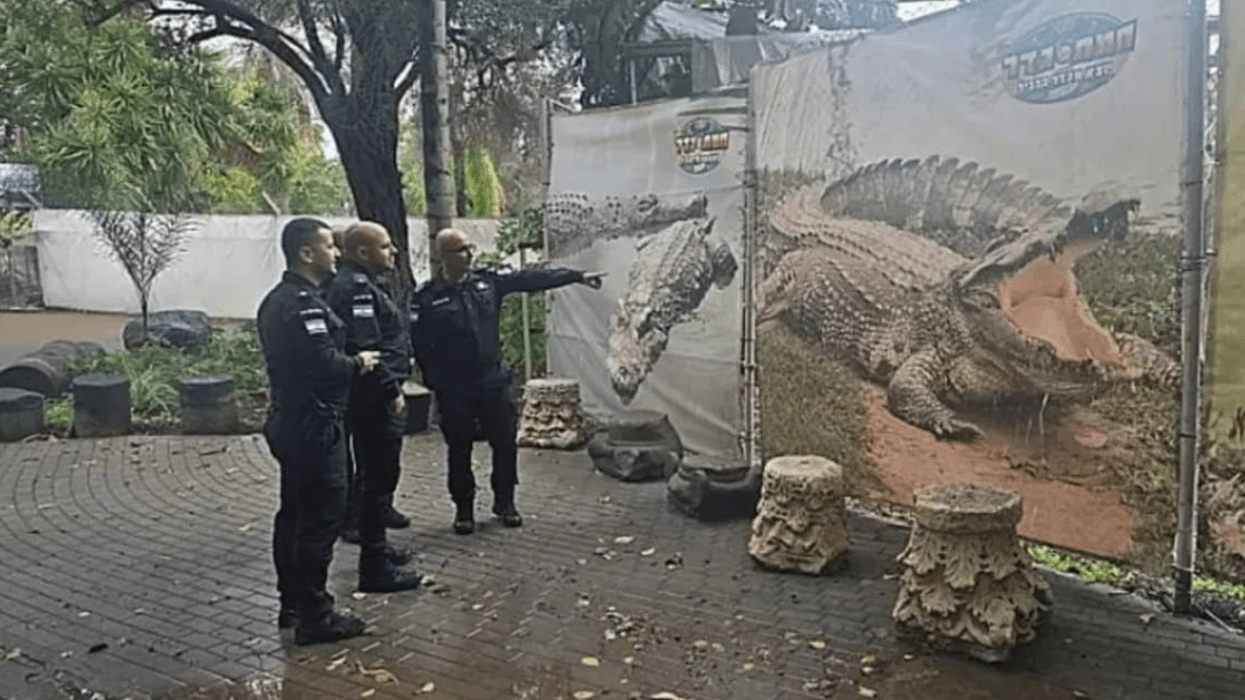
IPS, which sent a fact-finding mission to the Hamat Gader crocodile farm in January, argued that its employees could handle the animals, citing the agency's experience working with the attack dogs that Palestinian prisoners and human rights groups have claimed were used to maul and even sexually abuse detainees.
Silman's approval is contingent upon IPS meeting animal welfare requirements and appropriate holding conditions.
Meanwhile, Ben-Gvir has openly boasted about the dramatic deterioration in conditions endured by Palestinian prisoners since the Hamas-led attack of October 7, 2023 and Israel's retaliatory obliteration of Gaza, which United Nations and other experts describe as a genocide.
“We go into the prisons, and they wet themselves," Ben-Gvir said of Palestinian prisoners during a speech on Friday. "I'm not joking. They're afraid. Fear rules them, and that's how it should be.”
Ben-Gvir and other Israeli officials have worn noose lapel pins to celebrate a recently passed bill legalizing the execution by hanging of so-called "terrorists."
Former Palestinian detainees and Israeli personnel have described beatings, rape and sexual torture by male and female soldiers, routine amputations due to constant shackling, burnings, electrocutions, attacks by dogs, ice-water dousings, denial of food and water, sleep deprivation, constant loud music, and other abuse.
The Israeli military is investigating the deaths of dozens of detainees at the Sde Teiman prison in the Negev Desert, including one who died after allegedly being sodomized with an electric baton.
Ben-Gvir has defended Israeli reservists accused of torturing Palestinian prisoners, and called the reservists who allegedly gang-raped a man at Sde Teiman prison "heroes."
The minister is banned from entering a number of Western countries for his incitement to violence against Palestinians.
Several Israeli environmental groups issued a joint statement opposing the use of crocodiles in prisons.
"Crocodiles are sentient beings, with complex needs for space, water, temperature, and natural behavior," the groups said. "It is also highly doubtful that the crocodiles intended for this purpose have aggressive temperaments, and in any event, during the winter they slow their metabolism dramatically, become very sluggish, and stop eating.”
"Security should be achieved through real security measures, not through animals," they added. "We are considering filing a petition with the High Court of Justice over the matter.”
Last year, the Israeli military massacred 262 crocodiles that were being kept on a farm in the occupied West Bank near the illegal Israeli settler colony of Petzael, claiming the reptiles posed a risk to the public.
“They just slaughtered them," farm owner Danny Bitan told reporters at the time, describing the scene as "some kind of killing valley."
Ben-Gvir's plan comes amid ongoing slaughter in Gaza—where Israeli forces have killed more than 73,000 Palestinians, over 21,500 of them children, since October 2023—and accelerating colonization and ethnic cleansing in the West Bank.
News of Silman's approval sparked disbelief around the world and on social media, where Reddit users called the plan "cartoonish idiocy" and "Bond villain-level lunacy."
"The fact that Israel is trying to surround a prison with [crocodiles] tells you all you need to know about these camps, which are designed to torture, rape, and murder Palestinians, often held as hostages without charges," Israeli researcher and political commentator Shaiel Ben-Ephraim said Thursday on X.


As the Convoy grows, Stephen Miller fumes that claims of starvation in the Miller Strip are directed at him and are, therefore, antisemitic. He gloats that any protesters unlawfully gathering at the strip will be put in Alligator Alcatraz, which has been recently emptied, it’s prisoners sent to the strip. Department of Homeland Security insists that anyone truly concerned about conditions in the Miller Strip can make donations to an aid fund set up by the White House and administered by Barron Trump. His salary is undisclosed.
When the Convoy gets big enough that the media starts to pay attention, Trump says that the Convoy is a threat to national security, the rule of law, and his bid for a Nobel Prize.
Here’s a tip: If you have to keep telling people you’re the most moral army in the world—you ain’t.
Then, in the dark of night, in a MAGA-friendly rural county, 200 masked and heavily armed men in rental SUVs force much of the Convoy off the road. The men are never identified, but they are presumed to be ICE and private contractors. They trash the Convoy cars, slashing the tires, smashing the GPS systems and radios with rifle butts, and ripping the hoses and wires from the engines.
Most of the volunteers in those cars are taken away in trucks, beaten, sexually assaulted, and then released in a town so small it doesn’t even have a Greyhound stop. They are never charged or even given the identity of their attackers. On the night of the attack some are left without food or water or means of communication, out in the desert, in disabled cars. A couple of the Convoy organizers disappear into federal custody for questioning.
The Convoy manages to regroup, rescue their comrades left in the desert, and continue toward the Miller Strip. Then ICE and National Guard troops descend en masse on the Convoy. The participants in the Convoy are taken to a US Army base where they are charged with trespassing—trespassing on the very Army base where they were brought in zip ties.
Again, like the first attack, there are widespread beatings, repeated tasings, strip searches, and sexual assaults.
The Convoy cars are seized under civil forfeiture laws, the attorney general of the week alleging the cars were used in illegal activities to be named later. Trump, while climbing into a golf cart, is asked what laws were being broken to justify the seizure of the cars. He says only, “So sue me.”
Stephen Miller stages a photo op at the base, taunting the prisoners, screaming at them, calling them antisemites and communists. A few laugh at him, even though they are on their knees, their hands still zip-tied behind them. He has them dragged across the floor for individual abuse.
When Miller’s video goes viral a handful of news outlets feature it with reports of the violence against the Convoy volunteers. Climbing out of a golf cart, Trump is asked about the reports of violence and sexual assaults. He replies that he hardly knew Jeffrey Epstein and has the reporter who asked the question removed from the golf course.
Of course, this is satire. None of this has happened—yet. But this is exactly what Israel did to the Global Sumud Flotilla (GSF).
Israel attacked the Flotilla off Crete, in international waters, some 600 miles from Gaza and hundreds of miles from their self-declared, illegal exclusion zone. Israeli commandos attacked 22 boats, ripped up the engines, smashed the radios and navigation equipment, doing thousands of dollars of damage to privately owned boats that they had no legal authority to board. They took almost 200 hostages and left the boats disabled and adrift. At least one, Tam-Tam, was left adrift with a crew of seven stranded aboard. The hostages were beaten, some sexually assaulted, and then dumped ashore on Crete.
 (The Tam-Tam is seen on the dock in Barcelona before the mission. Photo by Mark Milinich)
The remaining boats of the flotilla scrambled to regroup, to reorganize the rigging, electrical, and engine teams who had been keeping the boats patched together. They searched for the disabled boats to take them in tow, but many are still adrift today, including Gotico, the boat I helped sail to Sicily. One of those ghost boats recently washed up on a beach near Alexandria. They did find Tam-Tam and rescue the crew.
The Flotilla limped into port in Türkiye. They made repairs, resupplied, got the volunteers onto working boats, and, undeterred and unbowed, headed back to sea with 58 boats.
And Israel attacked again—again in international waters hundreds of miles from Gaza, Israel, and Israel’s self-declared exclusion zone. This was another blatant act of piracy.
In Gaza and Lebanon, the Zionists found a garden and made a desert.
Again there were beatings and sexual assaults. There were broken bones and wounds from rubber bullets and tasers. Every one of the flotilla volunteers kidnapped by Israel suffered injuries, abuse, and violence at the hands of Israeli soldiers. At night, when the volunteers were forced to sleep on an open deck, the deck was flooded with several inches of cold sea water.
This from the self-described “most moral army in the world.”
Here’s a tip: If you have to keep telling people you’re the most moral army in the world—you ain’t.
Itamar Ben-Gvir, Israeli security minister, posted a video of his photo op with the kidnaped volunteers, haranguing people who were zip-tied and forced to their knees, having the thugs in his entourage beat a few, just for fun. He did the same thing last summer, with the hostages from the first GSF flotilla, but this time it got some media traction and Israeli Prime Minister Benjamin Netanyahu was forced to distance himself.
Netanyahu’s Captain Renault impression—I’m shocked, shocked to find that prisoner abuse is going on in here!—would be comical if it weren't part of an ongoing genocide.
On that note, the flotilla volunteers chose to join an act of political disobedience knowing that they would face Israeli violence—albeit minor when compared with the mass murder of Palestinians. The absolute arrogance that Israel showed, its contempt for maritime law, for the rights of property and persons to be protected from violence in international waters, is not minor. Agnes Callamard, head of Amnesty International, called Netanyahu, Trump, and Russian President Vladimir Putin “voracious predators” bringing us a world where “primitive ferocity could flourish.” She was not wrong.
Need I mention Trump and Netanyahu’s unprovoked war of choice on Iran? Thousands killed, massive destruction, global economic chaos, most of the world opposed but powerless to stop thugs who are undeterred by the United Nations Charter, or what Stephen Miller called the “international niceties” the world tried to build after the carnage of two world wars.
And as part of that war Israel chose to Gazafy southern Lebanon. They leveled towns, destroyed farms, and erased essential infrastructure. They even destroyed an entire forest with white phosphorus and bulldozers.
One of the foundational lies of Zionism is that they found a desert and built a garden. In reality the whole coastal zone of Palestine, including southern Lebanon and Gaza, was farmland long before the Zionists showed up.
In Gaza and Lebanon, the Zionists found a garden and made a desert.
But, Ben-Gvir is just getting started. He pushed for, and passed, a Palestinian-only death penalty law. On his 50th birthday his wife presented him with a cake with a hangman’s noose on it and the words, I’m told, “Sometimes dreams come true.” He wears a noose lapel pin. Even the Redeemer white governments that passed the Jim Crow laws weren’t that blatant; even the Ku Klux Klan wore hoods. Ben-Gvir grins like a game show contestant.
France has banned Ben-Gvir for his little stunt with the flotilla hostages, but Israeli clementines, from those stolen orchards, are in every market in Paris.
After the first death penalty was passed, the Knesset passed a special, retroactive death penalty for October 7 detainees. This second death penalty was passed 93-120, which interestingly, is very close to the 80-20 majority David Ben-Gurion wanted to achieve by ethnic cleansing when he sicced Irgun and Lehi on defenseless Palestinian villages—beginning in December 1947—six months before the UN Partition Plan was to take effect.
These death penalty laws relax the rules of evidence—rules that have been developed over hundreds of years to help insure fair trials—making it possible to make allegations in court that are not reliable evidence, that wouldn’t be allowed in fair trials. This is hardly necessary, since Israeli military courts already have a 99.74% conviction rate.
Relaxed rules of evidence make no sense until you factor in that the trials will be live streamed—show trials.
And what’s to point of a show trial? To put on a show.
What do they want to live stream that they couldn’t ordinarily put into a trial? I will hazard a guess.
In the first hours of October 7 Israeli first responders—to the cameras—told lurid tales of beheaded babies, babies strung up on clotheslines, and dismemberments. A doddering Joe Biden claimed to have seen pictures of beheaded babies, pictures that didn’t exist. The Israelis had learned well from the fantasist Nayirah al-Ṣabaḥ who claimed she was a volunteer nurse during the invasion of Kuwait and witnessed babies being taken out of incubators and left to die on the floor. Turns out she was the daughter of a Kuwaiti ambassador and all of it was a lie. But, a good lie will go viral around the world while the truth is still fact checking, and the Israelis know that.
Why repeat stories you can’t properly prove, over and over, in show trials? It seems Ben-Gvir and his 92 allies in the Knesset know that, if you repeat a lie often enough, people will believe it.
And after the show comes the executions. Pro forma appeals will be heard quickly by the same military tribunals that tried the cases; the laws mandate that execution, by hanging, will be within 90 days of conviction.
Get ready for a lot of hangings.
A large percentage of Israel’s exports in its first couple of years was citrus fruit, from existing orchards taken by force from the people who had planted and tended the trees for decades.
But this harvest, of Strange Fruit, will be solely the product of “galant” Israelis like Itaman Ben-Gvir.
For context I recommend the recording by Billie Holiday, but you might prefer Nina Simone.
So, when will it be enough? France has banned Ben-Gvir for his little stunt with the flotilla hostages, but Israeli clementines, from those stolen orchards, are in every market in Paris. Basically everyone who knows anything about genocide agrees Israel is committing genocide in Gaza. There is no point to repeat the numbers of dead, of amputations, of double-tap strikes on doctors and journalists. Everybody knows. But Israel is still allowed to spread their aggression to Iran and Lebanon and beyond.
When will it all be too much?
When will the conscience of the world grow beyond a few scruffy activists in beat-up sailboats, throwing themselves at the wall, again and again.
I guess the answer, my friend, is still blowing in the wind.