SUBSCRIBE TO OUR FREE NEWSLETTER
Daily news & progressive opinion—funded by the people, not the corporations—delivered straight to your inbox.
5
#000000
#FFFFFF
To donate by check, phone, or other method, see our More Ways to Give page.
Daily news & progressive opinion—funded by the people, not the corporations—delivered straight to your inbox.
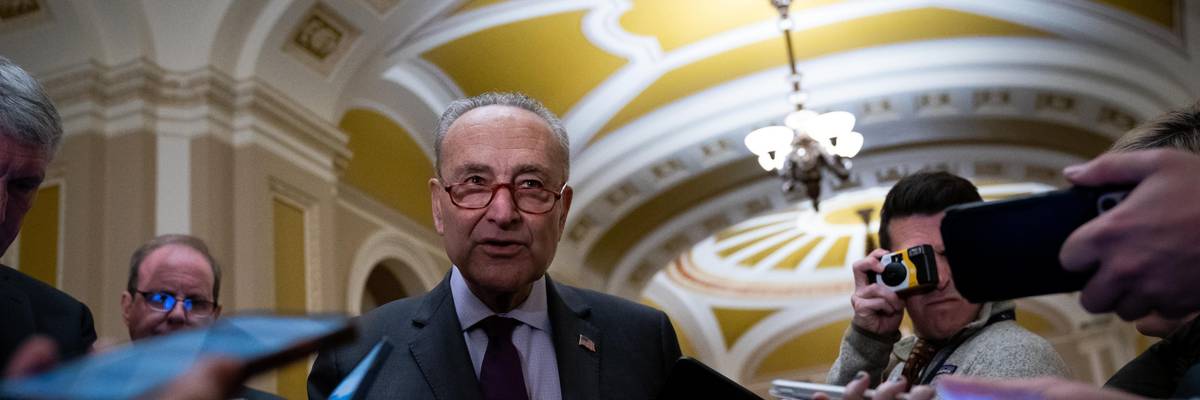
Senate Majority Leader Chuck Schumer (D-N.Y.) speaks to reporters after a meeting at the White House with congressional leaders and U.S. President Joe Biden on Capitol Hill in Washington, D.C. on November 29, 2022. (Photo: Elizabeth Frantz for The Washington Post via Getty Images)
Free press advocates this week urged people to contact Senate Majority Leader Chuck Schumer's office and ask the New York Democrat to pass legislation protecting journalists from government abuses during the closing days of the current Congress.
"Now is crunch time to make the PRESS Act the law of the land before this Congress adjourns."
"The time between an election and the inauguration of a new Congress--or the lame-duck, as it is affectionately known--is ironically a time when things can happen on the Hill, in part because departing members don't have to worry about reelection," Emily Hockett, a Technology Press Freedom Project fellow, wrote for the Reporters Committee for Freedom of the Press.
"This year, the Senate has a unique opportunity to pass a landmark federal shield bill that would protect journalists from being forced to disclose source information and work product to federal agencies and courts, with narrow exceptions," she continued.
"The PRESS Act has broad bipartisan support and is a reasonable, commonsense measure to protect the public's right to know," Hockett added. "That's why it passed the House unanimously, and why 49 states and the District of Columbia have similar protections. Your move, Senate."
Proposed in June 2021 by Sen. Ron Wyden (D-Ore.)--who noted former President Donald Trump's administration "spied on reporters it suspected of no crimes in its hunt to identify their sources and prevent the American people from learning the truth about Trump's lawlessness and corruption"--the Protect Reporters from Excessive State Suppression (PRESS) Act "would protect the free flow of information against government overreach."
"Specifically," said Wyden's office at the time, "the PRESS Act would shield journalists from court-ordered disclosure of information about a source and what the source told them unless disclosure of the protected information is necessary to prevent, or to identify any perpetrator of, an act of terrorism against the United States, or necessary to prevent the threat of imminent violence, significant bodily harm, or death."
Rep. Jamie Raskin's (D-Md.) House version of the PRESS Act passed in September with unanimous bipartisan support.
"Now is crunch time to make the PRESS Act the law of the land before this Congress adjourns," wrote Freedom of the Press Foundation director of advocacy Seth Stern on Wednesday. "Schumer now holds the keys to the bill's passage which is good news--Schumer has co-sponsored similar shield legislation in the past."
"We've previously explained that the PRESS Act is the most important free press legislation in modern times because it would finally stop the government from spying on journalists and threatening them with arrest for doing their jobs, except in real emergencies," he added. "Schumer can be a hero to journalists everywhere by pushing it through the Senate."
Shortly after the Senate bill's introduction, U.S. Attorney General Merrick Garland announced that the Department of Justice (DOJ) would end compulsory government seizures of information from journalists and other media professionals while promising to "further explain, develop, and codify" these protections. DOJ efforts to do so have largely been praised by press freedom advocates, with the caveat that reform work must continue.
In an opinion piece published earlier this week in the Chicago Sun-Times, John Cusack, an actor and founding member of the advocacy group Freedom of the Press Foundation, wrote that "for democracy to survive, journalists must be protected from government surveillance and shielded from harassment."
"We cannot allow the government to surveil journalists and expose sources--even the threat of which produces a chilling effect on the press," Cusack added, "if we expect journalists to expose corruption, speak truth to power, and print what the powerful don't want printed."
Dear Common Dreams reader, It’s been nearly 30 years since I co-founded Common Dreams with my late wife, Lina Newhouser. We had the radical notion that journalism should serve the public good, not corporate profits. It was clear to us from the outset what it would take to build such a project. No paid advertisements. No corporate sponsors. No millionaire publisher telling us what to think or do. Many people said we wouldn't last a year, but we proved those doubters wrong. Together with a tremendous team of journalists and dedicated staff, we built an independent media outlet free from the constraints of profits and corporate control. Our mission has always been simple: To inform. To inspire. To ignite change for the common good. Building Common Dreams was not easy. Our survival was never guaranteed. When you take on the most powerful forces—Wall Street greed, fossil fuel industry destruction, Big Tech lobbyists, and uber-rich oligarchs who have spent billions upon billions rigging the economy and democracy in their favor—the only bulwark you have is supporters who believe in your work. But here’s the urgent message from me today. It's never been this bad out there. And it's never been this hard to keep us going. At the very moment Common Dreams is most needed, the threats we face are intensifying. We need your support now more than ever. We don't accept corporate advertising and never will. We don't have a paywall because we don't think people should be blocked from critical news based on their ability to pay. Everything we do is funded by the donations of readers like you. When everyone does the little they can afford, we are strong. But if that support retreats or dries up, so do we. Will you donate now to make sure Common Dreams not only survives but thrives? —Craig Brown, Co-founder |
Free press advocates this week urged people to contact Senate Majority Leader Chuck Schumer's office and ask the New York Democrat to pass legislation protecting journalists from government abuses during the closing days of the current Congress.
"Now is crunch time to make the PRESS Act the law of the land before this Congress adjourns."
"The time between an election and the inauguration of a new Congress--or the lame-duck, as it is affectionately known--is ironically a time when things can happen on the Hill, in part because departing members don't have to worry about reelection," Emily Hockett, a Technology Press Freedom Project fellow, wrote for the Reporters Committee for Freedom of the Press.
"This year, the Senate has a unique opportunity to pass a landmark federal shield bill that would protect journalists from being forced to disclose source information and work product to federal agencies and courts, with narrow exceptions," she continued.
"The PRESS Act has broad bipartisan support and is a reasonable, commonsense measure to protect the public's right to know," Hockett added. "That's why it passed the House unanimously, and why 49 states and the District of Columbia have similar protections. Your move, Senate."
Proposed in June 2021 by Sen. Ron Wyden (D-Ore.)--who noted former President Donald Trump's administration "spied on reporters it suspected of no crimes in its hunt to identify their sources and prevent the American people from learning the truth about Trump's lawlessness and corruption"--the Protect Reporters from Excessive State Suppression (PRESS) Act "would protect the free flow of information against government overreach."
"Specifically," said Wyden's office at the time, "the PRESS Act would shield journalists from court-ordered disclosure of information about a source and what the source told them unless disclosure of the protected information is necessary to prevent, or to identify any perpetrator of, an act of terrorism against the United States, or necessary to prevent the threat of imminent violence, significant bodily harm, or death."
Rep. Jamie Raskin's (D-Md.) House version of the PRESS Act passed in September with unanimous bipartisan support.
"Now is crunch time to make the PRESS Act the law of the land before this Congress adjourns," wrote Freedom of the Press Foundation director of advocacy Seth Stern on Wednesday. "Schumer now holds the keys to the bill's passage which is good news--Schumer has co-sponsored similar shield legislation in the past."
"We've previously explained that the PRESS Act is the most important free press legislation in modern times because it would finally stop the government from spying on journalists and threatening them with arrest for doing their jobs, except in real emergencies," he added. "Schumer can be a hero to journalists everywhere by pushing it through the Senate."
Shortly after the Senate bill's introduction, U.S. Attorney General Merrick Garland announced that the Department of Justice (DOJ) would end compulsory government seizures of information from journalists and other media professionals while promising to "further explain, develop, and codify" these protections. DOJ efforts to do so have largely been praised by press freedom advocates, with the caveat that reform work must continue.
In an opinion piece published earlier this week in the Chicago Sun-Times, John Cusack, an actor and founding member of the advocacy group Freedom of the Press Foundation, wrote that "for democracy to survive, journalists must be protected from government surveillance and shielded from harassment."
"We cannot allow the government to surveil journalists and expose sources--even the threat of which produces a chilling effect on the press," Cusack added, "if we expect journalists to expose corruption, speak truth to power, and print what the powerful don't want printed."
Free press advocates this week urged people to contact Senate Majority Leader Chuck Schumer's office and ask the New York Democrat to pass legislation protecting journalists from government abuses during the closing days of the current Congress.
"Now is crunch time to make the PRESS Act the law of the land before this Congress adjourns."
"The time between an election and the inauguration of a new Congress--or the lame-duck, as it is affectionately known--is ironically a time when things can happen on the Hill, in part because departing members don't have to worry about reelection," Emily Hockett, a Technology Press Freedom Project fellow, wrote for the Reporters Committee for Freedom of the Press.
"This year, the Senate has a unique opportunity to pass a landmark federal shield bill that would protect journalists from being forced to disclose source information and work product to federal agencies and courts, with narrow exceptions," she continued.
"The PRESS Act has broad bipartisan support and is a reasonable, commonsense measure to protect the public's right to know," Hockett added. "That's why it passed the House unanimously, and why 49 states and the District of Columbia have similar protections. Your move, Senate."
Proposed in June 2021 by Sen. Ron Wyden (D-Ore.)--who noted former President Donald Trump's administration "spied on reporters it suspected of no crimes in its hunt to identify their sources and prevent the American people from learning the truth about Trump's lawlessness and corruption"--the Protect Reporters from Excessive State Suppression (PRESS) Act "would protect the free flow of information against government overreach."
"Specifically," said Wyden's office at the time, "the PRESS Act would shield journalists from court-ordered disclosure of information about a source and what the source told them unless disclosure of the protected information is necessary to prevent, or to identify any perpetrator of, an act of terrorism against the United States, or necessary to prevent the threat of imminent violence, significant bodily harm, or death."
Rep. Jamie Raskin's (D-Md.) House version of the PRESS Act passed in September with unanimous bipartisan support.
"Now is crunch time to make the PRESS Act the law of the land before this Congress adjourns," wrote Freedom of the Press Foundation director of advocacy Seth Stern on Wednesday. "Schumer now holds the keys to the bill's passage which is good news--Schumer has co-sponsored similar shield legislation in the past."
"We've previously explained that the PRESS Act is the most important free press legislation in modern times because it would finally stop the government from spying on journalists and threatening them with arrest for doing their jobs, except in real emergencies," he added. "Schumer can be a hero to journalists everywhere by pushing it through the Senate."
Shortly after the Senate bill's introduction, U.S. Attorney General Merrick Garland announced that the Department of Justice (DOJ) would end compulsory government seizures of information from journalists and other media professionals while promising to "further explain, develop, and codify" these protections. DOJ efforts to do so have largely been praised by press freedom advocates, with the caveat that reform work must continue.
In an opinion piece published earlier this week in the Chicago Sun-Times, John Cusack, an actor and founding member of the advocacy group Freedom of the Press Foundation, wrote that "for democracy to survive, journalists must be protected from government surveillance and shielded from harassment."
"We cannot allow the government to surveil journalists and expose sources--even the threat of which produces a chilling effect on the press," Cusack added, "if we expect journalists to expose corruption, speak truth to power, and print what the powerful don't want printed."