

SUBSCRIBE TO OUR FREE NEWSLETTER
Daily news & progressive opinion—funded by the people, not the corporations—delivered straight to your inbox.
5
#000000
#FFFFFF
To donate by check, phone, or other method, see our More Ways to Give page.
Daily news & progressive opinion—funded by the people, not the corporations—delivered straight to your inbox.
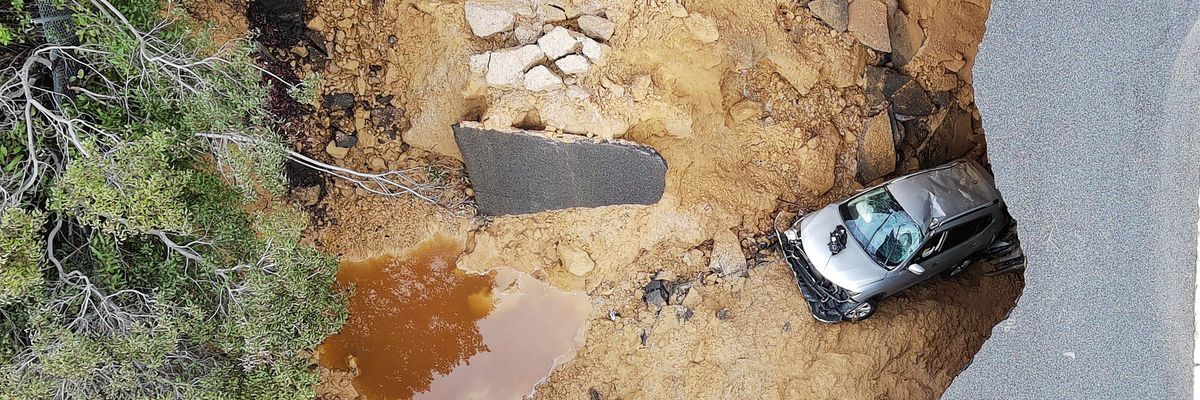
This aerial view shows cars in a large sinkhole that opened during a day of relentless rain in Los Angeles on January 10, 2023.
"Should U.S. and global policymakers fail to significantly ratchet up the ambition of existing climate policies they will all but guarantee irreversible tipping points will be exceeded," one scientist warned.
Multiple agencies concurred this week that 2022 was among the hottest years on record—a continuation of a dangerous trend that experts say underscores the need to move rapidly away from fossil fuels, the primary source of planet-heating pollution.
The World Meteorological Organization confirmed Thursday that last year was one of the hottest since record-keeping began. Citing its analysis of six international datasets, the WMO said that the average global temperature in 2022 was roughly 1.15°C above preindustrial (1850-1900) levels.
"The persistence of a cooling La Niña event" prevented 2022 from being even hotter, but "this cooling impact will be short-lived and will not reverse the long-term warming trend caused by record levels of heat-trapping greenhouse gases in our atmosphere," said the United Nations weather agency.
"These latest data are in line with long-term global warming trends that will continue to worsen unless heat-trapping emissions are slashed drastically—far more than what the United States and other major emitters are currently doing."
According to the U.S. government's National Aeronautics and Space Administration (NASA), last year was the fifth-warmest on record, while the National Oceanic and Atmospheric Administration (NOAA) labeled it the sixth-warmest.
More important than ranks, scientists say, is the fact that the past eight years were the hottest ever. As the WMO explained, "2022 is the eighth consecutive year (2015-2022) that annual global temperatures have reached at least 1°C above preindustrial levels."
Furthermore, each of the past four decades has been hotter than the one preceding it. "The 10-year average temperature for the period 2013-2022 is 1.14 [1.02 to 1.27]°C above the 1850-1900 preindustrial baseline," the WMO noted. "This compares with 1.09°C from 2011 to 2020, as estimated by the Intergovernmental Panel on Climate Change (IPCC) Sixth Assessment report."
Rachel Licker, a principal climate scientist with the Climate & Energy Program at the Union of Concerned Scientists, said in a statement that "these latest data are in line with long-term global warming trends that will continue to worsen unless heat-trapping emissions are slashed drastically—far more than what the United States and other major emitters are currently doing."
"People in the United States and around the world experienced heart-breaking devastation from the climate crisis over the last year as a result of record-breaking heatwaves, drought, storms, and wildfires," said Licker.
"Should U.S. and global policymakers fail to significantly ratchet up the ambition of existing climate policies they will all but guarantee irreversible tipping points will be exceeded," Licker continued. "In addition, more needs to be done to ensure people, economies, and ecosystems on the frontlines of the climate crisis receive adequate investments to shore up their resilience."
"We must do the hard but necessary work to secure a livable planet for all. Anything less is risking the lives and livelihoods of billions of people around the world."
Roughly 1.1°C of warming to date relative to the late 1800s has already unleashed increasingly frequent and intense extreme weather disasters across the globe.
Ahead of last November's COP27 climate summit—which ended, like the 26 meetings before it, with no concrete plan to rapidly move away from planet-wrecking fossil fuels—the U.N. warned that existing emissions reductions targets and policies are so inadequate that there is "no credible path" currently in place to achieve the Paris agreement's goal of limiting global warming to 1.5°C, beyond which impacts will grow increasingly deadly, particularly for the poorest members of humanity who bear the least responsibility for the climate crisis.
The U.N. made clear that only "urgent system-wide transformation" can prevent cataclysmic temperature rise of up to 2.9°C by 2100, but oil and gas corporations—bolstered by trillions of dollars in annual public subsidies—are still planning to expand fossil fuel production in the coming years, prioritizing profits over the lives of those who will be harmed by the ensuing climate chaos.
"Instead of caving to fossil fuel industry interests aimed at growing their profits, we need strong leaders willing to implement bold climate policies for the betterment of people and the planet," Licker said.
"Policymakers reluctant to move beyond incrementalism and companies engaging in greenwashing are—quite frankly—stealing the future that rightfully belongs to our children," she added. "The science is clear: Large-scale, transformative action is the only path forward."
Licker's message was echoed by Cherelle Blazer, senior director of the Sierra Club's International Climate and Policy Campaign.
"Again and again, the world's foremost scientists and experts are telling us that our planet is warming at an unprecedented rate and that the threat to our communities, homes, and lives will worsen without immediate action," said Blazer. "Yearslong droughts, deadly heatwaves, historic floods, superstorms, increased food insecurity, and record displacement are the daily reality for billions of people around the world."
"We have the tools and the scientific evidence we need to halt climate catastrophe, yet all too often we're still seeing business continuing as usual," Blazer added. "We are at a point in the climate crisis where we must do the hard but necessary work to secure a livable planet for all. Anything less is risking the lives and livelihoods of billions of people around the world."
Dear Common Dreams reader, It’s been nearly 30 years since I co-founded Common Dreams with my late wife, Lina Newhouser. We had the radical notion that journalism should serve the public good, not corporate profits. It was clear to us from the outset what it would take to build such a project. No paid advertisements. No corporate sponsors. No millionaire publisher telling us what to think or do. Many people said we wouldn't last a year, but we proved those doubters wrong. Together with a tremendous team of journalists and dedicated staff, we built an independent media outlet free from the constraints of profits and corporate control. Our mission has always been simple: To inform. To inspire. To ignite change for the common good. Building Common Dreams was not easy. Our survival was never guaranteed. When you take on the most powerful forces—Wall Street greed, fossil fuel industry destruction, Big Tech lobbyists, and uber-rich oligarchs who have spent billions upon billions rigging the economy and democracy in their favor—the only bulwark you have is supporters who believe in your work. But here’s the urgent message from me today. It's never been this bad out there. And it's never been this hard to keep us going. At the very moment Common Dreams is most needed, the threats we face are intensifying. We need your support now more than ever. We don't accept corporate advertising and never will. We don't have a paywall because we don't think people should be blocked from critical news based on their ability to pay. Everything we do is funded by the donations of readers like you. When everyone does the little they can afford, we are strong. But if that support retreats or dries up, so do we. Will you donate now to make sure Common Dreams not only survives but thrives? —Craig Brown, Co-founder |
Multiple agencies concurred this week that 2022 was among the hottest years on record—a continuation of a dangerous trend that experts say underscores the need to move rapidly away from fossil fuels, the primary source of planet-heating pollution.
The World Meteorological Organization confirmed Thursday that last year was one of the hottest since record-keeping began. Citing its analysis of six international datasets, the WMO said that the average global temperature in 2022 was roughly 1.15°C above preindustrial (1850-1900) levels.
"The persistence of a cooling La Niña event" prevented 2022 from being even hotter, but "this cooling impact will be short-lived and will not reverse the long-term warming trend caused by record levels of heat-trapping greenhouse gases in our atmosphere," said the United Nations weather agency.
"These latest data are in line with long-term global warming trends that will continue to worsen unless heat-trapping emissions are slashed drastically—far more than what the United States and other major emitters are currently doing."
According to the U.S. government's National Aeronautics and Space Administration (NASA), last year was the fifth-warmest on record, while the National Oceanic and Atmospheric Administration (NOAA) labeled it the sixth-warmest.
More important than ranks, scientists say, is the fact that the past eight years were the hottest ever. As the WMO explained, "2022 is the eighth consecutive year (2015-2022) that annual global temperatures have reached at least 1°C above preindustrial levels."
Furthermore, each of the past four decades has been hotter than the one preceding it. "The 10-year average temperature for the period 2013-2022 is 1.14 [1.02 to 1.27]°C above the 1850-1900 preindustrial baseline," the WMO noted. "This compares with 1.09°C from 2011 to 2020, as estimated by the Intergovernmental Panel on Climate Change (IPCC) Sixth Assessment report."
Rachel Licker, a principal climate scientist with the Climate & Energy Program at the Union of Concerned Scientists, said in a statement that "these latest data are in line with long-term global warming trends that will continue to worsen unless heat-trapping emissions are slashed drastically—far more than what the United States and other major emitters are currently doing."
"People in the United States and around the world experienced heart-breaking devastation from the climate crisis over the last year as a result of record-breaking heatwaves, drought, storms, and wildfires," said Licker.
"Should U.S. and global policymakers fail to significantly ratchet up the ambition of existing climate policies they will all but guarantee irreversible tipping points will be exceeded," Licker continued. "In addition, more needs to be done to ensure people, economies, and ecosystems on the frontlines of the climate crisis receive adequate investments to shore up their resilience."
"We must do the hard but necessary work to secure a livable planet for all. Anything less is risking the lives and livelihoods of billions of people around the world."
Roughly 1.1°C of warming to date relative to the late 1800s has already unleashed increasingly frequent and intense extreme weather disasters across the globe.
Ahead of last November's COP27 climate summit—which ended, like the 26 meetings before it, with no concrete plan to rapidly move away from planet-wrecking fossil fuels—the U.N. warned that existing emissions reductions targets and policies are so inadequate that there is "no credible path" currently in place to achieve the Paris agreement's goal of limiting global warming to 1.5°C, beyond which impacts will grow increasingly deadly, particularly for the poorest members of humanity who bear the least responsibility for the climate crisis.
The U.N. made clear that only "urgent system-wide transformation" can prevent cataclysmic temperature rise of up to 2.9°C by 2100, but oil and gas corporations—bolstered by trillions of dollars in annual public subsidies—are still planning to expand fossil fuel production in the coming years, prioritizing profits over the lives of those who will be harmed by the ensuing climate chaos.
"Instead of caving to fossil fuel industry interests aimed at growing their profits, we need strong leaders willing to implement bold climate policies for the betterment of people and the planet," Licker said.
"Policymakers reluctant to move beyond incrementalism and companies engaging in greenwashing are—quite frankly—stealing the future that rightfully belongs to our children," she added. "The science is clear: Large-scale, transformative action is the only path forward."
Licker's message was echoed by Cherelle Blazer, senior director of the Sierra Club's International Climate and Policy Campaign.
"Again and again, the world's foremost scientists and experts are telling us that our planet is warming at an unprecedented rate and that the threat to our communities, homes, and lives will worsen without immediate action," said Blazer. "Yearslong droughts, deadly heatwaves, historic floods, superstorms, increased food insecurity, and record displacement are the daily reality for billions of people around the world."
"We have the tools and the scientific evidence we need to halt climate catastrophe, yet all too often we're still seeing business continuing as usual," Blazer added. "We are at a point in the climate crisis where we must do the hard but necessary work to secure a livable planet for all. Anything less is risking the lives and livelihoods of billions of people around the world."
Multiple agencies concurred this week that 2022 was among the hottest years on record—a continuation of a dangerous trend that experts say underscores the need to move rapidly away from fossil fuels, the primary source of planet-heating pollution.
The World Meteorological Organization confirmed Thursday that last year was one of the hottest since record-keeping began. Citing its analysis of six international datasets, the WMO said that the average global temperature in 2022 was roughly 1.15°C above preindustrial (1850-1900) levels.
"The persistence of a cooling La Niña event" prevented 2022 from being even hotter, but "this cooling impact will be short-lived and will not reverse the long-term warming trend caused by record levels of heat-trapping greenhouse gases in our atmosphere," said the United Nations weather agency.
"These latest data are in line with long-term global warming trends that will continue to worsen unless heat-trapping emissions are slashed drastically—far more than what the United States and other major emitters are currently doing."
According to the U.S. government's National Aeronautics and Space Administration (NASA), last year was the fifth-warmest on record, while the National Oceanic and Atmospheric Administration (NOAA) labeled it the sixth-warmest.
More important than ranks, scientists say, is the fact that the past eight years were the hottest ever. As the WMO explained, "2022 is the eighth consecutive year (2015-2022) that annual global temperatures have reached at least 1°C above preindustrial levels."
Furthermore, each of the past four decades has been hotter than the one preceding it. "The 10-year average temperature for the period 2013-2022 is 1.14 [1.02 to 1.27]°C above the 1850-1900 preindustrial baseline," the WMO noted. "This compares with 1.09°C from 2011 to 2020, as estimated by the Intergovernmental Panel on Climate Change (IPCC) Sixth Assessment report."
Rachel Licker, a principal climate scientist with the Climate & Energy Program at the Union of Concerned Scientists, said in a statement that "these latest data are in line with long-term global warming trends that will continue to worsen unless heat-trapping emissions are slashed drastically—far more than what the United States and other major emitters are currently doing."
"People in the United States and around the world experienced heart-breaking devastation from the climate crisis over the last year as a result of record-breaking heatwaves, drought, storms, and wildfires," said Licker.
"Should U.S. and global policymakers fail to significantly ratchet up the ambition of existing climate policies they will all but guarantee irreversible tipping points will be exceeded," Licker continued. "In addition, more needs to be done to ensure people, economies, and ecosystems on the frontlines of the climate crisis receive adequate investments to shore up their resilience."
"We must do the hard but necessary work to secure a livable planet for all. Anything less is risking the lives and livelihoods of billions of people around the world."
Roughly 1.1°C of warming to date relative to the late 1800s has already unleashed increasingly frequent and intense extreme weather disasters across the globe.
Ahead of last November's COP27 climate summit—which ended, like the 26 meetings before it, with no concrete plan to rapidly move away from planet-wrecking fossil fuels—the U.N. warned that existing emissions reductions targets and policies are so inadequate that there is "no credible path" currently in place to achieve the Paris agreement's goal of limiting global warming to 1.5°C, beyond which impacts will grow increasingly deadly, particularly for the poorest members of humanity who bear the least responsibility for the climate crisis.
The U.N. made clear that only "urgent system-wide transformation" can prevent cataclysmic temperature rise of up to 2.9°C by 2100, but oil and gas corporations—bolstered by trillions of dollars in annual public subsidies—are still planning to expand fossil fuel production in the coming years, prioritizing profits over the lives of those who will be harmed by the ensuing climate chaos.
"Instead of caving to fossil fuel industry interests aimed at growing their profits, we need strong leaders willing to implement bold climate policies for the betterment of people and the planet," Licker said.
"Policymakers reluctant to move beyond incrementalism and companies engaging in greenwashing are—quite frankly—stealing the future that rightfully belongs to our children," she added. "The science is clear: Large-scale, transformative action is the only path forward."
Licker's message was echoed by Cherelle Blazer, senior director of the Sierra Club's International Climate and Policy Campaign.
"Again and again, the world's foremost scientists and experts are telling us that our planet is warming at an unprecedented rate and that the threat to our communities, homes, and lives will worsen without immediate action," said Blazer. "Yearslong droughts, deadly heatwaves, historic floods, superstorms, increased food insecurity, and record displacement are the daily reality for billions of people around the world."
"We have the tools and the scientific evidence we need to halt climate catastrophe, yet all too often we're still seeing business continuing as usual," Blazer added. "We are at a point in the climate crisis where we must do the hard but necessary work to secure a livable planet for all. Anything less is risking the lives and livelihoods of billions of people around the world."

