
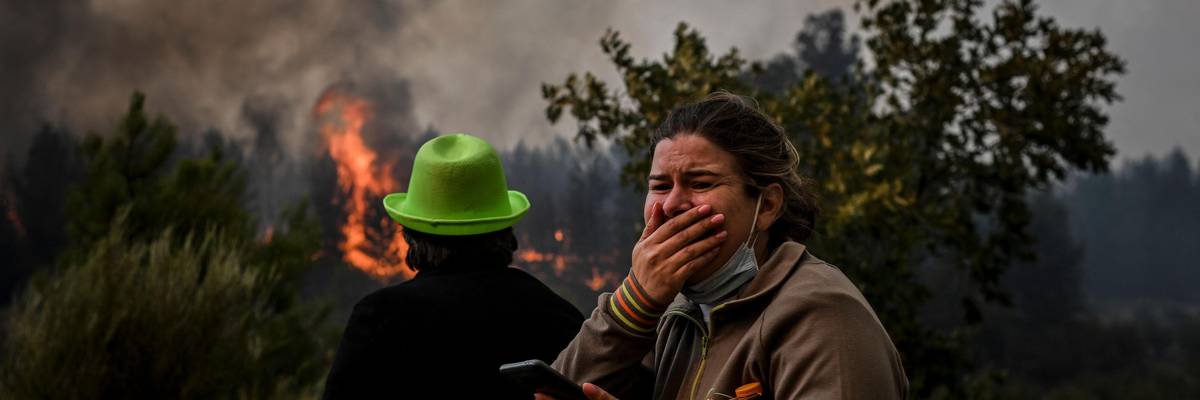
A local reacts to watching a wildfire advancing in Orjais, Covilha council in central Portugal, on August 16, 2022. (Photo: Patricia De Melo Moreira/ AFP via Getty Images)
WMO Climate Report Shows 8 Hottest Years on Record With Global Targets Nearly 'Out of Reach'
New WMO report released on first day of UN climate summit that the last eight years are the eight hottest on record.
A new report by the World Meteorological Organization released Sunday shows that the last eight years are on track to be the hottest on record and warns still soaring emissions means humanity's hopes to hit global temperature targets in the coming decades may not be achievable.
"It's already too late for many glaciers and the melting will continue for hundreds if not thousands of years, with major implications for water security."
The WMO report--released on the first day of COP27 climate summit in Sharm El-SheikhEgypt--details how "extreme heatwaves, drought, and devastating flooding have affected millions and cost billions" so far this year and that the "tell-tale signs and impacts of climate change are becoming more dramatic" with each passing day.
"The greater the warming, the worse the impacts. We have such high levels of carbon dioxide in the atmosphere now that the lower 1.5degC of the Paris Agreement is barely within reach," said WMO Secretary-General Prof Petteri Taalas, in a statement.
According to the WMO:
The rate of sea level rise has doubled since 1993. It has risen by nearly 10 mm since January 2020 to a new record high this year. The past two and a half years alone account for 10 percent of the overall rise in sea level since satellite measurements started nearly 30 years ago.
2022 took an exceptionally heavy toll on glaciers in the European Alps, with initial indications of record-shattering melt. The Greenland ice sheet lost mass for the 26th consecutive year and it rained (rather than snowed) there for the first time in September.
"It's already too late for many glaciers and the melting will continue for hundreds if not thousands of years, with major implications for water security. The rate of sea level rise has doubled in the past 30 years. Although we still measure this in terms of millimetres per year, it adds up to half to one meter per century and that is a long-term and major threat to many millions of coastal dwellers and low-lying states," said Taalas..
Some of the report's other key findings were included in this brief video released by the WMO:
U.N. Secretary-General Antonio Guterres ahead of the COP27 kickoff in Egypt warned Thursday that planet earth was "on course for reaching tipping points that will make climate chaos irreversible."
Remarking on the WMO report on Sunday, Taalas said, "All too often, those least responsible for climate change suffer most--as we have seen with the terrible flooding in Pakistan and deadly, long-running drought in the Horn of Africa. But even well-prepared societies this year have been ravaged by extremes--as seen by the protracted heatwaves and drought in large parts of Europe and southern China."
With none in the world truly safe from the implications of runaway climate chaos--but poor people across the globe inherently more vulnerable--campaigners attending the COP27 talks in Sharm El-Sheikh said Sunday that dire circumstances must be met with "real" and meaningful action to solve the crisis.
"This COP opens with so much at stake for those on the frontlines of the fight for climate justice," said May Boeve, executive director of the global climate action group 350.org.
"Communities on every continent are experiencing ever-worsening impacts of the climate crisis, and every government has a role to play in securing climate justice," Boeve said.
"The pathway to mitigation against climate chaos is increasingly steep and challenging, but the cost of inaction is even higher," she added. "The longer we indulge our reliance on fossil fuels, the greater the costs to be borne by this and future generations. We are here to remind global leaders of their responsibilities towards a just transition, press them to align finance flows with the goals of the Paris Agreement, and particularly in the case of rich nations, challenge them to pay the debts they owe to countries in the Global South, for decades of exploitation."
We are at a crossroads
This country and this world are at a monumental crossroads. In a few short weeks, US voters will have an opportunity to beat back the forces of fascism and confront the billionaires who are rigging the economy, our media system, and our democracy, making it increasingly impossible for ordinary people to get by. We’re not just talking about the election. We’re talking about what must be done once these fascist elements are vanquished from power. We need a bolder set of solutions than what either major party has so far been willing to offer and a working-class movement ready to fight like hell for it. Trump didn't emerge from nowhere. The conditions that fueled MAGA authoritarianism were created by decades of radical neoliberal economic policies and a corrupt political system dominated by corporate interests. They slashed taxes on the super-rich, promising that the benefits would trickle down. They said giveaways to the corporate titans would make life more affordable for the rest of us. It was all bullshit. And when a bitter, betrayed populace searches for someone to blame, right-wing demagogues have little trouble finding scapegoats. People know when they're being lied to, but you won't hear any of this from the corporate media. Only independent journalism—powered and funded by people who believe in building a better world—can deliver truly trustworthy daily news. Our Fall Campaign is underway, and we need your help. To power our newsroom through the rest of the year, we need to raise $125,000 by midnight on October 31. So if you share our vision, please contribute whatever you can to sustain our work. |
A new report by the World Meteorological Organization released Sunday shows that the last eight years are on track to be the hottest on record and warns still soaring emissions means humanity's hopes to hit global temperature targets in the coming decades may not be achievable.
"It's already too late for many glaciers and the melting will continue for hundreds if not thousands of years, with major implications for water security."
The WMO report--released on the first day of COP27 climate summit in Sharm El-SheikhEgypt--details how "extreme heatwaves, drought, and devastating flooding have affected millions and cost billions" so far this year and that the "tell-tale signs and impacts of climate change are becoming more dramatic" with each passing day.
"The greater the warming, the worse the impacts. We have such high levels of carbon dioxide in the atmosphere now that the lower 1.5degC of the Paris Agreement is barely within reach," said WMO Secretary-General Prof Petteri Taalas, in a statement.
According to the WMO:
The rate of sea level rise has doubled since 1993. It has risen by nearly 10 mm since January 2020 to a new record high this year. The past two and a half years alone account for 10 percent of the overall rise in sea level since satellite measurements started nearly 30 years ago.
2022 took an exceptionally heavy toll on glaciers in the European Alps, with initial indications of record-shattering melt. The Greenland ice sheet lost mass for the 26th consecutive year and it rained (rather than snowed) there for the first time in September.
"It's already too late for many glaciers and the melting will continue for hundreds if not thousands of years, with major implications for water security. The rate of sea level rise has doubled in the past 30 years. Although we still measure this in terms of millimetres per year, it adds up to half to one meter per century and that is a long-term and major threat to many millions of coastal dwellers and low-lying states," said Taalas..
Some of the report's other key findings were included in this brief video released by the WMO:
U.N. Secretary-General Antonio Guterres ahead of the COP27 kickoff in Egypt warned Thursday that planet earth was "on course for reaching tipping points that will make climate chaos irreversible."
Remarking on the WMO report on Sunday, Taalas said, "All too often, those least responsible for climate change suffer most--as we have seen with the terrible flooding in Pakistan and deadly, long-running drought in the Horn of Africa. But even well-prepared societies this year have been ravaged by extremes--as seen by the protracted heatwaves and drought in large parts of Europe and southern China."
With none in the world truly safe from the implications of runaway climate chaos--but poor people across the globe inherently more vulnerable--campaigners attending the COP27 talks in Sharm El-Sheikh said Sunday that dire circumstances must be met with "real" and meaningful action to solve the crisis.
"This COP opens with so much at stake for those on the frontlines of the fight for climate justice," said May Boeve, executive director of the global climate action group 350.org.
"Communities on every continent are experiencing ever-worsening impacts of the climate crisis, and every government has a role to play in securing climate justice," Boeve said.
"The pathway to mitigation against climate chaos is increasingly steep and challenging, but the cost of inaction is even higher," she added. "The longer we indulge our reliance on fossil fuels, the greater the costs to be borne by this and future generations. We are here to remind global leaders of their responsibilities towards a just transition, press them to align finance flows with the goals of the Paris Agreement, and particularly in the case of rich nations, challenge them to pay the debts they owe to countries in the Global South, for decades of exploitation."