SUBSCRIBE TO OUR FREE NEWSLETTER
Daily news & progressive opinion—funded by the people, not the corporations—delivered straight to your inbox.
5
#000000
#FFFFFF
To donate by check, phone, or other method, see our More Ways to Give page.

"Between record-breaking temperatures and wildfires currently threatening our centers and workforce in California, it has never been more important to understand our changing planet."
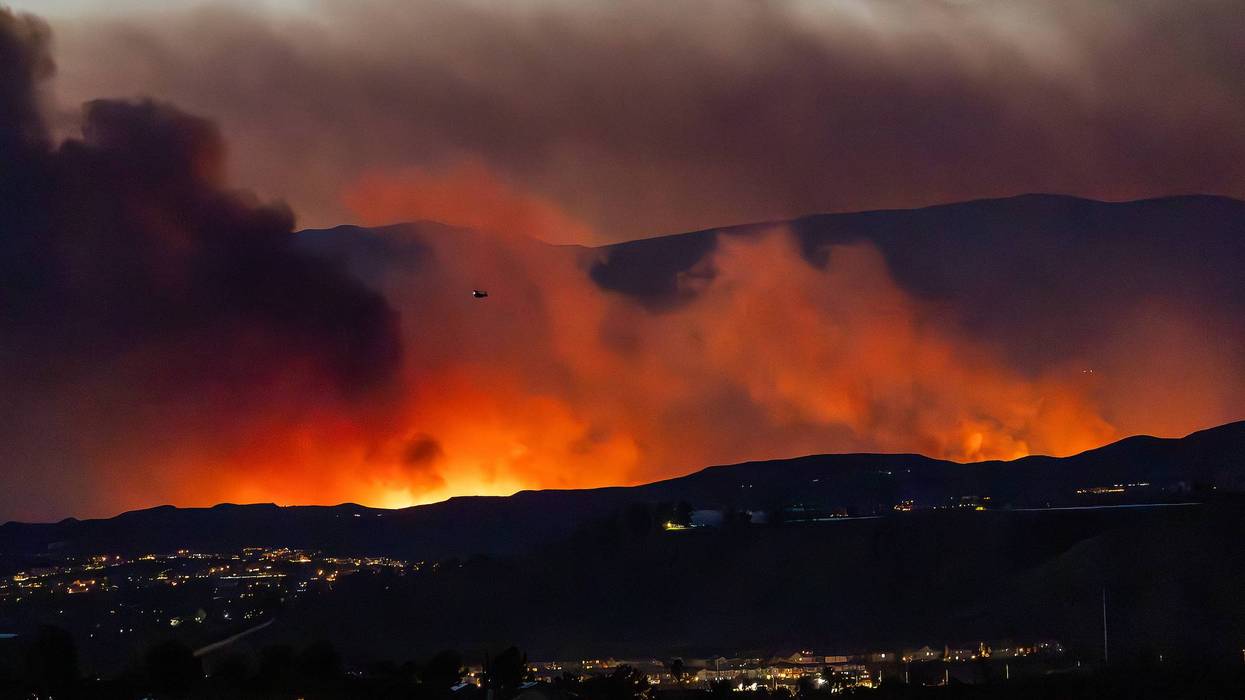
"Once again, the temperature record has been shattered—2024 was the hottest year since recordkeeping began in 1880," said NASA Administrator Bill Nelson in a statement. "Between record-breaking temperatures and wildfires currently threatening our centers and workforce in California, it has never been more important to understand our changing planet."
Other experts, at NASA and beyond, also responded to the findings by emphasizing that the climate emergency was created by humanity extracting and burning fossil fuels—and continuing to do so, despite scientists' warnings and initiatives including the 2015 Paris agreement, which was intended to limit global temperature rise this century to 1.5°C above preindustrial levels.
"To put that in perspective, temperatures during the warm periods on Earth three million years ago—when sea levels were dozens of feet higher than today—were only around 3°C warmer than preindustrial levels," explained Gavin Schmidt, director of NASA's Goddard Institute for Space Studies. "We are halfway to Pliocene-level warmth in just 150 years."
"Not every year is going to break records, but the long-term trend is clear," said Schmidt, acknowledging natural fluctuations such as El Niño and La Niña. "We're already seeing the impact in extreme rainfall, heatwaves, and increased flood risk, which are going to keep getting worse as long as emissions continue."
NASA noted that independent analyses from Berkeley Earth, Europe's Copernicus Climate Change Service, the United Kingdom's Met Office, and the United States' National Oceanic and Atmospheric Administration (NOAA) also concluded that "global surface temperatures for 2024 were the highest since modern record-keeping began," though some of the figures differ slightly due their to various methodologies and models.
For example, NOAA, which also released its 2024 conclusions on Friday, found that the global surface temperature was 2.32°F (1.29°C) above the 20th-century average and exceeded the 1850-1900 average by 2.63°F (1.46°C). The agency also found that the annual average for the contiguous United States was 55.5°F—3.5°F above average and the warmest in the 130-year record.
NOAA also put out findings on extreme weather events that are becoming more common and devastating due to fossil fuel-driven global heating. The agency identified 27 disasters across the country—a drought, a flooding event, a wildfire, two winter storms, five tropical cyclones, and 17 severe storms—with losses topping $1 billion each. They collectively cost $182.7 billion and killed at least 568 people.
Over a third of those deaths—219—were tied to Hurricane Helene, last year's costliest event at $78.7 billion. The Category 4 storm made landfall in Florida's Big Bend region and left a trail of destruction up to North Carolina and Tennessee. NOAA said that it "was the deadliest Atlantic hurricane since Maria (2017) and the deadliest to strike the U.S. mainland since Katrina (2005)."
The United States has faced 403 billion-dollar weather and climate disasters over the past 45 years, and 2024 had the second-highest count, after 28 events in 2023. The annual average for 1980-2024 is just nine, compared with 23 for the past five years.
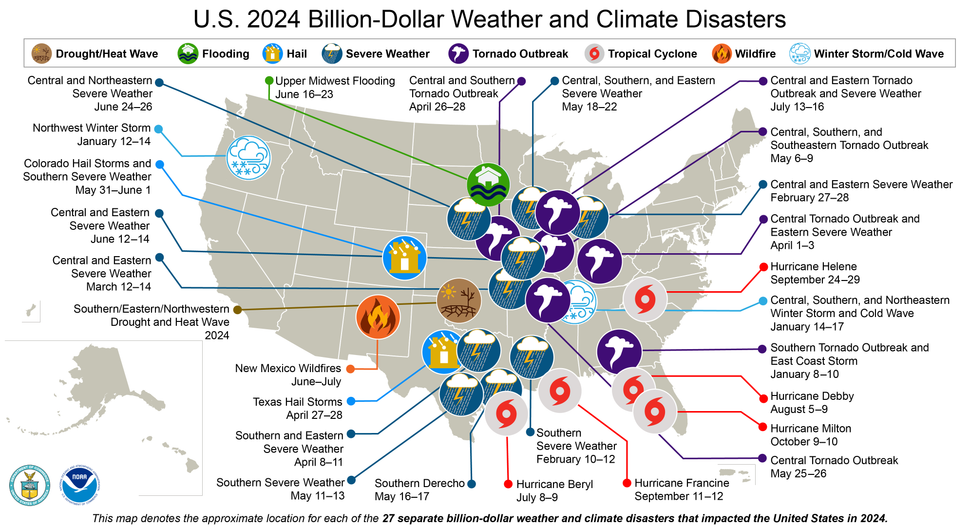 (Image: NOAA)
"Last year's record-breaking heat and billion-dollar disasters are an alarming harbinger of what's to come if the nation fails to invest in a climate-resilient economy and do its part to sharply cut global heat-trapping emissions," said Rachel Cleetus, policy director and lead economist at the Union of Concerned Scientists' (UCS) Climate and Energy Program, in a statement. "It's time for decision-makers at all levels of government and across the economy to acknowledge the staggering financial costs and human toll of burning fossil fuels and commit to building a stronger, safer economy powered by clean energy."
Cleetus also called out the fossil fuel companies that "seem intent on burning down the planet to protect their profits" and the "policymakers in their thrall." Her UCS colleague Astrid Caldas, a senior climate scientist for community resilience, similarly stressed the urgent need to act while blasting Big Oil and its allies in politics.
"As a scientist exhausted from sounding the alarm hottest year after hottest year, I'm no longer just concerned about the climate crisis and its impacts on vulnerable communities but incensed at world leaders for their grossly inadequate climate action to date," Caldas declared. "NOAA and NASA confirmed that the last 11 years have been the 11 hottest on record. Will it take another 11 years for policymakers to heed the irrefutable science and address the devastation being experienced in the United States and around the world largely due to fossil-fuel driven global warming?"
As Californians faced what experts fear will be the costliest fire disaster in U.S. history, Caldas said that "deadly and costly climate impacts, including accelerating sea-level rise and record-breaking heatwaves, droughts, storms, and wildfires, are mounting, and yet politicians stand by while heat-trapping emissions continue to rise globally. The science is indisputable: Transformative and comprehensive global climate action, including a speedy and just transition away from fossil fuels and increased investments in climate resilience, is paramount to protect people now and foster prosperity for generations to come."
"The villains of this escalating tragedy are also clear, with wealthy nations, the duplicitous fossil fuel industry, and spineless policymakers topping the list of those bearing primary responsibility for past and current global warming emissions and climate inaction," she added. "The biggest injustice is that the most vulnerable communities on the frontlines of the climate crisis have much to lose despite contributing the least to this problem."



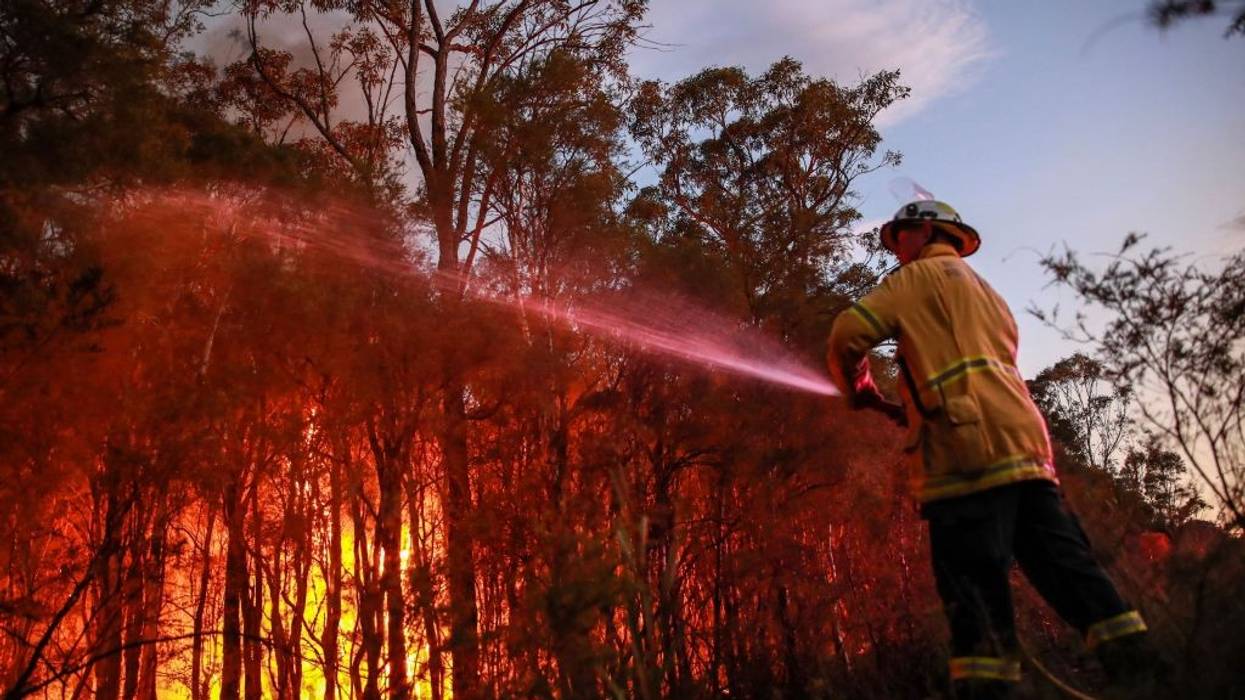
"NASA and NOAA's global temperature report confirms what billions of people around the world experienced last year; we are facing a climate crisis," declared Bill Nelson, NASA's administrator. "From extreme heat, to wildfires, to rising sea levels, we can see our Earth is changing."
"It's driven primarily by our fossil fuel emissions, and we're seeing the impacts in heatwaves, intense rainfall, and coastal flooding."
NASA, whose records date back to 1880, found that Earth's average surface temperature last year was about 1.2°C above the average for the agency's baseline period, which is 1951-1980, and 1.4°C above the late 19th-century average.
"Every month from June through December 2023 came in as the hottest month on record. July ranked as the hottest month ever recorded," NASA noted in an article explaining last year's record heat, which addresses greenhouse gases, the El Niño Southern Oscillation (ENSO), warming oceans, decreasing aerosols, and an undersea volcanic eruption.
"The exceptional warming that we're experiencing is not something we've seen before in human history," emphasized Gavin Schmidt, director of NASA's Goddard Institute for Space Studies. "It's driven primarily by our fossil fuel emissions, and we're seeing the impacts in heatwaves, intense rainfall, and coastal flooding."
NOAA, which has a climate record back to 1850, similarly found that the average land and ocean surface temperature last year was 1.18°C above the 20th century and 1.35°C above the preindustrial average, or 1850-1900. Sarah Kapnick, the agency's chief scientist, said that "after seeing the 2023 climate analysis, I have to pause and say that the findings are astounding."
"Not only was 2023 the warmest year in NOAA's 174-year climate record—it was the warmest by far," she highlighted. "A warming planet means we need to be prepared for the impacts of climate change that are happening here and now, like extreme weather events that become both more frequent and severe."
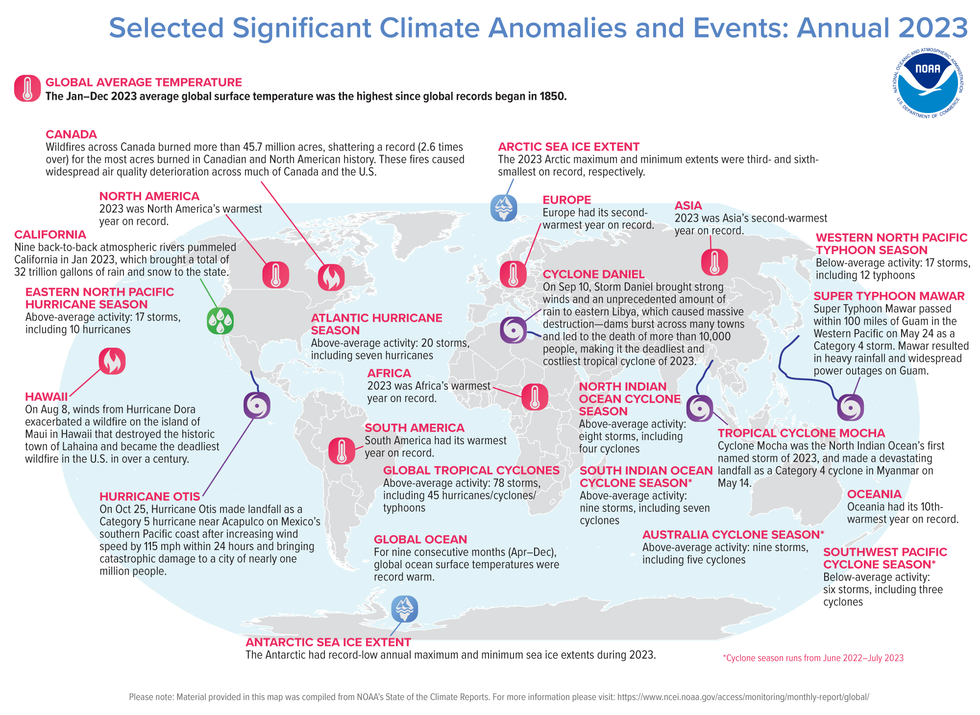
Both agencies found that the 10 hottest years in their records have all been in the past decade. NOAA pointed out that there is a one-in-three chance that this year will be even warmer than 2023, and a 99% chance that 2024 will be among the five hottest years.
"We will continue to see records broken and extreme events grow until emissions go to zero," Kapnick warned. "Government policy can address both emissions, but also actions to reduce climate impacts by building resilience."
NASA and NOAA's findings are in line with not only scientists' predictions amid extreme conditions last year but also data released Tuesday by the European Union's Copernicus Climate Change Service and Friday by the United Kingdom's Met Office—which has records back to 1850 and found that the global average temperature for 2023 was 1.46°C above the preindustrial baseline.
"It is striking that the temperature record for 2023 has broken the previous record set in 2016 by so much because the main effect of the current El Niño will come in 2024," said Adam Scaife, a principal fellow at the U.K. agency. "Consistent with this, the Met Office's 2024 temperature forecast shows this year has strong potential to be another record-breaking year."
El Niño and La Niña are the warm and cool phases of the climate phenomenon ENSO in the Pacific Ocean. As Common Dreams reported Thursday, a study published in Advances in Atmospheric Sciences found that 2023 was the hottest year on record for the world's oceans, which capture an estimated 91% of excess heat from greenhouse gases.
Government scientists were not the only ones who responded with alarm to the new climate data this week. Kristina Dahl, a principal climate scientist at the Union of Concerned Scientists, said Friday, "The latest data confirms heartbreaking and unprecedented scientific truths: The last decade has been the hottest in human history while heat-trapping emissions are continuing to rise."
"During this consequential decade, nations across the globe must swiftly reduce their heat-trapping emissions and enact widespread climate adaptation policies to limit the devastating climate harms and the toll they take on humans and ecosystems," she stressed, noting the "unrelenting onslaught of climate impacts" communities have already ensured. "Continuing to make only incremental policy changes will further jeopardize the safety of people around the world, especially those on the frontlines of the climate crisis."
Dahl argued that "as the largest historical emitter of global carbon emissions and the wealthiest nation, the United States has a moral imperative to lead on aggressive climate action. The science is clear: Transformative and comprehensive climate action, including a rapid transition away from fossil fuels and investments in resilience, are essential to ensure a livable future for generations to come."
"It's time for U.S. policymakers to place the needs of people over ill-gotten corporate profits by resisting and rejecting the potent allure of greenwashing narratives and false solutions that the fossil fuel industry has long pushed upon elected officials."
"Fortunately, the United States already has proven technologies to do this, including energy efficiency, renewable energy, and energy storage, at its fingertips," she added. "It's time for U.S. policymakers to place the needs of people over ill-gotten corporate profits by resisting and rejecting the potent allure of greenwashing narratives and false solutions that the fossil fuel industry has long pushed upon elected officials."
While making historic progress on climate during his first term, U.S. President Joe Biden has also faced criticism from scientists and campaigners for backing some false solutions, enabling more fossil fuel projects, and skipping COP28, the United Nations climate summit held late last year.
Global scientists called COP28—which was led by an oil CEO in the United Arab Emirates—a "tragedy for the planet" because its final agreement did not endorse a phaseout of fossil fuels, and have already expressed concerns about COP29, given host country Azerbaijan's recent announcement that the upcoming conference will also be overseen by an oil executive.