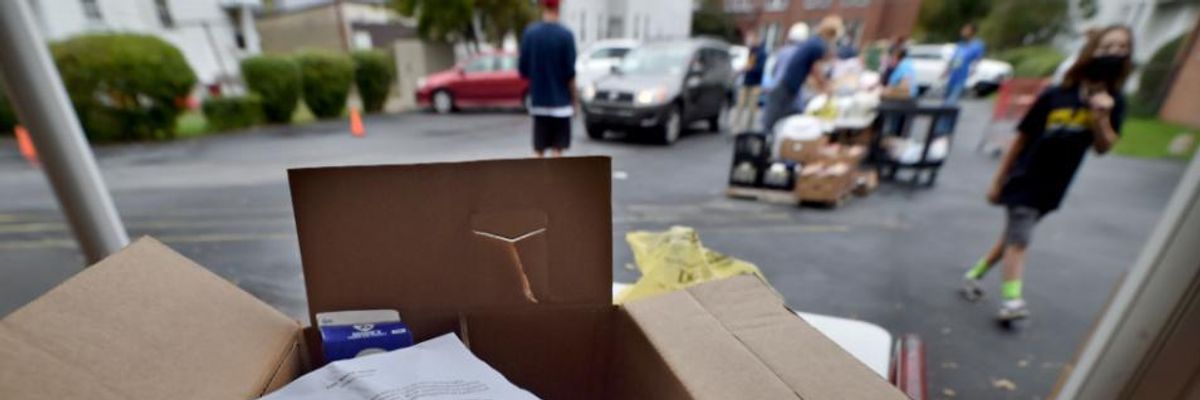
A letter from Donald Trump in a food box from the USDA Farmers to Families program, which was introduced in May. The program is reportedly running out of money ahead of its December 31 expiration date. (Photo: Aimee Dilger/SOPA Images/LightRocket via Getty Images)
Trump's Food Box Program Running Dry as US Hunger Crisis Heads Into Holidays
"People can't believe the government promised food and reneged."
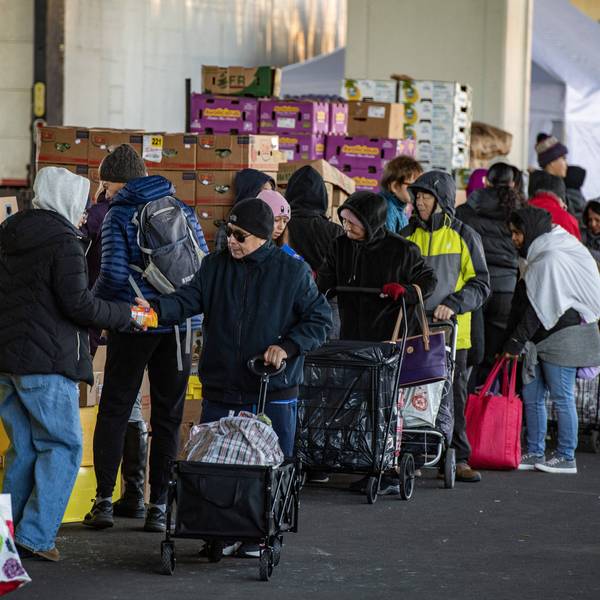
Non-profit groups which have spent much of this year meeting the soaring needs of food-insecure communities have learned in recent days that a program initiated by the Trump administration last spring is running out of money nearly a month before it was expected to, leaving anti-hunger workers scrambling to help millions of individuals and families.
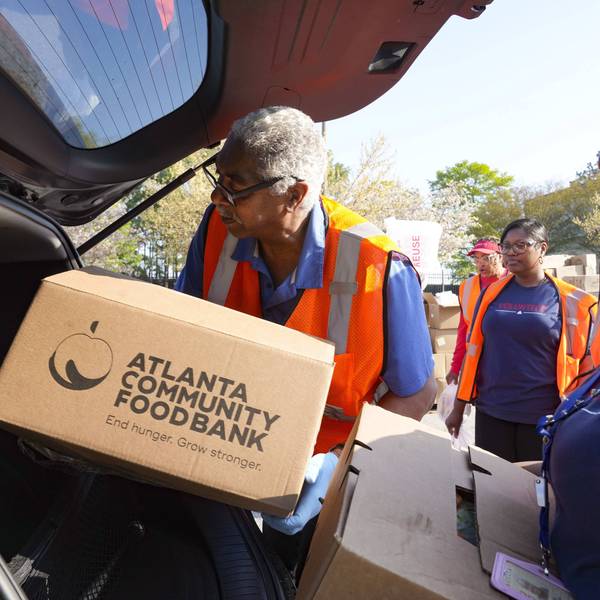
The $4.5 billion Farmers to Families food box program, run by the USDA to support struggling farms as well as people facing unemployment and hunger, was introduced in May. Along with the Food Purchase and Distribution Program, the initiative has helped serve 1.7 billion of the meals provided by Feeding America, a nationwide network of 200 food banks, this year.
Non-profits say the USDA did not warn them that the fourth round of funding for the program could be drastically cut at the end of the year, leaving food banks with dwindling food supplies and government funds.
Farmers to Families has relied on USDA contracts, awarded to large food distributors, to supply food boxes for growing food lines--in which 40% of people served since the pandemic hit have been first-time beneficiaries of government food assistance, having lost jobs and income in an economy in which 78% of workers live paycheck to paycheck.
The first three rounds of contracts amounted to $1.2 billion, $1.76 billion, and $1 billion, before the federal government cut funding to just $500 million in the last two months of the year, as the holidays and the current surge in coronavirus cases approached.
The funding cut left many parts of the country where non-profits have relied on the food boxes with little or no support; food banks across the country are poised to lose about half of the food they receive from the USDA, and some regions simply weren't selected by the federal government to receive more contracts in the last two months of the year.
"That left a palpable void," John Bernardi, of the United Way of the Adirondack Region in New York, told the Washington Post Tuesday. "This has left the food pantries overwhelmed."
Non-profits had been counting on the program to be fully funded through December 31, at which point anti-hunger groups are hoping Congress passes a new coronavirus relief package including food aid.
"People can't believe the government promised food and reneged," Jeremy Haicken, president of Unite Here Local 737 in Florida, told the Post this past weekend while working at a food line the union has helped to run during the pandemic.
As the union learned it would not have access to boxes of fresh dairy, meat, and produce through the USDA earlier this month, its leaders raised money and used some of the organization's own savings to purchase as much ramen, canned vegetables, and beans as it could to help serve families.
Over the weekend, families in the Ft. Wayne, Indiana area learned that a Farmers to Families distribution event had been canceled and that they won't be able to rely on the program for the rest of the year.
A day before the distribution in Indiana was canceled, President Donald Trump's daughter and adviser, Ivanka Trump, touted the "huge success" of Farmers to Families on social media.
However, the early end to the program is expected to leave tens of thousands of families without a supply of food they have come to rely on this year, as food banks report a 60% increase in demand.
According to the Post, 50 million people could face food insecurity by the end of the year, up from 35 million in January 2020.
We are at a crossroads
This country and this world are at a monumental crossroads. In a few short weeks, US voters will have an opportunity to beat back the forces of fascism and confront the billionaires who are rigging the economy, our media system, and our democracy, making it increasingly impossible for ordinary people to get by. We’re not just talking about the election. We’re talking about what must be done once these fascist elements are vanquished from power. We need a bolder set of solutions than what either major party has so far been willing to offer and a working-class movement ready to fight like hell for it. Trump didn't emerge from nowhere. The conditions that fueled MAGA authoritarianism were created by decades of radical neoliberal economic policies and a corrupt political system dominated by corporate interests. They slashed taxes on the super-rich, promising that the benefits would trickle down. They said giveaways to the corporate titans would make life more affordable for the rest of us. It was all bullshit. And when a bitter, betrayed populace searches for someone to blame, right-wing demagogues have little trouble finding scapegoats. People know when they're being lied to, but you won't hear any of this from the corporate media. Only independent journalism—powered and funded by people who believe in building a better world—can deliver truly trustworthy daily news. Our Fall Campaign is underway, and we need your help. To power our newsroom through the rest of the year, we need to raise $125,000 by midnight on October 31. So if you share our vision, please contribute whatever you can to sustain our work. |
Non-profit groups which have spent much of this year meeting the soaring needs of food-insecure communities have learned in recent days that a program initiated by the Trump administration last spring is running out of money nearly a month before it was expected to, leaving anti-hunger workers scrambling to help millions of individuals and families.
The $4.5 billion Farmers to Families food box program, run by the USDA to support struggling farms as well as people facing unemployment and hunger, was introduced in May. Along with the Food Purchase and Distribution Program, the initiative has helped serve 1.7 billion of the meals provided by Feeding America, a nationwide network of 200 food banks, this year.
Non-profits say the USDA did not warn them that the fourth round of funding for the program could be drastically cut at the end of the year, leaving food banks with dwindling food supplies and government funds.
Farmers to Families has relied on USDA contracts, awarded to large food distributors, to supply food boxes for growing food lines--in which 40% of people served since the pandemic hit have been first-time beneficiaries of government food assistance, having lost jobs and income in an economy in which 78% of workers live paycheck to paycheck.
The first three rounds of contracts amounted to $1.2 billion, $1.76 billion, and $1 billion, before the federal government cut funding to just $500 million in the last two months of the year, as the holidays and the current surge in coronavirus cases approached.
The funding cut left many parts of the country where non-profits have relied on the food boxes with little or no support; food banks across the country are poised to lose about half of the food they receive from the USDA, and some regions simply weren't selected by the federal government to receive more contracts in the last two months of the year.
"That left a palpable void," John Bernardi, of the United Way of the Adirondack Region in New York, told the Washington Post Tuesday. "This has left the food pantries overwhelmed."
Non-profits had been counting on the program to be fully funded through December 31, at which point anti-hunger groups are hoping Congress passes a new coronavirus relief package including food aid.
"People can't believe the government promised food and reneged," Jeremy Haicken, president of Unite Here Local 737 in Florida, told the Post this past weekend while working at a food line the union has helped to run during the pandemic.
As the union learned it would not have access to boxes of fresh dairy, meat, and produce through the USDA earlier this month, its leaders raised money and used some of the organization's own savings to purchase as much ramen, canned vegetables, and beans as it could to help serve families.
Over the weekend, families in the Ft. Wayne, Indiana area learned that a Farmers to Families distribution event had been canceled and that they won't be able to rely on the program for the rest of the year.
A day before the distribution in Indiana was canceled, President Donald Trump's daughter and adviser, Ivanka Trump, touted the "huge success" of Farmers to Families on social media.
However, the early end to the program is expected to leave tens of thousands of families without a supply of food they have come to rely on this year, as food banks report a 60% increase in demand.
According to the Post, 50 million people could face food insecurity by the end of the year, up from 35 million in January 2020.