SUBSCRIBE TO OUR FREE NEWSLETTER
Daily news & progressive opinion—funded by the people, not the corporations—delivered straight to your inbox.
5
#000000
#FFFFFF
To donate by check, phone, or other method, see our More Ways to Give page.


Daily news & progressive opinion—funded by the people, not the corporations—delivered straight to your inbox.
When economists and other experts address who is at fault for the
housing and financial crisis, the emerging consensus is that irresponsible
practices by lenders and investors and lax oversight by government regulators
are to blame. However, many in the media
have told a different story.
As recently as February 17, in a Hardball
discussion of who was to blame for the financial crisis, CNBC's David
Faber said to host Chris Matthews that he was "sure" there were
plenty of Hardball viewers
"who want to go back to the Community Reinvestment Act, and say that Bill
Clinton was certainly one of the engines behind tightening that act, make an
even stronger case for banks to be lending to minorities."
Indeed, Media Matters for America has
documented numerous media figures attempting to lay the blame for the crisis on
the proponents of the expansion of affordable housing, attacking the Community
Reinvestment Act (CRA) and congressional Democrats. On the day that President
Obama announces his plan to stabilize the housing market, Media Matters thought it would be helpful
to bring to your attention our research refuting these attacks.
CLAIMING THAT THE 1977 COMMUNITY
REINVESTMENT ACT FORCED LENDERS INTO IRRESPONSIBLE LENDING
Media Matters has
documented media figures claiming that the CRA and efforts to expand affordable
housing to minorities and low-income people are at least in part to blame for
the home foreclosure crisis. However, this argument has been refuted by former
Federal Reserve chairman Ben Bernanke, who stated in a letter to Sen. Robert
Menendez:
"Our own experience
with CRA over more than 30 years and recent analysis of available data,
including data on subprime loan performance, runs counter to the charge that
CRA was at the root of, or otherwise contributed in any substantive way to, the
current mortgage difficulties."
In addition, countering the argument that CRA forced banks into making "risky" subprime
loans, experts have said that approximately 80 percent of subprime loans were
offered by financial institutions that are not subject to the CRA, and, in
Bernanke's words, "The CRA statute and regulations have always
emphasized that" the lending activities it encourages "be
'consistent with safe and sound operation.' " Additionally,
Janet Yellen, president and CEO of the Federal Reserve Bank of San Francisco
stated that "studies have shown that the
CRA has increased the volume of responsible lending to low- and
moderate-income households."
On
Fox, Barnes, Krauthammer echoed conservative claim that CRA played key role in
subprime crisis
Faced
with economic turmoil, media conservatives turn to class warfare
Hannity
baselessly blamed Democrats, CRA for financial crisis
Fox
News' Baier advanced conservative attacks on CRA, repeated falsehood about Rep.
Frank
Media
conservatives baselessly blame Community Reinvestment Act for foreclosure spike
ACCUSING CONGRESSIONAL DEMOCRATS OF
OPPOSING STRENGTHENING OVERSIGHT OF FANNIE AND FREDDIE
Several media figures have blamed the mortgage crisis on congressional Democrats and
Rep. Barney Frank, in particular, accusing them of opposing stricter oversight
of mortgage giants Fannie Mae and Freddie Mac. In fact, a New York Times article on how "the
story of" the mortgage crisis "is partly one of [former President
George W.] Bush's own making" reports that it was Bush who "insisted that
Fannie Mae and Freddie Mac meet ambitious new goals for low-income
lending." Frank, the senior Democrat and now chairman of the Financial
Services Committee, has repeatedly supported legislation to strengthen
oversight over Fannie and Freddie. After Democrats retook control of Congress,
they passed a bill that strengthened oversight of Fannie and Freddie in 2008.
Scarborough
falsely suggested Frank is only "now ...
saying some people should just rent"
Bloomberg's
Baum falsely claimed that Frank "consistently opposed stricter regulation
of Fannie Mae and Freddie Mac"
O'Reilly
falsely claimed Frank "wanted to give mortgages to everybody"
Special Report falsely
suggested Fannie and Freddie chief perpetrators of "financial mess,"
Rep. Frank opposed stricter oversight
O'Reilly
falsely claimed that Rep. Frank "sat by" while "Freddie Mac and
Fannie Mae made bad loans"
For more
information on the media's coverage of the housing crisis, please visit www.mediamatters.org
Media Matters for America is a Web-based, not-for-profit, 501(c)(3) progressive research and information center dedicated to comprehensively monitoring, analyzing, and correcting conservative misinformation in the U.S. media.

"The Court’s decision today... against ICE’s unlawful effort to obstruct congressional oversight is a victory for the American people," said Rep. Joe Neguse.
Doubling down on a ruling from late last year, a federal judge on Monday once again rejected an effort by the Trump administration to block congressional lawmakers from accessing federal immigration detention facilities.
In the ruling, US District Judge Jia Cobb granted a temporary restraining order sought by Democratic members of the House of Representatives to overturn the US Department of Homeland Security's (DHS) policy of requiring lawmakers to give a week's notice before being granted access to US Immigration and Customs Enforcement (ICE) detention facilities.
Cobb had already overturned this DHS policy in a December ruling, arguing that it "was likely contrary to the terms of a limitations rider attached to" the department's annual appropriated funds.
However, Homeland Security Secretary Kristi Noem in January reimplemented the one-week notice policy and argued that it was now being implemented with separate funds provided to DHS through the 2025 One Big Beautiful Bill Act, which did not contain the language used in the earlier limitations rider.
Cobb rejected this argument and found that "at least some of these resources that either have been or will be used to promulgate and enforce the notice policy have already been funded and paid for with... restricted annual appropriations funds," including "contracts or agreements that predate" the passage of the One Big Beautiful Bill Act.
According to legal journalist Chris Geidner, the effect of Cobb's ruling will be that congressional oversight visits to ICE facilities will now be "allowed on request."
Rep. Joe Neguse (D-Colo.), the lead plaintiff in the case, hailed Cobb's ruling and vowed to keep putting pressure on the Trump administration to comply with the law.
"The Court’s decision today to grant a temporary restraining order against ICE’s unlawful effort to obstruct congressional oversight is a victory for the American people," said Neguse. "We will keep fighting to ensure the rule of law prevails."
One doctor warned that the outbreak "will become an epidemic if we don't act immediately."
Public health experts and immigrant advocates sounded the alarm Sunday over a measles outbreak at a US Immigration and Customs Enforcement internment center in Texas where roughly 1,200 people, including over 400 children, are being held.
Texas officials confirmed Saturday that two detainees at the Dilley Immigration Processing Center, located about 75 miles (120 km) southwest of San Antonio, are infected with measles.
"Medical staff is continuing to monitor the detainees' conditions and will take appropriate and active steps to prevent further infection," the US Department of Homeland Security (DHS) said in a statement. "All detainees are being provided with proper medical care."
DHS spokesperson Tricia McLaughlin said Sunday that ICE "immediately took steps to quarantine and control further spread and infection, ceasing all movement within the facility and quarantining all individuals suspected of making contact with the infected."
Responding to the development, Dr. Lee Rogers of UT Health San Antonio wrote in a letter to Texas state health officials that the Dilley outbreak "will become an epidemic if we don't act immediately" by establishing "a single public health incident command center."
"Viruses are not political," Rogers stressed. "They do not care about one's immigration status. Measles will spread if we allow uncertainty and delay to substitute for reasoned public health action."
Dr. Benjamin Mateus took aim at the Trump administration's wider policy of "criminalizing immigrant families and confining children in camps," which he called a form of "colonial policy" from which disease is the "predictable outcome."
Measles is a highly contagious viral disease that can kill or cause serious complications, particularly among unvaccinated people. The United States declared measles eliminated in 2000, but declining vaccination fueled by misinformation has driven a resurgence in the disease, and public health experts warn that the US is close to following Canada, which lost its elimination status late last year.
Many experts blame this deadly and preventable setback on the vaccine-averse policies and practices of the Trump administration, particularly at the Department of Health and Human Services, led by vaccine conspiracy theorist Robert F. Kennedy Jr.
US measles cases this year already exceed the total for the whole of 2023 and 2024 combined, and it is only January. Yikes.
[image or embed]
— Dr. Lucky Tran (@luckytran.com) January 29, 2026 at 12:29 PM
Critics also slammed ICE's recent halt on payments to third-party providers of detainee healthcare services.
Immigrant advocates had previously warned of a potential measles outbreak at the Dilley lockup. Neha Desai, an attorney at the Oakland, California-based National Center of Youth Law, told CBS News that authorities could use the outbreak as a pretext for preventing lawyers and lawmakers from inspecting the facility.
"We are deeply concerned for the physical and the mental health of every family detained at Dilley," Desai said. "It is important to remember that no family needs to be detained—this is a choice that the administration is making."
Run by ICE and private prison profiteer CoreCivic, the Dilley Immigration Processing Center has been plagued by reports of poor health and hygiene conditions. The facility is accused of providing inadequate medical care for children.
Detainees—who include people legally seeking asylum in the US—report prison-like conditions and say they've been served moldy food infested with worms and forced to drink putrid water. Some have described the facility as "truly a living hell."
The internment center has made headlines not only for its harsh conditions, but also for its high-profile detainees, including Liam Conejo Ramos, a 5-year-old abducted by ICE agents in Minneapolis last month and held along with his father at the facility before a judge ordered their release last week. The child's health deteriorated while he was at Dilley.
On Sunday, the League of United Latin American Citizens (LULAC)—the nation's oldest Latino civil rights organization—held a protest outside the Dilley lockup, demanding its closure.
"Migrant detention centers in America are a moral failure,” LULAC national president Roman Palomares said in a statement. "When a nation that calls itself a beacon of freedom detains children behind razor wire, separates families from their communities, and holds them in isolated conditions, we have crossed a dangerous line."
The Department of Homeland Security is using a repurposed $55 billion Navy contract to convert warehouses into makeshift jails and plan sprawling tent cities in remote areas.
In the wake of immigration agents' killings of three US citizens within a matter of weeks, the Department of Homeland Security is quietly moving forward with a plan to expand its capacity for mass detention by using a military contract to create what Pablo Manríquez, the author of the immigration news site Migrant Insider calls "a nationwide 'ghost network' of concentration camps."
On Sunday, Manríquez reported that "a massive Navy contract vehicle, once valued at $10 billion, has ballooned to a staggering $55 billion ceiling to expedite President Donald Trump’s 'mass deportation' agenda."
It is the expansion of a contract first reported on in October by CNN, which found that DHS was "funneling $10 billion through the Navy to help facilitate the construction of a sprawling network of migrant detention centers across the US in an arrangement aimed at getting the centers built faster, according to sources and federal contracting documents."
The report describes the money as being allocated for "new detention centers," which "are likely to be primarily soft-sided tents and may or may not be built on existing Navy installations, according to the sources familiar with the initiative. DHS has often leaned on soft-sided facilities to manage influxes of migrants."
According to a source familiar with the project, "the goal is for the facilities to house as many as 10,000 people each, and are expected to be built in Louisiana, Georgia, Pennsylvania, Indiana, Utah, and Kansas."
Now Manríquez reports that the project has just gotten much bigger after a Navy grant was repurposed weeks ago. It was authorized through the Worldwide Expeditionary Multiple Award Contract (WEXMAC), a flexible purchasing system that the government uses to quickly move military equipment to dangerous and remote parts of the world.
The contract states that the money is being repurposed for "TITUS," an abbreviation for "Territorial Integrity of the United States." While it's not unusual for Navy contracts to be used for expenditures aimed at protecting the nation, Manríquez warned that such a staggering movement of funds for domestic detention points to something ominous.
“This $45 billion increase, published just weeks ago, converts the US into a ‘geographic region’ for expeditionary military-style detention,” he wrote. "It signals a massive, long-term escalation in the government’s capacity to pay for detention and deportation logistics. In the world of federal contracting, it is the difference between a temporary surge and a permanent infrastructure."
He says the use of the military funding mechanism is meant to disburse funds quickly, without the typical bidding war among contractors, which would typically create a period of public scrutiny. Using the Navy contract means that new projects can be created with “task orders,” which can be turned around almost immediately, when “specific dates and locations are identified” by DHS.
"It means the infrastructure is currently a 'ghost' network that can be materialized anywhere in the US the moment a site is picked," Manríquez wrote.
Amid its push to deport 1 million people each year, the White House has said it needs to dramatically increase the scale of its detention apparatus to add more beds for those who are arrested. But Manríquez said documents suggest "this isn't just about bed space; it’s about the rapid deployment of self-contained cities."
In addition to tent cities capable of housing thousands, contract line items include facilities meant for sustained living—including closed tents likely for medical treatment and industrial-sized grills for food preparation.
They also include expenditures on "Force Protection" equipment, like earth-filled defensive barriers, 8-foot-high CONEX box walls, and “Weather Resistant” guard shacks.
Eric Feigl-Ding, an epidemiologist and health economist, said the contract's provision of materials meant to deal with medical needs and death was "extra chilling." According to the report, "services extend to 'Medical Waste Management,' with specific protocols for biohazard incinerators."
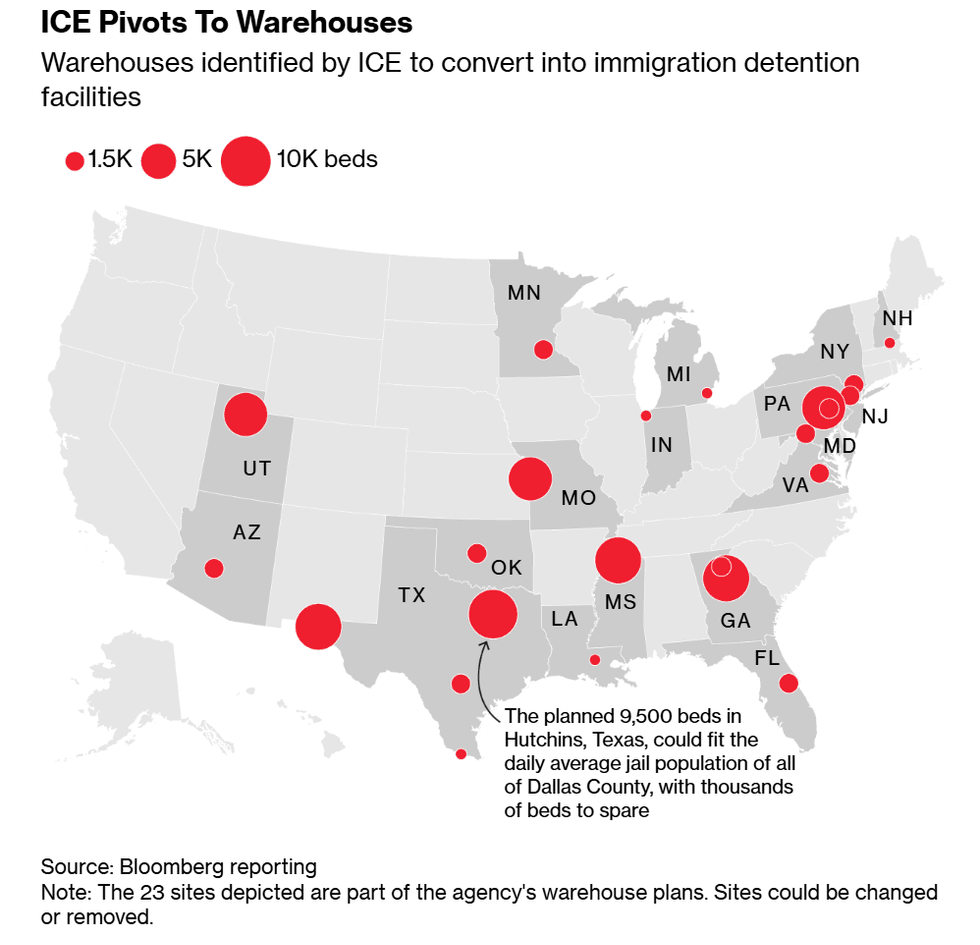
The new reporting from Migrant Insider comes on the heels of a report last week from Bloomberg that US Immigration and Customs Enforcement (ICE) has used some of the $45 billion to purchase warehouses in nearly two dozen remote communities, each meant to house thousands of detainees, which it said "could be the largest expansion of such detention capacity in US history."
The plans have been met with backlash from locals, even in the largely Republican-leaning areas where they are being constructed:
This month, demonstrators protested warehouse conversions in New Hampshire, Utah, Texas and Georgia after the Washington Post published an earlier version of the conversion plan.
In mid-January, a planned tour for contractors of a potential warehouse site in San Antonio was canceled after protesters showed up the same day, according to a person familiar with the scheduled visit.
In Salt Lake City, the Ritchie Group, a local family business that owns the warehouse ICE identified as a future “mega center” jail, said it had “no plans to sell or lease the property in question to the federal government” after protesters showed up at their offices to pressure them.
On January 20, Sen. Chris Van Hollen (D-Md.) joined hundreds of protesters outside a warehouse in Hagerstown, Maryland, that was set to be converted into a facility that will hold 1,500 people.
The senator called the construction of it and other detention facilities "one of the most obscene, one of the most inhumane, one of the most illegal operations being carried out by this Trump administration."
Reports of a new influx of funding from the Navy come as Democrats in Congress face pressure to block tens of billions in new funding for DHS and ICE during budget negotiations.
"If Congress does nothing, DHS will continue to thrive," Manríquez said. "With three more years pre-funded, plus a US Navy as a benefactor, Secretary Kristi Noem—or any potential successor—has the legal and financial runway to keep the business of creating ICE concentration camps overnight in American communities running long after any news cycle fades."