SUBSCRIBE TO OUR FREE NEWSLETTER
Daily news & progressive opinion—funded by the people, not the corporations—delivered straight to your inbox.
5
#000000
#FFFFFF
To donate by check, phone, or other method, see our More Ways to Give page.


Daily news & progressive opinion—funded by the people, not the corporations—delivered straight to your inbox.

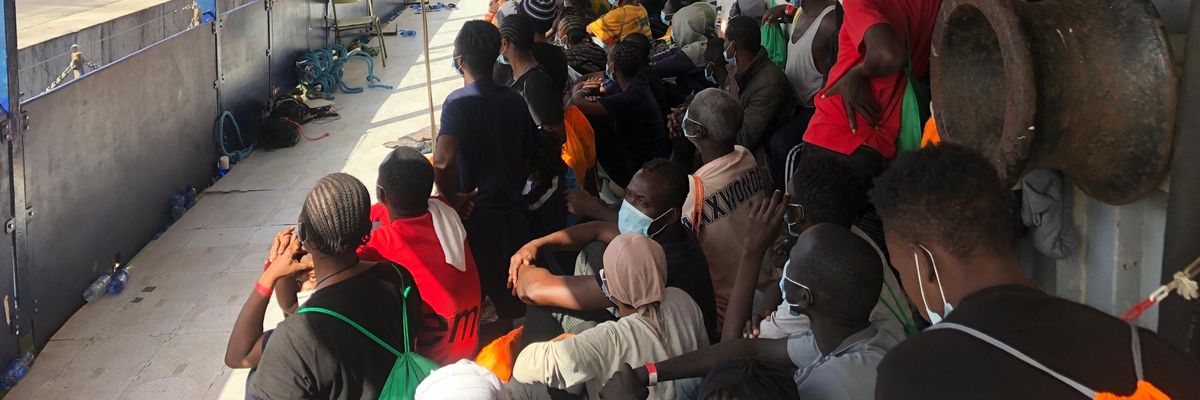
Asylum seekers aboard Sea Watch wait to be allowed to disembark. (Photo: Richard Hardigan)
Many of the European Union's policies make it very difficult for refugees to find safety within its borders. The authorities force them to spend years living in abysmal conditions in refugee camps, illegally push them back across both land and maritime borders, and fund Libyan militias that commit grave human rights violations against them. The consequences of these policies are particularly deadly along the Central Mediterranean Route, which runs primarily from Libya to Italy and has been called the world's most dangerous migration route.
The International Organization for Migration (IOM) reports that since 2014, more than 17,000 people have died or gone missing en route.
For three weeks this summer I worked as a translator on the German rescue ship Sea Watch. The over 300 refugees we picked up south of the Italian island of Lampedusa over two days in July were "lucky." They had managed to escape the horrors of the Libyan detention system (many had spent close to a year there) and evaded the efforts of the Libyan Coast Guard to capture them. They had begun their voyages across the Mediterranean in unseaworthy wooden or fiberglass boats or underinflated dinghies with insufficient food or water and often little to no navigational equipment, but they had survived long enough to be rescued. (For some it had been a close call. One boy told me he had clung to a gas canister in the sea for six hours after his boat capsized.)
Many attempting the crossing have not been so fortunate. The International Organization for Migration (IOM) reports that since 2014, more than 17,000 people have died or gone missing en route. In the first three months of 2022 alone, up to 600 people attempting to reach Europe have gone missing, per the IOM.
In fact, in the last month multiple shipwrecks have resulted in enormous loss of life. On Thursday, October 6, two boats carrying migrants and refugees sank in the Aegean Sea in separate incidents. At least 22 people died, and dozens are still missing. These events occurred just two weeks after another shipwreck during which, on September 22, at least 86 people died when their boat capsized in the Mediterranean Sea off the coast of Syria.
Despite the high number of deaths, in the last few years the EU has shifted the focus of its marine presence from search-and-rescue operations (SAR) to border protection. Simultaneously it has targeted for prosecution the NGO's that are attempting to fill the SAR gap, such as Sea Watch.
In 2017 Italy and Libya signed an agreement that placed the responsibility to intercept and return smugglers and asylum seekers on the Libyan Coast Guard, which has deep connections to the militias that rule the country. UNHCR data shows that the likelihood of dying in the waters in front of Libya has since more than doubled. There have additionally been reports of the horrific treatment faced by asylum seekers after they have been intercepted and then returned to Libya. Many of those returned are unaccounted for.
When the refugees first came aboard Sea Watch, relief was visible on their faces. After everything they had been through, they believed that their ordeal was finally over. But they underestimated the EU's desire to keep them out.
After the rescue the ship quickly headed towards Italy with its human cargo and was soon within sight of the Sicilian coast. The authorities however, refused to allow the passengers to disembark.
The conditions on a rescue ship are difficult to begin with, but they worsen significantly as time passes. There is insufficient food and shelter, severe overcrowding, and inadequate medical care and hygiene. This would be a challenge even for healthy people, but for the refugees aboard Sea Watch--many of whom had been traumatized multiple times--this delay could have tragic consequences.
As the days passed on the ship without a timetable for arrival, many of the refugees began to lose hope. Food and water started running out. Stress levels rose, and there were fights almost every day. For some it became too much to bear. At least one man was stopped fashioning a noose, while ten others threw themselves into the sea in a desperate attempt to reach the coast.
After a week, the government relented and--finally fulfilling the obligations required by international law--allowed the passengers on the ship to disembark.
The delay caused a great deal of suffering for a group of people who had already experienced more than their fair share. It begs the question. Why? Is it mere inefficiency on the part of the Italian government, or is it part of the EU policy to make the trip to Europe as difficult as possible, thereby discouraging others from coming?
Europe is seen--by itself and by much of the rest of the world--as a bastion of democracy and human rights. Many of the passengers on the ship told me they had dreams of coming to Europe because of this tradition. If the EU wants to be deserving of this reputation, it must reconsider its policies.

Dear Common Dreams reader, It’s been nearly 30 years since I co-founded Common Dreams with my late wife, Lina Newhouser. We had the radical notion that journalism should serve the public good, not corporate profits. It was clear to us from the outset what it would take to build such a project. No paid advertisements. No corporate sponsors. No millionaire publisher telling us what to think or do. Many people said we wouldn't last a year, but we proved those doubters wrong. Together with a tremendous team of journalists and dedicated staff, we built an independent media outlet free from the constraints of profits and corporate control. Our mission has always been simple: To inform. To inspire. To ignite change for the common good. Building Common Dreams was not easy. Our survival was never guaranteed. When you take on the most powerful forces—Wall Street greed, fossil fuel industry destruction, Big Tech lobbyists, and uber-rich oligarchs who have spent billions upon billions rigging the economy and democracy in their favor—the only bulwark you have is supporters who believe in your work. But here’s the urgent message from me today. It's never been this bad out there. And it's never been this hard to keep us going. At the very moment Common Dreams is most needed, the threats we face are intensifying. We need your support now more than ever. We don't accept corporate advertising and never will. We don't have a paywall because we don't think people should be blocked from critical news based on their ability to pay. Everything we do is funded by the donations of readers like you. When everyone does the little they can afford, we are strong. But if that support retreats or dries up, so do we. Will you donate now to make sure Common Dreams not only survives but thrives? —Craig Brown, Co-founder |
Many of the European Union's policies make it very difficult for refugees to find safety within its borders. The authorities force them to spend years living in abysmal conditions in refugee camps, illegally push them back across both land and maritime borders, and fund Libyan militias that commit grave human rights violations against them. The consequences of these policies are particularly deadly along the Central Mediterranean Route, which runs primarily from Libya to Italy and has been called the world's most dangerous migration route.
The International Organization for Migration (IOM) reports that since 2014, more than 17,000 people have died or gone missing en route.
For three weeks this summer I worked as a translator on the German rescue ship Sea Watch. The over 300 refugees we picked up south of the Italian island of Lampedusa over two days in July were "lucky." They had managed to escape the horrors of the Libyan detention system (many had spent close to a year there) and evaded the efforts of the Libyan Coast Guard to capture them. They had begun their voyages across the Mediterranean in unseaworthy wooden or fiberglass boats or underinflated dinghies with insufficient food or water and often little to no navigational equipment, but they had survived long enough to be rescued. (For some it had been a close call. One boy told me he had clung to a gas canister in the sea for six hours after his boat capsized.)
Many attempting the crossing have not been so fortunate. The International Organization for Migration (IOM) reports that since 2014, more than 17,000 people have died or gone missing en route. In the first three months of 2022 alone, up to 600 people attempting to reach Europe have gone missing, per the IOM.
In fact, in the last month multiple shipwrecks have resulted in enormous loss of life. On Thursday, October 6, two boats carrying migrants and refugees sank in the Aegean Sea in separate incidents. At least 22 people died, and dozens are still missing. These events occurred just two weeks after another shipwreck during which, on September 22, at least 86 people died when their boat capsized in the Mediterranean Sea off the coast of Syria.
Despite the high number of deaths, in the last few years the EU has shifted the focus of its marine presence from search-and-rescue operations (SAR) to border protection. Simultaneously it has targeted for prosecution the NGO's that are attempting to fill the SAR gap, such as Sea Watch.
In 2017 Italy and Libya signed an agreement that placed the responsibility to intercept and return smugglers and asylum seekers on the Libyan Coast Guard, which has deep connections to the militias that rule the country. UNHCR data shows that the likelihood of dying in the waters in front of Libya has since more than doubled. There have additionally been reports of the horrific treatment faced by asylum seekers after they have been intercepted and then returned to Libya. Many of those returned are unaccounted for.
When the refugees first came aboard Sea Watch, relief was visible on their faces. After everything they had been through, they believed that their ordeal was finally over. But they underestimated the EU's desire to keep them out.
After the rescue the ship quickly headed towards Italy with its human cargo and was soon within sight of the Sicilian coast. The authorities however, refused to allow the passengers to disembark.
The conditions on a rescue ship are difficult to begin with, but they worsen significantly as time passes. There is insufficient food and shelter, severe overcrowding, and inadequate medical care and hygiene. This would be a challenge even for healthy people, but for the refugees aboard Sea Watch--many of whom had been traumatized multiple times--this delay could have tragic consequences.
As the days passed on the ship without a timetable for arrival, many of the refugees began to lose hope. Food and water started running out. Stress levels rose, and there were fights almost every day. For some it became too much to bear. At least one man was stopped fashioning a noose, while ten others threw themselves into the sea in a desperate attempt to reach the coast.
After a week, the government relented and--finally fulfilling the obligations required by international law--allowed the passengers on the ship to disembark.
The delay caused a great deal of suffering for a group of people who had already experienced more than their fair share. It begs the question. Why? Is it mere inefficiency on the part of the Italian government, or is it part of the EU policy to make the trip to Europe as difficult as possible, thereby discouraging others from coming?
Europe is seen--by itself and by much of the rest of the world--as a bastion of democracy and human rights. Many of the passengers on the ship told me they had dreams of coming to Europe because of this tradition. If the EU wants to be deserving of this reputation, it must reconsider its policies.
Many of the European Union's policies make it very difficult for refugees to find safety within its borders. The authorities force them to spend years living in abysmal conditions in refugee camps, illegally push them back across both land and maritime borders, and fund Libyan militias that commit grave human rights violations against them. The consequences of these policies are particularly deadly along the Central Mediterranean Route, which runs primarily from Libya to Italy and has been called the world's most dangerous migration route.
The International Organization for Migration (IOM) reports that since 2014, more than 17,000 people have died or gone missing en route.
For three weeks this summer I worked as a translator on the German rescue ship Sea Watch. The over 300 refugees we picked up south of the Italian island of Lampedusa over two days in July were "lucky." They had managed to escape the horrors of the Libyan detention system (many had spent close to a year there) and evaded the efforts of the Libyan Coast Guard to capture them. They had begun their voyages across the Mediterranean in unseaworthy wooden or fiberglass boats or underinflated dinghies with insufficient food or water and often little to no navigational equipment, but they had survived long enough to be rescued. (For some it had been a close call. One boy told me he had clung to a gas canister in the sea for six hours after his boat capsized.)
Many attempting the crossing have not been so fortunate. The International Organization for Migration (IOM) reports that since 2014, more than 17,000 people have died or gone missing en route. In the first three months of 2022 alone, up to 600 people attempting to reach Europe have gone missing, per the IOM.
In fact, in the last month multiple shipwrecks have resulted in enormous loss of life. On Thursday, October 6, two boats carrying migrants and refugees sank in the Aegean Sea in separate incidents. At least 22 people died, and dozens are still missing. These events occurred just two weeks after another shipwreck during which, on September 22, at least 86 people died when their boat capsized in the Mediterranean Sea off the coast of Syria.
Despite the high number of deaths, in the last few years the EU has shifted the focus of its marine presence from search-and-rescue operations (SAR) to border protection. Simultaneously it has targeted for prosecution the NGO's that are attempting to fill the SAR gap, such as Sea Watch.
In 2017 Italy and Libya signed an agreement that placed the responsibility to intercept and return smugglers and asylum seekers on the Libyan Coast Guard, which has deep connections to the militias that rule the country. UNHCR data shows that the likelihood of dying in the waters in front of Libya has since more than doubled. There have additionally been reports of the horrific treatment faced by asylum seekers after they have been intercepted and then returned to Libya. Many of those returned are unaccounted for.
When the refugees first came aboard Sea Watch, relief was visible on their faces. After everything they had been through, they believed that their ordeal was finally over. But they underestimated the EU's desire to keep them out.
After the rescue the ship quickly headed towards Italy with its human cargo and was soon within sight of the Sicilian coast. The authorities however, refused to allow the passengers to disembark.
The conditions on a rescue ship are difficult to begin with, but they worsen significantly as time passes. There is insufficient food and shelter, severe overcrowding, and inadequate medical care and hygiene. This would be a challenge even for healthy people, but for the refugees aboard Sea Watch--many of whom had been traumatized multiple times--this delay could have tragic consequences.
As the days passed on the ship without a timetable for arrival, many of the refugees began to lose hope. Food and water started running out. Stress levels rose, and there were fights almost every day. For some it became too much to bear. At least one man was stopped fashioning a noose, while ten others threw themselves into the sea in a desperate attempt to reach the coast.
After a week, the government relented and--finally fulfilling the obligations required by international law--allowed the passengers on the ship to disembark.
The delay caused a great deal of suffering for a group of people who had already experienced more than their fair share. It begs the question. Why? Is it mere inefficiency on the part of the Italian government, or is it part of the EU policy to make the trip to Europe as difficult as possible, thereby discouraging others from coming?
Europe is seen--by itself and by much of the rest of the world--as a bastion of democracy and human rights. Many of the passengers on the ship told me they had dreams of coming to Europe because of this tradition. If the EU wants to be deserving of this reputation, it must reconsider its policies.