SUBSCRIBE TO OUR FREE NEWSLETTER
Daily news & progressive opinion—funded by the people, not the corporations—delivered straight to your inbox.
5
#000000
#FFFFFF
To donate by check, phone, or other method, see our More Ways to Give page.
Daily news & progressive opinion—funded by the people, not the corporations—delivered straight to your inbox.
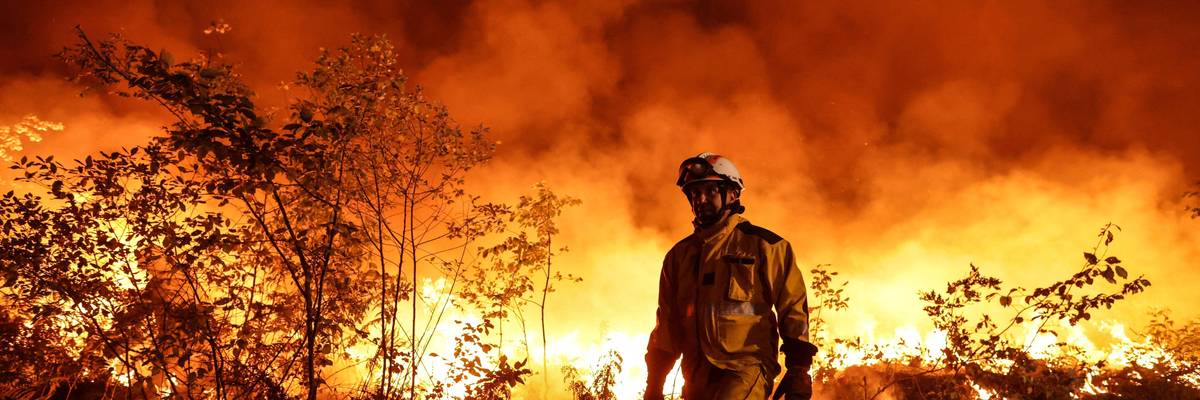
Tactical firefighters work to prevent a wildfire from spreading further as the winds change in Louchats, France on July 17, 2022. (Photo: Thibaud Moritz/AFP via Getty Images)
The last time prices rose this fast was 41 years ago. The last time the UK got through prime ministers this fast was the mid-1970s. The last time there was open war between major European powers was in 1945. The last time the Northern Hemisphere was this hot was probably 125,000 years ago.
Yet the FTSE 100 is worth more than ever, corporate profits are higher than ever, there are more British billionaires than ever. And oil companies are richer than ever.
If we took climate change seriously, the petroleum industry would be bankrupt. These firms borrow billions against the future value of reserves they are yet to drill, but atmospheric physics demands we can't burn that carbon if we wish civilization to survive.
"If our modern societies are to continue to exist in recognizable form, oil companies' assets are worthless."
If our modern societies are to continue to exist in recognizable form, oil companies' assets are worthless. And if we aren't, they are still worthless.
But in reality, fossil fuel giants are doing better than ever. Last week, Shell said it expected to revise upwards the value of oil and gas assets it had previously written down, causing its share prices to leap for joy.
Saudi Arabia, which has struggled for investment ever since it allegedly hung a bunch of businessmen by their feet and beat them until they coughed up their bank details, has been welcomed in from the cold.
In May, oil exporter Saudi Aramco overtook Apple as the most valuable company in the world - the most valuable in human history. This week, just months after pretending to take the climate emergency seriously at COP26, Joe Biden has gone to fist bump Saudi's narco-in-chief and beg him to pump more death into capitalism's veins.
Meanwhile, as temperatures across England rise above levels with which human homeostasis can cope, the climate crisis collides with the health crisis.
Crushed by a dozen years of Tory austerity and the government's incompetent response to COVID, NHS waiting lists are already at an all-time high. Accident and Emergency units are "on the fringe of collapse", with ambulances queueing up outside hospitals, unable to hand over their patients. This means that over the next few days - when experts predict we will see up to ten thousand excess deaths as a result of the heatwave - vast numbers of people will likely spend time cooking in ambulances.
And with world food supplies already shaken by the war in Ukraine, the heatwave also means worsening global hunger.
Italian farmers are expected to lose a third of summer crops like rice and corn, while Sardinia's fields have been scoffed by a plague of locusts. In China, soaring temperatures are drying out soil, devastating agriculture of all kinds. East Africa is experiencing one of its driest rainy seasons in 40 years, which, combined with the fact that 40% of Africa's wheat usually comes from Russia or Ukraine, leaves tens of millions facing hunger.
Food and agriculture billionaires, on the other hand, raised their collective wealth by 45% over the past two years, while global food giant Cargill posted a 63% increase in its profits for last year, the best haul in its nearly 160-year history.
As the world moves out of pandemic mode (if not actually out of the pandemic), we're entering a new phase of global capitalism.
For big businesses and billionaires, the 'omnicrisis' presents a perfect opportunity for disaster capitalism: use the overwhelming sense that everything is on fire to plunder: wrack up prices while keeping wages down, extract, extract, extract, extract.
But this isn't the inevitable future. The faint echo of promises to 'build back better' may have disappeared, and, with politics in crisis, people are increasingly realizing that they are going to have to fight for that future.
In Britain, more and more unions are voting to strike against the plunder. As concern about the climate crisis grows, so will action against those driving it. Distrust of our broken politics has deepened, creating a deep volatility.
A vast political fight over what comes next has arrived, just as the Labour Party has abandoned the field and, in the coming months, we can expect something else to rush into that space.
What? That's up to you.
Dear Common Dreams reader, It’s been nearly 30 years since I co-founded Common Dreams with my late wife, Lina Newhouser. We had the radical notion that journalism should serve the public good, not corporate profits. It was clear to us from the outset what it would take to build such a project. No paid advertisements. No corporate sponsors. No millionaire publisher telling us what to think or do. Many people said we wouldn't last a year, but we proved those doubters wrong. Together with a tremendous team of journalists and dedicated staff, we built an independent media outlet free from the constraints of profits and corporate control. Our mission has always been simple: To inform. To inspire. To ignite change for the common good. Building Common Dreams was not easy. Our survival was never guaranteed. When you take on the most powerful forces—Wall Street greed, fossil fuel industry destruction, Big Tech lobbyists, and uber-rich oligarchs who have spent billions upon billions rigging the economy and democracy in their favor—the only bulwark you have is supporters who believe in your work. But here’s the urgent message from me today. It's never been this bad out there. And it's never been this hard to keep us going. At the very moment Common Dreams is most needed, the threats we face are intensifying. We need your support now more than ever. We don't accept corporate advertising and never will. We don't have a paywall because we don't think people should be blocked from critical news based on their ability to pay. Everything we do is funded by the donations of readers like you. When everyone does the little they can afford, we are strong. But if that support retreats or dries up, so do we. Will you donate now to make sure Common Dreams not only survives but thrives? —Craig Brown, Co-founder |
The last time prices rose this fast was 41 years ago. The last time the UK got through prime ministers this fast was the mid-1970s. The last time there was open war between major European powers was in 1945. The last time the Northern Hemisphere was this hot was probably 125,000 years ago.
Yet the FTSE 100 is worth more than ever, corporate profits are higher than ever, there are more British billionaires than ever. And oil companies are richer than ever.
If we took climate change seriously, the petroleum industry would be bankrupt. These firms borrow billions against the future value of reserves they are yet to drill, but atmospheric physics demands we can't burn that carbon if we wish civilization to survive.
"If our modern societies are to continue to exist in recognizable form, oil companies' assets are worthless."
If our modern societies are to continue to exist in recognizable form, oil companies' assets are worthless. And if we aren't, they are still worthless.
But in reality, fossil fuel giants are doing better than ever. Last week, Shell said it expected to revise upwards the value of oil and gas assets it had previously written down, causing its share prices to leap for joy.
Saudi Arabia, which has struggled for investment ever since it allegedly hung a bunch of businessmen by their feet and beat them until they coughed up their bank details, has been welcomed in from the cold.
In May, oil exporter Saudi Aramco overtook Apple as the most valuable company in the world - the most valuable in human history. This week, just months after pretending to take the climate emergency seriously at COP26, Joe Biden has gone to fist bump Saudi's narco-in-chief and beg him to pump more death into capitalism's veins.
Meanwhile, as temperatures across England rise above levels with which human homeostasis can cope, the climate crisis collides with the health crisis.
Crushed by a dozen years of Tory austerity and the government's incompetent response to COVID, NHS waiting lists are already at an all-time high. Accident and Emergency units are "on the fringe of collapse", with ambulances queueing up outside hospitals, unable to hand over their patients. This means that over the next few days - when experts predict we will see up to ten thousand excess deaths as a result of the heatwave - vast numbers of people will likely spend time cooking in ambulances.
And with world food supplies already shaken by the war in Ukraine, the heatwave also means worsening global hunger.
Italian farmers are expected to lose a third of summer crops like rice and corn, while Sardinia's fields have been scoffed by a plague of locusts. In China, soaring temperatures are drying out soil, devastating agriculture of all kinds. East Africa is experiencing one of its driest rainy seasons in 40 years, which, combined with the fact that 40% of Africa's wheat usually comes from Russia or Ukraine, leaves tens of millions facing hunger.
Food and agriculture billionaires, on the other hand, raised their collective wealth by 45% over the past two years, while global food giant Cargill posted a 63% increase in its profits for last year, the best haul in its nearly 160-year history.
As the world moves out of pandemic mode (if not actually out of the pandemic), we're entering a new phase of global capitalism.
For big businesses and billionaires, the 'omnicrisis' presents a perfect opportunity for disaster capitalism: use the overwhelming sense that everything is on fire to plunder: wrack up prices while keeping wages down, extract, extract, extract, extract.
But this isn't the inevitable future. The faint echo of promises to 'build back better' may have disappeared, and, with politics in crisis, people are increasingly realizing that they are going to have to fight for that future.
In Britain, more and more unions are voting to strike against the plunder. As concern about the climate crisis grows, so will action against those driving it. Distrust of our broken politics has deepened, creating a deep volatility.
A vast political fight over what comes next has arrived, just as the Labour Party has abandoned the field and, in the coming months, we can expect something else to rush into that space.
What? That's up to you.
The last time prices rose this fast was 41 years ago. The last time the UK got through prime ministers this fast was the mid-1970s. The last time there was open war between major European powers was in 1945. The last time the Northern Hemisphere was this hot was probably 125,000 years ago.
Yet the FTSE 100 is worth more than ever, corporate profits are higher than ever, there are more British billionaires than ever. And oil companies are richer than ever.
If we took climate change seriously, the petroleum industry would be bankrupt. These firms borrow billions against the future value of reserves they are yet to drill, but atmospheric physics demands we can't burn that carbon if we wish civilization to survive.
"If our modern societies are to continue to exist in recognizable form, oil companies' assets are worthless."
If our modern societies are to continue to exist in recognizable form, oil companies' assets are worthless. And if we aren't, they are still worthless.
But in reality, fossil fuel giants are doing better than ever. Last week, Shell said it expected to revise upwards the value of oil and gas assets it had previously written down, causing its share prices to leap for joy.
Saudi Arabia, which has struggled for investment ever since it allegedly hung a bunch of businessmen by their feet and beat them until they coughed up their bank details, has been welcomed in from the cold.
In May, oil exporter Saudi Aramco overtook Apple as the most valuable company in the world - the most valuable in human history. This week, just months after pretending to take the climate emergency seriously at COP26, Joe Biden has gone to fist bump Saudi's narco-in-chief and beg him to pump more death into capitalism's veins.
Meanwhile, as temperatures across England rise above levels with which human homeostasis can cope, the climate crisis collides with the health crisis.
Crushed by a dozen years of Tory austerity and the government's incompetent response to COVID, NHS waiting lists are already at an all-time high. Accident and Emergency units are "on the fringe of collapse", with ambulances queueing up outside hospitals, unable to hand over their patients. This means that over the next few days - when experts predict we will see up to ten thousand excess deaths as a result of the heatwave - vast numbers of people will likely spend time cooking in ambulances.
And with world food supplies already shaken by the war in Ukraine, the heatwave also means worsening global hunger.
Italian farmers are expected to lose a third of summer crops like rice and corn, while Sardinia's fields have been scoffed by a plague of locusts. In China, soaring temperatures are drying out soil, devastating agriculture of all kinds. East Africa is experiencing one of its driest rainy seasons in 40 years, which, combined with the fact that 40% of Africa's wheat usually comes from Russia or Ukraine, leaves tens of millions facing hunger.
Food and agriculture billionaires, on the other hand, raised their collective wealth by 45% over the past two years, while global food giant Cargill posted a 63% increase in its profits for last year, the best haul in its nearly 160-year history.
As the world moves out of pandemic mode (if not actually out of the pandemic), we're entering a new phase of global capitalism.
For big businesses and billionaires, the 'omnicrisis' presents a perfect opportunity for disaster capitalism: use the overwhelming sense that everything is on fire to plunder: wrack up prices while keeping wages down, extract, extract, extract, extract.
But this isn't the inevitable future. The faint echo of promises to 'build back better' may have disappeared, and, with politics in crisis, people are increasingly realizing that they are going to have to fight for that future.
In Britain, more and more unions are voting to strike against the plunder. As concern about the climate crisis grows, so will action against those driving it. Distrust of our broken politics has deepened, creating a deep volatility.
A vast political fight over what comes next has arrived, just as the Labour Party has abandoned the field and, in the coming months, we can expect something else to rush into that space.
What? That's up to you.