SUBSCRIBE TO OUR FREE NEWSLETTER
Daily news & progressive opinion—funded by the people, not the corporations—delivered straight to your inbox.
5
#000000
#FFFFFF
To donate by check, phone, or other method, see our More Ways to Give page.
Daily news & progressive opinion—funded by the people, not the corporations—delivered straight to your inbox.
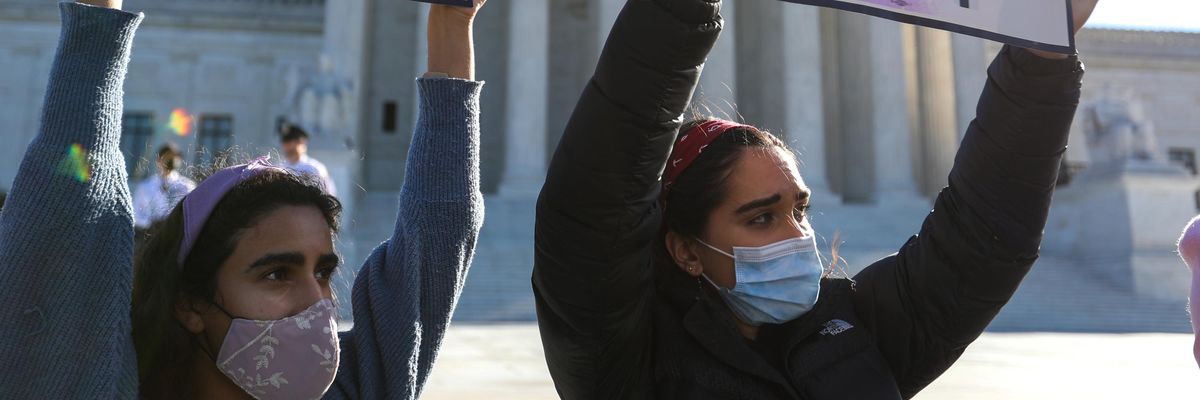
Reproductive rights advocates protest outside of the U.S. Supreme Court in Washington, D.C. on November 1, 2021. (Photo: Yasin Ozturk/Anadolu Agency via Getty Images)
Although it is shocking that someone in the Supreme Court leaked a purported draft of the opinion overruling Roe vs. Wade, no one should be the least bit surprised that it is what the justices are about to do.
Two-thirds of the American people believe that Roe vs. Wade should not be overruled.
The confirmation of Justice Amy Coney Barrett meant that there were five justices who were almost certain votes to overrule Roe. The oral arguments in Dobbs v. Jackson Women's Health on Dec. 1 erased any doubt when Justices Barrett and Brett Kavanaugh made clear that is how they would vote, joining Justices Clarence Thomas, Samuel Alito and Neil Gorsuch to overrule the 49 year-old precedent that protects a woman's right to abortion.
The draft of Alito's majority opinion overruling Roe, which was obtained by Politico, is right-wing Republican politics masquerading as law. In it, Alito declares:
"Roe was egregiously wrong from the start. Its reasoning was exceptionally weak, and the decision has had damaging consequences. And far from bringing about a national settlement of the abortion issue, Roe and Casey have enflamed debate and deepened division."
Every aspect of this statement is wrong. The reasoning of Roe, a 7-2 decision that was repeatedly reaffirmed by the court, was not weak. For decades before Roe, the Supreme Court held that the liberty of the due process clause protected fundamental aspects of privacy and autonomy. Prior to Roe, the court had protected liberties such as the right to marry, the right to procreate, the right to use contraception, the right to control the upbringing of children and the right of every person to choose "whether to bear or beget a child."
Roe followed these decisions with the common sense realization that laws that prohibit abortion and force a woman to carry a pregnancy to term against her will are intrusions on her autonomy and privacy. Unless the court is going to repudiate all of the other privacy rights, it is impossible to deny that laws prohibiting abortion also intrude on a woman's liberty.
Of course, there is a debate over how the fetus should be regarded and whether a state's desire to protect fetal life justifies infringing a woman's right to privacy. Justice Harry Blackmun's opinion in Roe explained that there is no scientific or medical way to answer the question of when human life begins and therefore until viability--the time at which the fetus can survive outside the womb--it is left to each woman to decide whether to terminate a pregnancy or have an abortion.
There is nothing about this reasoning that is weak. Alito speaks of the damaging consequences. But who is he or the conservative majority to decide what is best for women? Briefs filed in the court include many women, including prominent athletes, describing their choice to have an abortion and why they made that decision without regret.
As I read Alito's reference to "damaging consequences," I think of the women who became pregnant by rape or incest who would have been forced to continue their pregnancy and give birth under the laws that existed before Roe and that will go into effect now.
It also is a mistake to say that it is Roe that inflamed the national debate over abortion. There was a debate about abortion before Roe, as the first states legalized abortion. The debate over abortion has continued over decades and, ironically, what has really fueled the debate over abortion in recent years is the court becoming more willing to uphold laws prohibiting abortion.
Overruling Roe will not end the debate over abortion. Conservative politicians who have successfully used the abortion issue are going to push for ever more draconian laws, such as prohibiting women living in states that outlaw abortion from seeking abortions in states where it remains legal and outlawing contraceptives such the IUD and the morning-after pill.
According to opinion polls, two-thirds of the American people believe that Roe vs. Wade should not be overruled. At the oral argument, Justice Sonia Sotomayor asked how the court could survive the "stench" of overruling Roe in a purely political act by conservative justices. How indeed?
Dear Common Dreams reader, It’s been nearly 30 years since I co-founded Common Dreams with my late wife, Lina Newhouser. We had the radical notion that journalism should serve the public good, not corporate profits. It was clear to us from the outset what it would take to build such a project. No paid advertisements. No corporate sponsors. No millionaire publisher telling us what to think or do. Many people said we wouldn't last a year, but we proved those doubters wrong. Together with a tremendous team of journalists and dedicated staff, we built an independent media outlet free from the constraints of profits and corporate control. Our mission has always been simple: To inform. To inspire. To ignite change for the common good. Building Common Dreams was not easy. Our survival was never guaranteed. When you take on the most powerful forces—Wall Street greed, fossil fuel industry destruction, Big Tech lobbyists, and uber-rich oligarchs who have spent billions upon billions rigging the economy and democracy in their favor—the only bulwark you have is supporters who believe in your work. But here’s the urgent message from me today. It's never been this bad out there. And it's never been this hard to keep us going. At the very moment Common Dreams is most needed, the threats we face are intensifying. We need your support now more than ever. We don't accept corporate advertising and never will. We don't have a paywall because we don't think people should be blocked from critical news based on their ability to pay. Everything we do is funded by the donations of readers like you. When everyone does the little they can afford, we are strong. But if that support retreats or dries up, so do we. Will you donate now to make sure Common Dreams not only survives but thrives? —Craig Brown, Co-founder |
Although it is shocking that someone in the Supreme Court leaked a purported draft of the opinion overruling Roe vs. Wade, no one should be the least bit surprised that it is what the justices are about to do.
Two-thirds of the American people believe that Roe vs. Wade should not be overruled.
The confirmation of Justice Amy Coney Barrett meant that there were five justices who were almost certain votes to overrule Roe. The oral arguments in Dobbs v. Jackson Women's Health on Dec. 1 erased any doubt when Justices Barrett and Brett Kavanaugh made clear that is how they would vote, joining Justices Clarence Thomas, Samuel Alito and Neil Gorsuch to overrule the 49 year-old precedent that protects a woman's right to abortion.
The draft of Alito's majority opinion overruling Roe, which was obtained by Politico, is right-wing Republican politics masquerading as law. In it, Alito declares:
"Roe was egregiously wrong from the start. Its reasoning was exceptionally weak, and the decision has had damaging consequences. And far from bringing about a national settlement of the abortion issue, Roe and Casey have enflamed debate and deepened division."
Every aspect of this statement is wrong. The reasoning of Roe, a 7-2 decision that was repeatedly reaffirmed by the court, was not weak. For decades before Roe, the Supreme Court held that the liberty of the due process clause protected fundamental aspects of privacy and autonomy. Prior to Roe, the court had protected liberties such as the right to marry, the right to procreate, the right to use contraception, the right to control the upbringing of children and the right of every person to choose "whether to bear or beget a child."
Roe followed these decisions with the common sense realization that laws that prohibit abortion and force a woman to carry a pregnancy to term against her will are intrusions on her autonomy and privacy. Unless the court is going to repudiate all of the other privacy rights, it is impossible to deny that laws prohibiting abortion also intrude on a woman's liberty.
Of course, there is a debate over how the fetus should be regarded and whether a state's desire to protect fetal life justifies infringing a woman's right to privacy. Justice Harry Blackmun's opinion in Roe explained that there is no scientific or medical way to answer the question of when human life begins and therefore until viability--the time at which the fetus can survive outside the womb--it is left to each woman to decide whether to terminate a pregnancy or have an abortion.
There is nothing about this reasoning that is weak. Alito speaks of the damaging consequences. But who is he or the conservative majority to decide what is best for women? Briefs filed in the court include many women, including prominent athletes, describing their choice to have an abortion and why they made that decision without regret.
As I read Alito's reference to "damaging consequences," I think of the women who became pregnant by rape or incest who would have been forced to continue their pregnancy and give birth under the laws that existed before Roe and that will go into effect now.
It also is a mistake to say that it is Roe that inflamed the national debate over abortion. There was a debate about abortion before Roe, as the first states legalized abortion. The debate over abortion has continued over decades and, ironically, what has really fueled the debate over abortion in recent years is the court becoming more willing to uphold laws prohibiting abortion.
Overruling Roe will not end the debate over abortion. Conservative politicians who have successfully used the abortion issue are going to push for ever more draconian laws, such as prohibiting women living in states that outlaw abortion from seeking abortions in states where it remains legal and outlawing contraceptives such the IUD and the morning-after pill.
According to opinion polls, two-thirds of the American people believe that Roe vs. Wade should not be overruled. At the oral argument, Justice Sonia Sotomayor asked how the court could survive the "stench" of overruling Roe in a purely political act by conservative justices. How indeed?
Although it is shocking that someone in the Supreme Court leaked a purported draft of the opinion overruling Roe vs. Wade, no one should be the least bit surprised that it is what the justices are about to do.
Two-thirds of the American people believe that Roe vs. Wade should not be overruled.
The confirmation of Justice Amy Coney Barrett meant that there were five justices who were almost certain votes to overrule Roe. The oral arguments in Dobbs v. Jackson Women's Health on Dec. 1 erased any doubt when Justices Barrett and Brett Kavanaugh made clear that is how they would vote, joining Justices Clarence Thomas, Samuel Alito and Neil Gorsuch to overrule the 49 year-old precedent that protects a woman's right to abortion.
The draft of Alito's majority opinion overruling Roe, which was obtained by Politico, is right-wing Republican politics masquerading as law. In it, Alito declares:
"Roe was egregiously wrong from the start. Its reasoning was exceptionally weak, and the decision has had damaging consequences. And far from bringing about a national settlement of the abortion issue, Roe and Casey have enflamed debate and deepened division."
Every aspect of this statement is wrong. The reasoning of Roe, a 7-2 decision that was repeatedly reaffirmed by the court, was not weak. For decades before Roe, the Supreme Court held that the liberty of the due process clause protected fundamental aspects of privacy and autonomy. Prior to Roe, the court had protected liberties such as the right to marry, the right to procreate, the right to use contraception, the right to control the upbringing of children and the right of every person to choose "whether to bear or beget a child."
Roe followed these decisions with the common sense realization that laws that prohibit abortion and force a woman to carry a pregnancy to term against her will are intrusions on her autonomy and privacy. Unless the court is going to repudiate all of the other privacy rights, it is impossible to deny that laws prohibiting abortion also intrude on a woman's liberty.
Of course, there is a debate over how the fetus should be regarded and whether a state's desire to protect fetal life justifies infringing a woman's right to privacy. Justice Harry Blackmun's opinion in Roe explained that there is no scientific or medical way to answer the question of when human life begins and therefore until viability--the time at which the fetus can survive outside the womb--it is left to each woman to decide whether to terminate a pregnancy or have an abortion.
There is nothing about this reasoning that is weak. Alito speaks of the damaging consequences. But who is he or the conservative majority to decide what is best for women? Briefs filed in the court include many women, including prominent athletes, describing their choice to have an abortion and why they made that decision without regret.
As I read Alito's reference to "damaging consequences," I think of the women who became pregnant by rape or incest who would have been forced to continue their pregnancy and give birth under the laws that existed before Roe and that will go into effect now.
It also is a mistake to say that it is Roe that inflamed the national debate over abortion. There was a debate about abortion before Roe, as the first states legalized abortion. The debate over abortion has continued over decades and, ironically, what has really fueled the debate over abortion in recent years is the court becoming more willing to uphold laws prohibiting abortion.
Overruling Roe will not end the debate over abortion. Conservative politicians who have successfully used the abortion issue are going to push for ever more draconian laws, such as prohibiting women living in states that outlaw abortion from seeking abortions in states where it remains legal and outlawing contraceptives such the IUD and the morning-after pill.
According to opinion polls, two-thirds of the American people believe that Roe vs. Wade should not be overruled. At the oral argument, Justice Sonia Sotomayor asked how the court could survive the "stench" of overruling Roe in a purely political act by conservative justices. How indeed?