SUBSCRIBE TO OUR FREE NEWSLETTER
Daily news & progressive opinion—funded by the people, not the corporations—delivered straight to your inbox.
5
#000000
#FFFFFF
To donate by check, phone, or other method, see our More Ways to Give page.
Daily news & progressive opinion—funded by the people, not the corporations—delivered straight to your inbox.
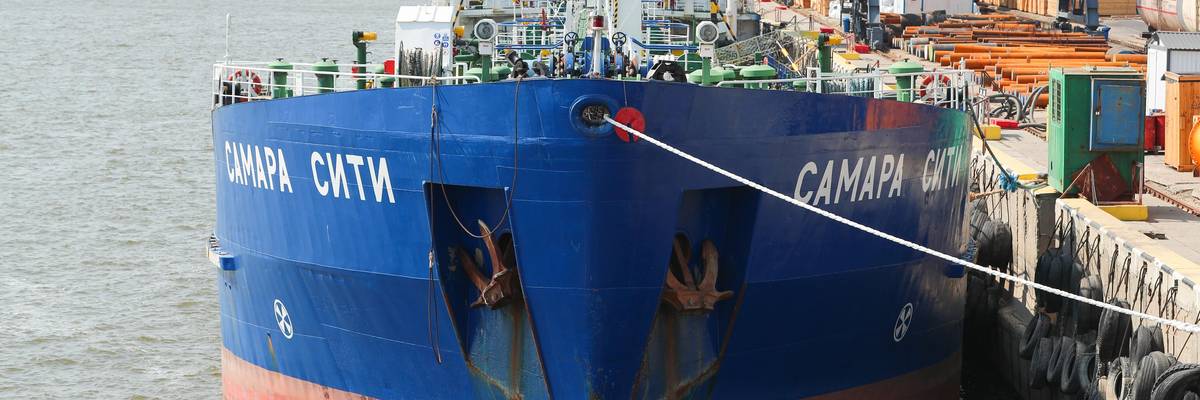
The Samara City vessel is pictured at the Astrakhan Seaport. The port, located in the lower part of the Volga River, is an important terminal of the International North-South Transport Corridor (INSTC). (Photo: Erik Romanenko\TASS via Getty Images)
Amid the mounting crisis in Ukraine, fossil fuel giants and an array of political leaders are using the guise of "global security" to promote an agenda that strengthens the dominance of dirty energy for decades to come.
Increasing fossil fuel production will not make the world safer... it will only exacerbate the already rapidly escalating climate crisis.
The industry and their Congressional allies have responded by rehashing inaccurate complaints that President Biden is refusing to open up more land to drilling and fracking. Other voices are chiming in to say we should expedite the increased flow of fracked gas to European countries as they attempt to move off of Russian gas. And the White House, in response to bipartisan efforts in Congress, announced a ban on Russian oil imports.
Increasing fossil fuel production will not make the world safer, or provide any short-term relief for families struggling to pay sky-high energy or gas bills; it will only exacerbate the already rapidly escalating climate crisis. To enhance domestic, European, and global security, it's time to aggressively promote energy efficiency and conservation while quickly deploying renewable energy and moving off fossil fuels.
The threats from climate chaos are well-known by now; we just received another dire warning from the Intergovernmental Panel on Climate Change. The scientific panel's report, in the words of its chair Hoesung Lee, laid out how "climate change is a grave and mounting threat to our wellbeing and a healthy planet."
The report explained in great detail the impact our fossil fuel-based economy is having on the environment and people living in it, from loss of biodiversity to acute food insecurity for millions of people.
In this context, calls for increasing fossil fuel production to address the immediate situation in Europe make little sense. This would not provide an effective short-term solution; oil rigs cannot immediately start pumping, and gas export facilities take years to complete. The real point of some of this pressure is to fulfill the long-term plans of the dirty energy industry by bolstering its position in the global energy market for decades to come. This would speed an already rapidly unfolding climate disaster of unprecedented proportions.
As a practical matter, the United States, even if it wanted to, does not currently have the capacity to meet anything close to Europe's energy needs. Though the gas industry is already making plans to massively expand its footprint, mostly on the Gulf Coast. Already planned facilities will increase fracking in this country, creating local air and pollution threats and increasing climate pollution.
Investing $500 billion in energy efficiency would save climate emissions equivalent to nearly 80 coal power plants, while at the same time creating over a million jobs and saving consumers over $300 a year on their energy bills.
The best way to address dependence on fossil fuels is to move off of them rapidly. Both the United States and Europe must invest significant funds in energy efficiency and conservation while at the same time building renewable energy. Not only will this approach result in greater energy independence, it will also help resolve the climate crisis rather than exacerbating it.
This would be a far more cost-effective solution.
Investing $500 billion in energy efficiency, for example, would save climate emissions equivalent to nearly 80 coal power plants, while at the same time creating over a million jobs and saving consumers over $300 a year on their energy bills. Solar and wind energy production are already less expensive than fossil fuels, and as oil, gasoline, and natural gas prices have risen due to a range of factors--from war to corporate greed--solar and wind prices have remained stable.
The fossil fuel industry is quite openly viewing the war as a business opportunity. One Italian fossil fuel executive touted the benefits of increased liquified natural gas deliveries to Europe by saying, "If we react to the current crisis with a warlike reaction, we can do a lot in six months." This is revealing--and harrowing at the same time. Making the world more dependent on volatile international energy markets is not a solution, it is an invitation to further crises. Imagine promoting energy efficiency, conservation, and renewables with such intensity! Instead of doubling down on fossil fuel production, we must embrace these common sense solutions while we pursue swift reductions in fossil fuel extraction and consumption.
Many elected leaders, from President Biden on down, call the climate crisis an existential threat to humanity. Their actions do not reflect that. The White House is seeking to say everything all at once--calling on oil companies to ramp up production while simultaneously pledging to end the fossil fuel era. Rather than approving more oil and gas projects, our national leaders should embrace an all hands on deck approach to moving the United States, Europe, and the rest of the world off fossil fuels. Not only would this make short-term sense, it is the only way to avoid even worse climate-driven disasters and wars in the future.
Dear Common Dreams reader, It’s been nearly 30 years since I co-founded Common Dreams with my late wife, Lina Newhouser. We had the radical notion that journalism should serve the public good, not corporate profits. It was clear to us from the outset what it would take to build such a project. No paid advertisements. No corporate sponsors. No millionaire publisher telling us what to think or do. Many people said we wouldn't last a year, but we proved those doubters wrong. Together with a tremendous team of journalists and dedicated staff, we built an independent media outlet free from the constraints of profits and corporate control. Our mission has always been simple: To inform. To inspire. To ignite change for the common good. Building Common Dreams was not easy. Our survival was never guaranteed. When you take on the most powerful forces—Wall Street greed, fossil fuel industry destruction, Big Tech lobbyists, and uber-rich oligarchs who have spent billions upon billions rigging the economy and democracy in their favor—the only bulwark you have is supporters who believe in your work. But here’s the urgent message from me today. It's never been this bad out there. And it's never been this hard to keep us going. At the very moment Common Dreams is most needed, the threats we face are intensifying. We need your support now more than ever. We don't accept corporate advertising and never will. We don't have a paywall because we don't think people should be blocked from critical news based on their ability to pay. Everything we do is funded by the donations of readers like you. When everyone does the little they can afford, we are strong. But if that support retreats or dries up, so do we. Will you donate now to make sure Common Dreams not only survives but thrives? —Craig Brown, Co-founder |
Amid the mounting crisis in Ukraine, fossil fuel giants and an array of political leaders are using the guise of "global security" to promote an agenda that strengthens the dominance of dirty energy for decades to come.
Increasing fossil fuel production will not make the world safer... it will only exacerbate the already rapidly escalating climate crisis.
The industry and their Congressional allies have responded by rehashing inaccurate complaints that President Biden is refusing to open up more land to drilling and fracking. Other voices are chiming in to say we should expedite the increased flow of fracked gas to European countries as they attempt to move off of Russian gas. And the White House, in response to bipartisan efforts in Congress, announced a ban on Russian oil imports.
Increasing fossil fuel production will not make the world safer, or provide any short-term relief for families struggling to pay sky-high energy or gas bills; it will only exacerbate the already rapidly escalating climate crisis. To enhance domestic, European, and global security, it's time to aggressively promote energy efficiency and conservation while quickly deploying renewable energy and moving off fossil fuels.
The threats from climate chaos are well-known by now; we just received another dire warning from the Intergovernmental Panel on Climate Change. The scientific panel's report, in the words of its chair Hoesung Lee, laid out how "climate change is a grave and mounting threat to our wellbeing and a healthy planet."
The report explained in great detail the impact our fossil fuel-based economy is having on the environment and people living in it, from loss of biodiversity to acute food insecurity for millions of people.
In this context, calls for increasing fossil fuel production to address the immediate situation in Europe make little sense. This would not provide an effective short-term solution; oil rigs cannot immediately start pumping, and gas export facilities take years to complete. The real point of some of this pressure is to fulfill the long-term plans of the dirty energy industry by bolstering its position in the global energy market for decades to come. This would speed an already rapidly unfolding climate disaster of unprecedented proportions.
As a practical matter, the United States, even if it wanted to, does not currently have the capacity to meet anything close to Europe's energy needs. Though the gas industry is already making plans to massively expand its footprint, mostly on the Gulf Coast. Already planned facilities will increase fracking in this country, creating local air and pollution threats and increasing climate pollution.
Investing $500 billion in energy efficiency would save climate emissions equivalent to nearly 80 coal power plants, while at the same time creating over a million jobs and saving consumers over $300 a year on their energy bills.
The best way to address dependence on fossil fuels is to move off of them rapidly. Both the United States and Europe must invest significant funds in energy efficiency and conservation while at the same time building renewable energy. Not only will this approach result in greater energy independence, it will also help resolve the climate crisis rather than exacerbating it.
This would be a far more cost-effective solution.
Investing $500 billion in energy efficiency, for example, would save climate emissions equivalent to nearly 80 coal power plants, while at the same time creating over a million jobs and saving consumers over $300 a year on their energy bills. Solar and wind energy production are already less expensive than fossil fuels, and as oil, gasoline, and natural gas prices have risen due to a range of factors--from war to corporate greed--solar and wind prices have remained stable.
The fossil fuel industry is quite openly viewing the war as a business opportunity. One Italian fossil fuel executive touted the benefits of increased liquified natural gas deliveries to Europe by saying, "If we react to the current crisis with a warlike reaction, we can do a lot in six months." This is revealing--and harrowing at the same time. Making the world more dependent on volatile international energy markets is not a solution, it is an invitation to further crises. Imagine promoting energy efficiency, conservation, and renewables with such intensity! Instead of doubling down on fossil fuel production, we must embrace these common sense solutions while we pursue swift reductions in fossil fuel extraction and consumption.
Many elected leaders, from President Biden on down, call the climate crisis an existential threat to humanity. Their actions do not reflect that. The White House is seeking to say everything all at once--calling on oil companies to ramp up production while simultaneously pledging to end the fossil fuel era. Rather than approving more oil and gas projects, our national leaders should embrace an all hands on deck approach to moving the United States, Europe, and the rest of the world off fossil fuels. Not only would this make short-term sense, it is the only way to avoid even worse climate-driven disasters and wars in the future.
Amid the mounting crisis in Ukraine, fossil fuel giants and an array of political leaders are using the guise of "global security" to promote an agenda that strengthens the dominance of dirty energy for decades to come.
Increasing fossil fuel production will not make the world safer... it will only exacerbate the already rapidly escalating climate crisis.
The industry and their Congressional allies have responded by rehashing inaccurate complaints that President Biden is refusing to open up more land to drilling and fracking. Other voices are chiming in to say we should expedite the increased flow of fracked gas to European countries as they attempt to move off of Russian gas. And the White House, in response to bipartisan efforts in Congress, announced a ban on Russian oil imports.
Increasing fossil fuel production will not make the world safer, or provide any short-term relief for families struggling to pay sky-high energy or gas bills; it will only exacerbate the already rapidly escalating climate crisis. To enhance domestic, European, and global security, it's time to aggressively promote energy efficiency and conservation while quickly deploying renewable energy and moving off fossil fuels.
The threats from climate chaos are well-known by now; we just received another dire warning from the Intergovernmental Panel on Climate Change. The scientific panel's report, in the words of its chair Hoesung Lee, laid out how "climate change is a grave and mounting threat to our wellbeing and a healthy planet."
The report explained in great detail the impact our fossil fuel-based economy is having on the environment and people living in it, from loss of biodiversity to acute food insecurity for millions of people.
In this context, calls for increasing fossil fuel production to address the immediate situation in Europe make little sense. This would not provide an effective short-term solution; oil rigs cannot immediately start pumping, and gas export facilities take years to complete. The real point of some of this pressure is to fulfill the long-term plans of the dirty energy industry by bolstering its position in the global energy market for decades to come. This would speed an already rapidly unfolding climate disaster of unprecedented proportions.
As a practical matter, the United States, even if it wanted to, does not currently have the capacity to meet anything close to Europe's energy needs. Though the gas industry is already making plans to massively expand its footprint, mostly on the Gulf Coast. Already planned facilities will increase fracking in this country, creating local air and pollution threats and increasing climate pollution.
Investing $500 billion in energy efficiency would save climate emissions equivalent to nearly 80 coal power plants, while at the same time creating over a million jobs and saving consumers over $300 a year on their energy bills.
The best way to address dependence on fossil fuels is to move off of them rapidly. Both the United States and Europe must invest significant funds in energy efficiency and conservation while at the same time building renewable energy. Not only will this approach result in greater energy independence, it will also help resolve the climate crisis rather than exacerbating it.
This would be a far more cost-effective solution.
Investing $500 billion in energy efficiency, for example, would save climate emissions equivalent to nearly 80 coal power plants, while at the same time creating over a million jobs and saving consumers over $300 a year on their energy bills. Solar and wind energy production are already less expensive than fossil fuels, and as oil, gasoline, and natural gas prices have risen due to a range of factors--from war to corporate greed--solar and wind prices have remained stable.
The fossil fuel industry is quite openly viewing the war as a business opportunity. One Italian fossil fuel executive touted the benefits of increased liquified natural gas deliveries to Europe by saying, "If we react to the current crisis with a warlike reaction, we can do a lot in six months." This is revealing--and harrowing at the same time. Making the world more dependent on volatile international energy markets is not a solution, it is an invitation to further crises. Imagine promoting energy efficiency, conservation, and renewables with such intensity! Instead of doubling down on fossil fuel production, we must embrace these common sense solutions while we pursue swift reductions in fossil fuel extraction and consumption.
Many elected leaders, from President Biden on down, call the climate crisis an existential threat to humanity. Their actions do not reflect that. The White House is seeking to say everything all at once--calling on oil companies to ramp up production while simultaneously pledging to end the fossil fuel era. Rather than approving more oil and gas projects, our national leaders should embrace an all hands on deck approach to moving the United States, Europe, and the rest of the world off fossil fuels. Not only would this make short-term sense, it is the only way to avoid even worse climate-driven disasters and wars in the future.