SUBSCRIBE TO OUR FREE NEWSLETTER
Daily news & progressive opinion—funded by the people, not the corporations—delivered straight to your inbox.
5
#000000
#FFFFFF
To donate by check, phone, or other method, see our More Ways to Give page.
Daily news & progressive opinion—funded by the people, not the corporations—delivered straight to your inbox.
It's hard to take on systems, but until we do, they'll continue to grind up nature and spit out profit where rivers, forests and meadows once stood. (Photo: Flickr/ccMark Dixon)
When people do things they shouldn't, they often try to distract attention from their actions. Guardian writer George Monbiot notes that many corporations fueling the planet's destruction spend significant resources to shift attention away from themselves and onto us.
"The deliberate effort to stop us seeing the bigger picture began in 1953 with a campaign called Keep America Beautiful. It was founded by packaging manufacturers, motivated by the profits they could make by replacing reusable containers with disposable plastic," he writes. "In 2004, the advertising company Ogilvy & Mather, working for the oil giant BP, took this blame-shifting a step further by inventing the personal carbon footprint. It was a useful innovation, but it also had the effect of diverting political pressure from the producers of fossil fuels to consumers."
"Greenwashing" is another way corporations divert attention from their true ecological impacts. As British psychology professor Steven Reicher points out, "One recent McDonald's spot boasts of the way the company is recycling cooking oil into truck fuel, coffee cups into greetings cards, and plastic toys into children's playgrounds. The problem is that it makes no mention of the fact that McDonald's beef footprint alone constitutes 22m metric tons of greenhouse gas emissions a year."
"Focusing on the personal runs the risk of eclipsing our responsibility to also marshal systemic change."
Facing the real issues often leaves us feeling anger, anxiety, and despair. While these are reasonable responses to the environmental crises engulfing us, the multi-billion-dollar self-help industry has profited enormously by convincing us that fixing ourselves is the priority.
How do we balance the need for personal change with systemic change, when both are necessary?
Personal actions can create consumer demand for sustainably made products, model greener behaviors, and foster empowerment. But focusing on the personal runs the risk of eclipsing our responsibility to also marshal systemic change.
As Reichler notes, "McDonald's advertising approach is emblematic of the way in which companies seek to continue with business as usual, by distracting us from where the real problems lie. Its adverts represent just one of many strategies by which this is accomplished. One of the most common methods is to turn the climate crisis from a systemic into an individual issue."
It's hard to take on systems, but until we do, they'll continue to grind up nature and spit out profit where rivers, forests, and meadows once stood.
Systemic and environmental racism underpin these systems.
Systemic racism provides advantages (and inheritances), privileging white people in employment, education, justice, and social standing. It enabled the mandate under which colonizers have invaded lands, occupied Indigenous territories, and exploited nature for financial gain.
As a result of environmental racism, Indigenous and racialized communities have been placed at greater risk of living adjacent to land degradation and pollution from industrial activities and waste disposal.
Our economic system has strong hands upon the bellows. It promotes growth with no limits, which leads to such degradation of nature that around a million species are at risk of extinction--more than ever in human history.
This economic system also results in gross inequities. It's possible for one person to make $36 billion in a day--more than the yearly gross domestic product of some countries. As Monbiot writes, "The richest 1% of the world's people (those earning more than $172,000 a year) produce 15% of the world's carbon emissions: twice the combined impact of the poorest 50%." He proposes "a new system, in which there is 'private sufficiency and public luxury.'"
In his words, "While there is not enough ecological or even physical space on Earth for everyone to enjoy private luxury, there is enough to provide everyone with public luxury: magnificent parks, hospitals, swimming pools, art galleries, tennis courts, and transport systems, playgrounds and community centers."
It's a lot to take on, and it's good to check out at times--to find respite in binge-watching, books, self-care routines, or nature--as long as we check back in. Change won't happen until we demand it, and unless we face the flames (metaphorically and, increasingly, literally), there is little chance we'll be sufficiently motivated to put them out.
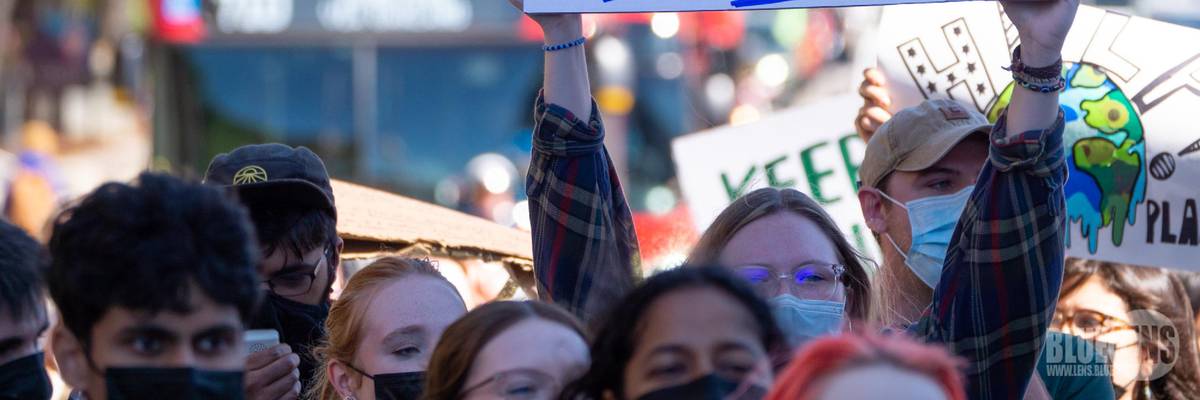
It's not all work. Joy can be found in dreaming up creative responses (think of the many clever protest signs!) and joining in community. To paraphrase Joan Baez, activism is the best antidote to despair.
Dear Common Dreams reader, It’s been nearly 30 years since I co-founded Common Dreams with my late wife, Lina Newhouser. We had the radical notion that journalism should serve the public good, not corporate profits. It was clear to us from the outset what it would take to build such a project. No paid advertisements. No corporate sponsors. No millionaire publisher telling us what to think or do. Many people said we wouldn't last a year, but we proved those doubters wrong. Together with a tremendous team of journalists and dedicated staff, we built an independent media outlet free from the constraints of profits and corporate control. Our mission has always been simple: To inform. To inspire. To ignite change for the common good. Building Common Dreams was not easy. Our survival was never guaranteed. When you take on the most powerful forces—Wall Street greed, fossil fuel industry destruction, Big Tech lobbyists, and uber-rich oligarchs who have spent billions upon billions rigging the economy and democracy in their favor—the only bulwark you have is supporters who believe in your work. But here’s the urgent message from me today. It's never been this bad out there. And it's never been this hard to keep us going. At the very moment Common Dreams is most needed, the threats we face are intensifying. We need your support now more than ever. We don't accept corporate advertising and never will. We don't have a paywall because we don't think people should be blocked from critical news based on their ability to pay. Everything we do is funded by the donations of readers like you. When everyone does the little they can afford, we are strong. But if that support retreats or dries up, so do we. Will you donate now to make sure Common Dreams not only survives but thrives? —Craig Brown, Co-founder |
When people do things they shouldn't, they often try to distract attention from their actions. Guardian writer George Monbiot notes that many corporations fueling the planet's destruction spend significant resources to shift attention away from themselves and onto us.
"The deliberate effort to stop us seeing the bigger picture began in 1953 with a campaign called Keep America Beautiful. It was founded by packaging manufacturers, motivated by the profits they could make by replacing reusable containers with disposable plastic," he writes. "In 2004, the advertising company Ogilvy & Mather, working for the oil giant BP, took this blame-shifting a step further by inventing the personal carbon footprint. It was a useful innovation, but it also had the effect of diverting political pressure from the producers of fossil fuels to consumers."
"Greenwashing" is another way corporations divert attention from their true ecological impacts. As British psychology professor Steven Reicher points out, "One recent McDonald's spot boasts of the way the company is recycling cooking oil into truck fuel, coffee cups into greetings cards, and plastic toys into children's playgrounds. The problem is that it makes no mention of the fact that McDonald's beef footprint alone constitutes 22m metric tons of greenhouse gas emissions a year."
"Focusing on the personal runs the risk of eclipsing our responsibility to also marshal systemic change."
Facing the real issues often leaves us feeling anger, anxiety, and despair. While these are reasonable responses to the environmental crises engulfing us, the multi-billion-dollar self-help industry has profited enormously by convincing us that fixing ourselves is the priority.
How do we balance the need for personal change with systemic change, when both are necessary?
Personal actions can create consumer demand for sustainably made products, model greener behaviors, and foster empowerment. But focusing on the personal runs the risk of eclipsing our responsibility to also marshal systemic change.
As Reichler notes, "McDonald's advertising approach is emblematic of the way in which companies seek to continue with business as usual, by distracting us from where the real problems lie. Its adverts represent just one of many strategies by which this is accomplished. One of the most common methods is to turn the climate crisis from a systemic into an individual issue."
It's hard to take on systems, but until we do, they'll continue to grind up nature and spit out profit where rivers, forests, and meadows once stood.
Systemic and environmental racism underpin these systems.
Systemic racism provides advantages (and inheritances), privileging white people in employment, education, justice, and social standing. It enabled the mandate under which colonizers have invaded lands, occupied Indigenous territories, and exploited nature for financial gain.
As a result of environmental racism, Indigenous and racialized communities have been placed at greater risk of living adjacent to land degradation and pollution from industrial activities and waste disposal.
Our economic system has strong hands upon the bellows. It promotes growth with no limits, which leads to such degradation of nature that around a million species are at risk of extinction--more than ever in human history.
This economic system also results in gross inequities. It's possible for one person to make $36 billion in a day--more than the yearly gross domestic product of some countries. As Monbiot writes, "The richest 1% of the world's people (those earning more than $172,000 a year) produce 15% of the world's carbon emissions: twice the combined impact of the poorest 50%." He proposes "a new system, in which there is 'private sufficiency and public luxury.'"
In his words, "While there is not enough ecological or even physical space on Earth for everyone to enjoy private luxury, there is enough to provide everyone with public luxury: magnificent parks, hospitals, swimming pools, art galleries, tennis courts, and transport systems, playgrounds and community centers."
It's a lot to take on, and it's good to check out at times--to find respite in binge-watching, books, self-care routines, or nature--as long as we check back in. Change won't happen until we demand it, and unless we face the flames (metaphorically and, increasingly, literally), there is little chance we'll be sufficiently motivated to put them out.
It's not all work. Joy can be found in dreaming up creative responses (think of the many clever protest signs!) and joining in community. To paraphrase Joan Baez, activism is the best antidote to despair.
When people do things they shouldn't, they often try to distract attention from their actions. Guardian writer George Monbiot notes that many corporations fueling the planet's destruction spend significant resources to shift attention away from themselves and onto us.
"The deliberate effort to stop us seeing the bigger picture began in 1953 with a campaign called Keep America Beautiful. It was founded by packaging manufacturers, motivated by the profits they could make by replacing reusable containers with disposable plastic," he writes. "In 2004, the advertising company Ogilvy & Mather, working for the oil giant BP, took this blame-shifting a step further by inventing the personal carbon footprint. It was a useful innovation, but it also had the effect of diverting political pressure from the producers of fossil fuels to consumers."
"Greenwashing" is another way corporations divert attention from their true ecological impacts. As British psychology professor Steven Reicher points out, "One recent McDonald's spot boasts of the way the company is recycling cooking oil into truck fuel, coffee cups into greetings cards, and plastic toys into children's playgrounds. The problem is that it makes no mention of the fact that McDonald's beef footprint alone constitutes 22m metric tons of greenhouse gas emissions a year."
"Focusing on the personal runs the risk of eclipsing our responsibility to also marshal systemic change."
Facing the real issues often leaves us feeling anger, anxiety, and despair. While these are reasonable responses to the environmental crises engulfing us, the multi-billion-dollar self-help industry has profited enormously by convincing us that fixing ourselves is the priority.
How do we balance the need for personal change with systemic change, when both are necessary?
Personal actions can create consumer demand for sustainably made products, model greener behaviors, and foster empowerment. But focusing on the personal runs the risk of eclipsing our responsibility to also marshal systemic change.
As Reichler notes, "McDonald's advertising approach is emblematic of the way in which companies seek to continue with business as usual, by distracting us from where the real problems lie. Its adverts represent just one of many strategies by which this is accomplished. One of the most common methods is to turn the climate crisis from a systemic into an individual issue."
It's hard to take on systems, but until we do, they'll continue to grind up nature and spit out profit where rivers, forests, and meadows once stood.
Systemic and environmental racism underpin these systems.
Systemic racism provides advantages (and inheritances), privileging white people in employment, education, justice, and social standing. It enabled the mandate under which colonizers have invaded lands, occupied Indigenous territories, and exploited nature for financial gain.
As a result of environmental racism, Indigenous and racialized communities have been placed at greater risk of living adjacent to land degradation and pollution from industrial activities and waste disposal.
Our economic system has strong hands upon the bellows. It promotes growth with no limits, which leads to such degradation of nature that around a million species are at risk of extinction--more than ever in human history.
This economic system also results in gross inequities. It's possible for one person to make $36 billion in a day--more than the yearly gross domestic product of some countries. As Monbiot writes, "The richest 1% of the world's people (those earning more than $172,000 a year) produce 15% of the world's carbon emissions: twice the combined impact of the poorest 50%." He proposes "a new system, in which there is 'private sufficiency and public luxury.'"
In his words, "While there is not enough ecological or even physical space on Earth for everyone to enjoy private luxury, there is enough to provide everyone with public luxury: magnificent parks, hospitals, swimming pools, art galleries, tennis courts, and transport systems, playgrounds and community centers."
It's a lot to take on, and it's good to check out at times--to find respite in binge-watching, books, self-care routines, or nature--as long as we check back in. Change won't happen until we demand it, and unless we face the flames (metaphorically and, increasingly, literally), there is little chance we'll be sufficiently motivated to put them out.
It's not all work. Joy can be found in dreaming up creative responses (think of the many clever protest signs!) and joining in community. To paraphrase Joan Baez, activism is the best antidote to despair.